

Billion-Dollar Regenerative Medicine Market: Key Technologies Powering Its Growth
Driven by the public’s desire for “longevity,” existing regenerative medicine therapies have already sustained a vast market.
According to statistics from the Alliance for Regenerative Medicine (ARM), financing in the regenerative medicine sector reached $23.1 billion in 2021, with 1,308 companies worldwide actively engaged in development within this field. Furthermore, according to Statista, the global market size for regenerative medicine was approximately $16.9 billion in 2021 and is projected to reach$95.5 billion,CAGR 21.22%。
Simply put, regenerative medicine views humans as modular “giant Legos,” replacing whatever part is malfunctioning.
Depending on the type of “parts” that need to be replaced, regenerative medicine can be divided into two technical routes: direct replacement of stem cellsStem Cell Therapyand replacing differentiated tissues and organsTissue Engineering。
Stem cell therapy is currently one of the most prominent fields in regenerative medicine. Its fundamental concept involves transplanting selected stem cells into patients using specific methods to promote the regeneration of pathological tissues, thereby achieving therapeutic goals.
The anti-aging applications of stem cell technology are widely recognized, with its efficacy and cost becoming popular topics of public discussion. Beyond its aesthetic and anti-aging benefits, stem cell technology also holds vast potential in addressing numerous complex diseases that currently lack effective treatments, such as chronic conditions like diabetes, neurological disorders like Parkinson’s disease, and the field of induced tissue and organ regeneration.
According to statistics, a total of 21 stem cell products have been approved worldwide, with 12 of them receiving approval from the U.S. FDA or the European EMA. The remaining nine products have primarily been approved in Asia. Notably, the approved products are mainly composed of hematopoietic stem cells or mesenchymal stem cells.
Taking mesenchymal stem cells (MSCs) as an example, there are currently a total of globally approved products10 Types, based on their mechanism of action and approved indications, mesenchymal stem cell (MSC) products possess multipotent differentiation potential, exhibit low immunogenicity, and are widely available. They can selectively migrate to sites of tissue injury, thereby facilitating the reconstruction of damaged tissues and organs. MSCs play a significant role in the field of organ repair and are extensively applied in areas such as neurological disorders, endocrine system conditions, cardiovascular diseases, urological disorders, immune-mediated diseases, liver disease, kidney disease, skeletal disorders, and anti-aging therapies.
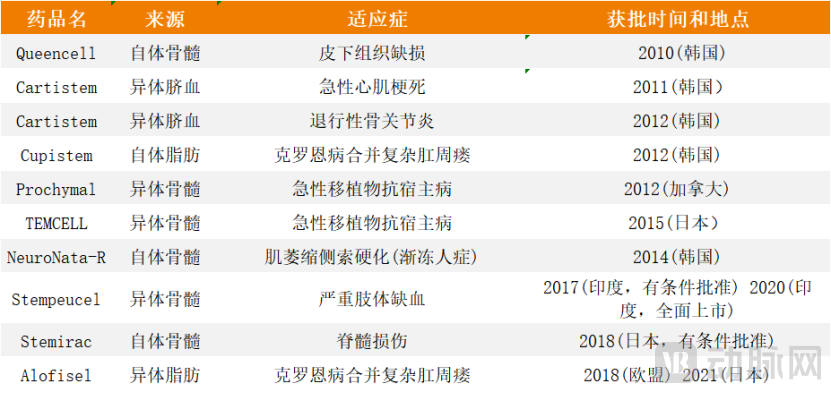
Figure: Globally Approved Mesenchymal Stem Cell Products
AlthoughNo mesenchymal stem cell products have been launched in China, but this does not hinder scientific research efforts in exploring this technological field.. As of the first half of 2022, the Center for Drug Evaluation (CDE) of the National Medical Products Administration (NMPA) had accepted a total of 135 applications for various cell therapy products. The vast majority were Investigational New Drug (IND) applications (including 8 supplemental applications), with only 3 being New Drug Applications (NDAs) for market approval (of which 2 have been approved to date). Among these 135 applications, 70 were for CAR-T therapies, 25 for other types of immune cell therapies, and 31 for mesenchymal stem cells (MSCs), making MSCs the second most common category after the highly prominent CAR-T therapies.
In addition to naturally derived types such as mesenchymal stem cells, advances in science have led to the emergence of artificially prepared stem cells, namelyInduced Pluripotent Stem Cells (iPSCs)and haploid embryonic stem cells.
During the stage of directed stem cell induction, stable cytokine expression is a key factor in tissue and organ regeneration. Currently, gene editing technology offers a solution to this challenge by generating seed cells that continuously and stably secrete the cytokines required for regeneration, thereby providing a stable local microenvironment and ultimately enhancing the efficiency of tissue repair.
This is a promising therapeutic approach currently being developed for diseases caused by irreversible cellular damage, with specific applications including the repair of hepatocytes and cardiomyocytes. Regenerative medicine research based on induced pluripotent stem cells (iPSCs) is viewed favorably by the market due to its low probability of immune rejection, excellent differentiation potential, and absence of ethical concerns.
In 2021, after completing a Series A+ financing round worth hundreds of millions,Ruifeng BiotechSuccessfully cured five patients with transfusion-dependent β-thalassemia using the first-in-class HBG-targeted gene editing therapy; in 2022, filed patents for iPSC line establishment and differentiation of stem cells into NK cells, macrophages, and other hematopoietic lineages.Xueji BioCompleted a RMB 100 million Series A financing round; in the same year, completed the establishment of key technological platforms, including iPS cell line reprogramming, iPSC gene editing platform, and induced differentiation of iPSCs into various neuronal subtypes.Shize BioCompleted nearly RMB 100 million in Pre-A+ round financing...
Unlike genomic reprogramming via integration with retroviruses and lentiviruses,Xinrui Regenerative Medicine and Ruijian PharmaBy leveraging exogenous small molecules to mimic extracellular signaling stimuli, cell fate can be driven to undergo phased transitions. Concurrently, the screening of small molecules is involved, and companies are increasingly relying on artificial intelligence (AI) to efficiently empower stem cell research and development.
withXinrui RegenerationFor example, by deploying its proprietary high-throughput targeted transcriptomic sequencing technology and cell imaging-based machine learning technology, and collaborating with AI experts from Tsinghua University to develop artificial intelligence models based on cellular phenotypes, Xinrui Regeneration has reduced the cost of drug screening while improving its efficiency. Among the highly effective small-molecule hits for partial reprogramming of damaged liver cells, a single small molecule was sufficient to achieve in situ regeneration in animals with liver injury.
Furthermore, in academia,Shanghai Children's Medical Center, Fu Wei's TeamFirst proposed regenerative medicine “mRNA Technology + Cell Therapy” novel strategy, which involves pre-treating human induced pluripotent stem cell-derived cardiomyocytes with vascular endothelial growth factor A (VEGFA) mRNA (modified messenger RNA), enabling them to secrete VEGFA protein in a pulsatile, highly efficient, and transiently rapid manner after transplantation. This approach promotes rapid vascularization and proliferation of the graft, significantly enhances the survival rate of transplanted cardiomyocytes, and facilitates cardiac functional recovery.
Overall, whether by integrating genetic technologies, mRNA technologies, or AI technologies, China’s scientific research community is pursuing a multidisciplinary approach in its technological pathways to efficiently empower stem cell research and development.
If stem cell therapy is the “skeleton of LEGO,” then tissue engineering is the “flesh and blood.”
Tissue engineering refers to the in vitro cultivation of biologically active tissues and organs for the purpose of maintaining, replacing, or repairing diseased or damaged native tissues and organs.
In vitro culture requires the use of"Seed Cells" and "Scaffolds", and these "seed cells" are mostly one or several types of stem cells, while the "scaffold" is a bio-regenerative material; therefore, their integration has also become an important topic in tissue engineering.
Starting with regenerative materials, unlike traditional biomaterials, bio-regenerative materials primarily possess three key characteristics. First, the material must haveBiocompatibility or Biosafety, exhibits a low host immune response and can support or enhance cellular activities to promote tissue repair and regeneration; second, the material possessesAppropriate Structure and Good Permeability, supports the transport of oxygen and nutrients, and facilitates and maintains intercellular interactions; thirdly, regenerative repair materials must possessBiodegradability or absorbability,The degradation rate should match the tissue regeneration rate.
It is precisely for this reason that bio-regenerative materials are widely applied in regenerative repair across fields such as orthopedics, neurosurgery, cardiology, ophthalmology, dentistry, and medical aesthetics.
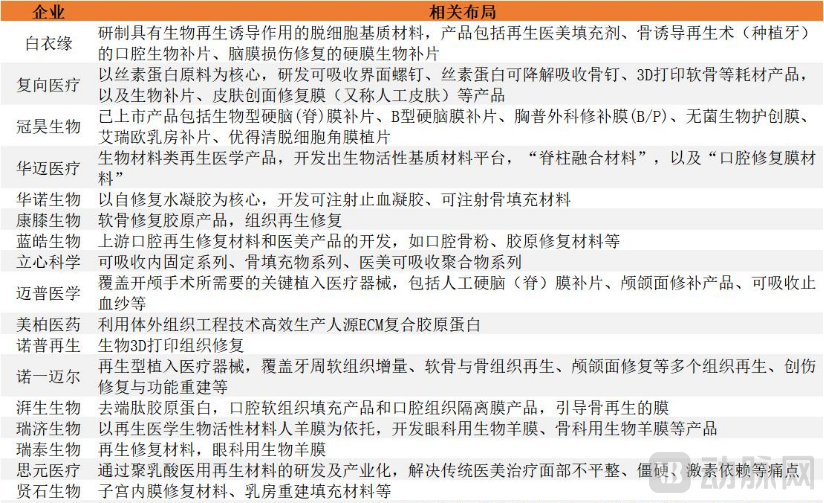
Figure: Selected Tissue Engineering and Regenerative Medicine Companies
From the perspective of bio-regenerative materials used by enterprises, these includeNatural polymer materials, synthetic polymer materials, and their composite materials.
Natural polymer materials, represented by silk fibroin, collagen, and chitosan, offer advantages such as excellent biocompatibility, high compatibility, and low antigenic activity.Fuxiang MedicalLeveraging innovative processes to utilize silk fibroin, we mass-produce consumable products such as absorbable interference screws, bone pins, and 3D-printed cartilage, as well as biological patches and skin wound repair membranes.
Synthetic polymer materials represented by polylactic acid, polycaprolactone, and poly(lactic-co-glycolic acid) offer multiple advantages, including high tensile strength, excellent rubber-like elasticity, and a combination of plastic-like strength and toughness. In the layout of the dura mater businessMaipu Medical, the absorbable dural sealant medical adhesive, prepared using absorbable synthetic polymer materials as raw materials, received registration acceptance from the National Medical Products Administration in October 2021.
However, when cells are combined with biomaterials, the cells first come into contact with the surface-modified molecules of the material, rather than the material itself; therefore,Surface-modifying molecules are the primary factor influencing cell adhesion to materials.。
Taking synthetic polymers as an example, although they exhibit superior mechanical properties, they suffer from poor cell affinity. These materials fail to provide adequate support for cell adhesion, proliferation, and differentiation, resulting in a relatively weak capacity to promote tissue regeneration. Therefore, bioactive molecules such as collagen, adhesive peptides, growth factors, hormones, and cytokines can be grafted onto the scaffold surface to improve its hydrophilicity/hydrophobicity balance and cell affinity.
Not only the material types, but also theirSurface MorphologyIt also affects the integration of cells with regenerative materials.
Surface microtopography of materials includes pore size, roughness, hardness, porosity, and micro/nanostructures of porous materials. Increased porosity or pore size typically leads to improved extracellular matrix (ECM) secretion, cell infiltration, tissue ingrowth, and molecular transport.
For stem cell differentiation, the physical parameters of different pores may lead to distinct differentiation pathways. For instance, without the addition of supplements such as growth factors, human mesenchymal stem cells (hMSCs) can be directly induced to differentiate solely by adjusting the pore size of porous honeycomb-like polystyrene scaffolds. Scaffolds with a smaller average pore size (1.6 μm) induce hMSCs to specifically differentiate into osteoblasts, whereas those with a larger average pore size (4.8 μm) induce hMSCs to differentiate into myoblasts.
Currently, scientists have pioneered a more promising approach to in vitro organ construction—3D Bioprinting, after conducting whole-cell analysis and modeling of the organ, suitable biofunctional materials are mixed with cells for layer-by-layer 3D printing, ultimately producing functional tissue organs for transplantation.
Compared with traditional manufacturing, 3D bioprinting enables computer-controlled, high-throughput cell arrangement to fabricate biomimetic structures with high precision and complexity, thereby enhancing bioactivity and supporting personalized therapy. Furthermore, by integrating diverse cell types and biomaterials, this technology allows precise spatial regulation of cells, modulating cell–scaffold interactions to foster the development of functional tissues and establish the three-dimensional microenvironment required for cellular activity.
Consequently, SmarTech projects that the market size for bioprinting will maintain a rapid growth trajectory after 2025, reaching nearly $3 billion by 2031. Meanwhile, as bioprinting products are applied in orthopedics, dentistry, cardiovascular care, and tissue transplantation, their market size is highly correlated with the expansion of these respective fields.
Taking orthopedic implants as an example, according to the market research report on orthopedic implants released by Bezhi Consulting, the global and Chinese markets for orthopedic implants reached RMB 341.299 billion and RMB 95.768 billion, respectively, in 2022, with a compound annual growth rate (CAGR) of approximately 14% over the next five years.
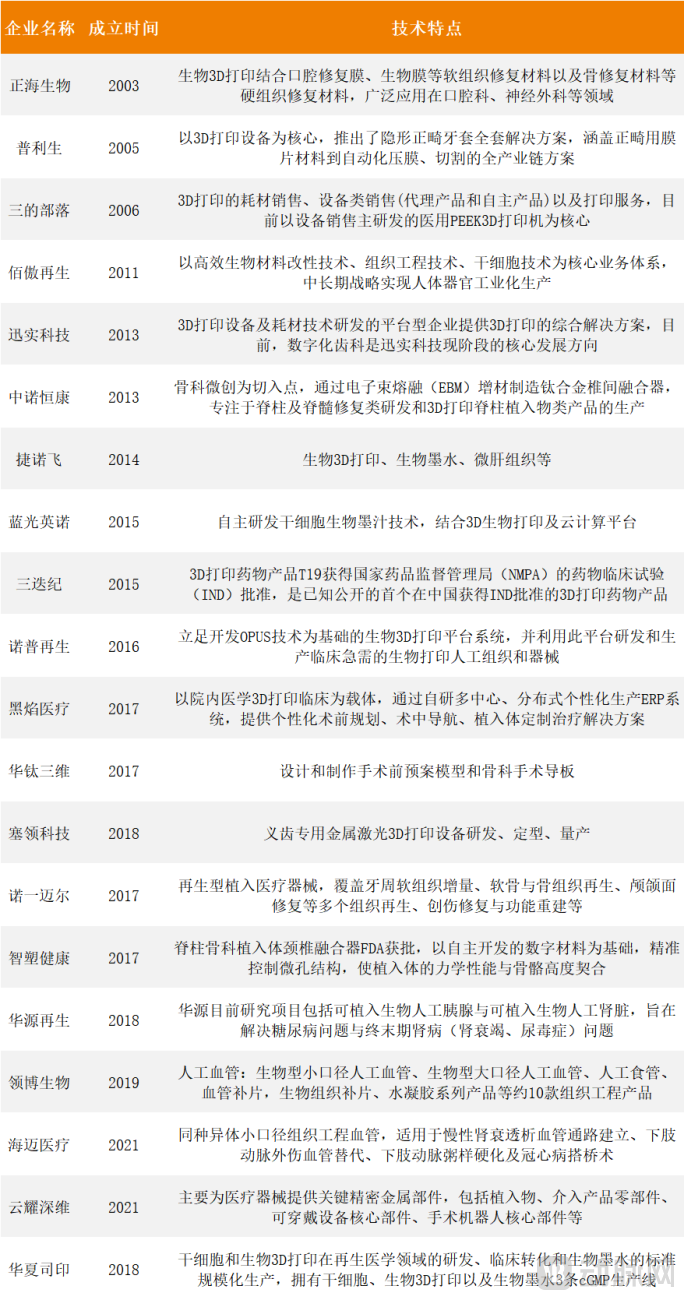
Figure: List of Selected Companies in the Tissue Engineering Field and the Bioprinting Sector (China)
Currently, there are quite a few regenerative medicine companies in China that have deployed 3D bioprinting technology, includingNuopu RegenerationDevelop a bio-3D printing platform system based on OPUS technology, and leverage this platform to research, develop, and manufacture bioprinted artificial tissues and devices urgently needed in clinical practice;Black Flame MedicalLeveraging in-hospital medical 3D printing clinical applications as the platform, and utilizing a self-developed multi-center, distributed personalized production ERP system, to provide personalized preoperative planning, intraoperative navigation, and customized implant treatment solutions;Huaxia SiyinIt operates three cGMP production lines for stem cells, bio-3D printing, and bioinks.
Bioprinting, with its cutting-edge technical attributes, relies heavily on academic research. Most corporate teams have evolved from university research groups and possess interdisciplinary academic backgrounds to align with the cross-disciplinary nature of tissue engineering. Founder and CEO of Huaxia SiyinDr. Chen HuiminHe holds a Ph.D. from Beijing Medical University and served as a Lecturer/Postdoctoral Fellow at Harvard University. With over ten years of R&D and comprehensive management experience at Wyeth and GSK, he developed Class II medical devices in his early career that have been sold to 33 countries worldwide.
At this stage, bio-3D printing has transitioned from academic research to commercialization. Although over a hundred companies have entered this blue-ocean market, most remain small in scale. With the development of domestic bio-3D printing in recent years, Chinese enterprises are gradually growing stronger, and the technological gap between China and other countries is further narrowing. There is still significant potential to unlock greater innovative vitality in this field.
From the perspective of stem cells and tissue engineering, regenerative medicine technology is in the early stages of industry development.
Stem cell technology is currently focused on achieving milestone breakthroughs in the research phase. In the next stage, particularly for products developed as standalone therapeutics, the focus will shift to Chemistry, Manufacturing, and Controls (CMC), including manufacturing processes and quality studies. Meanwhile, in the field of tissue engineering, bioprinting will become an important tool.
Future technological advancements in the regenerative medicine industry will continue to drive the healthcare sector. However, disruption does not mean the replacement of traditional approaches; rather, it signifies the synergistic development of traditional and emerging technologies, integrating a broader range of technical pathways. As an emerging industry, regenerative medicine still relies on collaborative efforts with traditional technology sectors and partners across the upstream and downstream value chains.