

Dencare Oral Care, an 80-Year-Old Chinese Oral Care Pioneer, Soars 173.89% on Debut as It Expands into Medical-Grade Oral Health
“Hot, cold, sour, or sweet—eat what you want, when you want…”
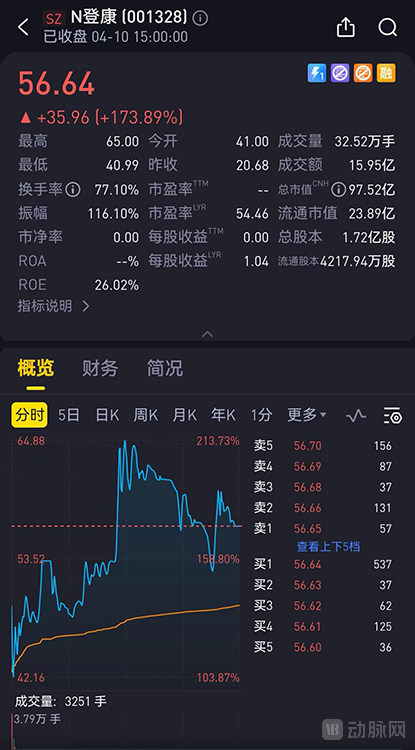
On April 10, Dencare Oral Care, the oral hygiene company behind a widely recognized advertising slogan, went public. As one of the first new listings under the registration-based IPO system on the Shenzhen Stock Exchange’s Main Board, Dencare Oral Care saw its shares surge by more than 213% at the peak on its trading debut. By the close, the stock was priced at 56.64 yuan, representing a gain of 173.89%, with a total market capitalization of 9.752 billion yuan.
In 1987, Lengsuanling desensitizing toothpaste was launched, marking the birth of the “Lengsuanling” brand. In 2001, Dencare Oral Care was established following the joint-stock reform of Chongqing Toothpaste Factory.
Counting from its earliest predecessor, Dencare Oral Care has a history of more than 80 years; since its restructuring, the company has been in operation for 22 years; and its flagship brand, “Leng Suan Ling,” has been on the market for 36 years.
DENCARE has built its core competitiveness around the "Cold Acid Ling" brand, demonstrating strong performance in competition with foreign brands. According to Nielsen retail research data, DENCARE’s toothpaste products hold a 6.83% share of retail sales and a 9.95% share of sales volume in offline channels, ranking fourth in the industry and second among domestic brands.
In recent years, DENCARE (Chongqing) Oral Care Co., Ltd. has achieved steady growth in its performance. From 2019 to 2021, the company's total revenue increased from RMB 944 million to RMB 1.143 billion, with revenue reaching RMB 611 million in the first half of 2022. In 2021, its net profit exceeded RMB 100 million, reaching RMB 119 million.
Adult toothpaste, primarily the “Leng Suan Ling” series, is the main revenue source for DENCARE. As competition in the oral care consumer goods market intensifies, DENCARE is also positioning oral healthcare and aesthetic care as key directions for future product expansion and revenue growth.
Prioritizing oral health has become an urgent imperative.
According to statistics, the number of patients with oral diseases in China has been on a continuous rise, driven by the increasing consumption of high-sugar foods, carbonated beverages, and spicy or irritating foods, as well as the prevalence of unhealthy lifestyle habits such as staying up late. Industry data show that the number of individuals suffering from oral diseases in China has increased year by year in recent years, reaching 704 million in 2020.
With the promotion of various oral health science popularization initiatives, public awareness of oral health maintenance has been steadily increasing. The most evident manifestation is the increased frequency of toothbrushing, which has in turn driven growth in the consumption of basic oral hygiene products such as toothpaste and toothbrushes.
Meanwhile, consumers have developed more mature purchasing awareness and increasingly diverse needs. In terms of oral health management, user demand has gradually expanded from basic cleaning to specialized functions such as whitening, anti-sensitivity, and antibacterial/anti-inflammatory care; from routine cleaning to cleaning solutions tailored for various orthodontic scenarios; and even personalized preferences for non-core features like product flavor and aesthetic design.
During this process, in addition to basic cleaning products such as toothpaste and toothbrushes, niche products like electric toothbrushes, water flossers, mouthwashes, and dental floss have also experienced rapid growth, leading to a diversification of the product category structure within the oral care industry.
Over the past three decades, the oral care industry has experienced rapid development. During this period, DENCARE’s product portfolio was initially dominated by toothpaste. As its market share and brand recognition in the oral care sector increased, the company gradually expanded its offerings to include toothbrushes, electric toothbrushes, mouthwashes, antibacterial oral gels, and desensitizing agents. This strategic expansion extended its business scope from basic oral cleaning products to electric oral care devices, oral hygiene products, and oral medical devices, thereby meeting consumers’ increasingly personalized and specialized needs.
Currently, DENCARE’s portfolio includes the well-known oral care brands “DENCARE” and “Leng Suan Ling,” as well as the premium professional oral care brand “Yi Yan,” the children’s oral care brand “Bei Le Le,” and the high-end infant and toddler oral care brand “Meng Ya.” This has established a four-pillar product matrix comprising basic oral care products for adults, basic oral care products for children, electric oral care products, and oral medical and cosmetic care products.
Among its offerings, DENCARE’s flagship brand “Leng Suan Ling” has become a household name, with its slogan “Enjoy hot, cold, sour, and sweet foods whenever you crave them” accompanying the growth of the post-80s and post-90s generations. Tracing back to the predecessor of DENCARE, the “Leng Suan Ling” brand boasts a history of over 30 years.
The prospectus shows that the “Leng Suan Ling” brand’s share of offline retail sales in the anti-sensitivity toothpaste segment has remained steadily at around 60%.
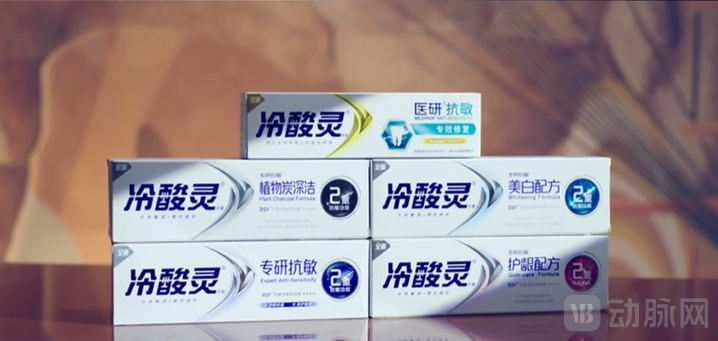
DENCARE’s “Lengsuanling” toothpaste. Image source: DENCARE official website
The enduring success of “Leng Suan Ling” is underpinned by DENCARE’s continuous technological research and development in the anti-sensitivity field. Building on its expertise in anti-sensitivity, DENCARE has established a “1+X” technological barrier, expanding into markets for products closely related to sensitivity relief to meet consumers’ diverse and differentiated needs for whitening, gum care, anti-sugar protection, and breath freshening.
Meanwhile, DENCARE will continue to invest in R&D for its anti-sensitivity products to consolidate this advantage.
In its prospectus, DENCARE (Chongqing) Oral Care Co., Ltd. stated that it has established an Anti-Sensitivity 3.0 technology matrix, focusing on the development and performance research of novel oral biomaterials, expanding the application of key technologies such as anti-sensitivity silicones and nanozymes in the field of oral health, building a multi-technology matrix featuring medical-grade precision biomimetic desensitization and digital intelligent regenerative anti-sensitivity technologies, and carrying out extended patent layouts for multiple anti-sensitivity innovations.
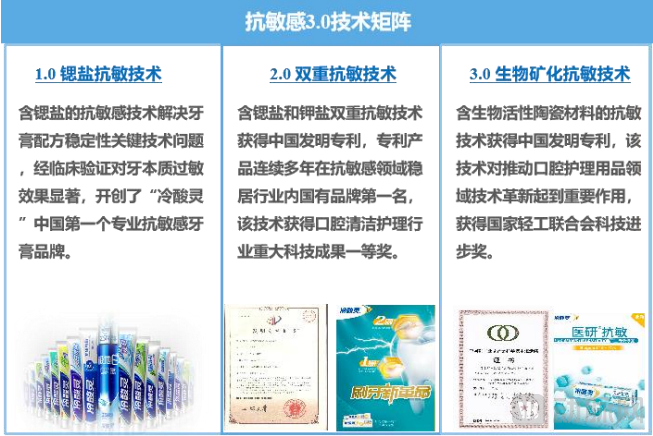
DENCARE’s Anti-Sensitivity Technology Matrix, Source: Prospectus
In the anti-sensitivity market, DENCARE will also increase its research on individuals with severe tooth sensitivity, strengthen the application and development of specialized technologies and new techniques, and launch new products based on bio-restorative technology, such as anti-sensitivity silicone toothpaste, anti-sensitivity gel, and anti-sensitivity foam, continuously iterating and enriching the range of anti-sensitivity product types.
Thus, it is evident that DENCARE will continue to focus on the anti-sensitivity sector, sustaining the brilliance of the “Leng Suan Ling” brand.
From the perspective of DENCARE’s product categories and revenue structure, oral care consumer goods such as toothpaste and toothbrushes dominate. However, in recent years, DENCARE has placed greater emphasis on its medical attributes, with the importance of products related to dental medical care and cosmetic nursing becoming increasingly prominent.
Intense Competition in the Daily Chemical Consumer Goods Sector Drives Up Marketing Costs
Amid the rapid development of the oral care industry, in addition to leading domestic enterprises such as DENCARE (Chongqing) Oral Care, Liangmianzhen, Yunnan Baiyao, and Weimeizi, as well as large foreign companies like Colgate and Crest, a large number of innovative companies have emerged. For instance, emerging brands represented by usmile, Soocas, and Canban have attracted significant attention from young consumers through their product aesthetics, detailed design, form factors, and marketing concepts.
Meanwhile, with the rapid development of mobile internet, the consumer base for online shopping continues to expand, further intensifying the fragmentation of distribution channels for daily chemical products. Emerging channels such as interest-based e-commerce, community group buying, B2B, and O2O are rising rapidly.
Overall, the oral care products market is mature, with a wide array of brands and categories available to consumers. Market competition is intense, and the factors influencing consumer purchasing decisions have become increasingly diversified.
In this market environment, oral care companies must enhance brand image, innovate marketing strategies, and improve sales channels to maintain and expand their market share. Currently, in addition to traditional marketing strategies and channels, various Internet-based cross-industry marketing and co-branded marketing campaigns are emerging one after another.
DENCARE has implemented brand innovation initiatives, including building a matrix of brand ambassadors, developing social-media-savvy viral products such as hotpot-flavored toothpaste, and establishing a private-domain membership system. By operating across digital content platforms like WeChat, Weibo, Douyin, Xiaohongshu (Little Red Book), Bilibili, and Zhihu, the company continuously refreshes comprehensive consumer perceptions of its brand rejuvenation, thereby enhancing brand awareness and influence.
In 2019, DENCARE launched “Hot Pot Toothpaste,” available in three flavors: Standard Medium Spicy, Sichuan-Chongqing Mildly Spicy, and the Legendary Extremely Spicy. The cross-industry marketing campaign for “Hot Pot Toothpaste” also received awards in the public relations and communications category.
For consumer goods, brand building and marketing require continuous investment. In oral care companies primarily focused on consumer products, selling expenses account for a high proportion. For example, from 2019 to 2021, Weimeizi’s selling expense ratio reached 44.17%, 39.06%, and 41.31%, respectively; DENCARE (Chongqing) Oral Care Co., Ltd.’s selling expense ratio was approximately 25%–29%. Within selling expenses, advertising and promotional costs, including celebrity endorsements, constitute a significant share.
Brand building is a “sink or swim” endeavor; once brand visibility wanes, market share may be directly threatened. However, even the most sensational marketing tactics and campaigns have limited longevity, often fading quickly as they are drowned out by the vast deluge of online information.
Take the then-blockbuster product and award-winning marketing campaign, “Hot Pot Toothpaste,” as an example; currently, searches on Tmall and other e-commerce platforms no longer show any toothpaste from this series for sale.
Therefore, in an environment of intensifying competition and soaring marketing costs, companies must strengthen their market position through more multidimensional competitiveness.
Vigorously expand products such as dental care and beauty care.
It is understood that competition in the oral care market has shifted from price and channel-based rivalry to comprehensive competition encompassing brand equity, R&D capabilities, product portfolio, service quality, operational management, and even capital strength. Companies must achieve holistic improvements in brand building, breakthroughs in core technologies, enhancement of product competitiveness, innovation in marketing models, and delivery of high-level customer service.
Among these competitive factors, professionalism has emerged as a key strategic breakthrough. For DENCARE, in addition to maintaining its focus on the anti-sensitivity segment, oral healthcare and cosmetic care have become priority areas for expansion.
In the oral healthcare and aesthetic care sector, DENCARE has launched a series of products encompassing dental medical devices, oral hygiene products, and oral aesthetic and professional care products.
Among these products, desensitizing agents for teeth, classified as Class II medical devices, can be used for preoperative preventive desensitization, postoperative desensitization and repair, as well as at-home treatments between procedures. They are commonly recommended by doctors for patient use before, during, and after surgery.
Among oral hygiene products, to meet consumers’ needs for oral antibacterial care, DENCARE has launched oral antibacterial toothpaste and oral antibacterial care solution, which exhibit inhibitory effects against Staphylococcus aureus, Escherichia coli, Candida albicans, and other microorganisms.
In the realm of cosmetic dentistry and professional care products, DENCARE has launched a series of products including orthodontic care items, antibacterial dental floss, and oral sprays enriched with hyaluronic acid essence.
Overall, oral healthcare and beauty care products reflect the attributes of medical or consumer healthcare, further enhancing DENCARE Oral Care's professional image in the minds of users.
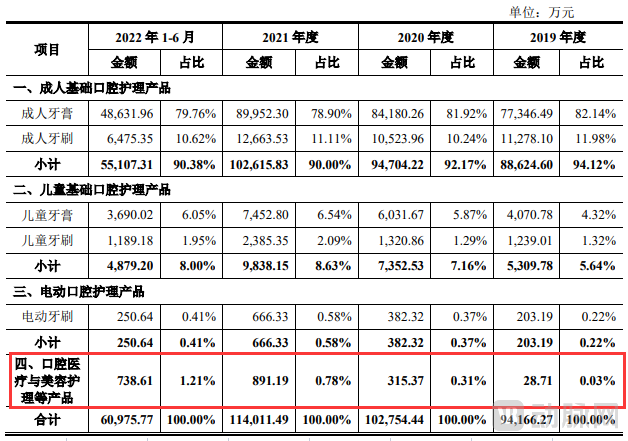
DENCARE Oral Care’s Four Major Product Matrices and Revenue Structure, Image Source: Prospectus
Over time, oral healthcare and cosmetic care products have also contributed increasingly significant revenue.
According to the prospectus, DENCARE (CHONGQING) ORAL CARE CO., LTD. derives its revenue from adult basic oral care products, children’s basic oral care products, electric oral care products, and oral medical and aesthetic care products. Among these, adult and children’s basic oral care products constitute the primary sources of the company’s revenue. While oral medical and aesthetic care products contribute a relatively small share of total revenue, this segment is exhibiting rapid growth.
From 2019 to the present, revenue from oral healthcare and beauty care products has grown from over RMB 200,000 initially to RMB 7.3861 million in the first half of 2022, with their share of total revenue increasing from 0.03% to 1.21%.
The oral healthcare and cosmetic care segment not only contributes an increasingly larger share of revenue, but DENCARE also stated in its prospectus that this segment is a key direction for the company’s future product expansion and revenue growth, serving as the cornerstone of overall value innovation across its four major product matrices.
In the new categories of oral healthcare and aesthetics, DENCARE will focus on areas such as tooth desensitization, orthodontics, and cosmetic dentistry, deploying oral medical device products including dental desensitizing pastes and mouthwashes for oral ulcers, thereby cultivating and expanding the emerging industry of medical-grade oral biomaterials.
Furthermore, DENCARE (CHONGQING) ORAL CARE CO., LTD. plans to target the global market and lay out its presence in industries such as dental medical devices, remote oral health consultations, remote diagnosis of oral diseases, orthodontics, and cosmetic dentistry. By means of equity cooperation, investment and mergers & acquisitions, and the introduction and recruitment of top-tier talent, the company will actively promote its strategic expansion into high-end manufacturing, as well as the dental healthcare and cosmetic dentistry service sectors.
In other words, the “medical-grade” attribute will be more prominently reflected in DENCARE (Chongqing) Oral Care Co., Ltd. in the future.
Looking at the oral care market, products seem to be diverging into two directions.
First, multiple brands have strong medical or pharmaceutical backgrounds. Yunnan Baiyao has combined its traditional Yunnan Baiyao products with oral care items, creating an oral care product series centered on Yunnan Baiyao toothpaste, which has become a classic case of cross-industry innovation among traditional Chinese medicine (TCM) enterprises. Liangmianzhen also focuses on TCM toothpaste as its flagship product; its financial reports indicate that its products were the first in the industry to have clinically verified efficacy data for TCM toothpaste. Sensodyne, a brand under GlaxoSmithKline (GSK), leverages GSK’s advantages in pharmaceutical research and development.
Meanwhile, a wave of emerging brands focuses on the consumer-oriented attributes of their products. Canban’s philosophy is to position oral care items, such as mouthwash, as fast-moving consumer goods (FMCG), which stands in stark contrast to the traditional approach of formulating mouthwash with a pharmaceutical mindset. This FMCG orientation is reflected, for example, in its diverse product portfolio and portable packaging designs.
As an ecosystem enterprise under Xiaomi, Soocas’s product positioning bears a clear imprint of its parent company. Soocas focuses on oral care products that emphasize high quality, cost-effectiveness, and aesthetic appeal, and has also launched portable devices with compact designs. The Soocas official website explicitly states that its founding team, composed of former product designers, holds “a deep obsession” with the visual design of its products.
So, is the future of oral care closer to healthcare or to consumer goods?
It is evident that these two major directions can target different demographic groups and form a complementary relationship. For brands leveraging medical and pharmaceutical expertise as their professional endorsement, the positioning can focus on individuals with existing oral diseases, those at high risk of oral diseases, or those with specific functional needs. For brands built purely as consumer goods, they can penetrate into more oral care scenarios beyond fixed brushing times, thereby meeting the diversified needs of users in the new consumer market.
Regardless of the direction, it will further enhance users' awareness of oral care and expand the overall market size. Even in a fiercely competitive market, brands that can meet user needs and possess core technological capabilities will stand out from the competition.