

Flare Therapeutics, First to Bring Transcription Factor-Targeting Drug FX-909 into Clinical Trials, Files for IPO

Flare Therapeutics
Small Molecule Drug Developer
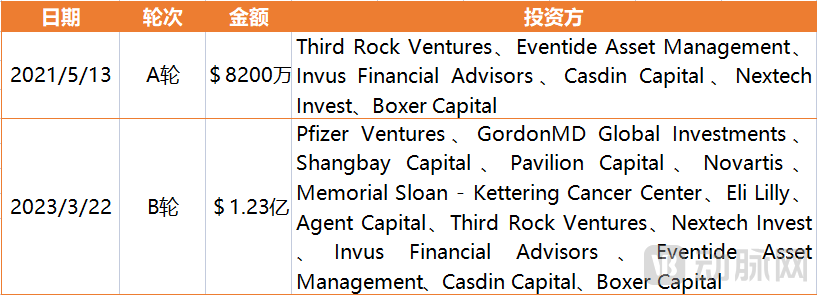
In March, Flare Therapeutics (“Flare”), a biotechnology company based in Massachusetts, USA, completed a $123 million Series B financing round led by GordonMD Global Investments and Pfizer. The funds will be used to support the clinical development of FX-909 for advanced urothelial carcinoma, advance the development of a novel transcription factor target, and progress a new drug candidate.
On March 30, Flare announced the promotion of former Chief Operating Officer and Chief Financial Officer Daphne Karydas to President and Chief Financial Officer; the promotion of Michaela Bowden, former Senior Vice President of Biology and Translational Science, to Chief Development Officer; and the appointment of Michael L. Meyers, M.D., as Chief Medical Officer.
Source: Compiled from public information
Behind a series of financing and personnel changes lies Flare’s ambition: to conquer transcription factors.
Flare was founded in 2021 and completed an $82 million Series A financing round led by Third Rock Ventures in its inaugural year. Dr. Abbie Celniker, then Interim CEO, stated, “We created Flare to fulfill the mission of conquering transcription factors.”
Transcription factors (TFs) are DNA-binding proteins that can activate or repress DNA transcription, thereby controlling gene expression. Transcription factors typically function within multi-protein complexes with interconnected biochemical activities, coordinating gene expression by reading the genome and recruiting co-regulatory proteins to specific DNA regions.
For a long time, transcription factors have been ideal targets for drug developers, as mutations in transcription factors can be driving forces behind many diseases. Despite their “potent influence,” less than 1% of transcription factors have been successfully targeted for therapeutic use, because conventional rules of drug design do not apply to them.
Research on targeted small-molecule drugs requires a specific region within the protein that can bind to small molecules and interfere with protein function. However, the structure and interactions of transcription factors (TFs) are highly disordered or even chaotic. Therefore, one of the major challenges in targeting TFs is the lack of structured binding sites, which prevents a systematic linkage between the biochemical functions of TFs and targetable sites for small-molecule drug discovery.
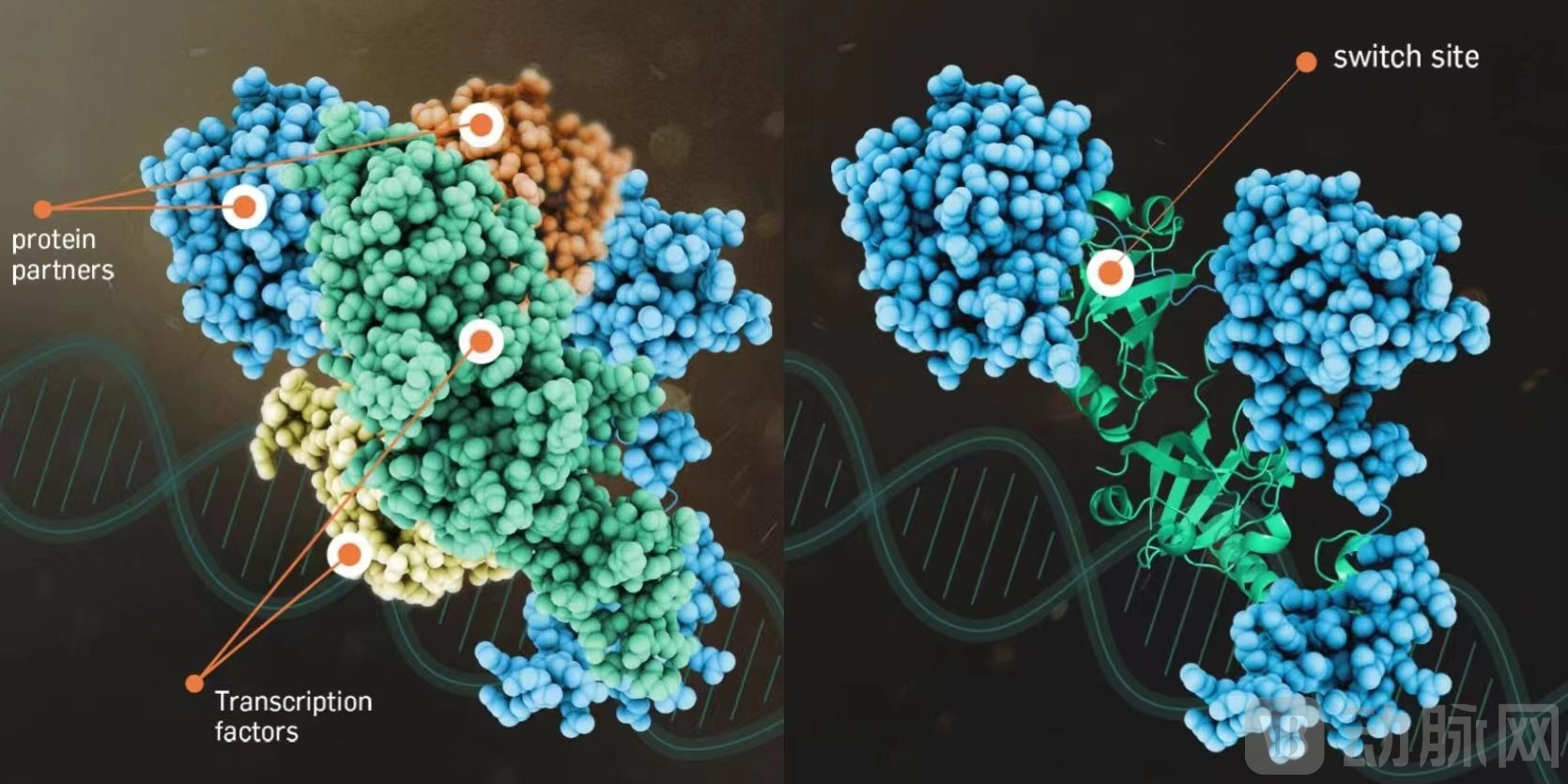
Key Regulators of Gene Expression and "Switching Sites"
Source: Flare Official Website
Inspired by the work of Dr. Fraydoon Rastinejad’s group at the University of Oxford on the HIF-2 transcription factor, Flare Therapeutics has sought to decipher the biological properties of transcription factors through novel approaches for small-molecule drug development, thereby illuminating a new therapeutic frontier.
Building on the pioneering work of its scientific advisors, the Flare team has identified “switch sites,” or druggable regions. These regions are key targets for transcription factor regulation and for addressing disease-causing mutations, enabling control over predictable changes in DNA transcription and thereby modulating gene expression.
A “switch site” can be understood as a single, definable location that governs cooperative interactions within transcription factor complexes, thereby exerting control over gene expression.Building on this, Flare has developed an emerging pipeline that applies the “switch site” paradigm to early discovery programs in neurology, immunology, inflammation, and rare genetic diseases driven by transcriptional dysregulation.
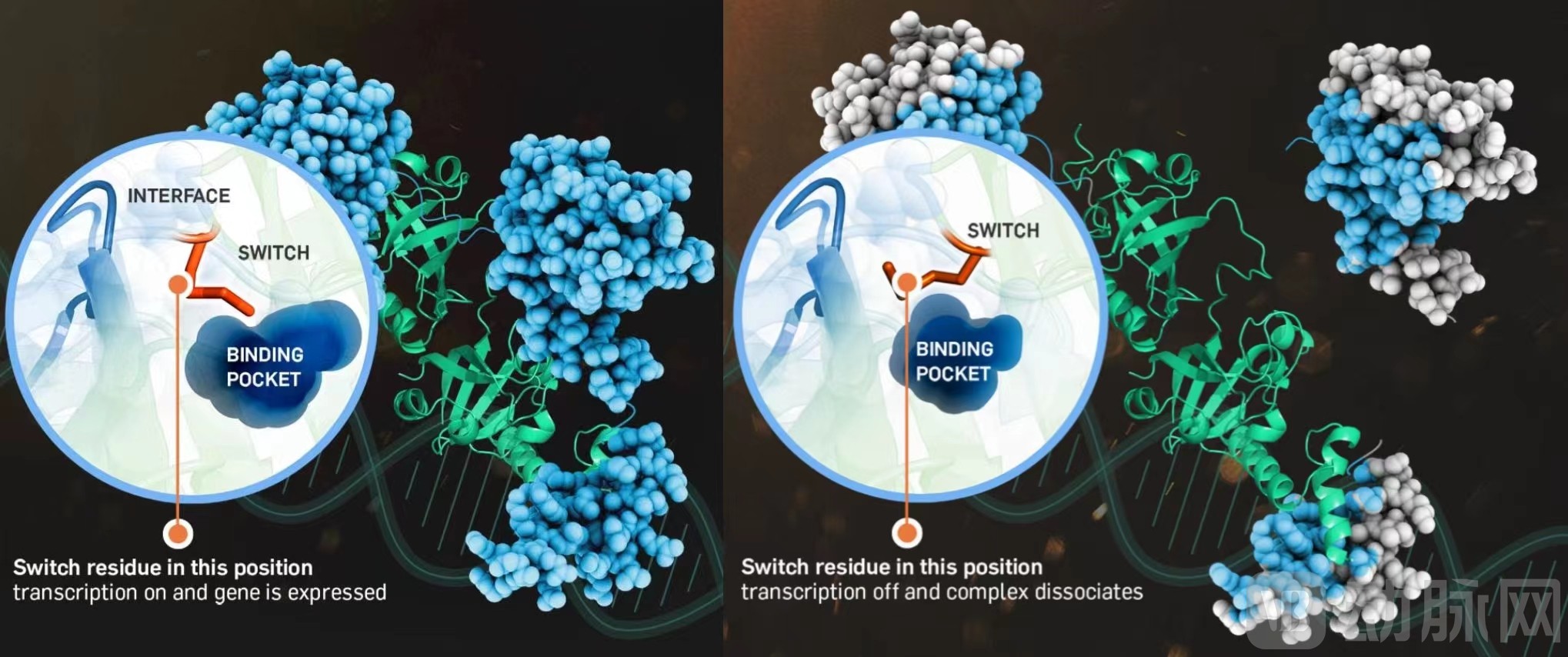
“Switch Site” Switching and Complex Dissociation
Source: Flare Official Website
The team has made new progress in the discovery of small-molecule drugs targeting the "switch site."The plan is to advance its precision oncology program, FX-909, into clinical trials in 2023.FX-909 is a small-molecule inhibitor targeting PPARG for the treatment of locally advanced or metastatic urothelial carcinoma (UC).
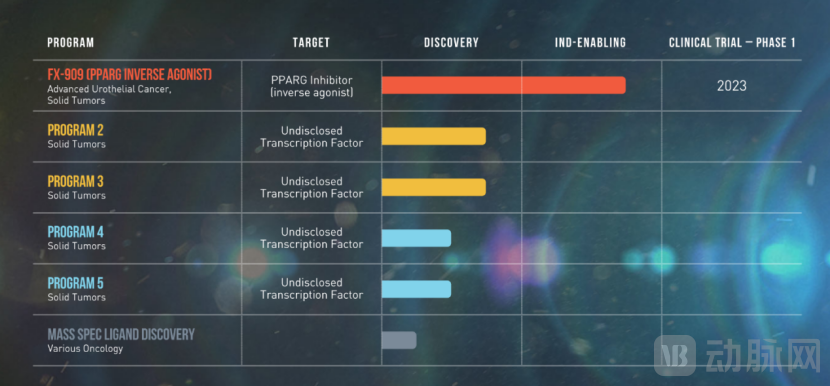
Flare's Pipeline Configuration
Source: Flare Official Website
Robert Sims is the Co-founder and Chief Scientific Officer of Flare. He graduated from The University of Texas at Austin in the United States. At this prestigious institution, renowned as one of the “Public Ivies,” he earned a Ph.D. in Cell and Molecular Biology and a B.S. in Microbiology, and has published more than 30 papers in top-tier journals such as Science and Nature.
In the field of transcription, Robert Sims has over 20 years of experience, including more than 10 years in gene-controlled drug discovery. Prior to founding Flare Therapeutics, he served as Senior Vice President of Research and Development at Constellation Pharmaceuticals and was an Entrepreneur-in-Residence at Third Rock Ventures.

Flare Co-founder and Chief Scientific Officer Robert Sims
Image source: Flare official website
In 2019, a research team led by Dr. Fraydoon Rastinejad at the University of Oxford published a study identifying a sensitive “control switch” within a gene that regulates the transcription factor hypoxia-inducible factor-2 (HIF-2). This factor is overactive in certain cancers but inactive in chronic kidney disease. At the time, Robert Sims was both struck and intrigued by this study and its implications for drug development targeting transcription factors.

Fraydoon Rastinejad, Co-founder of Flare and DPhil from the University of Oxford
Image source: Flare official website
In 2020, before the pandemic forced research laboratories around the world to shut down, Robert Sims flew specifically to Oxford to meet with Fraydoon Rastinejad and discuss experiments on transcription factors—the very experiments that laid the foundation for the establishment of Flare Therapeutics.
Initially, Flare was a small company with only a dozen or so employees, relying heavily on outsourced experiments. However, after two years of development, the company’s team has grown to nearly 40 people, and it has raised a total of $205 million in funding.
Flare is not the “first to try” in the exploration of transcription factors.
Founded in 2017 and headquartered in Cambridge, UK, Azeria Therapeutics is developing inhibitors of transcription factors such as FOXA1 for oncology indications. The company successfully completed its Series A and Series B financing rounds in 2018 and 2019, raising a total of £36 million.
Following the financing round, the Azeria Therapeutics team failed to meet expectations in subsequent preclinical study data. Ultimately, in 2020, the company decided to cease operations and return a substantial portion of capital to investors.
Azeria Therapeutics has reached its end, but this does not mean that this track is no longer viable.
In October 2022, at the 34th EORTC-NCI-AACR Symposium, Flare Therapeutics presented a report titled “Peroxisome Proliferator-Activated Receptor Gamma (PPARG) status defines the luminal lineage in molecular profiles of advanced urothelial cancers (UC).”
In preclinical experiments, Flare Therapeutics conducted therapeutic testing using the PPARG inhibitor FTX-6746 in UC cell lines, including UMUC9 (with PPARG amplification) and HT1197 (harboring the RXRA-S427F hotspot mutation).
Data showed that target gene inhibition in UMUC9 xenograft tumor tissues reached up to 80% on day 2 after administration, with tumor growth inhibition exceeding 100% by day 21. In HT1197 xenograft tumors, target gene inhibition exceeded 45% on day 2, and tumor growth inhibition ranged from 85% to 112% by day 42. No tumor regrowth was observed after treatment cessation.
Existing data indicate that FTX-6746 effectively inhibits PPARG target genes and achieves durable tumor regression at well-tolerated doses. These data also supported the entry of its FX-909 pipeline, intended for the treatment of locally advanced or metastatic urothelial carcinoma (UC), into clinical trials in 2023.
At the AACR Annual Meeting held in Orlando, Florida, from April 14 to 19, 2023, Flare Therapeutics highlighted the initial preclinical data of its lead compound, FX-909, through both an oral presentation and a poster. The oral report demonstrated that administration of FX-909 in animal models of ulcerative colitis (UC) induced durable tumor regression. The projected human starting dose of 50 mg/kg is also expected to exhibit pharmacological activity.
Dr. Robert Sims said, “We are eager to continue advancing FX-909, which will be further evaluated in the Phase I trial starting later this year.”This will be a milestone moment for Flare, as we are the first company to enter clinical trials.。”