

Orna Therapeutics Files for IPO: Pioneering In Vivo CAR-T Therapy with Circular RNA Platform Backed by Merck
Orna
Novel Full-Process Circular RNA (Orna) Therapy Developer
CAR-T Therapy, also known as Chimeric Antigen Receptor T-Cell Therapy, involves the ex vivo genetic engineering and modification of human T cells, which are then infused back into the patient.
Although this therapy has demonstrated certain advantages in the treatment of hematologic malignancies, it is limited by risks of infection, susceptibility to adverse reactions, complex and costly personalization, challenges in scaling up manufacturing processes, and diminishing therapeutic efficacy.
Compared with in vitro therapy,In vivo CAR-T therapy, which generates CAR-T cells directly within the patient’s body, offers a novel solution.
In vivo CAR-T therapy utilizes a single, universal drug product—a systemic delivery vector encoding the chimeric antigen receptor (CAR)—to directly transduce patient T cells. The new genes are decoded to produce CARs within one to two days. This approach not only shortens the treatment cycle and simplifies procedures but also avoids graft-versus-host reactions and manufacturing-related complexities by generating true autologous cells.
Currently, in vivo CAR-T therapy remains in the early stages of research; however, numerous startups are strategically positioning themselves in the field of mRNA-based in vivo reprogramming for CAR-T cells, aiming to achieve new breakthroughs.
Orna Therapeutics (hereinafter referred to as “Orna”), based in Cambridge, Massachusetts, has developed a novel approach—circular RNA therapy—that has achieved phased success in animal models.
Orna, founded in 2019 with support from MPM Capital and its subsidiary BioImpact Capital, is a biotechnology company dedicated to designing and delivering novel engineered circular RNA therapeutics. The company’s oRNA-LNP platform is extensively applied across multiple disease areas, including cancer, regenerative medicine, protein replacement, infectious diseases, and autoimmune disorders.
In January this year, Orna reached a collaboration with Shanghai Xianbo Biologics,to discover, develop, and commercialize multiple potential therapies in the field of oncology. Under the terms of the agreement, SynBio Tech will obtain rights to certain projects based on Orna’s breakthrough isCAR technology in the Greater China region, including Orna’s most advanced candidate ORN-101, to advance clinical trials initiated in China.
Although in vivo CAR-T therapy holds great promise, there is currently a lack of suitable vector platforms. Some scholars have compared and summarized different technical approaches to vector platforms, concluding that lentiviral vectors (LV), adeno-associated viral vectors (AAV), synthetic polymer nanocarriers (NC), and lipid nanoparticles (LNP) are worthy of exploration.
Orna has selected two key proprietary technologies: protein-encoding circular RNA (oRNA) and proprietary lipid nanoparticles (LNPs) to enable effective delivery.
oRNA is a fully synthesized, in vitro transcribed, unmodified, self-splicing circular RNA that does not require a cap or tail and translates proteins via an internal ribosome entry site (IRES).
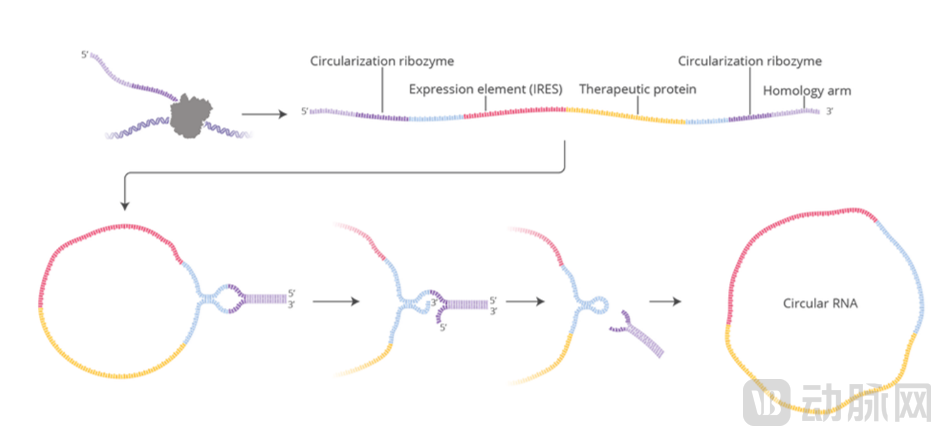
Structural Features and Synthesis Process of oRNA. Source: Orna Official Website
Lipid Nanoparticles (LNPs) are among the most clinically advanced RNA delivery vectors, composed of four components: ionizable lipids, phospholipids, cholesterol, and lipid-anchored PEG. They have received FDA approval for the delivery of siRNA and linear mRNA.
In LNPs, oRNA has a smaller diameter than mRNA, posing lower risks during filtration and potentially offering greater safety for intravenous administration, thus making it more suitable for clinical applications.
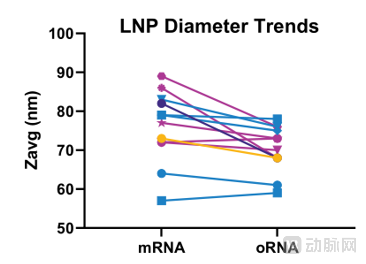
LNP Diameter Comparison, Image Source: Orna Official Website
In vivo, oRNA-LNPs demonstrated significantly higher splenic expression than mRNA-LNPs, surpassing industry standards. The spleen serves as a reservoir for effector immune cell subsets, including T cells, and is a tissue highly relevant to in situ CAR therapy.
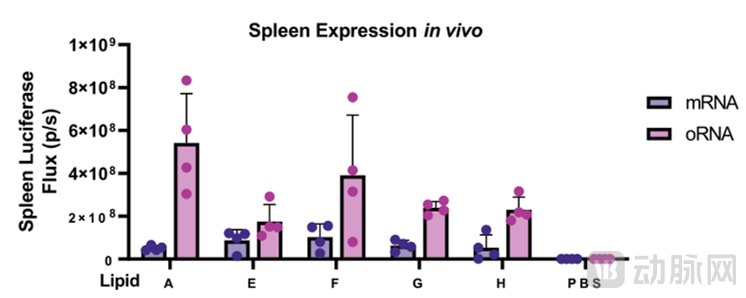
Comparison of splenic expression of oRNA-LNPs and mRNA-LNPs in mice. Source: Orna official website
In terms of in vivo biodistribution, oRNA-LNPs consistently exhibited higher relative flux in the spleen, whereas mRNA-LNPs were expressed primarily in the liver.
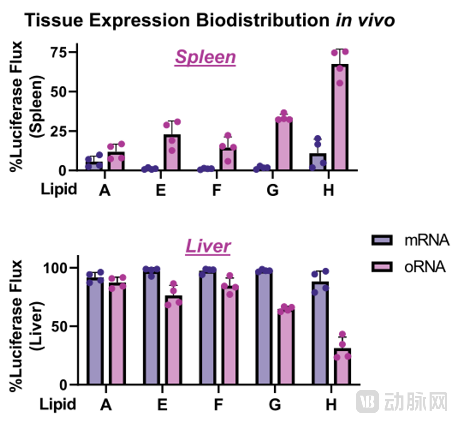
Comparison of in vivo biodistribution. Image source: Orna official website
At the cellular level, compared with LNPs delivering linear mRNA, LNPs delivering oRNA enabled higher expression in mouse splenic T cells. This result held true for two different ionizable lipids and three different reporter proteins.
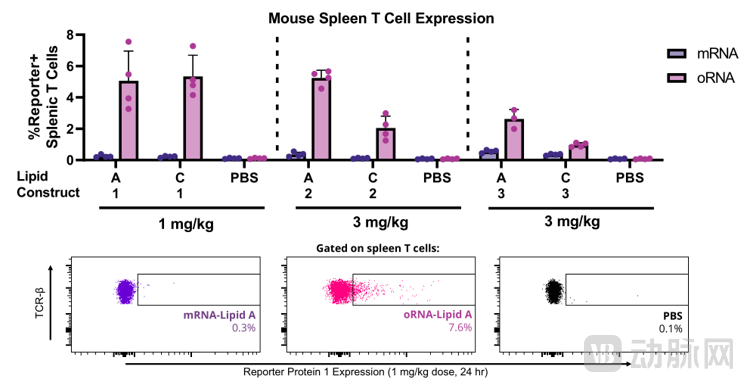
Comparison of T Cell Expression in Mouse Spleens. Image source: Orna official website
As can be seen from the above comparative data, novel oRNA and LNP technologies can be well integrated to maximize the in vivo expression in immune cells. These data also support Orna’s in vivo CAR therapy (isCARTM) provides support for the plan to introduce it into clinical practice.
According to Dr. Thomas Barnes, CEO of Orna, the company’s flagship program is an in vivo in situ CAR therapy that combines oRNA with customized LNPs to generate engineered immune cells within patients. This readily scalable approach eliminates the need for patient lymphocyte apheresis and enables precise dose control, thereby overcoming the limitations of ex vivo CAR-T therapies without compromising efficacy.
In March last year, Orna announced data from its isCAR program, which validated the potential of Orna’s novel oRNA technology and LNP delivery platform.Data indicate that oRNA-LNP can eradicate cancer cells in animal models. Additional iterative data from studies in rodents and non-human primates suggest that this approach may also be applicable in humans, further boosting Orna’s confidence.
Furthermore, Orna presented data from its proprietary FoRCE screening platform, which captures the entire oRNA production, formulation, and evaluation process in an arrayed and automated format. In its initial application, Orna has screened and characterized thousands of IRES elements across various primary human cell types. The identification and development of IRES elements are critical for optimizing oRNA functionality through tunable protein expression. Orna discovered numerous novel IRES elements that drive oRNA expression to levels significantly higher than those achieved by standard IRES elements, including some exhibiting differential activity across cell types. These findings provide a new technological toolkit for driving protein expression from circular RNA.
Currently, Orna has disclosed four R&D pipelines: in situ CAR therapy, Duchenne muscular dystrophy (DMD) therapy, infectious disease therapy, and one pipeline with undisclosed information.
In addition to its flagship in situ CAR therapy program, Orna has achieved non-viral delivery of full-length dystrophin-encoding RNA in human cells, as well as in vivo delivery of shorter variants in mouse models, marking a critical first step toward providing full-length gene therapy for patients with Duchenne muscular dystrophy (DMD).
Orna is also collaborating with Merck & Co. and ReNAgade to develop next-generation vaccine products, leveraging the potency and durability of oRNA along with new insights into LNP delivery.
In its undisclosed R&D pipeline, Orna is investigating the applicability of its oRNA and LNP technologies across a variety of target diseases and enhancing its platform to meet broader clinical needs.
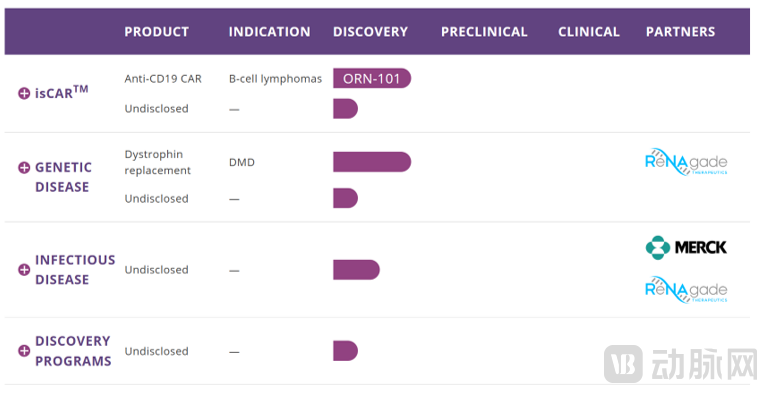
Orna’s R&D Pipeline, Source: Orna Official Website
Daniel G. Anderson is a professor in the Department of Chemical Engineering at the Massachusetts Institute of Technology (MIT), the Institute for Medical Engineering and Science, the Koch Institute for Integrative Cancer Research, and the Harvard-MIT Division of Health Sciences and Technology. His laboratory focuses primarily on the development of novel pharmaceutical materials. Alex Wesselhoeft is a doctoral student in Professor Anderson’s lab. Together with their team, they made new discoveries by leveraging exogenous circular RNA (circRNA) to prolong the expression duration of proteins encoded by full-length RNA transcripts, and founded Orna based on this research.

Daniel G. Anderson (left) and Alex Wesselhoeft (right), image source: Orna
In its four years since inception, Orna has completed three rounds of financing, raising a total of $321 million. Investors include Merck & Co., MPM Capital, Taiho Ventures, and Novartis, among others. The Series B round, closed last August, raised $221 million.
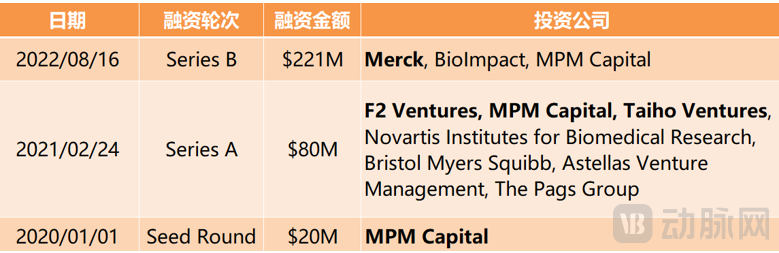
Orna’s Historical Financing and Investment Overview, Source: Compiled from Public Information
In addition, Orna has entered into a collaboration agreement with Merck & Co. In addition to investing $100 million in Orna’s Series B financing round, Merck will pay Orna an upfront payment of $150 million for the discovery, development, and commercialization of multiple programs, including infectious disease vaccines and oncology therapies. Furthermore, Orna will be eligible to receive up to $3.5 billion in downstream payments as well as royalties on any approved products resulting from the collaboration.