

Musculoskeletal Digital Health Innovator JiJiu Health Files for IPO: AI-Driven Solutions for MSK Disease Management
Dr. Li Gang, founder of Jijiu Health, is a thoughtful and deliberate individual. When he decides to undertake an initiative, it signifies that he has given it careful consideration. In 2022, Dr. Li established Jijiu Health, focusing on providing AI-driven comprehensive digital solutions for musculoskeletal (MSK) disorders.
This marks Li Gang’s second entrepreneurial venture. As a co-founder, he spearheaded the establishment (from 0 to 1) and subsequent scaling (from 1 to N) of a specialized orthopedic healthcare service provider. The company has served hundreds of thousands of patients through its offline channels and performed tens of thousands of surgeries, effectively addressing healthcare needs at the primary care level.
From a macroeconomic perspective, 2022 was by no means an ideal time for entrepreneurship; however, focusing on the musculoskeletal (MSK) sector, patients’ treatment needs did not dissipate but instead grew increasingly urgent. Identifying opportunities amid the restrictions on offline mobility during the COVID-19 pandemic, Li Gang aims to “leverage his expertise to advance medical technologies and transform care delivery models in this field, thereby enhancing the accessibility and effectiveness of healthcare.”
From an industrial investor to a founder in orthopedic services, and now embarking on a second entrepreneurial venture exploring the emerging field of digital musculoskeletal (MSK) care, how does Li Gang comprehensively evaluate and advance startup projects from an investor’s perspective? To find out, VCBeat conducted an interview with Li Gang.
In the early years, Li Gang engaged in industrial investment at central state-owned enterprises and listed companies, completing industrial and healthcare investments totaling over RMB 1 billion. He likened his transition from investor to entrepreneur to “a passenger in the front seat becoming the driver.”
As an industrial investor, Li Gang focused more on providing resource allocation support and did not directly participate in corporate execution. However, as an entrepreneur, he has had to make continuous decisions regarding numerous issues arising during company establishment and operations, delving into many operational details that are often difficult for investors to discern. He needs to determine the optimal path for project development based on sufficient information, firmly gripping the “steering wheel” to ensure that Jiu Health advances steadily and rapidly in the musculoskeletal disease sector.
People are the most critical factor in entrepreneurship. With over 20 years of experience in industrial investment, operations, and the healthcare sector, Li Gang possesses extensive social resources and can rapidly assemble a stable team for research, business development, and operational management. Regarding the founding team, Li Gang has long known his two co-founders, Dr. Liu Jia and Professor Zhang Xifeng, and all three have been deeply engaged in the field of orthopedics for many years.
Dr. Liu JiaandProf. Zhang XifengAll are professionals in the field of orthopedics. Dr. Liu Jia studied under Professor Wang Kunzheng, the President-Elect of the Chinese Orthopaedic Association of the Chinese Medical Association. After graduation, he served as a clinical orthopedic surgeon at the Affiliated Hospital of Xi’an Jiaotong University for over ten years. Professor Zhang Xifeng has practiced in tertiary hospitals for more than 30 years. He is a pioneer and leading figure in the field of minimally invasive spinal surgery in China, former Chief Physician of the Department of Spinal Surgery at the Chinese PLA General Hospital, Deputy Head of the Minimally Invasive Spine Surgery Group of the Chinese Medical Doctor Association, Chairman of the Minimally Invasive Spine Committee of the Bethune Foundation, holder of an M.D. from the Chinese PLA Medical School, and a graduate supervisor.
Yet each has their own strengths.Liu Jia has held positions at companies such as Johnson & Johnson (USA), Hologic Surgical Imaging (USA), Digital China, and Neusoft Group. As a multidisciplinary professional who combines medical expertise with business resource drive, he excels in resource integration, channel development, brand building, and marketing, serving as a key pillar for Jiujiu Health’s external expansion and commercialization in its future development. Professor Zhang Xifeng, a renowned senior expert in spinal surgery, has long been dedicated to clinical practice. He holds comparative advantages in medical research, healthcare system development, clinical trials, talent training, medical quality management, and the integration of medical resources. He will provide the medical foundation for Jiujiu Health’s product research and development, as well as the construction and operation of its healthcare system.
Three individuals, aligned in cognition and shared values, frequently exchanged their ideas on the development of the orthopedics field. Having been immersed in the industry for many years and acutely aware of the contradictions between medical supply and demand, they earnestly placed their early dream of “doing something for society” on the agenda once they possessed the resources necessary to realize their ambitions.
During the pandemic, Li Gang recognized that brick-and-mortar healthcare services were severely constrained in their scope, prompting a series of questions: How can remote diagnosis of musculoskeletal disorders be achieved for patients, enabling multi-scenario interactive treatment? Can preoperative preparation and postoperative rehabilitation guidance during the perioperative period be digitized and delivered remotely? Are there effective non-invasive treatments available beyond oral medications for cases where surgical indications are absent? Can technological innovations such as artificial intelligence further liberate healthcare professionals’ productivity and enhance work efficiency? Can big data and AI technologies assist primary care physicians in making clinical decisions? And can technological means improve the convenience of medical access for patients while reducing healthcare costs?
Li Gang engaged in discussions with two close friends to address practical challenges and reflections, covering topics ranging from China’s industrial policies, supply-and-demand shifts, and capital preferences to the frontier trends, advanced technologies, and exemplary development models in orthopedics across Europe and the United States.
Among them, digital health companies specializing in musculoskeletal disorders, such as Hinge Health and Sword Health from the United States and Kaia Health from Germany, have attracted their attention. These overseas enterprises apply technologies such as artificial intelligence, computer vision capture, hardware sensors, and miniature therapeutic devices to the treatment of musculoskeletal conditions, enabling remote medical services across multiple scenarios. This approach has significantly improved patient adherence and treatment efficacy. Most importantly, it provides greater convenience for patients seeking medical care, while reducing the need for oral medications and secondary injuries associated with invasive treatments.
“We believe this solution is one of the pathways to address the pain points in orthopedic healthcare in China. Solutions that build upon this foundation through model improvement and product optimization may become an effective approach to resolving these critical issues in the Chinese healthcare sector.” With a strategy of careful planning before action, the three founders were excited by this vision and reached a consensus—establishing Jijiu Health.
Guided by the project’s development plan and leveraging their own resource networks, the three founders quickly assembled a core team spanning technology, product R&D, and operations, including key executives such as the Director of Physical Therapy, the Director of Systems Engineering, the Director of Hardware Product R&D, and the Director of Operations.
Since its establishment, Jijiu Health has focused on the research and development of new technologies and products, as well as external collaborations, achieving phased results in a short period. The company has established cooperative relationships with universities, medical institutions, and upstream and downstream enterprises in the industry chain, including Tsinghua University, Beijing Sport University, Southwest Hospital, Peking University Third Hospital, West China Hospital, and Lefan Health. It has made significant progress in strategic layout and technological breakthroughs in areas such as artificial intelligence algorithm model development, secondary development of computer vision-based motion capture technology, digital prescription development, hardware development for assistive treatment and monitoring devices, and the development of digital perioperative management products.
Jiujian Health’s first digital product is scheduled for launch in early May 2023.
Jiujian Health positions itself as a provider of comprehensive digital solutions leveraging artificial intelligence and other technologies to address musculoskeletal (MSK) disorders, targeting three major pain points in the MSK market: the lack of auxiliary diagnostic tools (particularly in out-of-hospital settings) and decision-support systems; poor communication and suboptimal outcomes in perioperative management; and excessive reliance on non-interventional pharmacological treatments, which are associated with significant side effects.
In terms of disease selection, Jijiu Health focuses on four high-demand patient groups: perioperative care for knee arthroplasty, knee osteoarthritis, degenerative spinal disorders, and sports injuries with postoperative rehabilitation. Li Gang stated that this business decision was made after comprehensive consideration of multiple factors, including technical feasibility, commercial viability, financial profitability, and the alignment with the company’s available resources.
Addressing the most critical and urgent pain points in the industry, Jijiu Health has developed a systematic, holistic solution that encompasses AI-assisted diagnostic products, AI-assisted decision-making products, digital therapeutics, perioperative orthopedic management products and comprehensive solutions, computer vision-based motion capture technology (including sensors), peripheral auxiliary hardware products, and electronic medical record (EMR) integration systems.
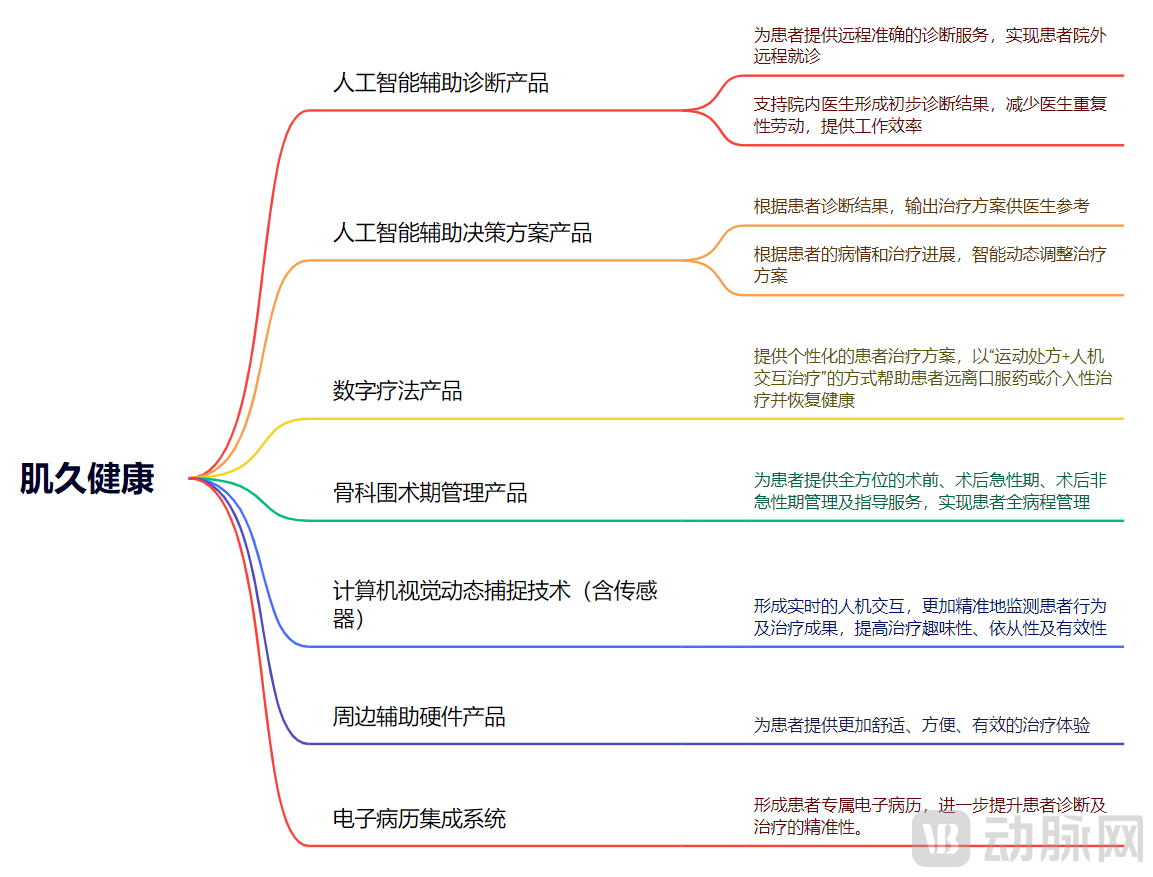
The application of technologies such as artificial intelligence is a hallmark of Jiu Health. Taking digital therapeutics as an example, related products integrate artificial intelligence, intelligent sensing, big data, and cloud computing technologies. Specifically, these include AI-driven techniques such as Human Pose Estimation (HPE), Clinical Decision Support Systems (CDSS) for intelligent auxiliary diagnosis, and Intelligent Exercise Prescription Generation (IEPG). Leveraging IMU technology and sensor data processing, Jiu Health effectively combines intelligent sensing with AI to achieve precise recognition, assessment, and calibration of rehabilitation movements. Furthermore, by applying big data and cloud computing technologies, it enables advanced functionalities such as cloud-based intelligent assessment and AI-guided cloud rehabilitation.
Jiujian Health establishes an associative knowledge base grounded in a knowledge graph, covering the entire care continuum from prevention, diagnosis, and treatment to rehabilitation and prognosis. This knowledge base is synchronized with the latest domestic and international clinical research findings, guidelines, and clinical evidence. Leveraging this knowledge base and integrating technologies such as AI, intelligent sensing, big data, cloud computing, dynamic imaging, video processing, and instant messaging, Jiujian Health achieves comprehensive patient management. This includes precise identification of key movement points, disease assessment and diagnosis, intelligent matching of personalized exercise prescriptions, as well as real-time capture, verification, and correction of movements throughout the rehabilitation process, thereby providing end-to-end interactive guidance for patients.
Currently, multiple product pipelines of Jijiu Health have entered small-scale clinical trials. Some products are in the process of applying for Class II medical device licenses, with approval expected by September. It is anticipated that certain products will obtain Class III medical device licenses in 2024.
It is important to note that Jijiu Health attaches great importance to data security management, strictly adheres to national laws and regulations, and employs rigorous technical management measures throughout the entire lifecycle of patient data—including its generation, application, storage, archiving, and destruction—to ensure compliance with data handling standards and safeguard patient data security.
“Due to differences in geography, culture, education, and values, Chinese consumers’ purchasing habits have long differed from those in European and American economies. Products and business models that work in Europe and the United States are not necessarily suitable for China. Digital therapeutics is a representative case in point.”
Jiujou Health believes: “Software alone cannot generate a strong willingness to pay, while hardware alone cannot address the issue of adherence in disease treatment, whereas ‘“A business model driven by hardware products, with digital therapeutics applications as the interactive medium,” may be one of the effective solutions to address the aforementioned dilemma.。”
Jiujou Health engages in exchanges with international peers to identify cutting-edge hardware products for localized manufacturing and product innovation. Simultaneously, it creates a synergistic combination of these hardware products with digital therapeutics. By leveraging software as the interface for contextual interaction, users operate the hardware within virtual scenarios, generating outcomes such as data upload, human-computer interaction, and report generation. This approach enhances user experience, increases product stickiness and acceptance, and fosters positive word-of-mouth and organic dissemination. The integration of digital therapeutics with tangible hardware-software solutions further boosts users’ willingness to pay, thereby overcoming the commercialization challenges faced by digital therapeutics.
Based on its product and business model strategy, Jijiu Health will focus in 2023 on the collaborative development of “Digital-Intelligent Rehabilitation Wards” in Grade A tertiary hospitals and the implementation of its “Corporate Employee Health Protection Program.”
In October 2022, Jijiu Health, a newly established company, secured seed funding. At that time, Li Gang decided to set aside his past achievements and devote himself entirely to the development of Jijiu Health, bringing with him valuable experience and an all-in commitment. “No matter what setbacks and challenges we encounter, we must persevere. This is our promise to patients, the team, and investors, and even more so, a steadfast adherence to our original entrepreneurial vision.”