

YC-Alum Sensible Biotechnologies Files IPO Prospectus, Pioneering Cell-Based mRNA Manufacturing Platform

Y Combinator Continuity Fund
Early-Stage Venture Capital Fund
As the COVID-19 pandemic winds down, mRNA companies represented by Moderna are striving to transform and explore new frontiers. In early 2023, Moderna’s founder outlined a new corporate goal in an open letter: “Maximizing the potential of mRNA therapeutics.”
To date, the global pipeline of mRNA vaccines and therapeutics under development has exceeded 200 candidates. Among these, 158 are related to infectious diseases, rare diseases, and oncology, underscoring the continuously expanding application scenarios of mRNA technology. However, inherent characteristics of mRNA—such as the high difficulty in precise synthesis, susceptibility to degradation, and challenges in storage—pose complex challenges in multiple aspects of mRNA drug development and manufacturing, including process control, engineering assurance, large-scale production processes, quality control, and quality systems.
Among Moderna’s series of acquisitions this year, the first was OriCiro Genomics, a pioneer in cell-free DNA synthesis and amplification technologies. Circular plasmid DNA is a key component in mRNA manufacturing, and this move is clearly aimed at enhancing mRNA synthesis technology.
Startups are also targeting the high-quality, large-scale production of mRNA. In early April, a company named Sensible Biotechnologies completed a $4.2 million Pre-Seed financing round.This round of investment was led by BlueYard Capital, with participation from Y Combinator, Amino Collective, Cultural Ventures, and others. Founded in 2021, this biotech company focuses on programming cells to produce molecules, aiming to create “better mRNA,” and has already established a partnership with Ginkgo.
Partnering with Ginkgo to Revolutionize mRNA Production
For the batch synthesis of mRNA, the currently common method is in vitro transcription (IVT) synthesis. This is a cell-free process that utilizes RNA polymerase as a catalyst and nucleoside triphosphates (NTPs) as substrates to transcribe the desired DNA template into mRNA molecules in vitro. The reaction is completed within a few hours, with typical yields of 2–5 g/L.
Throughout the entire production process, the most significant cost component stems from raw materials for in vitro transcription (IVT), particularly the enzymes used, which represent a key bottleneck in mRNA production and are relatively expensive. Furthermore, the IVT process currently faces major challenges, including inconsistent transcription efficiency and protocols, as well as limitations in scaling up to larger reaction volumes. IVT-based mRNA manufacturing generates highly immunogenic double-stranded RNA (dsRNA), which may lead to adverse reactions in patients and remains a concern hindering the broader application of mRNA technology.
To address the challenges associated with current cell-free mRNA production, Sensible has boldly proposed leveraging living cellular processes for mRNA synthesis by integrating natural cellular mechanisms with cellular engineering. According to Sensible, the company has established a scalable platform that combines principles of cellular engineering, computational biology, and precision fermentation to produce high-quality mRNA in a cost-effective manner.
Sensible’s platform develops and optimizes the selective packaging of target mRNA into specific protein complexes to achieve specialized mRNA encapsulation, prevent contamination, and streamline downstream processing. The mRNA produced by this platform is longer in length and effectively addresses the issue of double-stranded RNA (dsRNA) byproducts. As this method avoids the use of high-cost reagents, it makes mRNA production more cost-effective. Furthermore, its cell-based mRNA production approach enhances scalability, biosafety, and supply chain resilience.
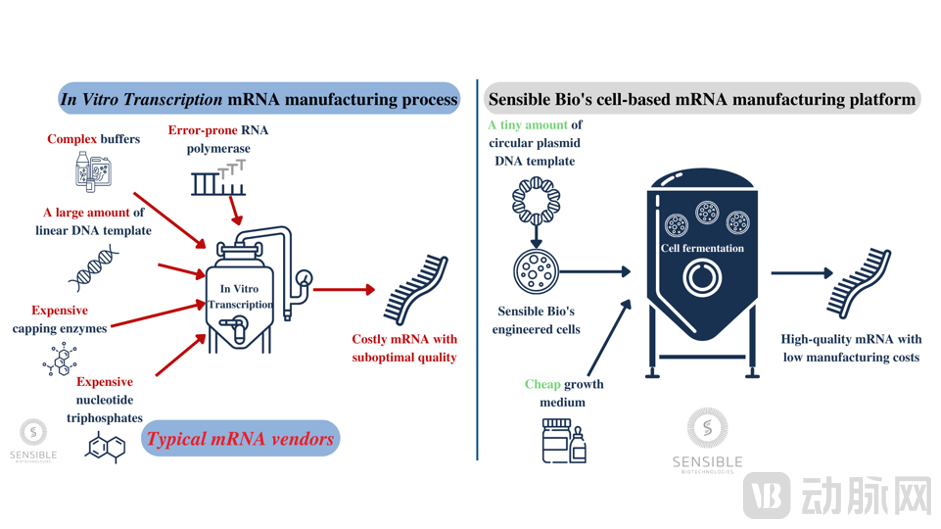
Schematic diagram of Sensible’s mRNA manufacturing platform (right)
As a company founded just two years ago, Sensible needed a partner to help it achieve its “ambitious goals” for innovating mRNA production. It promptly connected with Ginkgo Bioworks, a leader in the field of synthetic biology that is continuously expanding its business scope through acquisitions, mergers, and strategic partnerships, with RNA being one of its key focus areas. Previously, Ginkgo had completed the acquisition of Circularis, a biotech company possessing proprietary circular RNA and promoter screening platforms, whose main business is improving the efficacy and production yield of circular RNA.
On April 3, Sensible announced a collaboration with Ginkgo to develop an in vivo mRNA manufacturing platform. The goal is to produce higher-quality mRNA than that obtained through in vitro transcription (IVT), scale up mRNA production to over 100,000 liters, thereby enabling the production of longer mRNA molecules and expanding the potential of mRNA platforms for novel therapeutic approaches.
YC Bridge: Showcasing the “Luckiest” Biotechs?
Sensible Biotechnologies is a quintessential Y Combinator incubation case. As one of the projects in the YC S21 batch, its founders’ backgrounds and style embody the consistent “YC hallmark”: youth, ambition, and vitality.
Miroslav Gasparek is the Co-founder and CEO of Sensible. He studied bioengineering at Imperial College London, where he conducted research in systems and synthetic biology during his undergraduate studies at Imperial College London, the California Institute of Technology, and Stanford University. He is currently in the final stages of pursuing a DPhil in Engineering and Synthetic Biology at the University of Oxford.
His co-founder and the company’s Chief Scientific Officer (CSO) earned a Ph.D. in Molecular Biology from the University of Oxford, with a primary research focus on genetic engineering and cancer, and possesses over nine years of full-time wet-lab experience in cellular engineering.
From a background perspective, neither founder is particularly senior. However, based on the profile presented by Miroslav Gasparek, he appears to be an entrepreneur who is adept at showcasing his strengths to secure resources and excels at networking. In his self-introduction, he states that he has collaborated with TechBio venture capital investors in the United States and Europe, and provided consulting services in life sciences R&D and business development to public institutions and private enterprises in Central and Eastern Europe. He also serves as Co-Managing Director of Nucleate UK, the world’s largest non-profit organization supporting student-led life science ventures.
In fact, the collaboration between Sensible and Ginkgo also originated from an “informal” beginning. Initially, Austin Che, founder of Ginkgo, provided some guidance and advice to Sensible through the Y Combinator (YC) mentorship program. Later, Cindy Chang, a business development lead at Ginkgo, was introduced to Sensible. As both companies shared an interest in cell-based mRNA production, they ultimately reached the partnership agreement seen today.
“By partnering with Ginkgo, Sensible can leverage our platform capabilities; by adjusting various aspects of the manufacturing process, we will help Sensible optimize its mRNA production,” said Cindy Chang.
Since 2013, Y Combinator (YC) has expanded beyond its traditional focus on technology, providing specialized commercialization training to a growing number of biotech startups. Its mentors, alumni network, and culture of “mutual assistance” have collectively formed a powerful force within the entrepreneurial ecosystem. Ginkgo Bioworks, which is now supporting Sensible, was once a YC participant itself. As part of YC’s Summer 2014 batch, Ginkgo’s founders were all scientists with relatively limited business experience. It was at YC that they received their initial commercialization training and secured external financing, using YC’s SAFE (Simple Agreement for Future Equity) instrument for the raise.
In today’s landscape, biotech companies with strong technical capabilities remain highly sought after by investors. However, they must learn how to share and compete for information, market, and networking resources with rivals and large corporations, striving to maximize their success rates. While self-promotion may not come naturally to every CEO, it is nonetheless an essential skill for all.