Global Pharma Giants Reshape the Immunology Landscape in the Post-Humira Era
Sanofi
Pharmaceutical Manufacturer
Johnson & Johnson
Medical Device R&D and Manufacturer

AstraZeneca
Pharmaceutical Technology Research and Development Provider
In the field of immunology, with its alluring market potential worth hundreds of billions, it has always been a "must-contend-for territory" among global pharmaceutical giants.
However, this fertile ground that gave birth to the "global blockbuster drug" has always concealed a hidden rule: if you don't advance, you retreat.Intense Competition: AbbVie has consistently ranked at the top, Sanofi achieved a comeback with its blockbuster drug, Johnson & Johnson's growth slowed due to the patent cliff, Novartis steadily advanced through precise strategies, and giants like Roche, Eli Lilly, and AstraZeneca are also accelerating to catch up…
The rules of the game in the field of immunity are undergoing tremendous changes, and battles to reshape the industry landscape have already arrived.

Industry Landscape Changes
In the global pharmaceutical market, the immunology sector has become a core engine for MNC giants to achieve growth, thanks to its hundred-billion-dollar market scale and continuously increasing demand. However, the fierce competition among numerous players also makes the immunology track fraught with hidden crises at every turn.
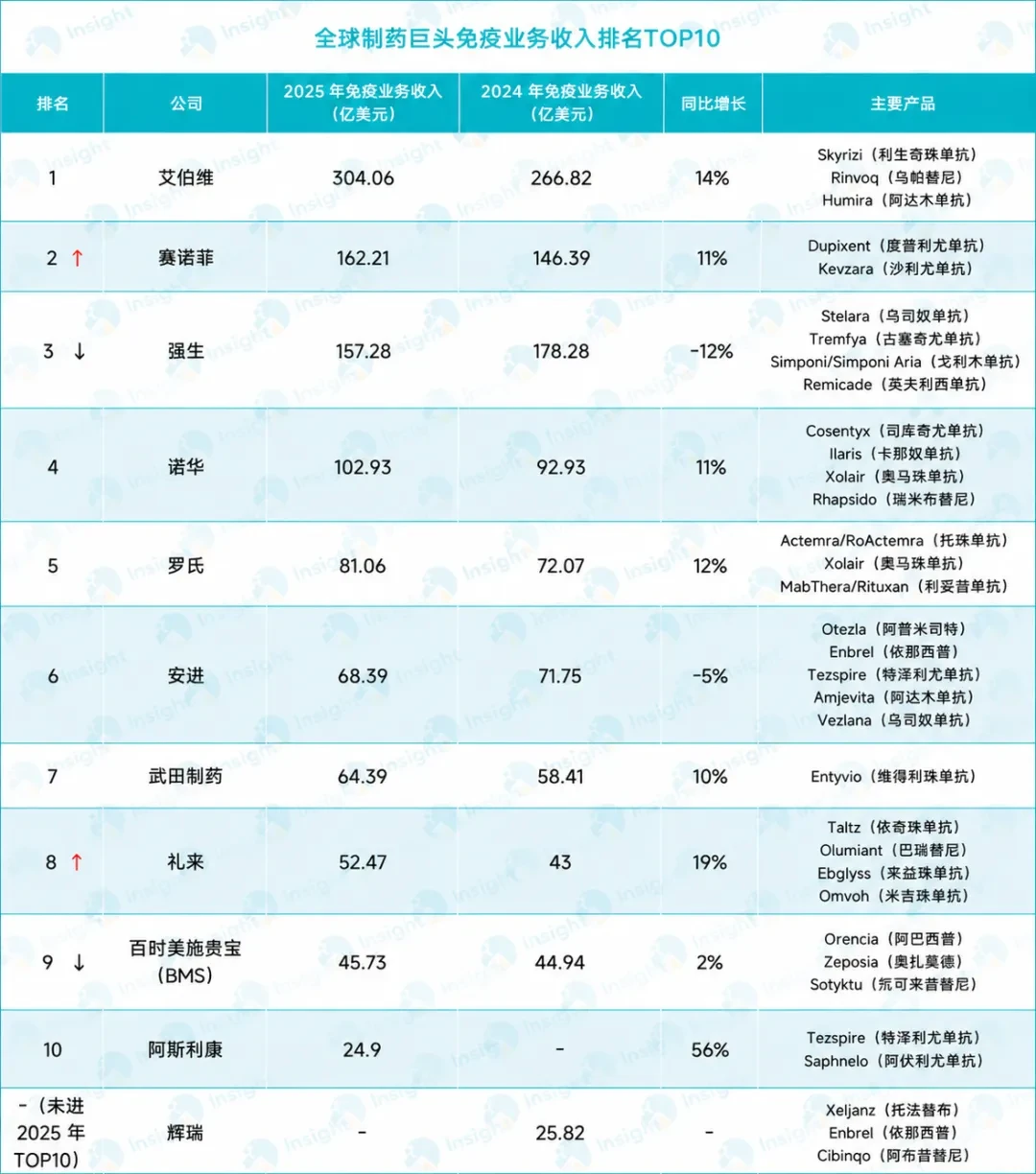
In recent years,Ranking of MNC Giants' Immunization Business Revenue Frequently ChangesThis is the best example.
In 2025, AbbVie successfully followed up on Humira with two new flagship products, driven by immunology business revenue.$30.46 billionOnce again clinching the top spot; Sanofi, holding the "new generation king of autoimmune drugs," rose to second place with revenue of $16.221 billion; in contrast, Johnson & Johnson, affected by the patent expiration of ustekinumab, saw its immunology business revenue decline by 12% year-over-year to $15.728 billion, dropping to third place.
Novartis, Roche, Amgen, and Takeda remain in the fourth to seventh positions. Notably, Novartis has achieved outstanding performance with its immunology business revenue surpassing the 10 billion USD mark; if Roche can maintain a growth rate of 12% over the next two years, it will also join the "10 Billion USD Club."
Moreover, Eli Lilly surpassed Bristol-Myers Squibb with double-digit growth.(BMS), rising from ninth to eighth place; AstraZeneca has shown the potential of a dark horse. With the rapid increase in sales of Tezspire and Saphnelo, it has replaced Pfizer with strong explosive power, entering the TOP10 list.
Source: Compiled from public information
This dramatic upheaval in rankings is, in essence, a microcosm of the harsh survival rules within the immunology field.In the first quarter of 2026, the battle continues, with multiple giants already drawing their swords.
AbbVie's immunology product revenue reachedUSD 7.29 billion, among which the sales of Risankizumab and Upadacitinib were $4.483 billion, respectively.(+30.9%)And 21.19 billion US dollars(23.3%), accounting for over 90%.
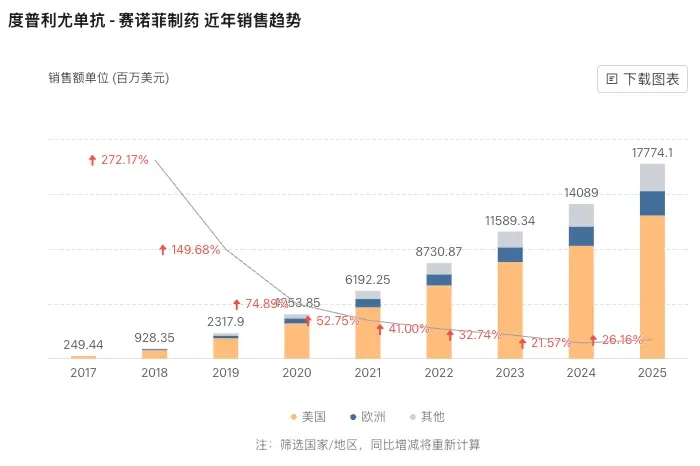
Sanofi's immunology business remains the largest source of revenue, achieving sales of4.294 billion euros(Approximately USD 5.019 billion), contributing 40% of the company's revenue, including Dupixent(Dupilumab)Sales increased by 30.8% year-on-year to 4.17 billion euros(Approximately USD 4.874 billion)。
Novartis' immunology segment generated $2.466 billion in revenue, with the core product secukinumab experiencing its first quarterly sales decline.($1.566 billion, -2%), still a distance away from the peak sales target of 8 billion US dollars.
Immunology is Roche's fourth-largest business segment, achieving revenue growth of 8% year-over-year to reach 1.5 billion Swiss francs.(Approximately 1.9 billion USD), wherein Xolair(Omalizumab)Increased by 26% year-on-year.
Affected by the expiration of its core product patents, Johnson & Johnson's immunology business continues to face pressure, with revenue declining to $3.38 billion, but Tremfya...(Guselkumab)Maintaining strong growth, singleQuarterly sales increased by 68.3% year-over-year to $1.608 billion, with projected peak annual sales breaking through 10 billion US dollars, it is expected to take over from ustekinumab and become Johnson & Johnson's new pillar.
The competition among the giants sends a clear signal: as the legend of Humira gradually comes to an end, a new generation of immunology drugs is reshaping the landscape, and the field of immunology has entered a multipolar contest phase in the "post-Humira era."

The Four Giants Launch Offensive and Defensive Battle
Behind the ranking changes lie the performance competition of core products, the covert博弈of pipeline research, and the strategic restructuring of giants in the immunology field. Take the four major immunology giants as an example.
AbbVie's ability to become a long-term leader in the immunology field and build an insurmountable moat by breaking through the $30 billion mark in immunology business revenue lies at its core inThe product relay strategy of "de-Humira-ization" has been extremely successful.: The explosive growth of Risankizumab and Upadacitinib, the two new flagship products, has filled the patent cliff of Humira, demonstrating extremely strong product iteration capabilities.
Sanofi's Comeback, IsThe Victory of the Single-Product Maximization Strategy: Relying on Dupilumab's coverage of a wide range of indications such as atopic dermatitis and asthma, it not only validates the industry landscape reshaping capability of a blockbuster drug but also propels Sanofi to the second position in the industry.
Source: Insight Database by DXY
Novartis, with itsPrecise Positioning of Differentiated Targets, has opened the door to the "10 billion US dollar club", immune product portfolio Cosentyx(The world's first IL-17A inhibitor)、IgE Monoclonal Antibody Omalizumab(The first targeted biologic in the field of asthma treatment)And Canakinumab(The world's first IL-1β inhibitor), continuously contributing to revenue.
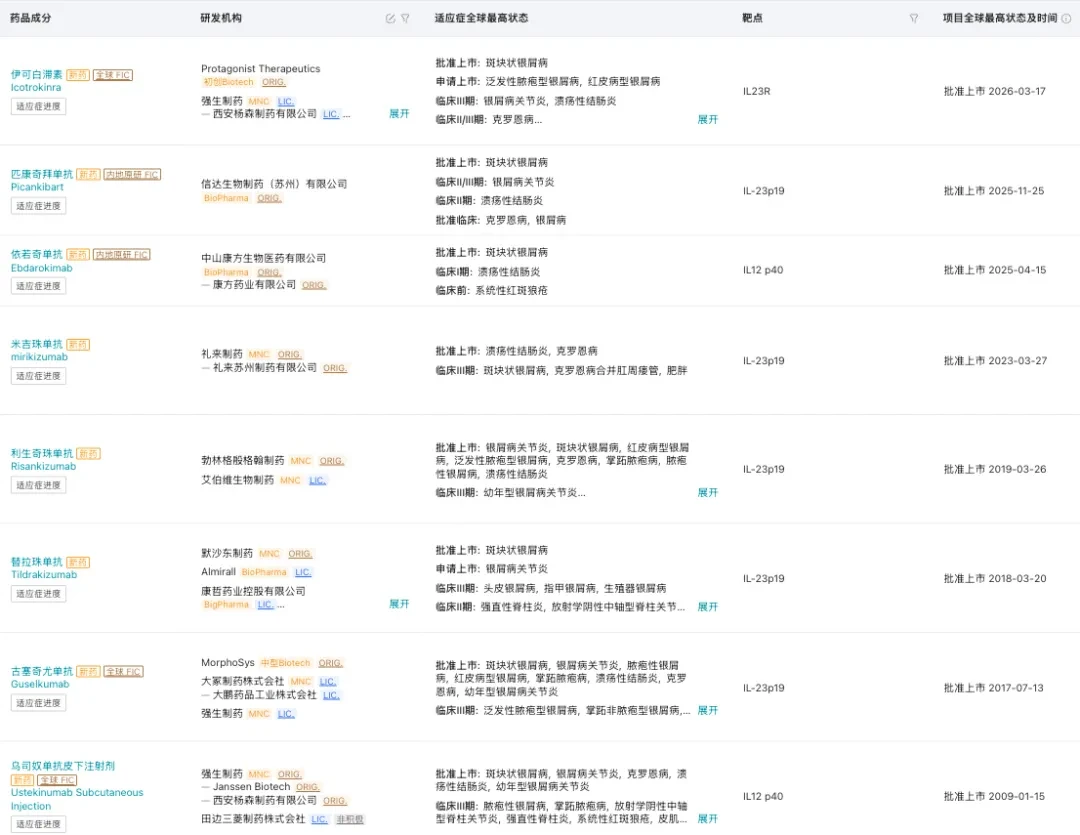
Johnson & Johnson, Despite Being on the Patent Cliff, Shows Resilience:Guselkumab has shown astonishing potential, which is due to the market share growth across all indications and inflammatory bowel disease(IBD)The strong momentum of the product's market launch is now aiming for a sales peak of 10 billion US dollars. Another powerful successor is the myasthenia gravis drug, Nicalizumab.(FcRn Blocker)Psoriasis Drug Icotrokinra(Global First-in-Class Oral IL-23R Antagonist), with peak annual sales expected to exceed $5 billion, serving as a pillar for future performance growth.
Globally Marketed New Drugs Targeting IL23R
Source: Dingxiangyuan Insight Database
In addition to the core single products already on the market, potential blockbuster pipelines are also key to determining the direction of the competitive landscape.
AbbVie Lutikizumab(IL-1β/IL-1α bispecific antibody)Phase III clinical trials are underway, with the hope of benefiting patients with moderate to severe refractory hidradenitis suppurativa.(HS)Treatment Brings New Breakthroughs. FG-M701, the next-generation inflammatory bowel disease therapy introduced by Mingji Biologics, targets a vast patient population and is also expected to become a blockbuster drug.
Sanofi Pipeline Abundant, Amlitelimab(OX40L Monoclonal Antibody)、SAR441566(Oral TNFR1 Inhibitor)、Frexalimab(CD40L Monoclonal Antibody), with peak sales potential expected to exceed 5 billion euros each; Lunsekimig(TSLP/IL-13 Dual Blocker)Sales peak is expected to reach 20-50 billion US dollars.
Novartis adheres to a differentiated strategy and has laid outBTK Inhibitor Remibrutinib and BAFF-R Monoclonal Antibody IanalumabCurrently, Remibrutinib has been approved for the treatment of chronic spontaneous urticaria and is under development for indications such as multiple sclerosis, with peak annual sales expected to exceed $3 billion; ianalumab has been submitted for use in Sjögren's syndrome.(SS)The listing application, Morgan Stanley predicted its peak sales in the SS field to be $2.2 billion, and if the treatment potential for other immune diseases is included, the peak sales are expected to reach $5 billion.

The Surging Waves
The immune track, a billion-dollar fertile ground, has never lacked challengers. Other MNC giants have already secured positions in multiple细分 tracks with differentiated strategies to break through strongly.
For example, Roche, Takeda, Eli Lilly, and AstraZeneca all achieved double-digit growth in their immunology business revenue by 2025. Among them,Roche Poised to Join the "Billion-Dollar Club", but currently faces challenges and is seeking new growth areas, including the expansion of the older blood cancer product Obinutuzumab (Gazyva) into the field of immune-mediated diseases, covering lupus nephritis.(Approved)、Systemic Lupus Erythematosus(Submitted NDA), and is currently conducting multiple Phase III clinical trials for primary membranous nephropathy.
In addition, Roche has laid out the TL1A monoclonal antibody RG6631 for the treatment of IBD.(Phase III)Antisense Therapy Sefaxersen for the Treatment of IgA Nephropathy(Phase III)、BTK Inhibitor Fenebrutinib for the Treatment of Multiple Sclerosis(Phase III Study Success)Among them, RG6631, which Roche acquired for 7 billion US dollars, shoulders the important task of driving future growth in the immunology business. Its ongoing indications also include rheumatoid arthritis.(Phase II)etc.
Takeda's immunology business revenue is not far behind Amgen's and is expected to surpass it in the future. This stems from Takeda's strategic layout.A New Generation of Highly Selective Oral TYK2 Inhibitor Zasocitinib, covering moderate to severe plaque psoriasis(Coming NDA)、IBD and other major indications, with an expected annual sales peak reaching $3 billion to $6 billion.
Lilly is accelerating its catch-up efforts, besidesIxekizumab, BaricitinibThe continuous revenue contribution from the product portfolio has led to a growing focus on the immunology sector in recent years. Particularly in the IBD field: Eli Lilly'sMijizumabAlready contributing to revenue, it has also laid out many oral therapies, including the oral small molecule α4β7 integrin inhibitor MORF-057.(LY4268989), FXR agonist FXR314, NLRP3 inhibitor(VTX3232 and VTX2735)S1P1R modulator Tamuzimod, TYK2 inhibitor VTX958, etc.
Currently, Tamuzimod has completed a Phase II study for ulcerative colitis; VTX958 has obtained Phase II study data in populations with Crohn's disease, plaque psoriasis, and psoriatic arthritis.
AstraZeneca, which has broken into the TOP10 list, has shown explosive growth, with its immunology business revenue mainly driven by Tezspire.(Tezelimab)And Saphnelo(Avuliyu Monoclonal Antibody)Contribution. Among them, Tezspire is the world's only approved TSLP monoclonal antibody, which has been approved for the treatment of asthma and chronic rhinosinusitis with nasal polyps.(CRSwNP)Leerink predicts that Tezspire's sales will reach $4.3 billion by 2030.

Conclusion
The layout of MNC giants and Chinese pharmaceutical companies in the immunology field shows both consensus and significant divergence.
The similarity lies in the focus on popular targets such as the IL family, JAK family, and BTK. The difference is that pharmaceutical companies in China tend to crowd into fast-follow strategies for mature targets, leading to serious homogenization, while MNC giants have already achievedIteration and Upgrade of Mature TargetsJohnson & Johnson's oral IL-23R cyclopeptide icotrokinra is leading a new direction in psoriasis treatment, while Sanofi, Novartis, and Roche's autoimmune BTK inhibitors have already taken the lead in capturing market opportunities.
Moreover, both MNC giants and Chinese pharmaceutical companies are following the path of transitioning from oncology to autoimmune diseases, competing to develop targets such as CD38, BCMA, and CD40/CD40L, but in the exploration of new mechanisms for autoimmune diseases...(Kv1.3, LANCL2, Nck Modulators), mainly led by foreign pharmaceutical companies.
Notably, no single major innovative drug for autoimmune diseases has emerged from Chinese production, and the throne of "China's Autoimmune Leader" remains unclaimed. Clearly, the development of China's pharmaceutical companies in the immunology field still has a long way to go.
Recommended Reading:Who is China's Top Player in Autoimmunity?
Cover Source:ZCOOL Hello
Disclaimer:This article is for information sharing only and does not represent the position or viewpoint of Insight. It does not recommend or introduce any treatment plans. If needed, please consult and contact正规医疗机构.
Editor: Crescent
PR Article Coordination: WeChat insightxb