

Exclusive Interview with Academician Zixin Deng: Where to Find Development Opportunities for Synthetic Biology in China?
From May 5 to 7, 2023, VB100, VCBeat, and Eggshell Research Institute served as the organizers, with Shanghai Zhangjiang Group as the strategic cooperation partner, to jointly host the 7th Future Healthcare Top 100 Conference.
Academician of the Chinese Academy of Sciences, Deng Zixin, has confirmed his attendance at the 7th Future Healthcare Top 100 Conference and will deliver a keynote speech titled “Leveraging Synthetic Biology to Drive Disruptive Innovation in General Health Technology,” jointly exploring the innovative research intersections between synthetic biology and healthcare.
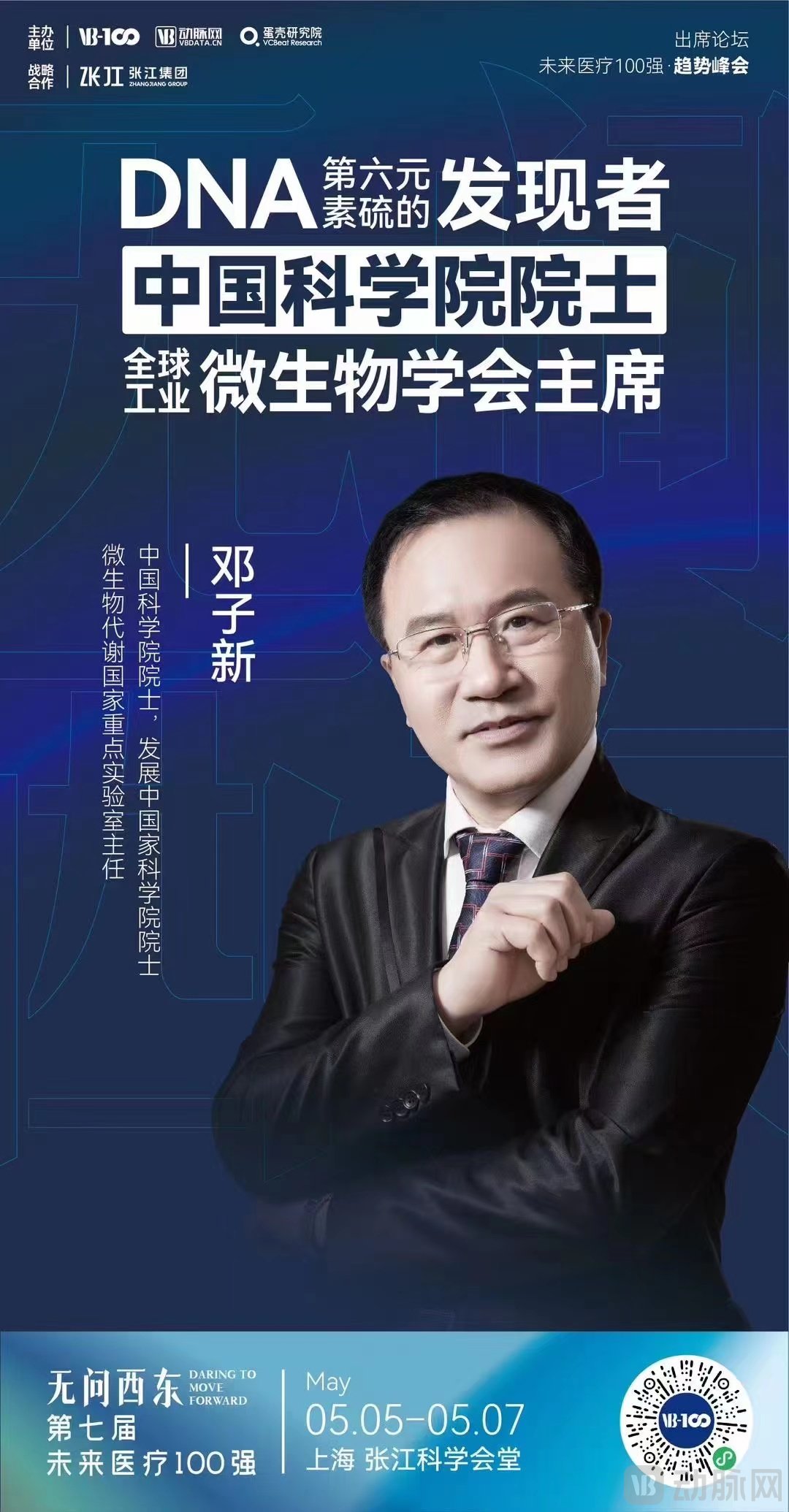
Profile:
Deng Zixin, Member of the Chinese Academy of Sciences (CAS), Fellow of The World Academy of Sciences (TWAS), Fellow of the American Academy of Microbiology (AAM), and Fellow of the Royal Society of Chemistry (FRSC). He currently serves as Director of the State Key Laboratory of Microbial Metabolism, Honorary President of the Chinese Society for Microbiology, Vice President of the Chinese Society of Agricultural Biotechnology, and President of the Global Industrial Microbiology Society (GIM).
To gain a deeper understanding of the current development of synthetic biology in China, as well as the underlying industry pain points and innovation opportunities, VCBeat was honored to conduct an exclusive interview with Academician Deng Zixin. The interview content is recorded as follows:
VCBeat: What phased achievements have been made in the rapid development of synthetic biology technology in China in recent years?
Academician Deng Zixin:Guided by national macro-strategies, research and industrial development in synthetic biology have advanced rapidly in recent years. After the 12th Five-Year Plan period, the state proposed support for biomanufacturing technologies, and during the 13th Five-Year Plan period, synthetic biology was listed as one of the disruptive technologies leading industrial transformation. Subsequently, the government introduced a series of policies to support the development of synthetic biology, with the 14th Five-Year Plan further emphasizing the application of synthetic biology technologies. With strong policy support, the synthetic biology industry is ushering in significant opportunities for development.
With strong support from national and local governments, China has established Shanghai, Shenzhen, and Tianjin as three major hubs for synthetic biology research and industry.
Shanghai can be regarded as the birthplace of synthetic biology in China. In recent years, it has achieved remarkable accomplishments in research areas such as yeast single-chromosome construction, microbial drug innovation, DNA sulfur modification and its application development in biomedical diagnosis and therapy, supermolecular catalytic machines, synthetic gene circuits and precision therapy, intelligent cell-based drug manufacturing factories, optogenetics and disease treatment, as well as new tools for gene editing and gene therapy. Overall, Shanghai has entered the fast lane of international competition in synthetic biology.
Shenzhen’s most prominent achievement is the establishment of the “Major Scientific and Technological Infrastructure for Synthetic Biology Research.” In the field of medical synthetic biology, particularly in technologies such as gene synthesis, its rapid development has begun to keep pace with international frontiers. Tianjin, by contrast, stands out uniquely and takes the lead in the synthetic biological manufacturing of bulk commodities, such as from CO2The synthesis of starch, among other achievements, represents a remarkable accomplishment from China.
Across China, many outstanding teams from fields such as agriculture and environmental science have also achieved significant results in synthetic biology technologies. Wuhan’s “Major Breakthrough in Innovative Vitamin E Synthesis Process” has disrupted the long-standing foreign monopoly on chemical total synthesis of vitamin E, establishing China’s independent production capability from scratch. This achievement was recognized as one of the Top Ten Scientific and Technological Events in Hubei Province in 2018 and received the First Prize for Scientific and Technological Progress in Hubei Province in 2019. It offers substantial cost advantages and a more environmentally friendly and green production process, reducing carbon emissions by over 60%. For several consecutive years, it has generated approximately RMB 2 billion in additional output value for Hubei Province.
However, there remains a gap between China and the international advanced level in foundational technologies and source innovations, such as the development of functional elements, the design of pathways and metabolic regulatory networks, and the creation of high-performance chassis cells. CRISPR technology and related gene-editing techniques are areas where we need to intensify our efforts; only by strengthening the accumulation of these original innovative technologies can we avoid potential “chokehold” issues in the future.
VCBeat: In terms of talent reserves, capital enthusiasm, and policy support, how do you think we can empower this field?
Academician Deng Zixin:"Collaboration among government, industry, academia, research, application, and finance is urgently needed in the industry at present."Many startups face significant challenges in their early stages; talent is the top priority, and capital injection is essential.For instance, in fields such as gene therapy and cell therapy, one should not solely emphasize or demand short-term economic returns; instead, attention should also be paid to the substantial economic and social benefits that may emerge over a relatively long-term development horizon.In terms of policy, Shenzhen and Tianjin began prioritizing this area early on, and have already achieved remarkable results across various fronts. In recent years, Shanghai has initiated coordinated efforts among the government, society, universities, and research institutes to advance its technology action plan. Looking ahead, it aims to establish an international hub for synthetic biology in China, spanning from basic research to industrial commercialization.
VCBeat: What challenges might arise in translating synthetic biology research achievements from the laboratory to industrial-scale production?
Academician Deng Zixin:Yes, synthetic biology has made it easier for us to achieve the artificial synthesis and green manufacturing of small-molecule compounds, such as pharmaceuticals and health products, in the laboratory compared to earlier times. However, achieving large-scale production and commercialization typically requires overcoming numerous significant “hurdles.”
“Goal-oriented design” is highly idealized and faces significant challenges. Currently, there is still a lack of efficient and rapid guidance for “predictive design”; suitable genetic parts are difficult to identify, and even when identified, they are not easily subjected to “tailor-made” modifications, among other issues.From small-scale trials to pilot studies, and then to large-scale production, each step involves renewed exploration and optimization. Therefore, "scalability" must be considered at the initial stage of experimental design. For instance, does the compound exhibit toxicity toward the host cell? What modifications to the host cell should be considered? Is the target product conducive to downstream extraction? Consequently, each scale-up phase presents specific scientific and technical challenges that require iterative "trial and error."
The development of a universal synthetic expression system is crucial, as it eliminates the need for repetitive and inefficient “trial-and-error” approaches to match different synthetic gene pathways with various chassis cells. By purposefully engineering chassis cells to optimize production cycles and enhance economic and environmental sustainability, manufacturing processes can be made simpler and more efficient, thereby addressing many critical challenges encountered during scale-up from laboratory to ton-scale production.
VCBeat: In your view, which emerging technologies are poised to help synthetic biology overcome its development bottlenecks?
Academician Deng Zixin:The integration of artificial intelligence and intelligent technologies with synthetic biology is poised to help overcome current bottlenecks, provide more efficient solutions for the research industry, and create richer opportunities.
In the field of artificial intelligence (AI), demand for related technologies is gradually increasing. Currently, AI technologies are widely applied in component engineering, metabolic engineering, and genetic engineering, demonstrating their role in “cost reduction and efficiency enhancement” across various stages of synthetic biology, thereby expanding the possibilities for research and development. Taking DeepMind’s AlphaFold2 as an example, this platform has predicted the structures of over 200 million proteins, covering one million species. This advancement offers the scientific community the prospect of designing enzymes that do not exist in nature, possess higher catalytic efficiency, and exhibit novel catalytic functions, thus enabling the development of more efficient metabolic pathways. However, in China, the application of this technology remains temporarily limited to Escherichia coli and a few other microorganisms. Significant limitations and challenges persist in areas such as data, algorithms, and evaluation metrics. Therefore, AI technology represents a promising breakthrough area for the future.
Furthermore, the application of intelligent technologies in metabolic engineering within synthetic biology is becoming increasingly prevalent. Currently, we are unable to directly design highly complex metabolic synthesis pathways; constructing even a relatively simple metabolic pathway requires at least ten individual DNA modules. This implies that obtaining the desired products necessitates the rational assembly of different modules. In this context, manual construction is time-consuming, labor-intensive, and impractical, whereas intelligent technologies can provide efficient and standardized solutions for engineering design. Leading intelligent manufacturing enterprises abroad have already developed corresponding intelligent solutions for synthetic biology. In China, companies such as BGI and Hansun Di have independently researched, developed, and launched high-complexity intelligent solutions, thereby breaking the monopoly held by foreign brands.
Synthetic biology is not merely an applied discipline; by leveraging the interdisciplinary integration of various fields, it can conversely drive basic research toward deeper, faster, and healthier comprehensive and convergent development, with artificial intelligence and intelligent technologies serving as prime examples.
VCBeat: In the field of life and health, in which application scenarios can synthetic biology create its own “highlight moments”?
Academician Deng Zixin:In 2021, the global synthetic biology market size reached $73.693 billion, representing a 767.5% increase from $8.496 billion in 2020, as the development of synthetic biology entered a fast lane. By segment, the life and health market size reached $68.724 billion, accounting for over 93%. According to McKinsey’s forecasts, between 2030 and 2040, synthetic biology is expected to have an annual potential impact of $0.5–1.2 trillion in the life and health sector, ultimately addressing 45% of the global disease burden. Based on China’s total disease burden of RMB 600 billion last year, this translates to a potential market opportunity of RMB 270 billion.
Cell therapy, RNA-based drugs, gene editing, in vitro diagnostics, medical consumables, and pharmaceutical ingredient production—synthetic biology has extensive applications in the life sciences field.
For instance, synthetic biology is expected to achieve several “highlight moments” in the field of life and health in the future, such as designing novel intracellular metabolic pathways to enable inexpensive “sugars” to serve as raw materials for drug synthesis by biological cells, engineering therapeutic gene circuits tailored to different diseases or pathogenic mechanisms, and achieving disease treatment by correcting dysfunctional metabolic circuits with the assistance of vectors.
VCBeat: As a leading figure in China’s synthetic biology sector, what message would you like to convey to innovative companies within the industry?
Academician Deng Zixin:Although synthetic biology has developed rapidly, it has not yet reached the stage of “doing whatever one pleases.” If the period before 2021 was the industry’s “infancy,” it is now in its “toddlerhood,” with companies across the upstream, midstream, and downstream segments still facing numerous challenges.
Upstream industries primarily focus on breakthroughs in foundational and intelligent technologies, laying the groundwork for the large-scale production of the synthetic biology industry. In the midstream sector, companies concentrate on product development, scale-up manufacturing, and the establishment of technical platforms, which have already achieved a certain scale. For enterprises operating in the upstream and midstream segments, maintaining technological leadership is key to their development. For downstream enterprises that connect with end customers, identifying market demand serves as the foundation for growth, while establishing the ability to anticipate market needs is even more critical.
On the one hand, enterprises across the upstream, midstream, and downstream segments need to identify their own capabilities, but more importantly, they must participate in the overall synergy of the market.Synthetic biology is interconnected, convergent, and integrated. While leveraging its own advantages, it must also focus on industry development, as only through the holistic and coordinated growth of the entire industry can more opportunities and possibilities be created.
Whether it is a “purpose”-oriented engineering design approach or product development aimed at “application,” the emphasis is on “integration” between upstream and downstream sectors.In this era of information explosion, R&D that neglects process scale-up and deviates from market demands will never achieve value conversion; often, advancing just half a step forward can yield transformative results.