

Zephyrm Biotechnologies Secures Over RMB 200 Million in Series B Funding to Advance Clinical Development and Industrialization of iPSC- and hESC-Derived Therapies

Zephyrm
Stem Cell Drug Developer and Manufacturer
VCBeat recently learned that,Suzhou Zephyrm Biotechnologies Co., Ltd. (“Zephyrm Biotechnologies”) has completed a Series B financing round exceeding RMB 200 million. The round was led by CCB (Beijing) Investment Fund, the equity investment platform of CCB Trust Co., Ltd., with continued participation from several existing shareholders. The proceeds will be primarily used to support Phase I–II registrational clinical studies of pluripotent stem cell therapies across multiple indications, including pulmonary diseases, degenerative joint diseases, central nervous system disorders, and congenital/degenerative retinal diseases, as well as to expand its technology platform and build an industrial-scale cell manufacturing facility.
Zephyrm has licensed and introduced “clinical-grade” human embryonic stem cells (hESCs) from the National Stem Cell Resource Bank, affiliated with the Chinese Academy of Sciences, as seed cells. The origin of these cells has undergone rigorous traceability and compliance reviews, addressing potential regulatory and ethical concerns associated with the clinical application of hESCs. Building on this foundation, Zephyrm has established a standardized, off-the-shelf cell therapy industrialization platform capable of low-cost mass production. The company has currently advanced indications including respiratory and osteoarticular diseases into registrational clinical trials (Phase II), and has initiated exploratory clinical studies in multiple areas such as central nervous system disorders and fundus diseases. Furthermore, the company has recently embarked on several external collaborations to explore potential combination therapies/products involving stem cells, aiming to fully leverage the body’s immune functions to address specific disease needs.
Leveraging the Chinese Academy of Sciences’ early exploratory achievements in stem cell therapeutics and its team’s expertise in innovative drug R&D and industrialization, Zephyrm has, within just four years since its inception, advanced multiple indications into Phase II registrational clinical trials and achieved industrial-scale production of its stem cell products, rapidly ascending to the first tier of stem cell drug developers in China and globally. Over 70% of the founding team hold master’s or doctoral degrees, hailing from prestigious institutions such as the University of Science and Technology of China, Stanford University, Johns Hopkins University, Peking Union Medical College, and Xuanwu Hospital. The team brings extensive senior executive experience from multinational pharmaceutical companies including Sanofi, Bayer, Allergan, and Vertex, covering the entire development lifecycle from pharmaceutical R&D, preclinical evaluation, and clinical pathway planning to regulatory submission, approval, and commercial launch.
Stem cell-based therapeutics are a unique class of innovative live-cell drugs that possess potent immunomodulatory properties, promote tissue repair, and enable the replacement of damaged cells through specific differentiation. These capabilities allow them to demonstrate significant potential across various major disease areas, offering therapeutic solutions for conditions that remain intractable to conventional pharmaceuticals or treatments. According to a report by the renowned international consulting firm Technavio, the global market share for cell therapy reached USD 21.061 billion in 2022 and is projected to accelerate at a compound annual growth rate (CAGR) of 56.79%. In China, stem cell therapy represents the most prominent segment of the cell treatment market. Data from Market Research Online indicates that the market size for stem cell therapy in China had already reached RMB 50 billion by 2020. With the increasing number of clinical applications of stem cells and the emergence of novel therapies, the prospects for China’s stem cell therapy market are expected to become even more expansive.
The manufacturing processes, quality control, and clinical administration of stem cell-based therapeutics differ significantly from those of conventional drugs, necessitating the development of a comprehensive set of standards that comply with regulatory requirements for novel biologics registration while also meeting the practical needs of clinical practice. Zephyrm has implemented a serum-free culture system throughout its entire cell product manufacturing process. By using chemically defined serum replacements during the directed differentiation of functional cells, it maximizes the mitigation of safety risks associated with animal serum, thereby overcoming technical bottlenecks in drug development. The cell therapies developed by Zephyrm consistently adhere to an off-the-shelf strategy. In hospital settings, cells are thawed and revived using customized cell revival devices, then formulated into injectable solutions for immediate clinical administration, offering significant convenience for clinical use.
Dr. Jia Yi, Chief Medical Officer of ZephyrmThe company stated that this round of financing will not only directly advance the indication pipeline for functional cell products, which have already entered the registration-focused clinical development phase, from the current exploratory clinical trial stage to the subsequent confirmatory clinical research stage, but will also propel the R&D of new functional cell products into subsequent registration-enabling clinical trials. Therefore, the successful completion of this financing round ensures that Zephyrm’s R&D pipeline continues to advance as planned, laying the foundation for the successful establishment of a competitive pluripotent stem cell product platform.
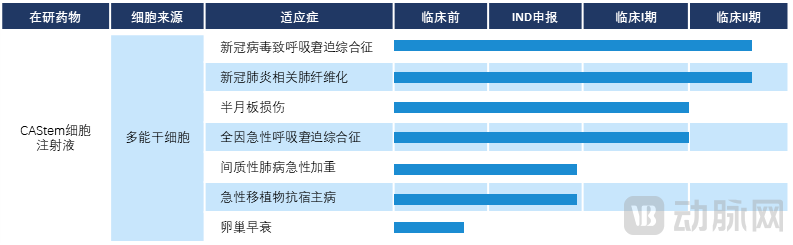
Zephyrm's Drug Pipeline
Wang Bangyuan, Head of the Healthcare Team at CCB (Beijing) Investment Fund, the Equity Investment Platform of CCB TrustOverview: Over the past decade, stem cell therapy in China has evolved from a state of ambiguity and disorder toward standardization, industrialization, and concretization. During this process, stem cell therapy has undergone a significant transformation from a medical technical service to a pharmaceutical product. To date, China’s basic research in stem cells has taken a global lead, ranking among the few sub-sectors in the biomedical industry that are in the world’s first tier in terms of both research quantity and quality. Against the backdrop of an aging population and the resulting shifts in disease patterns in China, stem cells, as a critical pillar of regenerative medicine, are poised to play an increasingly important role in the foreseeable future. Leveraging the Chinese Academy of Sciences’ long-standing frontier exploration and scientific achievements in regenerative medicine, Zephyrm has assembled a robust industrialization team, taking the crucial step of translating “laboratory-grade achievements” into “industrial-grade products.” As a participant in establishing the world’s first international standards for stem cells and as a leading entity in formulating multiple domestic stem cell standards, Zephyrm has advanced its human embryonic stem cell products to the clinical stage under stringent drug-development standards. It has become the only pluripotent stem cell R&D enterprise in China to obtain regulatory approvals for multiple Phase II clinical trials, with clinical explorations underway in areas such as pulmonary diseases, degenerative joint diseases, and optic/cranial nerve disorders. The company has already established an industrial-scale cell production base compliant with drug registration standards and demonstrated impressive cost-control capabilities. Breakthroughs in the application of stem cells for various diseases are expected in the near future, making it a sector worth watching.
About Zephyrm
Zephyrm, established in 2018, is a biopharmaceutical company dedicated to the research, development, and manufacturing of stem cell-based therapeutics. It was recognized as a National High-Tech Enterprise in 2021, and its Beijing subsidiary was designated as a Beijing “Specialized, Refined, Differential, and Innovative” SME in January 2022. The company operates GMP-compliant stem cell drug production facilities of international caliber, equipped with comprehensive cell culture and testing infrastructure. Zephyrm has established a robust quality management system for stem cell therapeutics and has successfully conducted process development and quality studies for its stem cell products, fully meeting the current demand for safe, reliable, and high-quality stem cell drugs for patients in China.
On CCB Trust’s Equity Investment Platform: CCB (Beijing) Investment Fund
CCB Trust Co., Ltd. (hereinafter referred to as “CCB Trust”) is a comprehensive asset management institution under the China Construction Bank group. The total scale of assets under its fiduciary management amounts to RMB 1.7 trillion, ranking first in the trust industry. Anchored in the main arena of national economic development, the company has deeply cultivated five major business lines: primary and secondary market investments, service trusts, wealth management, and real estate alternative investments. As CCB Trust’s equity investment platform, CCB (Beijing) Investment Fund focuses on nine specialized sectors, including biopharmaceuticals, new energy, new materials, electronics, telecommunications, and high-end manufacturing. It has established in-depth collaborations with large central state-owned enterprises and industry leaders such as China State Railway Group, China South Industries Group, Sinochem, Minmetals, Kweichow Moutai, and China Aerospace Science and Industry Corporation. CCB (Beijing) Investment Fund, the private equity subsidiary of CCB Trust, was recognized among the “Top 20 Best State-Owned Capital Investment Institutions of 2022” by Zero2IPO Research and listed among the “Top 100 Private Equity Firms in China 2022” by Clever Consulting. To date, the cumulative scale of its actively managed private equity investment projects has exceeded RMB 20 billion, with nearly 200 projects currently outstanding. The fund has invested in more than 150 technology-driven innovative enterprises, of which nearly 40 have gone public and over 20 are in the process of listing.