

Pengli Bio, a 15-Year Veteran in Preclinical CRO with Revenue Nearing RMB 200 Million, Files for STAR Market IPO
Peng Li Biomedical Technology (Shanghai) Co., Ltd.'s IPO application on the STAR Market has been accepted.
Peng Li Biomedical is a comprehensive preclinical CRO, specializing in providing internationally compliant services in pharmacology and efficacy, pharmacokinetics, non-GLP toxicology, in vitro immunology, and Class III medical device evaluation.
The CRO sector has always followed a pattern where the strong grow stronger. With the booming development of the biopharmaceutical industry, the leading-player effect among top domestic CRO enterprises is becoming increasingly pronounced. To establish a solid foothold in the CRO industry, there are two primary pathways: one is to pursue comprehensive scale and scope by continuously expanding across the entire industry chain and into new geographic regions, leveraging technical expertise and capital accumulation; the other is to pioneer niche segments, building technological barriers through continuous innovation to achieve specialized, high-quality, and irreplaceable excellence.
Peng Li Biomedical’s development path falls into the latter category. Established in 2008, Peng Li Biomedical has consistently focused on preclinical efficacy evaluation as its core business over the past 15 years. Even with subsequent business expansion, the company has primarily centered its efforts on strengthening the upstream and downstream segments of this sector. Currently,Its business covers more than 40 disease areas, including immune diseases/inflammation, oncology, metabolic diseases, bone diseases, ophthalmic diseases, and cardiovascular diseases. It possesses a comprehensive platform of disease animal models spanning from rodents to primates, has developed over 1,500 proprietary disease animal models, and has established core competitiveness.
The scale of experimental animal models is comparable to that of WuXi AppTec.
“At that time, Peng Li Biomedical was able to secure 120 clients worldwide within three years, 90% of whom were overseas. But CRO companies today are different. Most of their business is now domestic,” Ji Xiaohui said at an event in 2022.Before founding KingMed Pharmaceuticals, Ji Xiaohui co-founded Peng Li Biomedical in 2008 and served as its CEO for four years.
At its inception, Peng Li Biomedical was not yet a comprehensive preclinical CRO; it initially focused solely on preclinical efficacy evaluation of innovative drugs.
One of the primary reasons for Phase III clinical trial failures in the global new drug development and translation process is the lack or insufficiency of efficacy of candidate drugs. Preclinical efficacy evaluation has become a decisive factor influencing the success rate of new drug clinical trials, thereby driving strong demand for preclinical CROs specializing in efficacy assessment.
Faced with a vast market space,Peng Li Biomedical’s business primarily involves preclinical pharmacodynamic evaluation and preclinical pharmacokinetic evaluation.: In preclinical pharmacodynamic evaluation, Peng Li Biomedical leverages its extensive portfolio of proprietary disease animal models and broad coverage of disease types to focus on in vivo animal studies. In preclinical pharmacokinetic evaluation, the company screens for drug candidates with clinical potential by assessing bioavailability, the body’s response to the drug, and drug-related risks.
A rich and comprehensive portfolio of disease animal models has established a competitive advantage for Peng Li Biomedical. The quantity and quality of proprietary models, the completeness of disease coverage, and the diversity of animal species encompassed are all key indicators of core competitiveness for preclinical CRO companies.After 15 years of continuous R&D and experimental accumulation, Peng Li Biomedical has independently established more than 1,500 disease animal models, covering over 40 disease areas including immune/inflammatory diseases, oncology, metabolic disorders, bone diseases, ophthalmic diseases, and cardiovascular diseases.
Among domestic preclinical CROs, this scale of experimental animal models has approached that of WuXi AppTec, laying a solid foundation for Peng Li’s in-depth development in the field of efficacy evaluation.
In these experimental animal models,Non-human primate disease animal models and humanized immune system mouse models are the core foundational technologies of Peng Li Biomedical.Currently, they have developed nearly 100 experimentally induced non-human primate disease animal models, covering a wide range of fields including inflammatory/immune diseases, hematological disorders, metabolic diseases, central nervous system disorders, and cell and gene therapy. In the area of humanized immune system mouse models, Peng Li has independently developed and constructed first- and second-generation hCD34+ and PBMC humanized immune system mouse models, achieving reconstitution of the human immune system in mice. This capability has helped establish their competitiveness in the research and evaluation of tumor immunotherapeutics.
These experimental animal models have enabled Peng Li Biomedical to establish a comprehensive preclinical efficacy evaluation business centered on animal models, thereby building competitive barriers in the field of drug research and evaluation.
In addition to independently developed disease animal models,Peng Li Biomedical has accumulated extensive expertise in the field of pharmacodynamic evaluation for immune-inflammatory conditions.Since its inception, the company has remained dedicated to the research and development of drugs for autoimmune diseases and has independently developed an immune-inflammatory evaluation platform. Currently, this platform encompasses most clinically relevant conditions, including general inflammation, respiratory inflammation, arthritis, colitis, encephalomyelitis, neuritis, lupus erythematosus, and nephritis. Furthermore, the platform achieves comprehensive coverage of disease models across species ranging from rodents to primates. These technical capabilities ensure that Peng Li Biomedical Technology(Shanghai) Co., Ltd. continues to advance significantly in the field of pharmacodynamic evaluation for immune-inflammatory disorders.
Revenue to Break Through the 200 Million Ceiling
For a CRO company, with a clear business layout, the key criterion by which the market evaluates it is revenue.
Currently, CXO companies that have gone public in the past two years generally maintain annual revenues exceeding RMB 200 million. Taking Obio Technology (Shanghai) Corp., Ltd. (“Obio Technology”), a CGT CDMO successfully listed last year, as an example, its revenues in 2020 and 2021 prior to the IPO were RMB 143 million and RMB 255 million, respectively. It continued to achieve robust growth in 2022, reaching RMB 293 million. Similarly, Nearshore Protein, a “water seller” providing protein raw materials/tools required for drug research and development and manufacturing, was successfully listed last September. Its revenue in 2019 was RMB 35.98 million, but 2020 marked a turning point with strong growth. From 2020 to 2022, its revenues were RMB 180 million, RMB 342 million, and RMB 213 million, respectively.
200 million yuan is indeed a watershed moment for the revenue of CXO companies. Although there are numerous domestic CXO enterprises, generating annual revenues of tens of millions of yuan is not difficult; however, few companies manage to break through the 200-million-yuan revenue ceiling.
According to Peng Li’s prospectus, from 2019 to September 2022, Peng Li’s operating revenues were RMB 67.8055 million, RMB 111 million, RMB 193 million, and RMB 180 million, respectively, with a compound annual growth rate (CAGR) of 68.70% from 2019 to 2021.
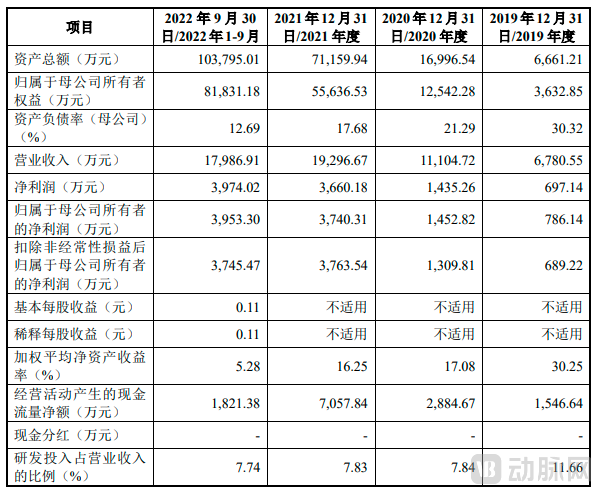
Peng Li Biomedical’s Revenue from 2019 to September 2022, Source: Peng Li Biomedical Prospectus
In the revenue composition, although the proportion of preclinical CRO services for drugs has decreased, it remains the primary revenue contributor and has achieved strong growth. In 2019, preclinical CRO services for drugs accounted for 92.8% of revenue, amounting to RMB 60.7 million; by January–September 2022, this proportion had declined to 74.91%, while total revenue from this segment reached RMB 132 million.
Another major revenue stream comes from preclinical CRO services for medical devices. Preclinical CRO services for medical devices and laboratory animal sales are business lines established by Peng Li Biomedical in 2019 and 2021, respectively. Although their current contribution to total revenue remains relatively low, a consistent growth trend is evident. It is foreseeable that these two segments will gradually emerge as new drivers of Peng Li Biomedical’s development.
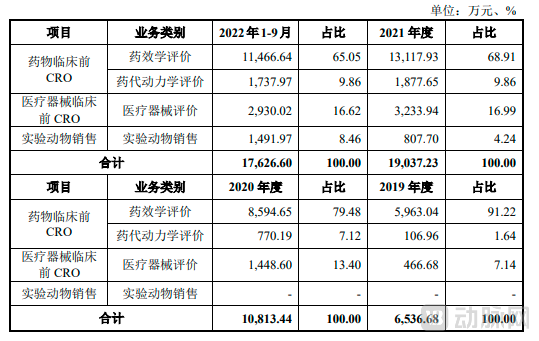
Revenue Composition of Peng Li Biomedical, Source: Peng Li Biomedical Prospectus
Peng Li Biomedical’s business expansion is built upon long-term accumulation.
Leveraging its long-standing expertise in bone diseases and hard tissue pathology, Peng Li has gradually established a preclinical evaluation research team for medical devices.In 2019, Peng Li Testing was established, thereby enabling Peng Li Biomedical to build a one-stop preclinical research and evaluation service system featuring an innovative “integrated drug-device” model.
Likewise, Peng Li Biomedical has also expanded into upstream business operations.In 2021, the company acquired Shanghai Jihui, achieving a strategic layout in the upstream production and breeding of laboratory animals.For preclinical CRO companies, laboratory animals are the foundational resource for serving clients. The acquisition of Shanghai Jihui not only helps Peng Li Biomedical Technology(Shanghai) Co., Ltd. further improve its upstream industry chain layout and establish full-chain service capabilities, but also enhances the company’s quality control over laboratory animals, effectively ensuring the supply of experimental animals for its own CRO services.
Since then,Peng Li Biomedical has established an integrated, comprehensive research and evaluation technical system covering all fields, and built four core technology platforms: the Immunology and Inflammation Pharmacodynamics Evaluation Platform, the Tumor Immunology Pharmacodynamics Evaluation Platform, the Non-Human Primate Pharmacodynamics Evaluation Platform, and the Medical Device Testing Platform.Meanwhile, the business has expanded into four major segments: preclinical pharmacodynamic study and evaluation, preclinical pharmacokinetic study and evaluation, preclinical efficacy and safety evaluation of innovative medical devices, and laboratory animal sales.
As disclosed in the prospectus,Peng Li Biomedical has provided preclinical drug development services to over 700 clients worldwide., covering international leading pharmaceutical companies such as Sanofi, Boehringer Ingelheim, Teva, Takeda, and Johnson & Johnson, as well as renowned domestic innovative biopharmaceutical enterprises and research institutions including Hengrui Medicine, Kelun-Biotech Biopharmaceutical, WuXi Biologics, Chia Tai Tianqing, Mabwell Bioscience, I-Mab Biopharma, Changchun GeneScience Pharmaceuticals, and Shanghai Pharma. In the field of medical device CRO services, Peng Li Biomedical’s clients include prominent innovative medical technology companies such as MicroPort Endovascular, Sino Medical Sciences Technology, Acandis, and Johnson & Johnson.
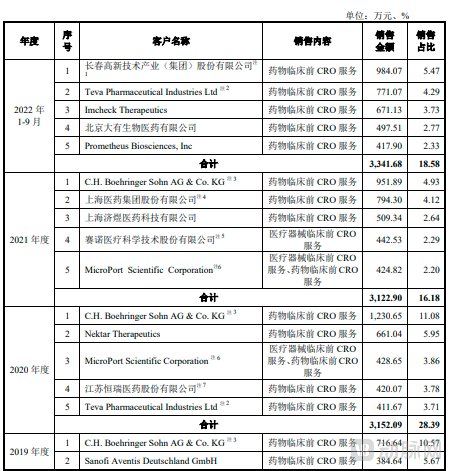
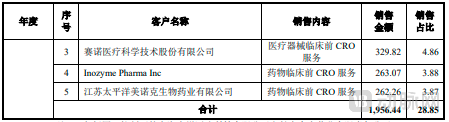
Peng Li Biomedical’s Customer Profile, Source: Peng Li Biomedical Prospectus
While a large customer base is one factor, customer stickiness and quality are equally important as key indicators for evaluating the development of CXO enterprises. The prospectus of Peng Li Biomedical Technology (Shanghai) Co., Ltd. lists its top five major customers for each year from 2019 to the present,International pharmaceutical companies Boehringer Ingelheim and Teva, as well as medical device companies Microport and Sino Medical Sciences Technology, have repeatedly placed repeat orders with Peng Li Biomedical. These high-quality enterprises are the core benchmark customers accumulated by Peng Li Biomedical.Furthermore, in 2020, the orders signed with Boehringer Ingelheim exceeded RMB 10 million. In 2021 and 2022, the company’s largest orders also approached RMB 10 million, demonstrating Peng Li Biomedical’s capacity to undertake larger contracts, which has become a driving force behind its revenue growth.
Since its establishment in 2008, Peng Li Biomedical has witnessed the evolution and development of China’s biopharmaceutical industry, naturally withstanding numerous market tests. Currently facing financing difficulties among downstream biotech companies, 2023 will be a crucial year for the CXO industry. Whether Peng Li Biomedical can withstand this major test by choosing to go public this year remains to be seen.