

Hangzhou's Top Three Unicorns: Ant Group, Cainiao, and WeDoctor Lead Innovation in Fintech, Logistics, and Digital Health
On April 18, the Hurun Research Institute released the “2023 Global Unicorn Index,” which showed that China had 316 unicorn companies. Hangzhou continued to stand out with 22 companies on the list. Ant Group, Cainiao Network, and WeDoctor Group ranked in the top three, leading globally in valuation within the “fintech,” “logistics,” and “healthtech” segments, respectively. This highlights Hangzhou’s profound foundation and leading position in the innovation-driven economy.
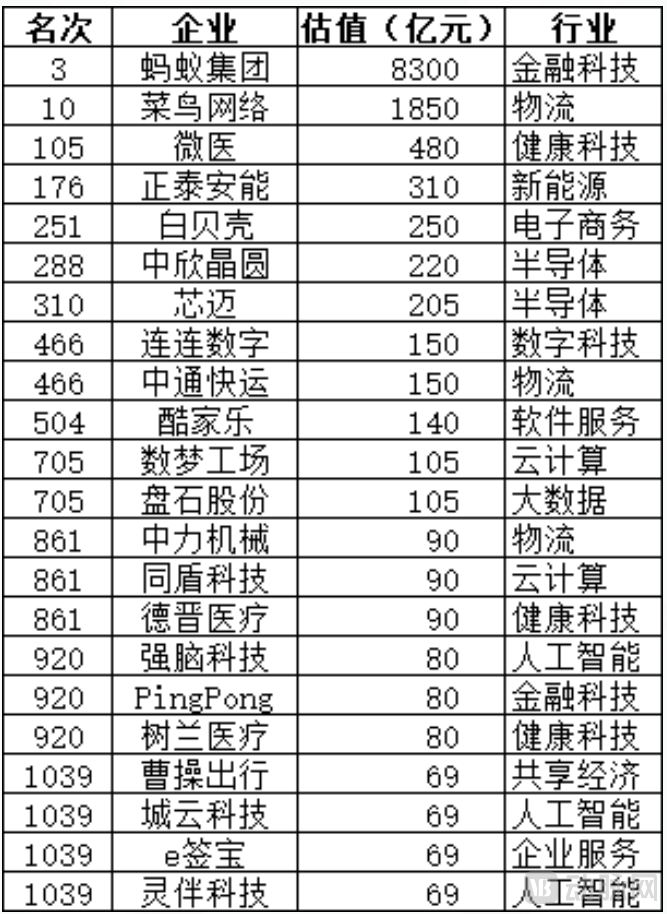
The “Global Unicorn Index 2023” lists privately held companies founded after 2000 with valuations exceeding $1 billion worldwide. Notably, the Hurun Research Institute has been tracking unicorn companies since 2017, marking the fifth release of the Global Unicorn Index.
Rupert Hoogewerf, Chairman and Chief Research Officer of Hurun Report, stated that the “Hurun Global Unicorn Index 2023” offers insights into the future economy by listing the world’s most successful startups. The industries, countries, and cities represented reveal which sectors are attracting the top young talent and smartest capital globally, and which countries and cities boast the strongest entrepreneurial ecosystems.
The report shows that there are currently 1,361 unicorn companies globally, distributed across 48 countries, with a total valuation of $4.3 trillion, representing a 17% increase from a year ago. China ranks second with 316 unicorns. In terms of regional distribution, the number of cities hosting unicorns has increased from 118 before the pandemic to 271 currently. San Francisco remains the “Global Unicorn Capital,” home to 181 unicorns.
As China’s “No. 1 City in the Digital Economy,” Hangzhou has 22 unicorns on the list, including Ant Group, Cainiao Network, and WeDoctor, ranking eighth worldwide.
In recent years, Hangzhou has vigorously implemented the “No. 1 Project” for its digital economy, focusing on technological innovation and the cultivation of industry-leading enterprises, thereby continuously enhancing its overall industrial competitiveness. In 2022, the value added by Hangzhou’s core digital economy industries exceeded RMB 500 billion, accounting for more than 27% of the city’s GDP. An analysis of the sectors in which Hangzhou’s unicorn companies are concentrated reveals that new finance, new logistics, and new health have emerged as highlights. Led by the “big three” unicorns—Ant Group, Cainiao Network, and WeDoctor—Hangzhou is gradually securing a leading position in the global industrial race, providing sustained new momentum for the development of its digital economy.
The financial industry is the core of the modern economy and plays a pivotal role in a country’s economic development. As a representative of China’s “new finance,” Ant Group ranks third on the overall unicorn list and first in the “fintech” category. Earlier this year, Ant Group completed a structural restructuring, and recent announcements indicate that the company is driving its overall business toward more comprehensive, efficient, and diversified development.
For instance, in the realm of digital payments, by developing innovative payment technologies such as express payment, barcode payment, facial recognition payment, and QR code payment, we cater to digital payment needs across various scenarios, including commercial operations, utility bill payments, and transportation.
In terms of digital connectivity, by opening up digital products, technical interfaces, and platform resources, we empower merchants and institutions to undergo digital transformation, helping physical enterprises reduce costs, improve efficiency, and achieve sustainable development.
In the realm of digital finance, we leverage technology, data, and platform capabilities to serve financial institutions across China, providing consumers and micro- and small-sized merchants with inclusive financial services such as micro-loans, consumer finance, wealth management, and insurance.
As a leader in the “New Logistics” sector, Cainiao Network was established in 2013. According to public information, as a big data-driven logistics collaboration platform, Cainiao leverages socialized coordination and data-centric strategies to integrate an end-to-end logistics network spanning express delivery, cross-border logistics, rural logistics, warehousing and distribution, and last-mile delivery, while providing services such as big data connectivity, data empowerment, and foundational data products.
For consumers, Cainiao Network has launched the one-click online shipping and pickup app, Cainiao Guoguo, tailored to various scenarios; community stations that offer temporary storage, consignment services, and diverse community-based services; campus stations leveraging smart solutions such as IoT; and Cainiao Rural, which focuses on last-mile logistics in rural areas.
For merchants, Cainiao Network provides services to both Alibaba-affiliated and external merchants, including digital intelligent supply chain solutions, C2M model services, Cainiao intra-city direct delivery, consolidated electronic shipping labels, and integrated merchant financial services such as ecosystem financial services and large-sum loans through Cainiao Cloud Loan. For cross-border merchants, Cainiao Network offers supply chain, parcel, freight, and financial services.
In the era of globalization, digital health is not only a vital livelihood-related endeavor but also a competitive industrial arena for enterprises, industries, and nations worldwide. In the “Health Tech” sector of the Global Unicorn List, the digital health platform WeDoctor ranks No. 1.
It is understood that, driven by the upgrading of China’s healthcare service system and the substantial societal demand for responding to public health emergencies such as COVID-19, WeDoctor has continuously leveraged digitalization to integrate medical care, pharmaceuticals, and health insurance over the past decade. In doing so, it has built a “health-centric” value-based healthcare system and established three major platforms: Digital Healthcare, Digital Pharmaceuticals, and Digital Traditional Chinese Medicine.
In the realm of digital healthcare, WeDoctor leverages its digital hospitals established in multiple cities across China to collaboratively build digital medical consortia with tertiary hospitals and primary care institutions on a city-by-city basis. It delivers standardized, end-to-end diagnosis, treatment, and health management services tailored to specific disease categories. By coordinating with basic medical insurance and commercial insurance providers, WeDoctor implements a payment model transition from fee-for-service to pay-for-performance for each disease category. This approach alleviates pressure on tertiary hospitals, enhances the capabilities of primary care institutions, and improves the efficiency of medical insurance funds, thereby constructing an integrated, high-quality, and efficient regional healthcare service system. WeDoctor’s practice in Tianjin ranked first among the “Top Ten New Initiatives in National Healthcare Reform” awarded by the National Health Commission of China in 2021.
In the realm of digital healthcare, WeDoctor has been supporting the “Sanming Healthcare Reform” since 2017. Its established Xiamen Haixi Pharmaceutical Trading Center has provided end-to-end services for pharmaceutical reforms, scaling from Sanming to a national level. As the earliest digital centralized procurement platform to implement the “Three-Medical Linkage” model, it is currently the only nationally authorized market-based trading platform for pharmaceuticals and medical devices in China. With cumulative transaction volume exceeding RMB 330 billion, it has grown into the largest pharmaceutical and medical device trading platform in the country.
In the realm of digital Traditional Chinese Medicine (TCM), WeDoctor has established the Bianque TCM Group, a digital innovation platform for the TCM industry. This platform integrates resources from planting bases and production areas upstream to ensure direct supply of authentic medicinal herbs and refined decoction pieces. Downstream, it leverages TCM medical consortia to promote the large-scale industrialization of TCM product series and in-hospital preparations, thereby forming a “one body, two wings” closed-loop layout across the entire digital TCM industry chain.
Currently, with the implementation of the "Overall Layout Plan for Building a Digital China" issued by the Central Committee of the Communist Party of China and the State Council, high-quality unicorn companies in Hangzhou, represented by Ant Group, Cainiao Network, and WeDoctor, are accelerating their development. Guided by national policies, driven by market demand, and powered by technological innovation, they are promoting the in-depth application of digital technologies in more fields such as finance, logistics, and healthcare. This facilitates the deep integration of the digital economy with the real economy, contributing to the construction of Digital Hangzhou, Digital Zhejiang, and Digital China.