

Sonosine Aims to Rival CT and MRI with Electromagnetic Acoustics Imaging Combining Radio Waves and Ultrasound

Sonosine
Medical Imaging Technology Developer
In 1895, German physicist Dr. Wilhelm Röntgen discovered Röntgen rays, now known as X-rays. Subsequently, he utilized the penetrating power of these rays to capture images of human tissues, sending shockwaves around the world.
With the discovery of X-rays, the curtain on medical imaging was gradually raised, bringing about a profound transformation in the paradigms of disease diagnosis and treatment. After more than a century of development, modern medical imaging diagnostic equipment can be broadly categorized into four types: X-ray (including CR, DR, DSA, and CT), ultrasound, magnetic resonance imaging (MRI), and nuclear medicine.
Although MRI and CT provide clear images with well-defined anatomical relationships, the equipment is relatively bulky, requiring patients to visit hospitals or imaging centers for examinations. In contrast to MRI and CT scanners, which can weigh several tons, ultrasound devices are much more portable, allowing sonographers to bring the machines directly to patients’ bedsides for examination. However, this convenience comes at a cost,Ultrasound images are susceptible to numerous interfering factors, resulting in lower image clarity compared to large-scale equipment such as MRI and CT. Furthermore, ultrasound examination is significantly limited for assessing bones and hollow organs.
To this end, Sonosine, a University of Oxford spin-out founded in 2015, has integrated a novel medical imaging technology—electromagnetic acoustic tomography—into ultrasound systems, aiming to optimize ultrasound diagnosis.
The physical properties of ultrasound determine the limitations of its equipment. Sonosine’s first product, Pulsar1, is designed to address this issue at the technological source.Pulsar1 resembles traditional ultrasound systems in appearance and examination methods, but its core technology is fundamentally different.
In 2006, a research team at the University of Oxford developedElectromagnetic Acoustic (EMA) Imaging Technology. EMA technology combines radio frequency signals with ultrasound. Due to the diagnostic value of electromagnetic properties such as electrical conductivity, it can assist ultrasound by effectively inducing vibrations in small-volume tissues within the scanning area. Irradiating the scanning area with radio frequency signals and detecting their echoes allows for differentiation of tissue types in that region, offering greater precision in diagnosing fluid accumulation, calcification, and capillarization.EMA technology serves as a complement to and integration with ultrasound, achieving capabilities that ultrasound alone cannot provide.
Sonosine has embedded EMA technology into the Pulsar1 scanner. In addition to conventional ultrasound components, the Pulsar1 features a “loop antenna” that transmits and receives electromagnetic waves. While physicians scan patients using an ultrasound probe, the loop antenna attached to the patient’s body simultaneously emits radiofrequency signals into tissues and organs and captures the returning echoes. The system integrates ultrasound and radiofrequency signals, automatically registering them to generate images.
Generated by Pulsar1High-Quality ImagesImaging that surpasses traditional ultrasound systems and is even comparable to MRI and CT scans, itsThe examination scope is also broader than that of traditional ultrasound.However, compared with MRI and CT, Pulsar 1 is more cost-effective, with scanning costs similar to those of ultrasound examinations. Like conventional ultrasound machines, it is portable and enables physicians to perform point-of-care diagnostics at the patient’s bedside, thereby eliminating unnecessary referrals and the need for escalated imaging studies—i.e., avoiding further scans using MRI or CT scanners. Meanwhile, Pulsar 1 scanning is safer, as it prevents patients and healthcare workers from exposure to ionizing radiation and strong magnetic fields.
For clinicians, workflow and efficiency are improved. For patients, the cost of imaging examinations is also reduced.
This technology is particularly beneficial to people in remote areas, who often struggle to access high-quality medical imaging services due to high healthcare costs and a lack of large-scale medical facilities.EMA technology can be embedded in devices that are more portable than MRI or CT scanners. In the absence of CT and MRI facilities, patients can obtain high-quality imaging examinations at a lower cost, while physicians can use portable devices such as Pulsar 1 to diagnose and treat patients in remote areas.
Currently, Pulsar 1 is primarily focused on the diagnosis of sports medicine, trauma, and orthopedic conditions—areas where conventional ultrasound is less proficient. In the future, Sonosine will also explore solutions for diagnosing liver, kidney, prostate, and ovarian diseases.
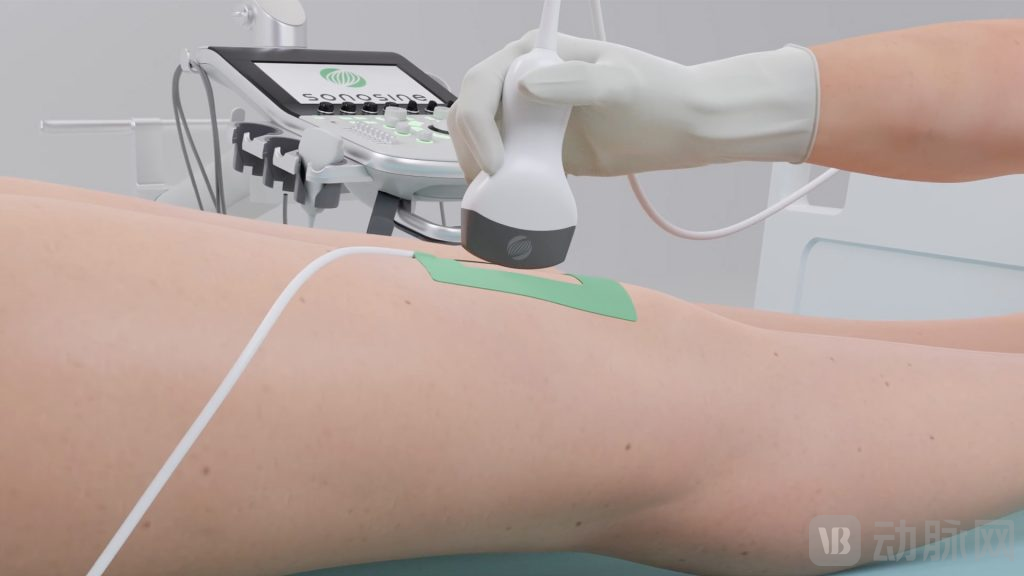
Pulsar 1 Operation Demonstration Image Source: Sonosine Official Website
The team behind the translation of EMA technology from theory to application in imaging equipment deserves much credit, with Professor David Edwards, founder of Sonosine, being a key figure.
Nine years before the establishment of Sonosine, a team of scientists at the University of Oxford, led by Professor Edwards, developed a new technology known as EMA technology. They firmly believed that this technology would create ripples in the fields of medical imaging and diagnostics.
Edwards was a Professor of Engineering Science at the time, and he had previously served asDean of the Department of Engineering Science, University of Oxford, and Vice-Master of Wadham College, University of Oxford. He worked in the industry for nearly 12 years, where he was responsible for telecommunications technology and regulation at BT Group (British Telecom).
For the next 30 years, Professor Edwards remained active in academia. He researched and developed more than 100 products, securing numerous patents, many of which have been commercialized across fields such as radio systems, radio imaging, and medical imaging. Professor Edwards has also received many awards for his work, includingIEE Innovation Award, awards conferred by the Automatic Radio Frequency and Microwave Measurement Society (ARMMS), etc.

David Edwards. Image source: Sonosine official website
Even an exceptional team cannot succeed without the support of outstanding management and technical experts. David Herbada manages Sonosine as its Chief Executive Officer. Herbada is an executive and investor in global healthcare, industrial, and technology companies, with 20 years of experience in investing in and managing technology firms. He began his career as a design engineer, and his professional trajectory has since expanded to include roles such as Senior Investment Advisor at the globally renowned investment firm KKR, Board Advisor at Altran Technologies, and Consultant at Accenture.

David Herbada. Image source: Sonosine official website
Sonosine’s Chief Engineer, Julian Hayball, and Hardware Engineer and Quality Manager, Charlotte Edwards, graduated from the University of Cambridge and the University of Oxford, respectively. Both possess extensive experience in developing medical imaging systems. Hayball, a physicist and engineer, is a former healthcare engineer at Siemens Healthineers.

Julian Hayball and Charlotte Edwards. Image source: Sonosine official website
Sonosine has currently obtained globally30 Core Patents. Their next step is to establish a laboratory and test the EMA technology, and to conduct further clinical (in vitro and in vivo) trials to demonstrate the safety and efficacy of the EMA technology.
However, the development of a company relies not only on robust technology but also on financial support.
Since its establishment in 2015, Sonosine has secured a total of £2.2 million in financing. These funds have not only supported the research and development of Sonosine’s products but also accelerated their commercialization. Herbada stated,They are by no means content with the $13 billion U.S. medical imaging market; they also aim to expand into markets such as the European Union and Asia-Pacific, seeking a share of the global medical imaging market, which exceeds $42 billion.
However, commercializing new technologies and expanding into overseas markets is no easy feat. GE, Philips, Siemens, and Toshiba dominate the global ultrasound market with the majority share, leaving Sonosine with a long road ahead to outpace its competitors. Particularly during promotion, the biggest obstacle many medical technology companies face is obtaining safety approvals for their products in the countries where they are used, and Sonosine is no exception.
“In the coming years, we plan to collaborate with ultrasound equipment manufacturers and integrate our product into existing ultrasound machines. This should reduce the time required for our product to obtain U.S. FDA approval, as well as the time needed for certification in the UK and the EU. We have already embarked on the regulatory approval pathway,” Herbada wrote in a blog post in August 2021.
Recently, Sonosine announced that it isCollaboration with Newbury Innovation, a UK-based electronics, software, and product design company, launched the next-generation EMA imaging system,Offering specialized diagnostic solutions previously available only at well-funded medical centers. In addition, Sonosine alsoDeveloped in collaboration with U.S. cable connector supplier BizLink Group and German connector manufacturer ODU GmbH & Co. KG, distributing EMA's disposable consumable patch antennas globally using their custom MEDI-SNAP connectors.