

Medtrade Submits IPO Prospectus Highlighting Celox™ Hemostatic Technology for Arterial Bleeding, Coagulopathy, and Diabetic Patients

Medtrade Products
Medical Device Developer
An adult weighing 60 kg has approximately 4,800 mL of blood in their body. Blood loss exceeding 30% within a short period can be life-threatening. Therefore, for patients experiencing sudden massive hemorrhage, the primary concern for emergency responders is achieving hemostasis as quickly as possible.
In addition to the urgent need for hemostasis in trauma caused by accidental injuries, hemostasis is also one of the three cornerstones of surgery. According to an article published in The Lancet, more than 4 million people die after surgery worldwide each year. Postoperative complications, such as bleeding and infection, are the main causes of postoperative death.
As early as the 2nd century AD, Roman physicians began using cauterization to achieve hemostasis for wounds; however, this method caused significant pain to patients and carried a high risk of infection. Today, minor everyday wounds can be easily managed with non-woven gauze adhesive bandages. In contrast, complex wounds with larger surface areas and greater depth require specialized hemostatic products, such as hemostatic sprays, gels, and powders. Furthermore, the healing and nursing care of major wounds remain considerably challenging.
In response, the UK biotechnology company Medtrade Products Limited (hereinafter referred to as “Medtrade”) has developed, manufactured, and supplied a range of products for hemostasis and wound care.
Medtrade has secured two rounds of financing, totaling over $30 million. Its latest round was a $30 million private equity financing in 2019, exclusively participated by the French investment firm Tikehau Capital.
Medtrade has developed a hemostatic powder, Celox™ (Saifeining). This product can effectively control rapid, high-volume arterial bleeding as well as routine venous bleeding.
The main component of Celox™ is chitosan, a substance derived from chitin extracted from the biological shells of deep-sea shrimp in Iceland, following deacetylation. Chitosan exhibits high biocompatibility, hemocompatibility, and safety. Over the 16 years since its introduction, Celox™ has received regulatory approvals in multiple countries, including clearance from the U.S. FDA, CE marking in the European Union, and approval from China’s NMPA.
In 2007, Beijing Health Guangji Biotechnology Co., Ltd. obtained the exclusive distributorship for Celox™ in China. The 15g pack of Celox™ hemostatic powder is priced at RMB 1,498 on the official store of Beijing Health Guangji.
Celox™ is completely independent of the body’s intrinsic coagulation mechanism and can be used in patients with coagulation disorders.Positively charged chitosan can absorb moisture from the blood and cross-link with negatively charged red blood cells to form a firm clot, rapidly sealing the bleeding site. The clot prevents and occludes surface bleeding by coagulating blood through direct contact with the wound.
From minor fingertip cuts to severe bleeding from deep arteries and major vessels, Celox™ can effectively and rapidly control hemorrhage. Furthermore, the residue left after hemostasis with Celox™ is absorbable by the human body, converting into glucosamine, which is beneficial to health. As glucosamine is not a sugar, it does not affect its use in patients with diabetes.
Celox™ is easy to use,Simply pour the hemostatic powder onto the bleeding site and apply pressure with any dressing; minor wounds can achieve hemostasis within 1–3 minutes. While Celox™ stops bleeding promptly and effectively, it does not induce thrombus formation, reduces fluid loss, lowers the incidence of shock, provides effective bacterial barrier and bacteriostatic effects as well as wound protection, thereby preventing secondary tissue injury.
Since Celox™ first received FDA approval and was marketed in the United States, Medtrade has developed several new hemostatic products with varying forms and application sites around this product line, such as Celox™ RAPID gauze and Celox™ A applicator-style hemostats. Medtrade has secured more than 40 patents related to hemostasis and primarily operates these patented products through its three major product divisions.
According to a market size, share, and trend analysis report on the wound care market released by Grand View Research, the global wound care market reached $20.6 billion in 2021 and is projected to grow at a compound annual growth rate (CAGR) of 4.1% from 2022 to 2030.
Facing a wound care market valued at tens of billions, how can Medtrade Products, with nearly two decades of deep industry expertise and proprietary core hemostatic technologies, capture market share and expand its market presence?
Medtrade currently delivers its core value through three divisions: ① Advanced Wound Care, ② Trauma, and ③ Hospital Hemostats and Obstetrics.
Guided by the needs of customers, clinicians, and patients, Medtrade has developed its proprietary brand, AVARUS™. This brand is dedicated to creating innovative wound care solutions for these blue-chip clients and helping partners grow their businesses. Its main products include foam dressings, gelling fiber technology, and spray plasters.
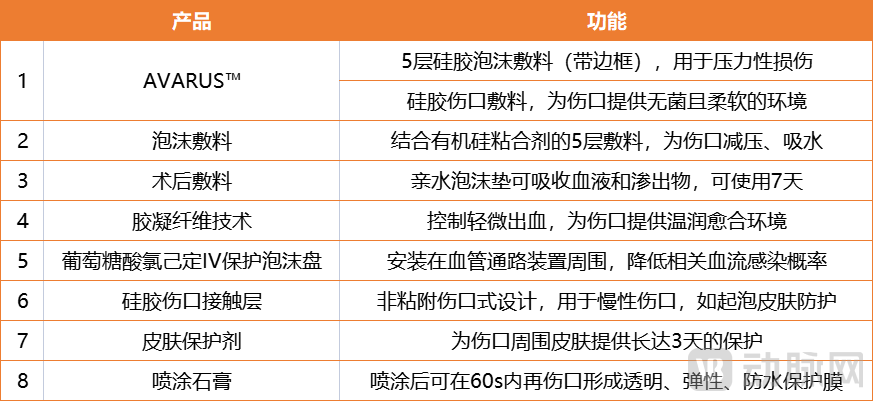
Advanced Wound Care Division Products
VCBeat Production
The core ingredient of the Trauma Department’s products is derived from Celox™. Composed of chitosan (polyglucosamine), Celox™ achieves rapid and effective hemostasis, particularly for patients suffering from sudden, catastrophic wounds, thereby enabling first responders and lay rescuers to save lives to the greatest extent possible. Building upon Celox™, the department has developed a range of hemostatic products, including Celox™ hemostatic bandages, hemostatic dressings, and chest seals.
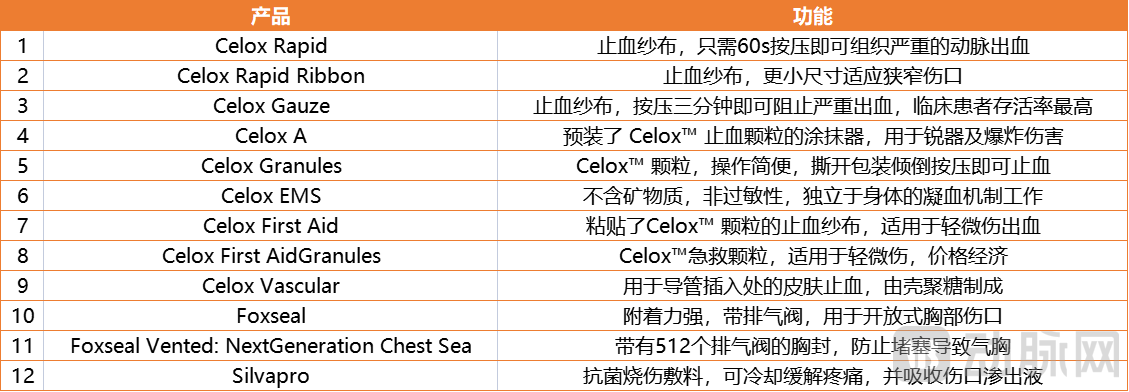
Trauma Department Products
Produced by VCBeat
Medtrade operates this division under its subsidiary, Omni-stat Medical. Its flagship product is also Celox™, Medtrade’s star hemostatic agent. Currently, Omni-stat has two products on the market: OMNI-STAT®Hemostatic Powder and Gauze. These two high-performance hemostatic products are primarily intended for use by medical professionals and are suitable for hemostatic treatment of any type of wound in every patient in hospital settings.
OMNI-STAT®OMNI-STAT is a hemostatic gauze made from highly absorbent non-woven fabric, laminated with Celox™ chitosan hemostatic powder.®The product shall be used under the supervision of medical professionals. It is primarily indicated for controlling minor external bleeding and exudate associated with suturing and surgical procedures, and is also suitable for temporary external management of moderate to severe hemorrhage.
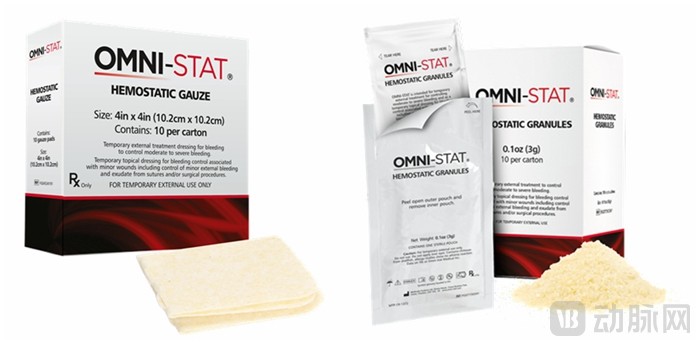
OMNI-STAT®Gauze and Granules
Source: Medtrade Official Website
Currently, in addition to the operation and sales of its existing products, Medtrade has also been expanding into the new field of postpartum hemorrhage (PPH) prevention in recent years.
Postpartum hemorrhage is a severe and common complication of childbirth, representing the leading cause of maternal mortality worldwide. According to WHO statistics, approximately 14 million women experience postpartum hemorrhage each year, resulting in an estimated 70,000 maternal deaths, with the vast majority occurring in low-income countries. However, most deaths attributable to postpartum hemorrhage can be prevented through the prophylactic use of uterotonics during the third stage of labor and timely, appropriate hemostatic management.
Therefore, there is an urgent need for an effective, convenient, and economical intervention for postpartum hemorrhage, including in low-income countries. Celox™ Uterine Hemostatic Gauze, developed and manufactured by Medtrade Products, meets these needs.
Celox™ Uterine Hemostatic Gauze is a physical hemostatic material. When placed in the vagina by a physician or midwife, the Celox™ granules loosely adhered to the fabric surface interact with blood at the wound site to form a robust gel plug, sealing the bleeding area and achieving rapid hemostasis.
Celox™ Uterine Hemostatic Gauze features a "Z"-fold design, with a total length of 30 m and a width of 7.6 cm, making it compact and lightweight. Although intended for use by physicians and nurses, the product requires minimal training and is easy to use, requiring only the tearing open of the package for immediate application. With a shelf life of up to five years and no specific storage requirements, it can be rapidly deployed in any environment, making it particularly suitable for obstetric care in low-income countries and regions.
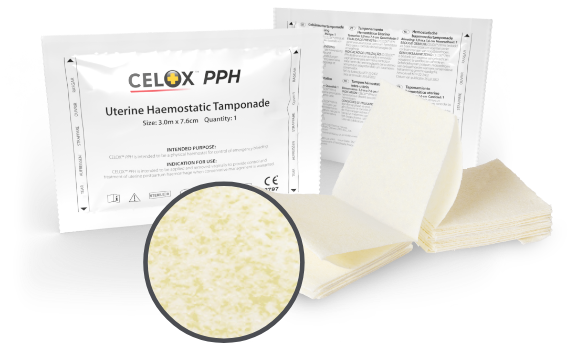
Celox™ Uterine Hemostatic Gauze
Image source: Medtrade official website
Celox™ Uterine Hemostatic Gauze has undergone 10 years of clinical trials and received EU CE certification in 2022. According to data from a retrospective study by Medtrade,Celox™ uterine hemostatic gauze achieved a 100% hemostasis rate for Grade 1 and Grade 2 hemorrhage during delivery, and a 95.6% hemostasis rate for Grade 3 hemorrhage in vaginal deliveries. Furthermore, compared with current treatment regimens, the maternal hysterectomy rate was reduced by 78%.

Clinical Progress
Source: Medtrade Official Website
Whether it involves hemostatic bandages for managing postpartum hemorrhage or various forms of hemostatic products, “hemostasis” often entails a race against time between life and death. Leveraging the application of its core hemostatic technology, Celox™, across diverse usage scenarios, Medtrade has built a product portfolio spanning from hemostasis to wound care, and supports effective hemostasis and the healing of chronic wounds through continuous product innovation.
Currently, domestic medical device companies in China have established a presence across the low-, mid-, and high-end segments of the hemostatic materials market. Among these, the development of domestically produced high-end hemostatic materials started relatively late, with foreign high-end products, represented by Johnson & Johnson, dominating the market. According to data from the “China Medical Device Industry: Market Prospects and Investment Strategic Planning Analysis Report” by Qianzhan Industry Research Institute, Johnson & Johnson’s sales revenue for absorbable hemostatic materials in China reached RMB 850 million in 2020, accounting for a 27.04% market share.
Currently, the key domestic players focused on the research, development, and manufacturing of hemostatic materials include Jiangxi Born Real’s fluid gelatin hemostat, Shandong Saikesaisi’s polysaccharide hemostatic powder, Beijing Tech-Boman’s absorbable hemostatic gauze, Beijing Daqing Biology’s absorbable hemostatic membrane, and Jiangsu Deweilan’s pure plant-based polysaccharide hemostatic powder, among other notable enterprises and their products.
The hemostatic materials mentioned above are all Class III medical devices, categorized as low-value consumables with widespread application. Born Real’s fluid gelatin hemostat is used for adjunctive hemostasis during surgical procedures (excluding ophthalmic and urological surgeries); Saikesaisi’s polysaccharide hemostatic powder is employed for hemostasis on fresh wound surfaces in various surgeries; Tyco Boman’s absorbable hemostatic gauze helps prevent postoperative adhesions; Daqing Biological Paper is suitable for hemostasis in various types of surgical procedures; and Deweilan’s hemostatic powder is utilized in minimally invasive catheter-based interventions, among other applications.
In addition to medical hemostatic materials, domestically produced hemostatic agents are continuously expanding their application scenarios. Nanfangyuan’s hemostatic polysaccharide can be used in multiple settings, including police operations, traffic management, industrial and mining environments, and household use. This hemostatic material is currently still in the clinical stage.
The high-end hemostatic materials sector features significant technical and market access barriers, necessitating substantial capital investment and time commitments from research and development through to commercialization. Many high-end hemostatic materials in China are still under development, such as the absorbable hemostatic gel products from Huanuo Biotech. In the future, hemostatic products derived from diverse material sources will continue to fill gaps and strengthen the market landscape of domestically produced high-end hemostatic materials.