Johnson & Johnson Unveils First Clinical Data from Ottava Soft Tissue Robotic Surgery System

Johnson & Johnson
Medical Device R&D and Manufacturer

May 5, 2026Johnson & JohnsonAt the annual meeting of the American Society for Metabolic and Bariatric Surgery (ASMBS), it was announcedResults of the First Human Clinical Study (FORTE Study) of the Ottava Surgical Robot. This is the first time that Ottava has disclosed formal clinical data since its initial public release in 2020. The study was conducted in30 Cases of Roux-en-Y Gastric Bypass SurgeryThe primary safety and performance endpoints were achieved in patients, with all surgeries completed robotically without any conversion to non-robotic procedures. By 30 days post-operation, the patientsAverage weight loss of approximately 30 pounds。
Johnson & Johnson submitted an application for FDA approval in January 2026, targeting indications covering multiple general surgical procedures in the upper abdomen, including gastric bypass, sleeve gastrectomy, small bowel resection, and hiatal hernia repair.
# Product Architecture: Focusing on Spatial Constraints in the Operating Room
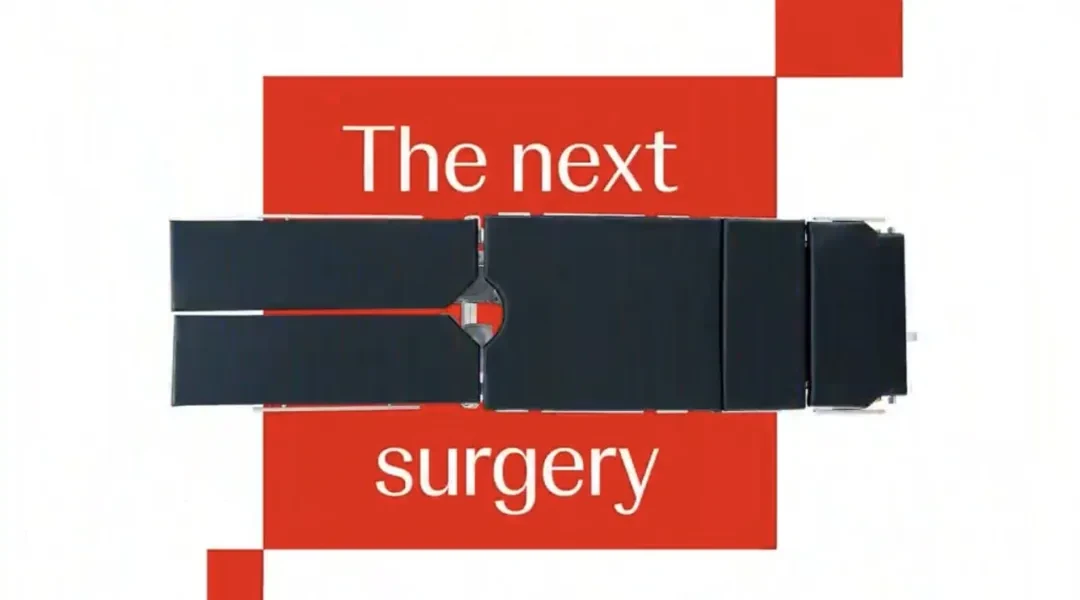
The core design feature of Ottava is the integration of four robotic arms into a standard-sized operating table, with the arms stored beneath the table when not in use. Johnson & Johnson describes this as a "unified architecture of invisible design." This design directly addresses a real bottleneck in the current promotion of surgical robots—Operating Room Space Limitations。
The data from the FORTE study provides a specific reference: the operating room areas of the six participating hospitals range from 243 square feet (approximately 22.6㎡) to 694 square feet (approximately 64.5㎡); surgeries in five of these hospitals were completed in operating rooms that had never before been used for robotic surgery, as they were previously considered "unsuitable" for robotic systems due to spatial limitations.
The significance of this set of data is: If Ottava does indeedCan perform bariatric surgery in a 22.6㎡ operating roomThis will be significantly lower than the typical operating room size threshold required by the da Vinci system. The patient cart of the da Vinci Xi requires independent space and docking, with actual requirements for operating room space typically exceeding 400 square feet (approximately 37㎡). Ottava’s tabletop integrated solution eliminates the need for an independent cart at the physical level, theoretically reducing the demands on operating room size and layout adjustments.
# Competitive Landscape: Multiple Platforms in Competition, Each at Different Stages
Ottava's clinical progress occurs during a time window when the soft tissue surgical robot track is becoming increasingly crowded. The da Vinci system has long dominated this market, but in the past two years, multiple new platforms have successively entered or are approaching the commercialization stage.
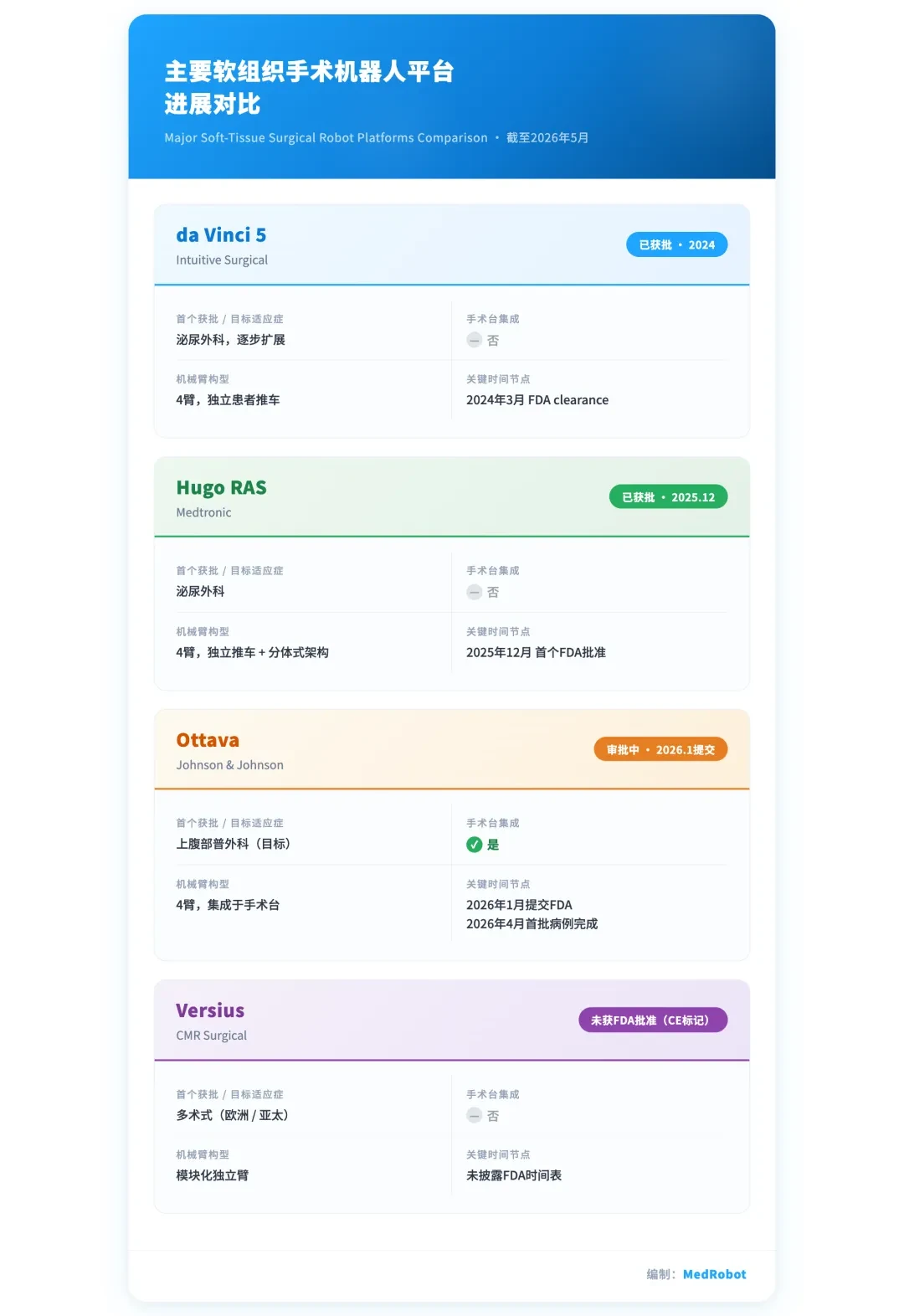
Several noteworthy differences:
Different Indication Entry Strategies。Medtronic Hugo’s first FDA approval falls in urology – the field with the largest installed base of da Vinci systems and the most mature clinical evidence, marking a head-to-head competition. Johnson & Johnson's Ottava chooses to enter through bariatric/general surgery, avoiding direct confrontation in urology, while bariatric surgery is currently in a period of growing demand (the impact of GLP-1 drug penetration on surgical volumes remains controversial, but the total volume of bariatric surgeries will continue to grow in 2024-2025).
Architectural differences determine the different emphases of commercial narratives.。Hugo emphasizes modularity and an open ecosystem; Ottava highlights spatial adaptability brought by operating table integration; da Vinci 5 iterates on performance and force feedback based on an already large installed base. These three address different pain points in hospital procurement decisions.
# Timeline Rewind: A Project Delayed by Two Years
The development pace of Ottava is worth reviewing. When it was first unveiled in 2020, Johnson & Johnson positioned it as the core product to challenge da Vinci. However, by the end of 2021, the company postponed its development timeline by about two years, citing "multiple factors," with almost no updates disclosed to the public during this period. It wasn’t until October 2024 that the IDE application was submitted, followed by FDA approval to initiate clinical trials in November of the same year. The de novo application is scheduled for submission in January 2026, with the first batch of cases expected to be completed by April.The interval from IDE approval to the submission of the marketing application was only about 14 months., the pace of advancement has significantly accelerated.
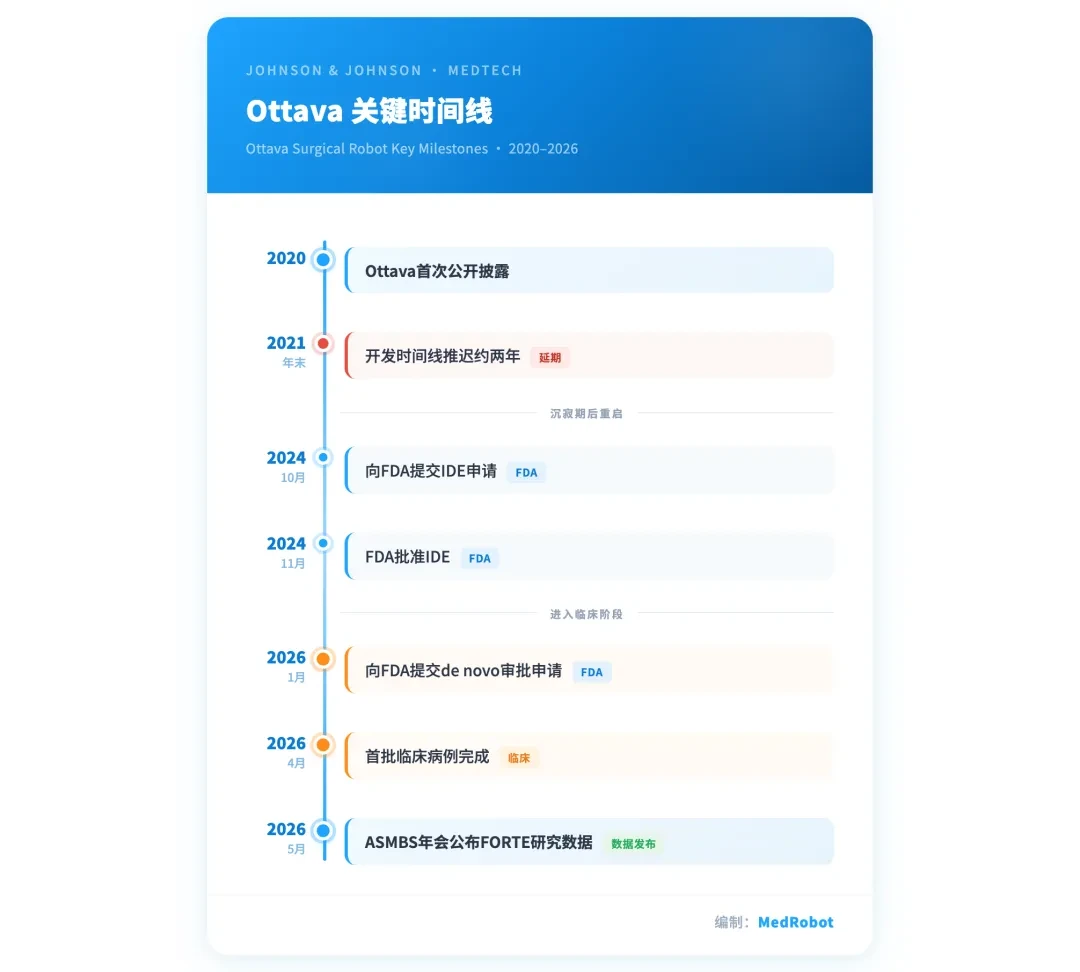
The De Novo approval pathway itself also reveals information: this means the FDA considers Ottava as a new device classification without an existing predicate device, rather than referencing existing products like the da Vinci through the 510(k) pathway. This classification may be related to its integrated operating table architecture and implies that the review cycle and requirements could differ from traditional pathways.
# Conclusion
The sample size of 30 cases in the FORTE study belongs toEarly Feasibility/Pivotal StudyThe typical scale is sufficient to support safety and basic performance signals but not enough for comparative analysis with existing procedures. The study did not include a control group (such as laparoscopic or Da Vinci-assisted similar surgeries),The 30-day postoperative follow-up window only covers perioperative safety and does not yet involve medium- to long-term weight loss outcomes or complication data.。
Moreover, Johnson & Johnson mentioned that Ottava will integrate Ethicon instruments and the Polyphonic digital ecosystem in the future. However, the specific timeline and functional details for this integration have not been disclosed yet, and this information remains at the strategic vision level.
FDA’s review decision on the application will be the next critical milestone for Ottava’s commercialization process. Based on historical approval timelines, decisions are typically made within several months to a year after submission, but Johnson & Johnson has not disclosed the expected approval date.
Well-known surgical robot companies and upstream and downstream enterprises
Comprehensive▌Minimally Invasive Robot | Tudao Medical | Intuitive Fosun | Weigao
Endoscope▌MicroPort Medical | Sizherui Intelligent Medical | ConorStent
Orthopedics▌Rosunbot | Yuanhua Intelligence | Changmu Valley | Xin Jun Te| Stryker
Vascular Intervention▌Aibohc | Weimai Medical
Puncture Robot▌True Health | Virtue Precision
Surgical Robot Tools▌Good Doctor