

Wei Lai Capital: Three Key Strategies to Stand Out and Win Investor Favor in a Crowded Market
Walking into a supermarket, labels boasting “0 fat, 0 sugar, 0 calories” are everywhere. Whether it’s beverages, jelly, bread, or candy, all are emphasizing their status as healthy foods.
Undoubtedly, these brands are all designed to cater to the preferences of young people. Nowadays, “how to eat healthily and nutritiously” is the topic of greatest concern among the youth.The emerging nutritional needs of young people have also spurred the rise of many new nutrition brands focused on niche categories.Meanwhile, an increasing number of investors are entering the nutrition sector.
According to the report released by China Business Industry Research Institute,"2017-2022 China Health and Wellness Industry Market Development Status and Investment Prospect Forecast Report", the current market size of China's health and wellness industry has exceeded one trillion yuan, with each urban resident spending an average of over 1,000 yuan annually on health and wellness.Notably, young adults aged 18–35 accounted for as high as 83.7% of the population.
What opportunities remain in this high-potential market? How can players break through? What are investors’ perspectives?
Billions in the Market: Which Direction Does Capital Favor?
In just four months since the start of 2023, capital investment in the nutrition sector has begun to show early signs of momentum.
Since January 2023, the field of nutrition has witnessed17 Financing Rounds, with a cumulative amount exceeding RMB 100 million.
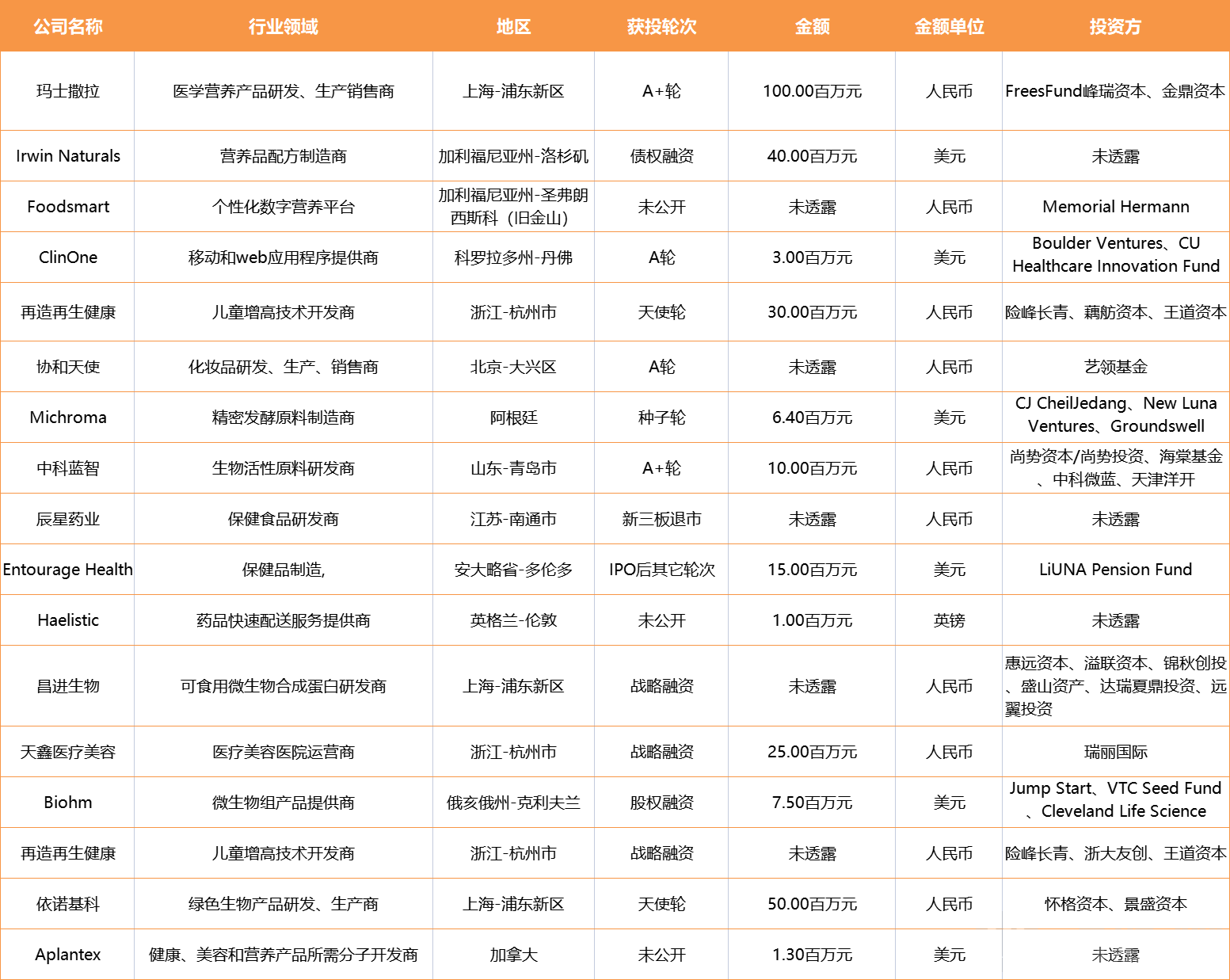 Data source: Artery Orange Data, compiled by Artery Orange Guoju
From the perspective of the business sectors of companies that have secured financing, in addition to the common businesses in the nutrition track, digital nutrition has also become a hot area of interest for investors. Among the 17 financing events, three companies were involved inDigital Nutrition Sector. In contrast, the recently emerging health management services appear to differ from their predecessors; they do not merely record users’ physical conditions and daily lifestyle habits, but also incorporate functionality to provide diagnostic recommendations for healthcare providers.
For example, Clin One, a U.S.-based company, offers an application software designed to optimize the clinical trial enrollment process, ensure patient nutritional adherence, and improve the patient care experience. Leveraging information technology, Clin One records users’ health habits, enabling seamless retrieval of these data when users seek medical attention or contact their primary care physicians, thereby facilitating more appropriate clinical recommendations. Furthermore, when researchers prepare for clinical trials, Clin One serves as a bridge connecting patients, researchers, and clinical trial institutions, helping researchers identify and match with the most suitable patients who best fit the study criteria.
Both domestically and internationally, numerous new business models have emerged in the nutrition sector, with many investors also willing to explore new directions.However, in terms of overall proportion, companies in the nutritional and health supplement sectors remain a major focus for investors.
Team and Track Selection Are Equally Important
How Can Nutritional Food Companies “Break Through the Pack” to Win Over Investors?Zhang Jiutao, Partner at Weilai CapitalHe provided his answer.
Weilai Capital was established in 2018, with its cornerstone investor being a publicly listed company specializing in nutritional dietary supplements.Tang ChenBeijian. Weilai Capital is committed to becoming a comprehensive investment platform, with functional food and beverages as well as foods for special medical purposes (FSMP) constituting an important component of its investment portfolio.
In Zhang Jiutao’s view,Team ConfigurationandCategory SelectionAll are important.
First,Category selection determines the target audience for the product.Nutritional foods differ from conventional food products; unlike universally consumed items such as bread and candy, they are designed to deliver specific health benefits tailored to the needs of distinct population groups. Moreover, market trends indicate that consumers increasingly favor personalized and customized nutritional supplementation. Therefore, companies in the nutritional food sector should precisely target their intended consumer segments. Such focused positioning will not constrain their market potential; rather, it will enable them to deepen their expertise and competitiveness within specialized niche markets.
Secondly,Team Configuration. Currently, there is a wide variety of nutritional food products, which can be broadly categorized into three groups besides functional foods: health supplements, foods for special dietary uses (FSDU), and foods for special medical purposes (FSMP). These three categories are subject to different regulatory approval standards; specifically, complete formula foods for special medical purposes require clinical trials, meaning the entire “R&D-to-market” process can take several years. In comparison, functional foods have lower entry barriers, but this also implies more intense competition in this sector. Therefore, whether a company can enter a less competitive and more specialized niche, or achieve success in a highly competitive market, depends onResearch Strength of the TeamInseparable.
Of course, team support extends far beyond research capabilities; it also includesMarket Insight Capability. Although nutritional foods share similarities with pharmaceuticals, their sales models differ significantly. Zhang Jiutao told VCBeat’s Chengguo Bureau: “Relatively speaking, due to differences in professional expertise, consumers largely rely on professionals such as physicians or pharmacists when purchasing pharmaceuticals, and brand awareness is not strong. However, for nutritional supplements, consumers have the ability to make independent decisions and place particular emphasis on brands.”
From a consumer perspective, buyers are highly susceptible to brand influence when selecting nutritional food products. Consequently, this creates a reciprocal demand for talent within nutritional food teams who possess expertise in market dynamics and channel marketing.
Zhang Jiutao stated:“The nutritional food sector may appear straightforward, but it actually demands more sophisticated team composition. When engaging with companies, I tend to place greater emphasis on teams equipped with multidisciplinary talent.”
Innovating to Forge New Strategies in the Nutrition Sector
For nutritional food companies to stand out, marketing strategies are just as crucial as R&D capabilities. Zhang Jiutao shared a successful case he encountered.
A dairy company based in Yinchuan, Ningxia, has leveraged its proprietary core technology system—including membrane separation, enzymatic hydrolysis, and fat membrane reconstruction technologies—to isolate bioactive functional protein components from bovine milk, thereby developing"Whole Milk Protein"Product Series. Whole milk protein is rich in high-quality nutrients, including active immunoglobulins (867 mg/100 g) and lactoferrin (172 mg/100 g). It also preserves the golden ratio of proteins found in milk (20% whey protein and 80% casein), providing more than eight essential amino acids required for life support. This formulation enables sustained amino acid release, helping to maintain blood amino acid levels and ensuring continuous protein supplementation.Leveraging this innovation, the company has executed a strategic transformation from a dairy ingredient supplier to a nutrition enterprise.
This company’s “secret to success” lies in achievingTechnical UpgradeandLaunched Innovative Products。
On the R&D front, innovation is the foundation of corporate development.To stand out in a highly homogenized market, it is essential to possess innovative advantages that surpass those of competitors. For startups, business models and marketing strategies are often learnable or even replicable. Only continuous technological upgrades can truly enable a company to maintain its leading position.
From a product perspective, pioneering new concepts means discovering blue oceans within red oceans.When a market sector becomes overly crowded, companies must think outside the box to identify new strategic directions. Although venturing into uncharted territories carries significant risks, success enables firms to secure a first-mover advantage and establish a sustainable competitive moat.
Refocusing on the nutrition sector, Zhang Jiutao also highlighted a crucial point:“Academic recognition not only enhances the professional credibility of a product but also represents a new market direction.”
Looking at the domestic nutrition market, we have observed many nutrition companies initially testing the waters through professional channels, such as hospitals, before entering the mass consumer market. Although most nutrition-related products do not require clinical validation, having clinical data support can enhance their professional credibility. Furthermore, if nutrition products are confined solely to hospital settings, their sales channels become overly restricted; only by actively expanding into potential out-of-hospital markets can companies capture broader market opportunities.
Therefore, establishing a foundation in professional channels and entering the mass market at the appropriate time are essential to achieving a win-win outcome for both brand image and market potential.
In the wake of the three-year pandemic’s impact on public health, the nutritional food market has gradually entered the public spotlight, and its surging popularity is certain to attract increased capital investment. However, for both consumers and investors, a company’s core technologies and products remain the primary focus. Therefore, regardless of sales channels or marketing strategies, the most critical factor is to ensure robust product efficacy. If efficacy cannot be guaranteed, even the most elaborate marketing efforts will prove fleeting.
As Zhang Jiutao stated, “If a company does not invest effort in research and development, its first batch of consumers will likely be its last.”