

Doc Abode Files IPO Prospectus Following AWS Healthcare Accelerator Selection to Scale Digital Workforce Solutions for NHS

Doc Abode
Provider of Digital Solutions for Healthcare
WHO Report: All 53 countries in the WHO European Region, including those in Central Asia, are currently facing severe challenges in health workforce management, with a crisis of healthcare worker shortages and management issues imminent.
To address the urgent challenges faced by healthcare professionals, Amazon Web Services (AWS) launched the AWS Healthcare Accelerator in November 2022. This program offers cloud technology training, expert mentorship, and access to AWS partners, aiming to help healthcare startups develop digital solutions. Recently, AWS announced the 23 startups successfully selected for the program, which focus on three core areas: training, recruitment, and management of healthcare personnel.
Doc Abode is one of the selected companies, dedicated to developing innovative digital solutions to alleviate the NHS’s staffing scheduling burden. Doc Abode provides a comprehensive and actionable system that optimizes staff allocation and ensures continuous patient care, enabling seamless adaptation to and satisfaction of patients’ growing and increasingly complex needs.
Doc Abode, backed by AWS, will create a safer and more responsive healthcare management system to develop solutions addressing the healthcare crisis.
Dr. Taz Aldawoud, the founder of Doc Abode, is an entrepreneurial general practitioner who has served as a Digital Clinical Specialist for the UK’s National Health Service (NHS) and as Clinical Innovation Director at Local Care Direct, an urgent primary care provider. In addition, Dr. Aldawoud is a member of the Bradford District Clinical Commissioning Group and serves as Chief Clinical Information Officer (CCIO) for International Registries.

Taz Aldawoud Image source: Doc Abode official website
Following the injection of funding from the Yorkshire & Humber Academic Health Science Network (AHSN) in 2016, Taz successfully founded Doc Abode, assembled a research panel comprising more than 70 general practitioners, and launched a feasibility pilot program. The Yorkshire & Humber AHSN is one of the key innovation bodies established by the UK’s National Health Service (NHS), designed to assist the NHS in developing solutions that span product research, development, implementation, and commercialization.
In March 2017, Doc Abode was awarded £100,000 from the UK Small Business Research Initiative (SBRI) Innovation Fund to support the development of its system prototype. The system was successfully piloted in Leeds and Huddersfield, demonstrating that the Doc Abode platform can reduce time spent on clinical administration and patient waiting times for treatment.
The pilot program was a resounding success, with SBRI awarding an additional £900,000 in initial funding to support the development of a scalable Doc Abode system across the UK. Thanks to its innovative approach, Doc Abode successfully won the Top 20 Tech Award in Yorkshire in 2018.
In the following years, Doc Abode gradually leveraged AI-based systems to support NHS healthcare workforce management, providing end-to-end personnel management solutions that reduced operational costs and improved efficiency. To date, Doc Abode has successfully established a national presence in China and emerged as a leader in the digital solutions sector.

Doc Abode: Award History | Source: Doc Abode Official Website
In England, 100 million community healthcare visits are made annually, far exceeding the capacity of healthcare professionals; there is a shortage of more than 100,000 positions, and the skills of healthcare workers are underutilized. The cost of face-to-face services provided by general practitioners amounts to approximately £400 million per year, with 24% of these services being high-cost yet consistently failing to meet national quality standards. Doc Abode’s dynamic management platform offers an innovative solution to healthcare challenges stemming from clinical workforce shortages.
Doc Abode offers three core functions: workforce scheduling, resource management, and workforce administration.
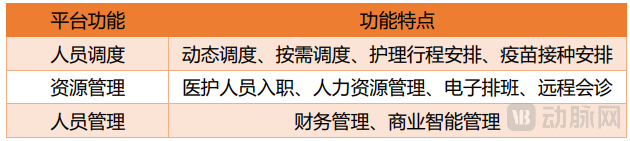
Platform FeaturesData Source:Doc Abode Official Website
The personnel scheduling module can dispatch healthcare professionals and adjust resource allocation in real time to respond to urgent care needs; it can generate staff schedules and create optimal personnel assignments. For instance, clinicians can provide detailed information such as their specialties, qualifications, locations, preferred distance limits, and availability. The Doc Abode platform matches them with eligible patients requiring treatment, thereby ensuring continuity of care for patients.
The Resource Management Module supports intra- and inter-organizational personnel mobility, streamlining employee registration, onboarding, and training. It automatically calculates staffing requirements for various positions based on business needs, intelligently generates electronic schedules, and adopts differentiated scheduling strategies for different employee types to fully meet diverse operational demands. Additionally, it provides centralized human resources management and remote consultation capabilities.
The personnel management module encompasses financial management and business intelligence management. It generates visualized reports and analyses based on multi-dimensional data, including attendance, working hours, performance, compensation, and patient needs. This approach unifies the “fragmented” management of personnel, continuously optimizes staff scheduling and rostering, and ensures the continuous operation of healthcare organizations.

Doc Abode Platform Image source: Doc Abode official website
In 2019, following a successful pilot with Local Care Direct, Doc Abode established a partnership to launch its platform for the first time in Leeds. Local Care Direct is a social enterprise providing urgent primary care to over 5 million patients across Yorkshire and the Humber. The two organizations scaled their collaboration in subsequent phases, gradually expanding the Doc Abode platform to other parts of Yorkshire, marking Doc Abode’s first step toward expansion.
In 2020, Doc Abode and Docobo announced a cross-organizational partnership to provide services to Integrated Care Systems (ICSs), Sustainability and Transformation Partnerships (STPs), Clinical Commissioning Groups (CCGs), Primary Care Networks (PCNs), GP federations, social enterprises, and healthcare service providers. Doc Abode offers a real-time clinician management platform, while Docobo provides remote monitoring solutions through its DOC@HOME platform. An interface between the two systems connects clinicians with patient needs, enabling remote monitoring and 24/7 care for patients, thereby improving the management efficiency and skill utilization of healthcare professionals.
Doc Abode subsequently expanded its platform’s service offerings through a partnership with Sesui, a specialist in providing remote solutions to UK healthcare organizations. By integrating Sesui’s telephone and video triage services with Doc Abode’s real-time clinician management platform, the collaboration enables dynamic remote scheduling for healthcare organizations, supporting Integrated Urgent Care (IUC) services—an innovative care pathway and way of working.
In 2021, after investing heavily in product development, Doc Abode partnered with the Central and North West London NHS Foundation Trust to deliver a vaccination program for patients isolating at home due to COVID-19. By leveraging its app to access real-time data on patient locations, traffic conditions, and healthcare worker availability, the platform enabled direct matching between clinicians and patients. Doc Abode’s digital solution alleviated the clinical, operational, and administrative burdens faced by the NHS.

Partners Data source: Doc Abode official website
The outbreak of the COVID-19 pandemic has overwhelmed global healthcare systems, leading to a surge in patient numbers, increased medical demand, shortages of healthcare personnel, and strained supply chains.
According to the report “Deloitte: 2023 Global Health Care Outlook,” 25% of U.S. healthcare spending (totaling $935 billion) is wasted due to administrative complexity, unreasonable pricing, and poor quality of care; 42% of physicians report being overworked, and the global shortage of healthcare workers is projected to reach 12.1 million by 2035.
Therefore, an increasing number of countries and enterprises are beginning to leverage digitalization to empower the healthcare sector. In the realm of healthcare workforce management, companies such as CareRev and Kronos in the United States, and Laoqin and Yonyou in China, have all undertaken active explorations.
In addition, multiple sectors such as telemedicine and electronic health records (EHRs) have developed under policy support and catalyzed by the COVID-19 pandemic. Currently, many regions and countries have begun to vigorously promote the development of telemedicine and EHRs.
For instance, the European Parliament launched the EU4Health programme in 2021 to support electronic health record sharing, e-prescriptions, and telemedicine; the U.S. Department of Health and Human Services introduced a new initiative to establish a nationwide interoperable healthcare IT ecosystem by 2024; Estonia, a model for digital health implementation, has been pursuing healthcare digitization for 12 years, with over 99% of medical data already digitized; meanwhile, the UK’s National Health Service (NHS) plans to roll out electronic health records to all hospitals and community clinics across the country by 2025.