

Shanghai Bisheng Management Consulting Files IPO Prospectus, Aiming to Lead Niche Medical Device CRO Market with Clinical Evaluation Expertise
China has firmly established itself as the world’s second-largest medical device market. According to “Current Status and Trends of China’s Medical Device Industry Development” published by Roland Berger, an international management consulting firm,The market size of China's medical device industry is expected to reach 958.2 billion yuan in 2022. The rapid growth of the medical device industry has driven the swift development of related third-party services, including clinical evaluation, regulatory submission and registration, and manufacturing.
Medical device CRO services cover a broad spectrum, encompassing the entire product lifecycle from R&D, testing, animal studies, clinical trials/equivalent device clinical evaluation, quality systems, and regulatory submission to post-market iterative product development. Clinical evaluation is a critical component of regulatory submission; it refers to the ongoing activity of analyzing and assessing clinical data using scientifically sound methods to confirm the safety, clinical performance, and/or effectiveness of a medical device within its intended scope of application.
In recent years, regulations related to clinical evaluation in China have been continuously improved, and the collection and organization of data have become more standardized. The concept of full lifecycle clinical evaluation was proposed in the latest "Technical Guidelines for Clinical Evaluation of Medical Devices" released in 2021.
Shanghai Bisheng specializes in providing clinical evaluation services for medical device enterprises and has ranked second in China’s clinical evaluation sector for similar medical devices.In the “large and comprehensive” CRO sector, what was the rationale behind Shanghai Bisheng’s deliberate choice to focus on a “small and beautiful” niche?

After earning her Ph.D. from Peking Union Medical College, Ji Chengxue, founder of Shanghai Bisheng, began her career as an assistant researcher at the Institute of Materia Medica, Chinese Academy of Medical Sciences, where she secured a National Natural Science Foundation of China Young Scientists Fund grant in her very first year. Despite her smooth and successful research trajectory, Ji chose to step out of her comfort zone and transition into the industry sector.
In 2015, China’s National Medical Products Administration (NMPA) officially issued the *Technical Guidelines for Clinical Evaluation of Medical Devices*. At that time, Ji Chengxue was working at a contract research organization (CRO), becoming one of the first professionals in China to specialize in clinical evaluation. She explored and pioneered this unfamiliar field, deciphering regulatory requirements, and—with the support of client teams—developed China’s first standardized template system for clinical evaluations. Subsequently, Ji Chengxue joined two multinational medical device giants, where she helped build their clinical evaluation teams from the ground up, conducted staff training, and established template systems, thereby accumulating extensive experience in talent management and project management.
During this process, Ji Chengxue discovered thatMany enterprises have limited understanding of regulations related to clinical evaluation. For certain products, following the clinical evaluation pathway for equivalent devices would suffice to meet registration requirements. However, due to a lack of awareness of relevant regulations, these companies still conduct clinical trials, which not only delays product approval but also increases corporate investment.。
To further standardize clinical evaluations and benefit more enterprises, Ji Chengxue embarked on the second career transition of her professional life by founding Shanghai Bisheng in 2020. “A person’s career unfolds in distinct stages; there are times when one must quietly accumulate strength, and other critical junctures when it is necessary to demonstrate one’s capabilities with greater visibility.”
Before the establishment of Shanghai Bisheng, the company encountered the outbreak of the global pandemic. At that time, the overall environment in the medical device industry was unfavorable, particularly for startups, with some companies facing work and production stoppages. Nevertheless, Ji Chengxue chose to proceed with the opening as originally planned. Her reasoning was: “If we encounter a pandemic today, we may face other difficulties tomorrow; we cannot retreat due to changes in the external environment.” This might well be a moment when the tide washes away the sand, revealing the true quality of gold.
She started out alone and gradually built a team of more than ten people. The core team members all have many years of work experience, and together they navigated through the outbreak of the pandemic and the Shanghai lockdown. As the company continued to grow and expand, it established branch offices in Beijing, Suzhou, Shenzhen, and other cities."Faced with colleagues who fight side by side, Ji Chengxue knows even better how to build a stage for team members and maximize their individual talents."
Ji Chengxue stated, “Last year, a registration manager from a listed company applied to our firm for a position as a clinical evaluation writer. After she joined, the company placed great emphasis on her personal development aspirations. In addition to providing her with opportunities for growth and hands-on experience in clinical evaluation projects, the company expanded into regulatory affairs-related business areas, building upon her existing professional competencies. This allowed her to further leverage her skills and maximize the value of her prior experience. Later, I recognized her aptitude for business negotiations and provided timely coaching and support, enabling her to participate in and gradually take the lead in commercial negotiations for projects.”
At Shanghai Bisheng, all business negotiations are conducted directly by directors or senior managers. Ji Chengxue believes that business negotiation and service execution are strongly correlated. Personnel responsible for execution possess extensive project experience and have the clearest understanding of their own capabilities and strengths. Through direct engagement in business negotiations, they not only gain insight into customers’ actual needs but also enhance their professional competencies in the process of further problem-solving. This approach also improves communication efficiency with manufacturers, creating a virtuous cycle where business development drives professional excellence, and professional expertise, in turn, fuels business growth.
It is precisely based on Ji Chengxue’s accurate positioning of her own capabilities that Shanghai Bisheng has chosen a niche segment within the CRO sector—clinical evaluation for predicate devices—as the company aims to build a moat that is one meter wide and ten thousand meters deep.
China’s clinical evaluation sector started relatively late, with the Technical Guidelines for Clinical Evaluation of Medical Devices officially released only in 2015, leading to progressively standardized registration management for medical devices. However, some companies remain unfamiliar with the relevant regulations and require support from third-party consulting firms to accelerate the process, which has spurred the emergence of clinical evaluation services.
There are two primary pathways for clinical evaluation: clinical evaluation based on equivalence (comparison with similar devices already registered in China) and clinical trials. According to Ji Chengxue,The market size for clinical evaluation of similar products is approximately RMB 400 million. Shanghai Bisheng’s initial objective is to capture 10% of the premium segment and establish a strong reputation.
Clinical evaluation is a field driven by technology, regulations, and talent.As regulations related to medical devices continue to be updated, CRO companies must re-adapt and promptly adjust their clinical evaluation standard systems. Meanwhile, products in various niche segments of the medical device industry have distinct characteristics, leading to differing requirements for clinical evaluation.
CRO companies must possess technical and product expertise to conduct targeted comparisons and analyses; they must also understand clinical diagnosis and treatment to evaluate product performance, efficacy, and safety from a clinical perspective. Furthermore, they require robust data statistical analysis capabilities, as clinical evaluation is not merely an accumulation of data but involves comprehensive collection and screening of relevant data, followed by rational and systematic analysis to derive scientific and valuable conclusions.
The Shanghai Bisheng team boasts extensive experience in the field of clinical evaluation and a robust project management mechanism. Firstly, the company provides clinical evaluation strategy consulting for medical device enterprises to help them select the appropriate regulatory pathway; if a product qualifies for clinical evaluation based on equivalence to predicate devices, clinical trials are not required. Secondly, the company efficiently prepares clinical evaluation reports, leveraging an internal standardized template system, efficient communication protocols, and one-on-one review and guidance mechanisms, which significantly shorten the project implementation cycle. Shanghai Bisheng adheres to an internal principle—The initial draft of the clinical evaluation report must be 100% completed within 100 days after official launch.。
According to Ji Chengxue, “Previously, one of our products entered the technical review stage, during which the reviewer issued eight questions and required the company to respond within 24 hours. Upon receiving the questions, we immediately held internal discussions to rapidly develop a response strategy. We then convened a meeting with the client to clarify the division of responsibilities between both parties. After the meeting, we prepared minutes listing all action items and assigned tasks accordingly. We consolidated the information and drafted the initial response, followed by an internal review and proofreading process. The draft response was then submitted to the client for their review. Through more than two rounds of iterative communication, we finalized the document. Thanks to our close collaboration and well-coordinated ten-step process, we successfully completed the response in just 21 hours.”
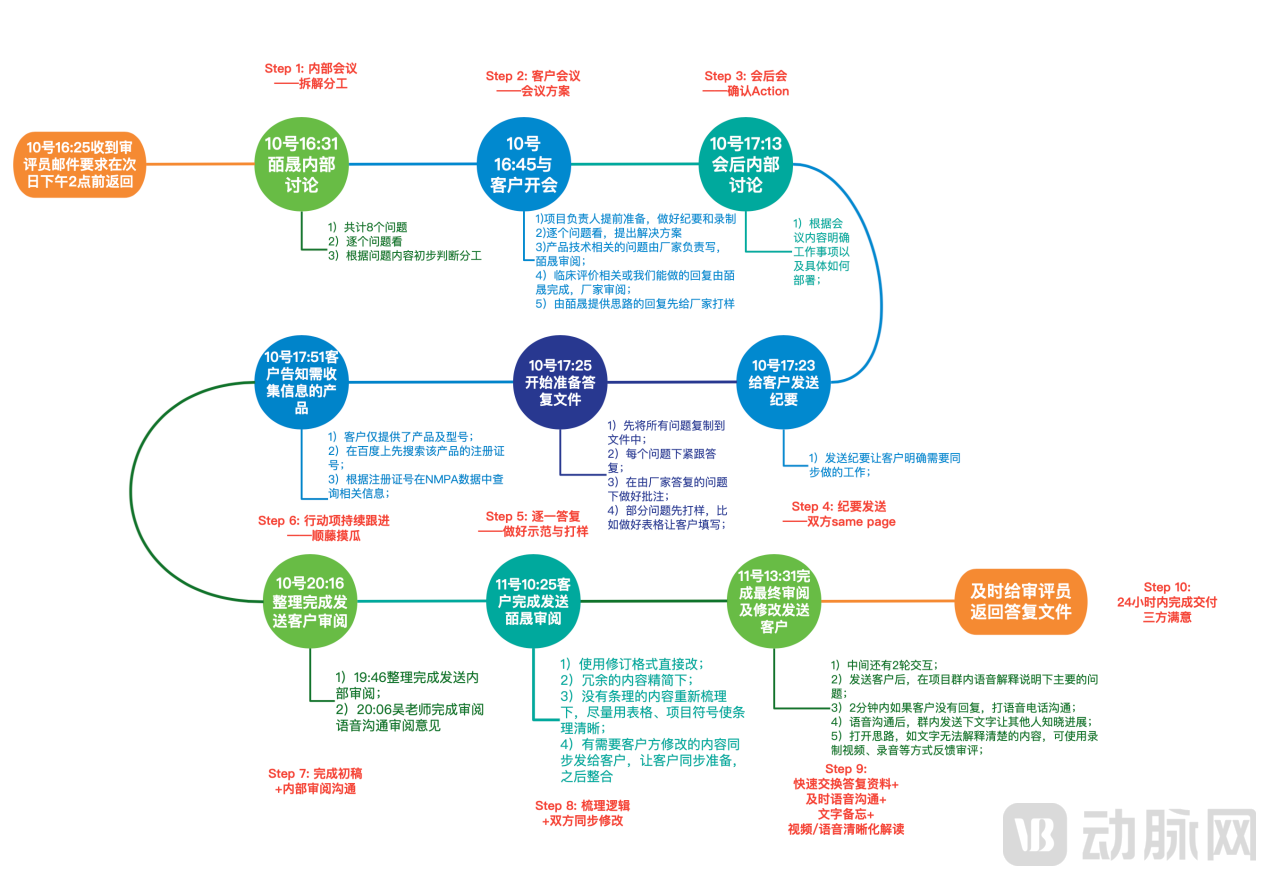
Accepting a critical assignment under pressure served as a test of Shanghai Bisheng’s project management mechanisms. The company rose to the occasion, delivering on time, earning client trust, and securing a long-term strategic partnership.
Shanghai Bisheng’s operational philosophy is guided by the “Four Principles”: institutionalizing the repetition of critical tasks, standardizing repetitive tasks into processes, equipping processes with tools, and intelligentizing those tools. Beyond team collaboration and management mechanisms, the company also emphasizes the adoption of intelligent tools to automate repetitive and tedious work, thereby enabling team members to devote more energy to high-value activities. Amid the current surge in popularity of ChatGPT, Bisheng is actively engaging with partners to jointlyDevelopment of an Intelligent Clinical Evaluation and Writing System Based on SaaS+Data, integrating a series of software functions such as literature search, literature screening and management, and data processing, to improve the efficiency of evaluation and writing.
Building on its professional and efficient operational capabilities, Shanghai Bisheng’s business scope extends both domestically and internationally. In addition to assisting domestic and foreign enterprises with registration and market launch with China’s National Medical Products Administration (NMPA), the company is rapidly expanding its overseas operations amid the growing trend of Chinese manufacturers going global.To date, Shanghai Bisheng has served over 70 projects for more than 50 enterprises, with its client roster including leading domestic and international medical device giants.
Meanwhile, to promote the widespread understanding of regulations related to clinical evaluation of medical devices, Shanghai Bisheng has participated in dozens of industry training sessions. In February last year alone, the company co-hosted three events with CMDHRA (the Human Resources Professional Committee of the China Medical Device Industry Association).Viewership exceeded 5,000 unique viewers and over 30,000 views. Through continuous refinement, the team has formed a 10-member lecturer team led by Ji Chengxue,Conducted dozens of training sessions, with over 10,000 participants, enjoys a good reputation in the industry.
Ji Chengxue has consistently conveyed to the team the principle that there must always be a Plan B, and even a Plan C.
In early 2021, Shanghai Bisheng undertook a clinical evaluation service for an internationally innovative medical device, coinciding with the release of the draft for comments on the new clinical evaluation guidelines. The project stood at the intersection of the transition between old and new regulations. Under the previous regulations, as there were no similar products marketed in China, the pathway of clinical evaluation based on equivalent devices was not feasible. However, the direction of adjustments under the new regulations was unclear, particularly regarding whether predecessor products that had not been marketed could still be considered for establishing equivalence. Furthermore, given the types and quality of data available, the pathway relying on overseas clinical trial data also presented certain uncertainties.
Shanghai Bisheng’s solution adopts a two-pronged approach,A clinical evaluation report for the same variety of products, using the previous-generation product as a comparator, was also prepared, along with an evaluation report primarily based on overseas clinical trial data for both the submitted product and the previous-generation product.. In September, when the company was preparing to submit the Clinical Evaluation Report (CER), the newly revised Guidelines for Clinical Evaluation were officially released (Announcement No. 73 of 2021). Given the product’s characteristics, the only viable pathway was to rely on overseas clinical trial data, which still required the submission of a CER. Leveraging prior preparations, Shanghai Bisheng promptly adjusted the CER in accordance with the new guidelines, rapidly integrating the two originally prepared reports into one, thereby ensuring no delay in the final delivery of the report.
During the project’s execution, another significant adjustment arose. The National Medical Products Administration (NMPA) issued the “Guiding Principles for Registration Review of Submission Requirements for Clinical Trial Data of Medical Devices” (No. 91 of 2021), which requires enterprises to include raw databases, analysis databases, explanatory documents, and program code in the clinical trial-related materials submitted. Shanghai Bisheng promptly adjusted and refined its processes in response to the new requirements, ensuring that the overall timeline for product registration remained unaffected and efficiently completing each round of queries and responses.
The successful completion of this project once again exemplifies the Shanghai Bisheng team’s rapid learning and adaptation to new regulations, their consistent readiness for regulatory filings, and their efficiency in project execution.
At the 13th China International Medical Device Regulatory Conference (CIMDR), it was mentioned thatThe Center for Medical Device Evaluation (CMDE) of the National Medical Products Administration will restructure its review process with a clinical orientation, establishing review departments and teams organized by clinical specialties to meet the requirements for scientific evaluation of the safety and effectiveness of medical devices aimed at addressing clinical needs.This means that clinical value and the metrics required for clinical evaluation should be further considered at the very inception of a product project, making it more urgent to establish full-chain services for product development.
Ji Chengxue has gained profound insights from her previous experience in conducting clinical evaluation services. “Clinical evaluation is an integral part of medical device development. In the past, it was merely submitted as part of the product registration dossier after R&D completion, meaning the clinical evaluation narrative could only be constructed retrospectively. However, through our in-depth collaboration with enterprises, we have gradually reached a consensus: clinical evaluation strategies should be considered at the project initiation stage, enabling early assessment, early implementation, and early benefits.”
If a company intends to pursue the pathway of clinical evaluation for a predicate device, it should determine the specific comparator product during the project initiation phase to ensure sufficient clinical evidence. Meanwhile, the comparator device must be taken into account in parameter design, animal studies, and non-clinical testing. By proceeding in an orderly manner in accordance with relevant regulations and guidelines, the company can avoid unnecessary clinical trials upon completion of product development.
Providing services across the entire lifecycle of medical devices is beyond the capability of any single enterprise. When collective strength is mobilized, no challenge is insurmountable.In the process of helping clients identify service providers and resources, Shanghai Bisheng has evolved from a mere project executor into a hub and center for resource integration. The company has established strategic partnerships with multiple highly professional and capable enterprises that offer services such as animal experimentation, biological testing, EMC testing, and physicochemical analysis.
Looking ahead, Shanghai Bisheng aims to collaborate with more upstream and downstream enterprises. By providing comprehensive guidance and services—including online and offline training courses, clinical evaluation reference guides, hands-on mentoring bootcamps, mini-consulting services, regulatory registration and clinical evaluation stewardship, and outsourced projects—the company will help medical device clients make informed decisions regarding R&D, clinical evaluation, regulatory registration, and market strategies. This support will facilitate talent development, accelerate project implementation, and expedite product launches, thereby enabling clients to save time, effort, and costs to the greatest extent possible.
This is a win-win endeavor. Leveraging its competitive edge in clinical evaluation, Shanghai Bisheng has secured a stable client base and is gradually expanding its business footprint, thereby delivering more comprehensive services to the industry. Meanwhile, by joining forces with CRO companies specializing in vertical sectors, it aims to collaboratively build an ecosystem covering the entire lifecycle of medical devices, thus fostering the growth and development of the entire industry.