Hangzhou-based Neurotech Firm Nuosignal Secures $420M Funding, Challenges Neuralink in Visual BCI Race

Nanochap
Core Chip Developer in the Biomedical Field

When Musk'sWhile Neuralink is still recruiting volunteers for human trials of its visual brain-computer interface, Nanochap Electronics Co., Ltd. in Hangzhou has alreadyOfficially ushered in the large-scale clinical transformation of high-resolution visual brain-computer interfaces in China.。
Recently, Nanochap Electronics Co., Ltd. announced the completionNanochap Electronics Co., Ltd. has completed a 300 million yuan strategic financing round, led by well-known industry investment institutions and Legend Capital, with super-proportional follow-up investments from Harvest Capital, GF Xinde, and Caitong Capital, while Qifeng Capital served as the financial advisor. This funding will be primarily used for multi-center clinical trials across China in the field of visual brain-computer interfaces, iteration of next-generation neuro-biological chips, and industrial capacity building, marking that Chinese enterprises are formally challenging Musk at the forefront of the global brain-computer interface in the visual reconstruction track.

The First Year of Commercialization for Brain-Computer Interfaces: Driven by Both Policy and Capital
2026 is the "Commercialization Year" for China's brain-computer interface industry, with a surge in capital enthusiasm. According to data from the High-End Medical Device Research Institute, in the top 10 billion-yuan-level financings in Q1 of 2026, brain-computer interfaces accounted for 4 spots, with a total scale of nearly 3 billion yuan.NeuroStrong 2 billion yuan, Step Medical 500 million yuanAs large-scale transactions are intensively completed,Tencent, Baidu Ventures, Shunwei CapitalCross-border giants have entered the market one after another.
Specific Financing Events in the Brain-Computer Interface Sector in the First Quarter of 2026
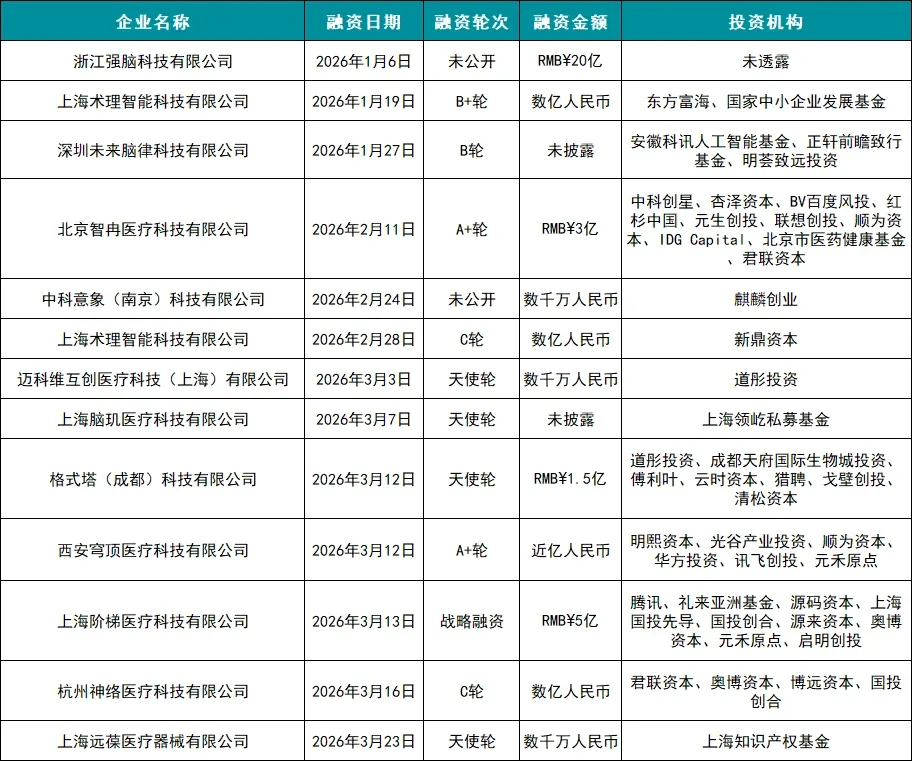
Data Source: High-end Medical Device Research Institute Data Center
The industry turning point occurred inMarch 2026: Neuracle's global first invasive brain-computer interface approved for marketing and included in medical insurance within 10 days, demonstrating China's strategic support for brain-computer technology and sending a clear signal that "innovative products with clinical value will receive full-chain green channel support.",Greatly alleviated the industry's long-term concerns about commercial implementation.。

Nanochap: From Melbourne to Hangzhou, a decade of refinement"The Original Intention of the Core"
Founded inNanochap, founded in 2014, is one of the earliest companies in China to venture into visual brain-computer interfaces and is also a national-level specialized and innovative "little giant." As founder Yang Jiawei mentioned in previous interviews, the three characters of "Nanochap" embody the company's original aspirations: "'Nan' stands for creating products with warmth, 'Chap' signifies starting from the underlying technology of chips, and 'o' represents empowerment."
This original intention stems from Yang Jiawei's near20 Years of Deep Cultivation in Neural Engineering. Twenty years ago, after graduating from the Automation Department of Zhejiang University, he enteredGlobal Birthplace of Neuromodulation Technology—— Melbourne University Neuroengineering CentreFurther Studies (where the world's first cochlear implant and the giant Cochlear were born).After obtaining his Ph.D. in 2011, he stayed on as a researcher. By 2014, he had become one of the few scientists internationally to simultaneously master high-density neural stimulators and high-resolution visual brain-computer technology.
Moved by China's thriving entrepreneurial ecosystem and Hangzhou's precise industry support policies, he ultimately chose to settle in Hangzhou and embark on his own venture."Core" Journey. When talking about the original intention of starting a business, Yang Jiawei frankly said: "At that time, China's biochip industry was still in its infancy, with many core technology barriers. I founded Nanochap to overcome these challenges and focus on the independent research and development of brain-computer interface and biosensor chips."

Core Confidence: Self-developed Biomedical Chips, Dual-path Layout Challenges Global Top-tier
Unlike most brain-computer companies that focus on sports rehabilitation,Nanochap set its sights on the brain-computer interface field from the very beginning of its establishment.Widely recognized for its extremely high technical barriers and urgent clinical needsTheVisual Reconstruction Track,This is exactly MuskThe main focus of Neuralink.
Nanochap is one of the few companies globally that simultaneously mastersRetinal Pathway Brain-Computer InterfaceE-BCI, V-BCI Dual Technical Routes of Visual Cortex Pathway Brain-Computer InterfaceThe enterprise.
Nanochap's Retinal Pathway Visual Brain-Computer Interface (E-BCI) is primarily aimed at patients who have gone blind or experienced central vision loss due to retinal diseases (such as age-related macular degeneration and retinitis pigmentosa). The product utilizes a retinal implant approach, where a flexible high-density electrode array is implanted in the macular region of the retina via minimally invasive ophthalmic surgery. This stimulates residual retinal ganglion cells, helping patients...Restoration of Functional Vision。Currently, the product has completed all preclinical verification work and is expected to launch a nationwide multicenter clinical trial in China within this year.
The visual cortex pathway of the brain implants electrode arrays in the visual cortex area. Since it completely bypasses the optic nerve pathway, the universality of vision reconstruction is enhanced. It can achieve artificial vision reconstruction for patients with eyeball loss, optic nerve atrophy, or absence. However, as it involves intracranial implantation, the corresponding clinical safety requirements are significantly increased.
Currently,Nanochap's retinal interface product has initiated human clinical trials, and its visual cortex pathway brain-computer interface product will also enter prospective clinical trials this year.

Global Race: Chinese and American Companies Compete on the Same Stage, China Holds Its Ground
The global visual brain-computer interface market has now formed a tripartite competitive landscape among China, the United States, and Europe. Chinese companies, with over a decade of technical accumulation and the policy dividends in China, have entered the top tier globally, possessing the solid strength to compete with leading players.
Players in China have formed a clear differentiated layout:MingVision Brain-MachineIn April 2026, secured an angel round of financing worth 150 million yuan; achieved the world's first "complex pattern + multi-color" vision reconstruction in 2025; and will initiate the first human clinical trials in the second half of 2026.MicroMedCompleted the first domestic clinical case of retinal implant in the same period, featuring the world's first 256-channel IMIE intelligent retina, with visual effects far surpassing the mainstream international 60-channel products;Zhongke XianjianComplete the primate verification of China's first wireless 100-channel visual cortex implant in 2025; the 128-channel chip is only button-sized, making it the world's smallest visual brain-computer implant product.
On the international track, leading companies are also making frequent moves.March 5, with Neuralink Globally Renowned Visual Brain-Computer Interface Enterprise ScienceCompleted a $230 million Series C financing round, with a post-investment valuation of $1.5 billion. Its core retinal prosthesis product has submitted an EU MDR certification application in Q4 2025, with approval expected in the second half of 2026, and will be launched first in France, Germany, and Italy.
Under Musk'sAlthough Neuralink has garnered the most attention due to its reputation, its Blindsight visual reconstruction device remains in the primate experimental stage. Recently, according to MobiHealthNews,Musk Reveals Plan to Launch First Human Implant Trials by End of 2026; He has publicly stated that the short-term goal of Blindsight is to help the blind restore basic vision, and in the long term, it will achieve "superhuman vision" capabilities such as perceiving infrared rays.
Overall, Chinese companies have basically kept pace with the international leading level in the retinal implant route, and the breakthrough in the visual cortex route technology is accelerating, which is expected to make significant progress in the future.Achieve a comprehensive surpassing of overseas competitors within 3-5 years.

Conclusion
Nanochap This Round300 Million Yuan in Financing: Not an Ordinary Corporate Funding, butThe Starting Gun for the Clinical Translation of Visual Brain-Computer Interfaces in China, and it is also an important step for Chinese technology companies to make a breakthrough towards the world's top technologies.InIn the early stages of industry development, the frontier exploration and product implementation in the visual brain-computer interface sector were mostly concentrated among overseas companies, but now Chinese companies have reached the top tier globally.
With the continuous breakthroughs of companies like Nanochap and the strong support of national policies, China's brain-computer interface industry is ushering in unprecedented development opportunities.Perhaps in the near future, the first brain-computer interface product to truly restore sight to the blind will not come from Musk.Neuralink, but from Hangzhou, China.

Report on Competition Project Achievements
Medtronic Leads, Lilly Follows! This Wuxi Medical Device Company Secures Another $100 Million in Financing
World's First + Over 1 Billion in Financing in Six Years! Medical Device Unicorn Gains Momentum
$200 Million Series C Announcement: Why Is Capital Frequently Betting on This Company?
Not chasing trends, already ahead! Overseas secures 500 million in financing, Chinese companies lead new track