

Pioneering NASH Drug Candidate DT-109 and the First Non-Human Primate Model: How Close Is a Breakthrough for NASH Therapeutics?
The Multi-Billion NASH Market: When Will It See a “Breakthrough”?
On one hand, the market size is growing steadily. According to Frost & Sullivan data, the global NASH drug market increased from $1.7 billion in 2016 to $1.9 billion in 2020, and is expected to show a trend of rapid growth in the future, reaching2It will exceed $10 billion in 2025.
On the other hand, multinational corporations (MNCs) are vying to establish their presence in the NASH drug market. Currently, more than 200 new drugs are being developed worldwide for the treatment of NASH, with nearly 30 of them originating from China; however, to dateNo company has achieved success yet.。
Currently, the pace of NASH drug development fails to keep up with the growing market demand. This discrepancy is largely attributable to the unclear pathogenesis of NASH,Lack of Appropriate Animal Models, causing a large number of new drug R&D projects to stall at the clinical development stage.
To address this challenge and accelerate the development of NASH therapeutics, on April 10, 2023,Liu Enqi of Xi’an Jiaotong University, Chen Yuqing and Zhang Jifeng of the University of Michigan, and Zheng Lemin of Peking UniversityCo-corresponding author atCell Metabolism(IF=31) Published the research paper “DT-109 ameliorates nonalcoholic steatohepatitis in nonhuman primates” Liu Enqi’s research team, leveraging a highly translatable non-human primate model of NASH, discovered that the tripeptide DT-109 (Gly-Gly-Leu) attenuates steatohepatitis and fibrosis in mice in a dose-dependent manner, demonstrating its therapeutic potential in NASH.
To gain deeper insights into research in the field of NASH treatment and explore the potential and direction for future translation of findings, VCBeat’s Orange Fruit Bureau held a dialogue with Professor Liu Enqi. The interview content is recorded as follows:
VCBeat Orange Bureau: When was this project initiated? Could you briefly introduce the team’s research achievements?
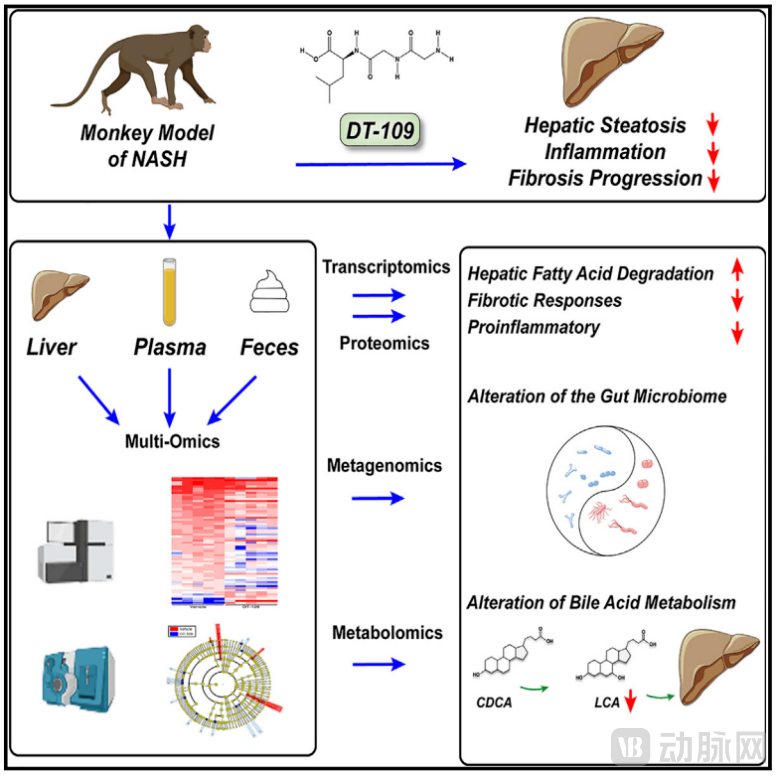
Professor Liu Enqi:Project from2018Project Initiation: Our Team Project GroupFirst, successfully established a non-human primate model of NAFLD/NASH., addressing the critical challenge of lacking reliable animal models in current NASH drug development. We then evaluated the efficacy of DT109, a novel investigational drug for NASH, and the results demonstrated thatDT-109Capable of reversing hepatic steatosis in non-human primates with NASH and inhibiting the progression of liver fibrosis. Thanks to these positive results, DT-109 is expected to enter clinical trials shortly, holding great promise for addressing the current lack of approved therapies for NASH and benefiting tens of millions of patients.
VCBeat Orange Bureau: Why Choose Non-Human Primates as Models? What Are the Advantages Compared to Other Animal Models?
Professor Liu Enqi:Animal models play a crucial role in elucidating the pathophysiological mechanisms of non-alcoholic steatohepatitis (NASH) and in the development of new drugs. Although numerous compounds have successfully treated NASH in mouse models, these models do not accurately recapitulate human disease, causing the vast majority of mouse-based studies to fail to advance beyond the preclinical stage. The non-human primate NASH model we have successfully established closely mirrors human non-alcoholic fatty liver disease (NAFLD)/NASH in terms of pathology, gene expression, metabolism, and immunity. In particular, the model animals exhibit typical pathological features observed in NASH patients, including hepatic steatosis, inflammation, ballooning degeneration, and fibrosis, as well as characteristic metabolic abnormalities.Capable of effectively simulating the pathophysiological characteristics of human diseases.
VCBeat: What is the importance of non-human primate models in NASH research? Will this model continue to be used for research in other fields in the future?
Professor Liu Enqi:I believe that the advantages of non-human primate NASH models confer greater reference value and higher success rates in mechanistic research and translational applications, which constitutes a critical aspect of these models. Given the pathogenic mechanisms underlying NASH replication, important issues such as multi-organ crosstalk in NASH, metabolic reprogramming, epigenetic reprogramming, the association between NASH and hepatocellular carcinoma, and the development of novel therapeutics for NASH still require further exploration. In my view,Applications of Non-Human Primate NASH Models Will Garner Widespread Attention and Adoption。
VCBeat Orange Bureau: What are the advantages of DT-109 under investigation in the treatment of NASH?
Professor Liu Enqi:The advantages of DT-109 in the treatment of NASH are mainly reflected in itsEfficacy and Safetyaspect. Our research results indicate that DT-109 can induce fatty acid degradation and de novo glutathione biosynthesisAntioxidant Defenseto reduce steatohepatitis and liver fibrosis. We also found that DT-109Capable of regulating blood glucose and inhibiting atherosclerotic plaques. These findings suggest the therapeutic potential of DT-109 in various lipid-mediated diseases. Furthermore, DT-109 is also capable ofMediating Bile Acid and Amino Acid Metabolism to Improve NASH, to dateNo toxic or side effects of DT-109 have been observed to date.。
VCBeat Orange Bureau: Has the team applied for relevant patents? What are the next steps?
Professor Liu Enqi:The research team comprises multiple research groups from both domestic and international institutions. Our team has achieved results related to the project.Patent Applied, some patents have already been granted. In the next step, we will focus on model-based and clinical-need-oriented approaches to further optimize our models, continue elucidating the mechanisms of NASH, and advance the development and testing of new drugs.
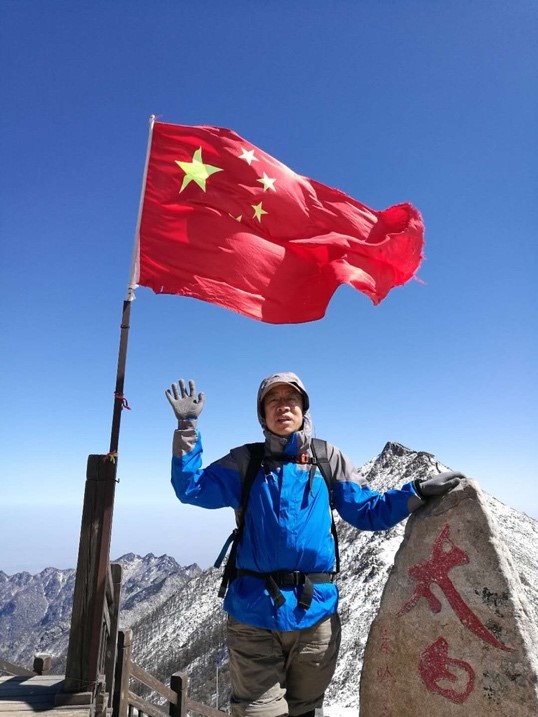
Liu EnqiPh.D., Professor, Doctoral Supervisor in Pathology and Pathophysiology, and Genetics.
Currently serves as Director of the Laboratory Animal Center/Department of Laboratory Animal Science at Xi’an Jiaotong University, concurrently as Director of the Shaanxi Provincial Center for Medical Laboratory Animals, and as Principal Investigator (PI) at the Institute of Cardiovascular Research, Translational Medicine Institute, Xi’an Jiaotong University.
Scientific Research: Research focuses on experimental studies of atherosclerosis and lipid metabolism, as well as animal embryonic development and gene editing. Has presided over more than 10 projects, including the National Natural Science Foundation of China and the National Key Technology R&D Program. Significant progress has been made in studying human atherosclerosis-related diseases and embryonic development using animal models, with over 100 academic papers published in international journals.