

Experts from NMPA Converge in Hainan to Discuss Regulatory Framework and Market Access for Digital Therapeutics
From April 27 to 28, 2023, the “2023 High-Level Forum on Policies and Regulations for Registration and Approval of Digital Therapeutics Products” (hereinafter referred to as the “Forum”), jointly organized by the Hainan Provincial Medical Products Administration, the Digital Therapeutics Professional Committee of the China Association for Medical Devices Industry, and the Administrative Committee of Haikou National High-Tech Industrial Development Zone, was successfully held in Haikou.
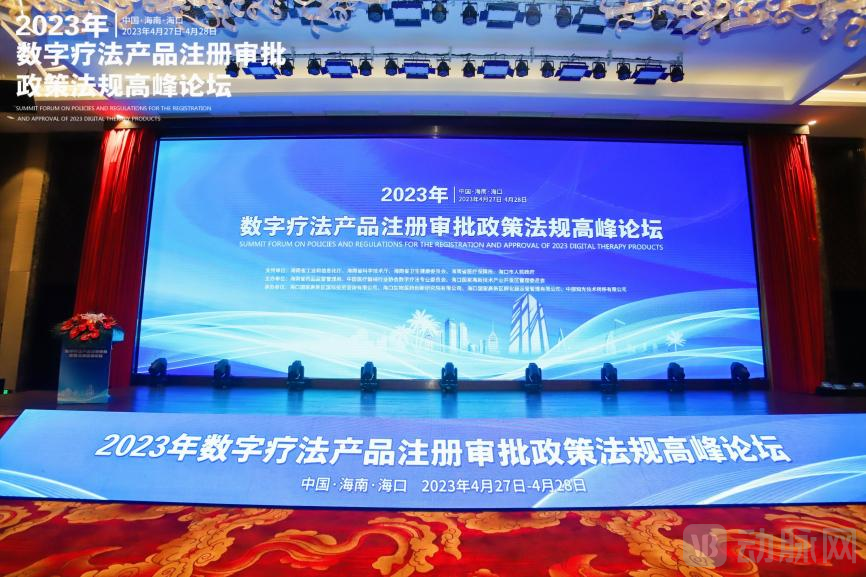
The forum focused on discussions regarding clinical research, registration submissions, and review and approval processes for digital therapeutics medical devices, aiming to facilitate key steps in market access for digital therapeutics companies. At the event, the Digital Therapeutics Industrial Park in Haikou National High-Tech Zone was officially unveiled, welcoming the signing and entry of the first batch of ten companies, including Meigao Digital Therapeutics, Aolin Optical Technology, Shijing Medical, Tehuofen Intelligent Technology, Weiming Brain-Brain, Zhuhai Yunkang, Sixteen Plus Technology, Huiren Health, Wujiang Brain Intelligence Technology, and Saike Medical.

Wang Gang, Deputy Director of the Hainan Provincial Medical Products AdministrationIn his address, he emphasized that digital therapeutics, by deeply integrating digital technologies with public health needs, are accelerating the formation of a new landscape in healthcare. Hainan will seize this historic opportunity to build itself into an innovation hub for digital therapeutics, a cluster for innovative resources, and an industrial highland, thereby positioning digital therapeutics as a new engine driving the high-quality development of Hainan’s health industry.

Zhang Yuhui, Deputy Director of the Hainan Provincial Health CommissionIntroduction: Promoting digital therapeutics is not merely about industry development; more importantly, it leverages innovative technologies to drive a revolutionary paradigm shift in the healthcare delivery system, thereby better safeguarding public health. Hainan has taken the lead in accelerating this transition through a series of policy innovations, providing comprehensive support across the entire lifecycle of digital therapeutic products.

Xu Shan, Secretary-General of the China Medical Device Industry AssociationIt was pointed out that digital therapeutics, as an emerging technology, represent an innovative approach to overcoming the limitations of traditional pharmacotherapy. The China Association of Medical Device Industry established a Special Committee on Digital Therapeutics last year. The Association will fully support the Committee’s work, and the Committee will leverage the Association’s resources to make positive contributions to exchange and cooperation among local governments, enterprises, and the industry.

Ma Yue, Deputy Director of the Administrative Committee of Haikou National High-Tech Industrial Development ZoneHaikou City accounts for over 97% of the province’s total pharmaceutical industrial output value, with the High-Tech Industrial Development Zone contributing more than 80% of Haikou’s total. Facing pressure on pharmaceutical output value, the High-Tech Zone can leverage digital therapeutics to drive transformation and upgrading. By capitalizing on the integrated innovation of provincial policies and combining the Boao Lecheng Real-World Data Study channel with professional consulting services, the High-Tech Zone will provide pharmaceutical and medical device enterprises within the park with space and platforms for innovative exploration.

Currently, as an emerging medical technology, digital therapeutics still faces market access challenges related to clinical research, regulatory submission, and review and approval. To help digital therapeutics companies navigate these complexities and promote industry development, this forum invited regulators, as well as registration and clinical professionals, to share insights on frontline work progress and practical experience.
Liang Hong, Center for Medical Device Technical Evaluation, National Medical Products AdministrationThis article introduces the regulatory review framework and research progress of digital therapeutics (DTx) medical devices. Current technical review focuses for DTx include product format, usage environment, target population, algorithm design, evidence-based medicine principles, product positioning, clinical evaluation pathways, trial design, and research conclusions. At present, key research areas in DTx encompass chronic disease management, rehabilitation training, and cognitive, psychological, and psychiatric disorders.

Wang Chenxi, Medical Device Testing Institute, National Institutes for Food and Drug ControlDiscussion on Product Quality Risks of Digital Therapeutics Medical DevicesDigital therapeutics medical devices currently face technical risks related to data, human factors engineering, safety, changes, and design and development. To mitigate these risks, it is necessary to establish technical review principles for digital therapeutics medical devices that cover major risk points; build a quality control platform and an industry standard system for digital therapeutics medical devices to provide technical guidance for the industry; and implement robust design and development practices to ensure high product quality.

Zhang Chunqing, Deputy Director of the Center for Medical Device Standards Management, National Medical Products Administration"Practical Approaches to the Classification and Determination of Medical Devices and Case Studies of Typical Software Products." The classification and determination of medical devices constitute a technical consultation matter. The classification and determination of digital therapeutics must adhere to the principle of comprehensive assessment, which involves a holistic consideration of product risk analysis. Products submitted for classification and determination should be finalized in design, and applicants must ensure that the submitted materials are lawful, authentic, accurate, complete, and traceable.

Liu Chongsheng, Secretary-General of the Digital Therapeutics Committee of the China Medical Devices Industry AssociationA report was presented on the Special Committee’s work over the past year, along with an introduction to its plans for the current year, which include hosting more than five forums, publishing more than four sets of publications, conducting more than two training sessions, and establishing one standard technical committee. The importance of standardization efforts for digital therapeutics was emphasized, and a call was made to industry experts and R&D enterprises to join the Special Committee to jointly build a standardized system for digital therapeutics. Additionally, the testing capabilities of the Shanghai Institute of Medical Device Testing in the areas of digital therapeutics, software quality, and cybersecurity were introduced, along with quality issues identified in recent years during the unique inspection processes for digital therapeutic products. The Institute also expressed its willingness to provide high-quality testing technical services for digital therapeutic products in Hainan Province, offer technical support for the review and approval of digital therapeutics in Hainan, and contribute expertise and efforts to promote the development of Hainan’s digital therapeutics industry.

Gu Xiaofang, Deputy Director of the Hainan Provincial Center for Drug and Medical Device Evaluation and Review ServicesPresenting "Interpretation of Policies Related to the Registration of Digital Therapeutics Products in Hainan Province." To support industrial development, the Center has established multiple consultation channels and implemented a series of service measures, such as pre-review, early-stage evaluation, integrated research and review, and targeted assistance for key industrial parks. These initiatives help enterprises prepare for standardized registration during the product development phase, thereby accelerating subsequent market launch. Specifically for digital therapeutics, dedicated consultation channels and priority pathways for innovative products have been added to shorten the evaluation timeline.

Jiang Luping, Chief Physician and Professor at Hainan Anning HospitalShared insights on “Academic Advances and Clinical Practice in Digital Therapeutics.” Currently, the overall prevalence of mental disorders is approximately 17.5%, with more than 300 million affected individuals. However, this is contrasted by severe challenges such as a shortage of specialized clinical professionals, uneven distribution of resources, and the lack of objective, specific biomarkers for diagnosis. The development of artificial intelligence and digital therapeutics offers new possibilities for the existing diagnostic and treatment systems. Clinically, digital therapeutics have been applied in the management of insomnia, anxiety, depression, obsessive-compulsive disorder, chronic schizophrenia, phobias, attention-deficit/hyperactivity disorder (ADHD), addiction, and post-traumatic stress disorder (PTSD), demonstrating favorable safety and efficacy profiles.

In early March 2023, the Hainan Provincial Health Commission held a promotional meeting for the Hainan Digital Therapeutics Trial Center and awarded plaques to the first batch of 20 provincial-level digital therapeutics clinical trial centers in the province. These clinical trial centers cover disease areas most frequently addressed by digital therapeutics companies, including chronic disease management, sports rehabilitation, vision rehabilitation, and mental disorders.
However, there is still a long way to go from research to practical implementation for digital therapeutics. To this end, the forum has specially organized a roundtable discussion on the clinical implementation of digital therapeutics, inviting multiple clinical experts to jointly explore the current status and practical issues of their clinical application.

Zeng Gang, Deputy Secretary of the Teaching and Research Office, Department of Pediatric Rehabilitation, Hainan Women and Children's Medical CenterHe stated that in his department, digital therapeutic products for autism-related cognitive impairments have become a powerful complement to traditional rehabilitation methods. Expert consensus on digital therapeutics for cognitive impairments has already been issued. As the digital therapeutics industry gradually matures, clinical trials for digital therapeutics may shift from the traditional medical device trial model to a combined drug-device model. Products will also need to be continuously updated and iterated through real-world studies, making them more user-friendly and accessible for both pediatric patients and their parents.
Zhang Lei, Director of the Department of Endocrinology, Haikou Orthopedic and Diabetes HospitalSharing: Digital therapeutics can improve patients' health status by influencing their lifestyles and behaviors. Currently, our department has leveraged digital therapeutics in three key areas: screening and management of diabetic complications, personalized management of patients with diabetes, and clinical decision support for primary care physicians. For clinical trials of digital therapeutics, randomized controlled trials (RCTs) are essential. Preliminary study data are also required to calculate sample size and identify specific therapeutic areas with significant efficacy. Meanwhile, patient privacy must be strictly protected.
Jia Bingshen, Director of the Department of Joint Surgery, The First Affiliated Hospital of Hainan Medical UniversityIntroduction: In the field of knee osteoarthritis, digital therapeutics can play key roles such as providing guidance on weight-loss exercises, facilitating medication delivery and offering medication adherence counseling, and supporting preoperative planning. A mature digital therapeutic product must be safe, effective, and reproducible. However, developing a mature product requires substantial investments of time, effort, and material resources.
Jiang Lianlian, Director of the Medical Technology Department at He Eye Center in ShenyangDigital therapeutics are considered to have a wide range of application scenarios in visual function training, such as amblyopia treatment, adjunctive myopia prevention and control, alleviation of visual fatigue, post-eximer laser surgery visual rehabilitation, and reading disorders, playing an important role in eye health management across the entire life cycle. Conducting clinical trials for digital therapeutics in visual training requires the team to possess high professional competence and evidence-based medical thinking, and to anticipate various factors that may affect training outcomes in advance, such as training frequency, regimen design, patient adherence, and patient education.
Professor Zhang Hong, Director of the Department of Rehabilitation Medicine, Shanghai Fourth People's Hospital Affiliated to Tongji UniversityIt is stated that the advantage of digital therapeutics for home-based rehabilitation lies in the exemption from professional personnel involvement, thereby avoiding a series of issues potentially associated with in-home visits and making the widespread adoption of home-based rehabilitation feasible. One bottleneck in clinical trials is the application scenario; it is unreasonable to verify and evaluate the safety and efficacy of digital therapeutics intended for home use within designated medical institutions, necessitating further research into the expansion of relevant regulations. Additionally, it is recommended to conduct sufficiently comprehensive virtual experiments in the early stages, after which clinical trials and subsequent clinical research can be entrusted to specialized clinical research organizations. This approach will achieve greater intensification, reduce R&D costs for enterprises, and enable companies to operate with greater agility during the early R&D phase.