

Annual Report Insights: Polarization Among China's Top Five Listed Internet Healthcare Companies

JD Health
Internet Medical and Health Service Platform Provider
When we talk about internet healthcare, the first thing that comes to mind is undoubtedly online consultation. However, mere online consultation alone is insufficient to sustain a company’s scalable revenue and profitability.
After years of evolution, internet healthcare companies have generally established service systems encompassing online consultations, prescription issuance, medication delivery, and chronic disease or health management. While these services are common across most internet healthcare firms, each company has developed distinct strategic models due to differences in their initial starting points and core competitive resources.
An examination of the current development status of several major companies reveals that the internet healthcare sector has formed a "multipolar differentiation" landscape. What does this differentiation look like? VCBeat analyzes this trend by examining the latest financial reports of five listed companies: Alibaba Health, Ping An Good Doctor, JD Health, Zhiyun Health, and Dingtang Health. (Note: Due to differences in fiscal year divisions, Alibaba Health’s data is from its 2022 interim report, while the others are from their 2022 annual reports.)
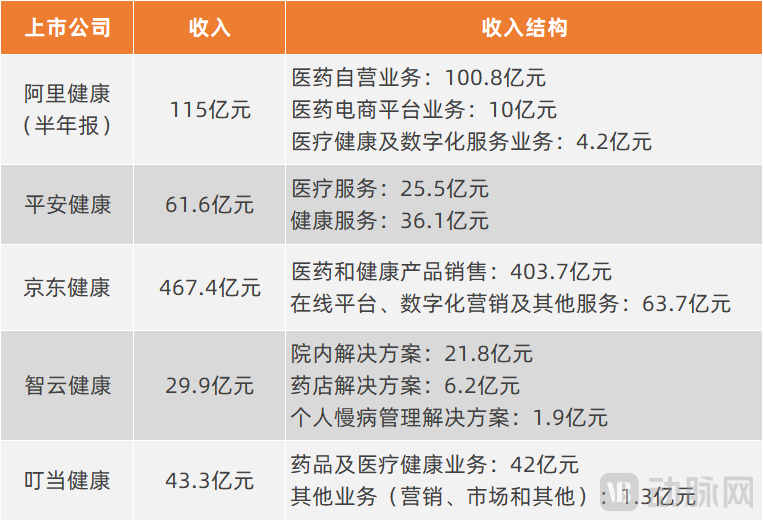
Overview of 2022 Revenues of Five Listed Companies (Ali Health: Semi-Annual Report); Source: Company Performance Reports
When categorized by primary payers, companies fall into two major groups: consumer-facing (C-end) and business-facing (B-end, referring to all payers other than individual consumers). Among these, Alibaba Health, JD Health, and Dingdang Health primarily serve individual consumers. Their e-commerce nature results in many shared characteristics among the three companies.
First, pharmaceutical retail has grown rapidly and remains the primary source of revenue.
The growth in market share of pharmaceutical e-commerce has become an inevitable trend, and the short-term impact of the pandemic has further accelerated this process.
Companies are continuously expanding their portfolios of pharmaceutical and healthcare products, including prescription drugs, over-the-counter (OTC) medications, medical devices, and health supplements, thereby offering users more choices and further accelerating the shift toward online purchasing habits. In addition, companies have been consistently enhancing their warehousing and logistics capabilities, ensuring timely medication delivery, which has also been a key factor driving more users to choose online pharmacies.
In 2022, Alibaba Health’s Tangqi Warehouse in Hangzhou commenced operations, with a maximum daily shipping capacity of 1 million orders. The entire warehouse adopts a digital and intelligent design, leveraging tools such as intelligent slotting and AI-powered picking to significantly enhance operational capacity and efficiency within the facility.
As of the end of 2022, JD Health had utilized 22 pharmaceutical warehouses and over 500 non-pharmaceutical warehouses within JD Logistics’ nationwide network, with its self-operated cold chain capability for pharmaceuticals covering more than 300 cities across China.
Driven by both internal and external factors, several companies have achieved significant performance growth. In 2022, JD Health reported total revenue of RMB 46.74 billion, with sales revenue from pharmaceuticals and health products reaching RMB 40.37 billion, a year-on-year increase of 54.2%. Dingdang Health recorded total revenue of RMB 4.33 billion, among which its core online direct-sales quick-delivery pharmacy business generated RMB 3.09 billion, representing a year-on-year growth of 19.6%.
Ali Health’s semi-annual report also holds certain reference value. In the six months ended September 2022, total revenue amounted to RMB 11.5 billion, of which revenue from its self-operated pharmaceutical business reached RMB 10.08 billion, representing a year-on-year increase of 24.2%.
Enterprises are increasingly prioritizing professional services, including medical services, pharmaceutical care, and chronic disease management.
Online medical services are directly linked to subsequent prescription and pharmaceutical services, making them a key focus for companies.
As of September 2022, Alibaba Health had contracted with nearly 180,000 licensed pharmacists, physicians, and nutritionists for its online health consultation services (including Xiaolu TCM).
JD Health has also continuously enriched its portfolio of medical and healthcare service products, launching offerings such as “Instant Ask JD Doctors,” “Online Specialist Consultations,” “Nighttime Emergency Care,” and “Find Top Doctors Online” in 2022, with daily average online consultation volumes exceeding 300,000 throughout the year.
In areas such as pharmaceutical care services and chronic disease management, the growing scale of online prescription drug sales and the increasing trend of launching new specialty drugs exclusively on digital platforms have made related patient support services essential.
As of the end of September 2022, Ali Health’s self-operated business had deeply operated 17 major “Health Care Centers,” covering disease areas such as cardiovascular diseases, dermatology, and oncology, providing pharmaceutical care services to patients. The number of chronic disease patients served reached 7.3 million, representing a year-on-year increase of 46%.
By the end of 2022, JD Health had launched 15 patient care centers covering conditions such as diabetes, hepatitis, and nutritional disorders, encompassing more than 41 diseases, to provide post-diagnosis management and follow-up services for users. Through pharmaceutical care clinics and collaboration with clinical pharmacy experts at offline medical institutions, it offers users guidance on rational medication use. In addition, JD Health opened its first hearing center store in Beijing, providing hearing aid fitting services.
Pharmaceutical services and chronic disease management can more effectively address issues related to patient treatment and medication safety. Meanwhile, improved patient adherence and timely, appropriate medication usage translate into higher repurchase rates for online platforms. Therefore, these professional services deliver significant value to all stakeholders involved.
Building on existing service workflows, digital marketing has emerged as a new growth driver.
In fact, the post-consultation follow-up, chronic disease management, and pharmaceutical care services mentioned earlier constitute, to some extent, part of digital marketing. However, digital marketing extends far beyond medication itself or merely moving academic promotion online. Collaborations between internet healthcare platforms and pharmaceutical companies have already expanded to include pre-diagnosis screening, post-diagnosis payment, and other stages.
In 2022, JD Health collaborated with Takeda China to launch an online screening program in the field of rare diseases, and also achieved phased results in innovative payment projects with Salubris Pharmaceuticals.
Dingdang Health also engages in marketing collaborations with brand partners through technological innovation. In 2022, it partnered with Voltaren to launch a digital self-assessment mini-program titled “Self-Test Your Physical Fitness and Identify Pain Risks Early,” and collaborated with Flixonase to introduce an allergy-index mini-program for digital self-assessment titled “Understand Your Allergic Rhinitis Risk Level in One Minute.”
Currently, digital marketing revenue accounts for a relatively small proportion of total revenue across companies. For instance, in 2022, JD Health’s combined revenue from its online platform, digital marketing, and other services amounted to RMB 6.37 billion, representing 13.63% of its total revenue; Dingdang Health’s combined revenue from marketing services, market services, and other services totaled RMB 130 million, accounting for only 2.9% of its total revenue.
However, most digital marketing initiatives leverage existing patient-physician and technological resources, resulting in high gross profit margins of approximately 70%–80%. Internet healthcare platforms have accumulated technical and service capabilities across the entire care continuum—pre-consultation, during consultation, and post-consultation. They provide pharmaceutical and medical device companies with a suite of marketing services, including patient screening, follow-up consultations and prescribing, drug sales and distribution, post-consultation management, and innovative payment solutions. These services help enhance partners’ marketing efficiency and more comprehensively uncover new growth opportunities.
Despite sharing certain commonalities, each of these companies exhibits distinct characteristics.
For example, Alibaba Health leverages its extensive traffic entry points to focus on building services such as traditional Chinese medicine and vaccines.
Alibaba Health boasts extensive traffic sources. In addition to the Yilu app, its pharmaceutical and healthcare services also reach users across Alibaba’s ecosystem, including Tmall, Taobao, Alipay, Taobao Deals, Ele.me, Amap, DingTalk, Hema, and Quark Search.
While maintaining steady growth in its self-operated pharmaceutical business, pharmaceutical e-commerce platform, and healthcare and digital services, Alibaba Health has prioritized the deepening of traditional Chinese medicine and vaccine-related services.
In the field of Traditional Chinese Medicine (TCM), Ali Health has continued to leverage its years-accumulated resources, technological capabilities, and brand advantages following its acquisition of Xiaolu TCM, thereby enhancing its medical service capabilities. In 2022, Xiaolu TCM partnered with “Beijing Time,” the official new media platform of Beijing Radio and Television Station, to establish an appointment registration platform for renowned TCM practitioners in the capital, improving the accessibility of TCM services. As of September 2022, Xiaolu TCM had registered 91,000 TCM physicians, served nearly 11 million patients cumulatively, and further refined its pharmaceutical service network.
In the area of vaccines, Alibaba Health has partnered with thousands of vaccination institutions to enhance the digitalization of vaccination services, improve users’ experience and efficiency in accessing vaccine-related information and services, and boost vaccination uptake.
JD Health builds online medical service capabilities by referencing physical entity architectures and strengthens reverse customization of products.
In 2022, JD Health continued to refine its online departmental structure, establishing more than 150 secondary clinical departments. Building on the foundation of 27 specialized centers, JD Health launched its Dermatology Hospital in 2023. This initiative can be understood as an upgrade from a major specialty or diagnostic and treatment center within a general hospital to a dedicated specialized hospital. These structures closely mirror those of physical medical institutions, thereby enabling the provision of more targeted medical services.
In retail, JD Health is focused on enhancing its C2M (Consumer-to-Manufacturer) reverse customization capabilities. By leveraging years of accumulated user data, the company customizes products and services for different demographic groups and even individuals, thereby improving supply chain efficiency.
Dingdang Health has consistently focused on the niche demand for “urgent medication,” and, building on its established coverage areas and user base in the early stages, has reduced operational costs.
In 2022, the total number of orders through Dingdang Health’s online direct-sales channels reached 61.7 million, with an average revenue per order of RMB 50.1. Amidst intense “price wars” in the online pharmaceutical market, increasing the average transaction value is one aspect, while reducing operational costs has become increasingly critical.
Dingdang Health leverages technologies such as AI, 5G, the Internet of Things (IoT), and cloud computing. It employs “geo-fencing” technology to scientifically optimize pharmacy site selection, and utilizes intelligent systems—including “electronic route planning,” “Dingdang Sandbox,” “smart mobile picking,” and “dynamic mobile inventory counting”—to comprehensively enhance operational efficiency. Additionally, it flexibly configures multi-modal delivery capacity to significantly reduce costs.
It is worth noting that Dingdang Health has begun piloting the collection of medication delivery fees in select cities, which has helped reduce costs to some extent.
Overall, in the consumer-paid model, companies need to build a service model that drives volume, price, and effectiveness simultaneously, although specific approaches vary among companies.
Among publicly listed internet healthcare companies, Ping An Good Doctor and Zhiyun Health primarily rely on B-side clients as their main payers. However, the commonalities between the two companies are largely limited to basic services such as online consultations and prescription refills for follow-up visits; their differences far outweigh their similarities. The key distinction lies in the fact that they serve different “B-side” clients, with vastly divergent business structures and operational logics.
Targeting financial channels and enterprises as primary clients, representing payers to integrate service providers
Business synergy with the Ping An Group has always been a distinguishing feature of Ping An Health compared to other internet healthcare companies.
In 2022, Ping An Health rapidly adjusted its previously individual-centric channel and business development system, building a new framework capable of supporting business expansion for financial and corporate clients, with these characteristics becoming even more pronounced.
In terms of financial channels, Ping An Health continues to leverage the customer base and resources of Ping An Group, collaborating with its integrated financial services to build a managed care model through the “Integrated Finance + Healthcare” combination. Meanwhile, the precise conversion of high-value customers from Ping An Group’s integrated financial services serves as another key growth driver.
In 2022, the number of paying users from Ping An Group’s integrated financial channels exceeded 34 million, achieving a penetration rate of approximately 15% among its 228 million individual financial customers.
While actively exploring and strengthening business synergies with Ping An Group to serve its integrated finance customers, Ping An Health is fully focused on the corporate client segment, serving enterprise employees and corporate users.
For corporate clients, Ping An Health has established the “Yi Qi Jian Kang” product system, featuring two core solutions—“Check-up+” and “Health Management+”—which are combined with various service modules to meet the diverse needs of enterprises.
As of the end of 2022, Ping An Health had cumulatively served 978 corporate clients, covering nearly 3 million enterprise employees and users; at the end of 2022, the renewal rate for its existing large-scale corporate clients (with more than 3,000 employees) reached nearly 90%.
On the supply side, Ping An Health has integrated a variety of resources, including internal and external physician teams, physical medical institutions, pharmacies, and consumer healthcare providers, to jointly serve customers.
In other words, Ping An Health’s B-side clients primarily include insurance companies, banks, and enterprises with employee health management needs. Its business logic lies in integrating service providers on behalf of payers; the payers are various B-side clients, while the service providers encompass online and offline resources such as physicians and healthcare institutions.
“Hospital First” Strategy Continues to Gain Momentum, Driving a Surge in In-Hospital Business Revenue
“Hospital First” is the core strategy of Zhiyun Health. Based on hospital partnerships, Zhiyun Health generates revenue through value-added solutions and subscription-based solutions.
Among these, the comprehensive value-added service solutions leveraging the hospital SaaS network include SaaS platforms and medical supplies for chronic disease management, including proprietary AIoT devices that can connect to the SaaS platform. By the end of 2022, approximately 2,567 hospitals had installed the Zhiyun Yihui SaaS system, including 714 tertiary public hospitals, 761 secondary public hospitals, and 38 of China’s top 100 hospitals. In 2022, the number of hospitals purchasing value-added solutions directly or indirectly from Zhiyun Health reached 2,818, representing a year-on-year increase of 34%.
The subscription-based solution primarily leverages the hospital and physician resources covered by SaaS to provide digital marketing services to pharmaceutical companies. As of the end of 2022, Zhiyun Health had 26 paying customers, with a customer retention rate of 93%.
The growth in hospital clients may not only drive revenue increases from medical supplies, but also unlock more digital marketing opportunities by expanding access to physician resources.
Driven by deep engagement with hospital clients and aggressive market expansion, Zhiyun Health achieved revenues of RMB 2.99 billion in 2022, of which RMB 2.18 billion came from its in-hospital solutions, representing a year-on-year increase of 71.6%.
Therefore, although Zhiyun Health also collaborates with pharmacies and provides chronic disease management services, its overall business logic is built on partnerships with hospitals, which serve as both the payers and the providers of resources and services.
There are significant differences in the decision-making processes between B2B and B2C clients. Enterprises must better strike a balance between standardized services and personalized offerings to expand customer coverage while controlling costs.
It is evident that the “multi-polar differentiation” among internet healthcare companies is becoming increasingly pronounced. During this process of differentiation, each company’s business model exhibits distinct characteristics.
It is not only listed companies that are following this trend; unlisted companies are doing the same. For instance, Haodf Online leverages expert resources across various regions, extending its services to insurance and corporate client solutions while maintaining online consultations as its core business. WeDoctor’s Digital Health Community model continues to operate in Shandong, Tianjin, and other regions, deeply integrating with local healthcare systems to demonstrate the value of internet-based healthcare in improving medical quality and efficiency, as well as controlling health insurance costs. Medlinker has developed medGPT, an AI doctor powered by large language models, seeking to expand the application scenarios of AI in disease prevention, diagnosis, treatment, and rehabilitation. Weimai has long collaborated with hospitals nationwide to provide whole-course disease management services for patients, addressing the lack of out-of-hospital care and the disconnect between in-hospital and out-of-hospital services in traditional healthcare delivery.
To date, it has become increasingly difficult to directly compare companies based on a single dimension or a few select metrics. While their service offerings overlap, each company addresses different industry pain points, all of which warrant improvement. Consequently, it is premature to declare any single business model the definitive “winner.” More likely, participants will leverage their complementary strengths to form a rational ecosystem, propelling the industry forward and emerging as collective winners.