

From Cultural Capital to Europe's Life Science Hub: The Rise of London's Innovation Ecosystem

The London Fund
Provider of Investment Banking Services for Emerging Technologies
London has been a prominent presence in nearly every era of world history. It is a city brimming with charm and the hometown of Byron, Shakespeare, and Dickens. London boasts more than 192 museums, including 11 national museums, and commands a 30% share of the global art market.
Moreover, it is Europe’s largest life sciences innovation hub, where countless tech companies, startups, and incubators have formed a highly dynamic innovation ecosystem. These companies demonstrate exceptional performance in both technological innovation and business models, injecting robust innovative momentum into London’s innovation ecosystem.

London Nightscape. Image source: London & Partners
However, prior to 2010, London’s global image was still that of a “cultural capital.” Over the subsequent decade, bolstered by robust policy support, high-level scientific research and innovation, and a rich, vibrant industrial cluster, London emerged as Europe’s most attractive hub for life sciences, actively engaging in the global innovation landscape as a “city of technology” and the UK’s “Silicon Valley.”
In this process, the development of an innovation ecosystem has played a nearly decisive role.
From the capital of arts and culture to today’s “Silicon Valley” of European life sciences, London’s remarkable transformation is inextricably linked to an initiative called “MedCity.”
In 2014, the UK government proposed transforming London into Europe’s “capital of health and medical technology.” After visiting a biodesign project at Stanford University, Christopher Kit Malthouse, then Deputy Mayor of London, decided to establish London as a city of medicine—MedCity.
In simple terms, MedCity is a cluster organization dedicated to building London’s health and life sciences industry. Established through a partnership between the Mayor of London and the city’s Academic Health Science Centres, its purpose is to foster international collaboration between healthcare innovation companies and London’s life sciences ecosystem, thereby accelerating medical innovation across the UK. The initiative encompasses nearly all areas of healthcare and life sciences, including drug discovery, advanced therapies, medical devices, diagnostics, digital health, technologies supporting prevention, management, healthcare delivery, and system improvement, as well as medtech companies leveraging big data, artificial intelligence, and machine learning.
For MedCity, the UK government and relevant agencies have introduced a series of policies covering multiple areas, including innovation strategy, new drug development, investment and entrepreneurship, digital health, and European ecosystem partnerships.
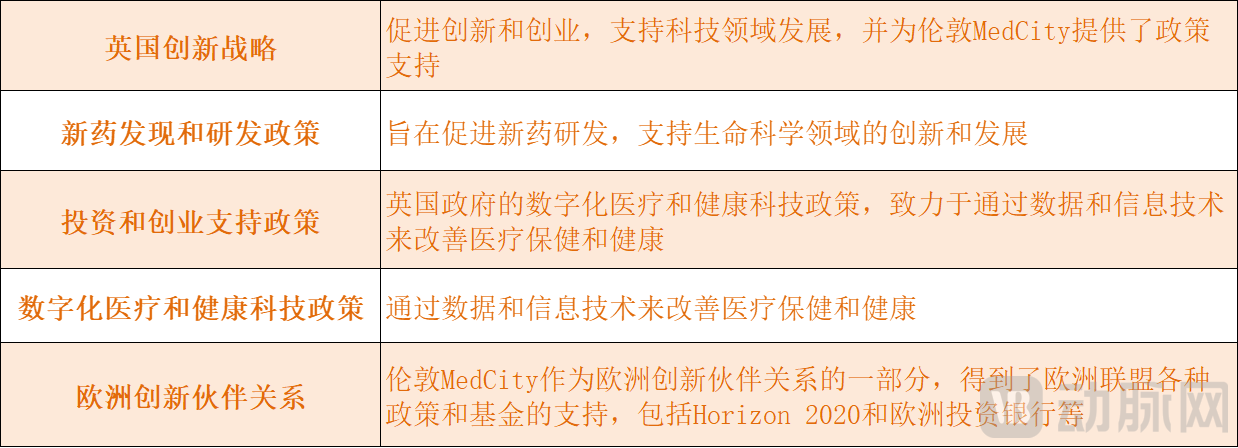 MedCity-Related Policy Highlights
On April 1, 2023, the organization was formally merged into London & Partners to jointly promote investment and innovation in London’s health and life sciences sectors and strengthen connections within the ecosystem.
London’s life sciences cluster ranks among the global leaders in R&D, second only to Boston, USA. The “UK Life Sciences Golden Triangle” (hereinafter referred to as the “UK Golden Triangle”) brings together the most premier innovation resources in the UK and even worldwide.
The so-called "Golden Triangle Universities" refer to six top-tier research universities in England, located in the cities of Cambridge, Oxford, and London. These institutions are the University of Cambridge, the University of Oxford, Imperial College London, University College London (UCL), King's College London, and the London School of Economics and Political Science (LSE). Among them, the University of Cambridge, the University of Oxford, UCL, Imperial College London, and King's College London all rank within the top 20 globally in life sciences.

University of Oxford, one of the UK’s “Golden Triangle” elite universities. Image source: Unsplash
As leaders in various fields spanning the natural and social sciences, the “Golden Triangle” universities are also synonymous with prestige and reputation. Leveraging these academic resources, the UK’s “Golden Triangle” region boasts the largest pool of research talent in the country, with more than 185,000 life sciences students enrolled and over 55,000 graduates produced annually.
This is Europe’s largest talent pool for the life sciences. London, closely linked with the Oxford and Cambridge clusters, also enjoys access to the finest life sciences research and intellectual resources.
Furthermore, the United Kingdom is home to five Academic Health Science Centres (AHSCs), three of which are located in London. These centers aim to strengthen collaboration between academic researchers and healthcare innovation companies, laying the foundation for exploring new therapies, developing new technologies, and cultivating new talent.
Moreover, the government has invested in building several platform-type research institutions to foster innovation in related fields. Examples include the Roslin Institute, which focuses on life sciences, and the Henry Royce Institute, which specializes in advanced materials. In 2021, the UK government also established the Advanced Research and Invention Agency (ARIA). Backed by £800 million in government funding, ARIA primarily supports high-risk, high-reward projects aimed at translating scientific achievements into practical applications.
For innovation in the healthcare sector, clinical validation is required in addition to technological innovation itself. In this regard, London also provides robust support for the clinical validation of medical technology innovations.
The NHS (National Health Service), or the UK’s National Health Service, is responsible for providing publicly funded healthcare to all UK residents and serves a patient population of over 80 million. This highly diverse healthcare system offers extensive data support to medical companies.
Within the MedCity framework, there are 140 specialized clinical service providers, 39 hospital trusts, 32 Clinical Commissioning Groups, and nine NIHR Biomedical Research Centres. Additionally, London is home to four Experimental Cancer Medicine Centres, three Academic Health Science Centres, three Genomic Medicine Centres, and three NIHR Translational Research Collaboration Centres. These institutions and entities have established a health science network encompassing academia, clinical research, and clinical services, providing the conditions and platforms for the generation and clinical validation of medical technology innovations.
The presence of universities and clinical validation platforms has provided fertile ground for innovation and translation in the healthcare industry. On the corporate side, the London municipal government has implemented a series of innovative policies to encourage R&D and innovation among enterprises, supporting the growth and development of startups.
First, establish fundamental regulations such as the tax system and intellectual property rights (IPR) system. The United Kingdom was the first country in the world to implement IPR protection. To support innovative companies of all sizes in establishing and growing within the UK, and to encourage enterprises to adopt new technologies and pursue independent innovation, the UK government introduced R&D tax relief. For large enterprises, the R&D expenditure credit is equivalent to 20% of eligible R&D expenditures, resulting in a standard net post-tax benefit of 15%. Small and medium-sized enterprises (SMEs) that incur qualifying R&D expenditures can claim tax credits amounting to 186% of their R&D costs.
Furthermore, in 2013, the UK government launched the Patent Box policy, which allows companies to apply for a reduced tax rate (as low as 10%) on income derived from patents. This initiative aims to incentivize enterprises to create intellectual property and file patents in the UK, as well as to further develop and commercialize patented innovations within the country.
Second, improve innovative financing channels. Support entrepreneurs and startups in increasing R&D capital; enhance access to financing for small companies, startups, and companies with high impact on future markets; increase international R&D capital investment in the UK's most innovative companies.
London boasts the most developed financial industry in the UK. To promote industrial innovation, the London Municipal Government has established a series of funds to support startups, innovative projects, and technological research and development.
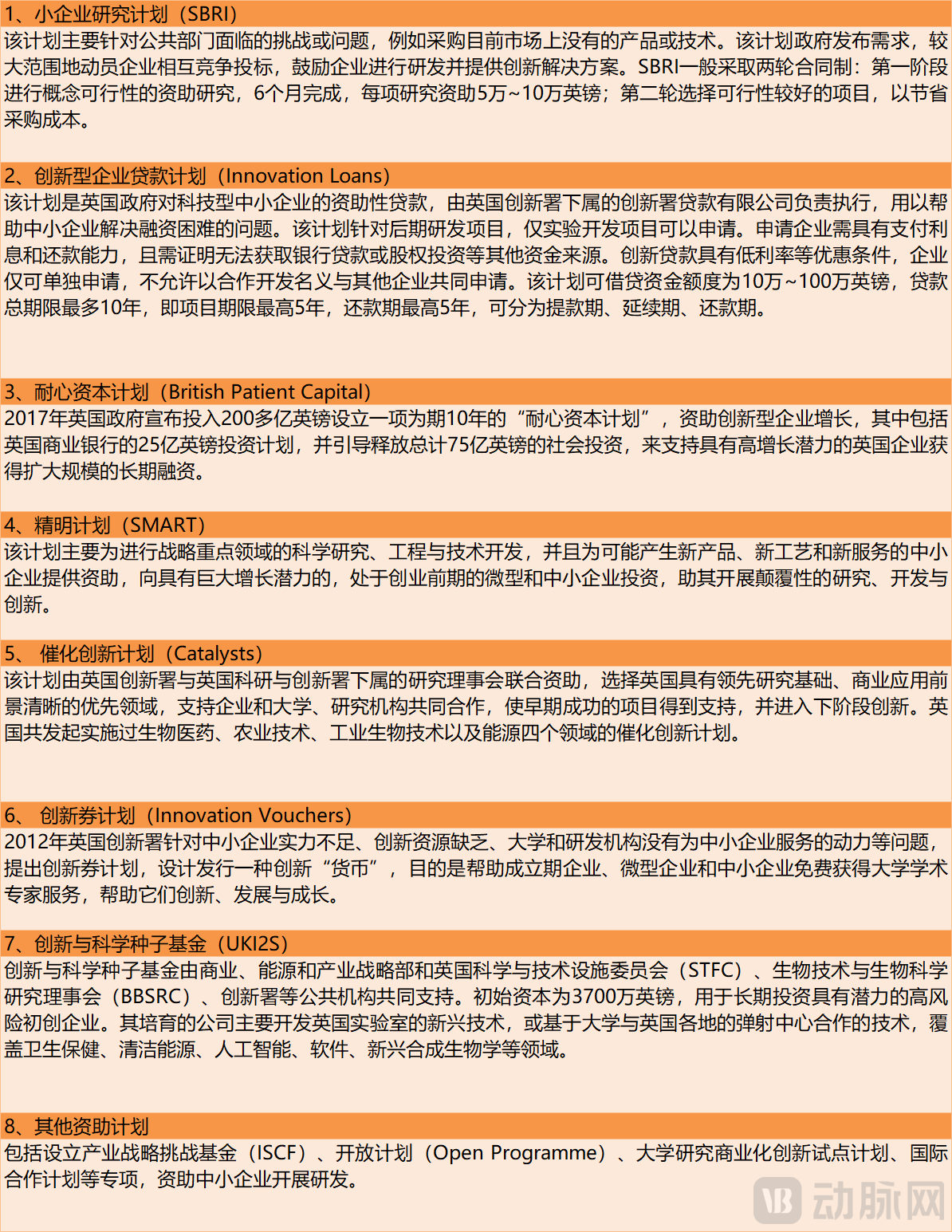
London City Hall’s Fund for Startups and Innovative Enterprises
UK Research and Innovation (UKRI) is the UK’s largest public funder of research, responsible for allocating approximately £7 billion in annual public research and development funding on behalf of the UK government. The agency comprises nine councils, including seven disciplinary research councils. In June 2021, the Infrastructure Fund under UKRI announced an investment of £50 million in 17 infrastructure projects to enhance the UK’s research and innovation capabilities.
Following its 2018 reform, Innovate UK became part of UK Research and Innovation (UKRI). As the UK government’s primary public body for directly supporting business innovation, enhancing technology transfer, and building an innovative nation, its core function is to support technology development in alignment with governmental strategic objectives. By designing and implementing programs, fostering innovation networks, and promoting collaboration between industry and academia, it underpins the growth of the UK’s innovation-driven economy. The agency primarily provides funding to companies registered in the UK and innovative teams, offering grants ranging from £25,000 to £10 million per project.
Furthermore, to facilitate the translation of research outcomes into economic and social benefits, the UK government began establishing Catapult Centres in 2010. These centres are designed to be industry-demand-driven, bridging academia, research, and industry to address technical challenges faced by sectors and to help technological innovations cross the “valley of death.” One-third of the funding for Catapult Centres is provided by the UK government through Innovate UK, one-third comes from industry, and the remaining one-third is earned competitively through paid services offered by the centres. To date, nine Catapult Centres have been established, two of which are related to healthcare: the Cell and Gene Therapy Catapult and the Medicines Discovery Catapult.
Scientific innovation requires the integration of industry, finance, and science. To promote close collaboration among these three sectors, the UK government established the Knowledge Transfer Network (KTN), aiming to facilitate cross-sectoral and interdisciplinary exchanges and to identify markets and funding for innovation. The KTN comprises 20 interest groups in fields such as biotechnology, the Internet of Things (IoT), and graphene, with participants primarily consisting of researchers, industry professionals, and investors from relevant domains.
Finally, public websites and online tools also play a role. The Academic Health Science Networks (AHSNs), established by the NHS in 2013, primarily aim to translate research on medical innovations into practice, with one of their key responsibilities being to assist the NHS in project tendering. In addition to the government website gov.uk, UK Research and Innovation (UKRI) and various research council platforms—such as Research Fish, Konfer, and Gateway to Research—also promptly publish information on project tenders and diverse innovation resources.
Creation of Innovation Spaces
Since the inception of Cambridge Science Park, nearly 100 science and technology innovation parks of varying sizes and types have emerged across the United Kingdom. These parks are primarily established to facilitate the commercialization of scientific and technological achievements and to provide services to entrepreneurs, startups, and technology-based enterprises.
In 2022, the NHS Property Services submitted a plan to redevelop five underutilized and vacant sites at the Whitechapel Campus in London, creating a new life sciences hub adjacent to The Royal London Hospital.
Whitechapel is home to The Royal London Hospital and Queen Mary University of London. Notably, Queen Mary University of London has produced nine Nobel laureates and is the birthplace of medical and dental education in London. Consequently, the presence of numerous other health and research institutions has established Whitechapel as a major hub for academic life sciences and clinical activities.
It is reported that a large-scale urban regeneration plan is underway in the Whitechapel area, with an investment of £300 million. Of course, this is far from the only life sciences center being planned and built in London; more such hubs are converging on the city.
Canary Wharf Group and developer Kadans Science Partner have announced the formation of a joint venture to develop a life sciences-focused wet laboratory building in London’s Canary Wharf. The first phase of the project, spanning 750,000 square feet across 22 floors, is scheduled for completion in 2026. It is reported that the developers also plan to construct a “world-leading health and life sciences hub” at North Quay, adjacent to the new Elizabeth line station.
The life sciences project at Vinegar Yard, London Bridge, was designed by the developer in collaboration with Guy’s and St Thomas’ NHS Foundation Trust. The 20-story building will comprise 370,000 square feet of commercial space, including 60% laboratory space and 40% office space.
White City, as the new hub of West London, has long been in the spotlight and is home to Imperial College London’s new campus. Spearheaded by Imperial College London and numerous developers, White City has attracted a significant influx of cutting-edge life sciences companies, evolving into a thriving life sciences cluster.
Most of these life science hubs are located near London’s renowned universities and top-tier hospitals, while the city’s vibrant financing ecosystem provides essential support for innovation incubation and startup growth. In 2022, London-based tech startups ranked first in Europe and fourth globally in total funding raised, amounting to $1.98 billion (with the U.S. Bay Area, New York, and Boston occupying the top three spots). Therefore, despite higher rental costs compared to Cambridge and Oxford, London continues to attract life science centers and innovative companies due to its excellent transportation infrastructure, high-quality university and hospital resources, and its influence as the UK capital. The establishment of these life science industry bases will create numerous job opportunities, attract a large pool of high-caliber talent, stimulate trade and commercial development in surrounding areas, and inject greater vitality and opportunity into the region.
Bolstered by robust industrial support, ample space, and world-class research capabilities, London has become one of the preferred destinations for life sciences startups.
The most famous cluster of startups here is called Shoreditch, which is home to London’s earliest arts district. After Tech City UK was established in London in 2010, Shoreditch attracted tech giants such as Cisco, Intel, Amazon, Bloomberg, Twitter, and Qualcomm. In 2011 alone, more than 200 technology companies headquartered their operations in Tech City UK.
Today, Shoreditch is hailed as the UK’s “Silicon Valley,” with renowned incubators and startup accelerators such as Y Combinator, Seedcamp, and Accelerator London based there, providing startups with funding, incubation services, networking opportunities, technical support, and a favorable business environment.
Furthermore, 1 Knowledge Quarter on King’s Cross has emerged as one of the most concentrated research clusters globally, housing 75 research institutions and technology companies, including the Francis Crick Institute, Google’s headquarters, and The Alan Turing Institute.
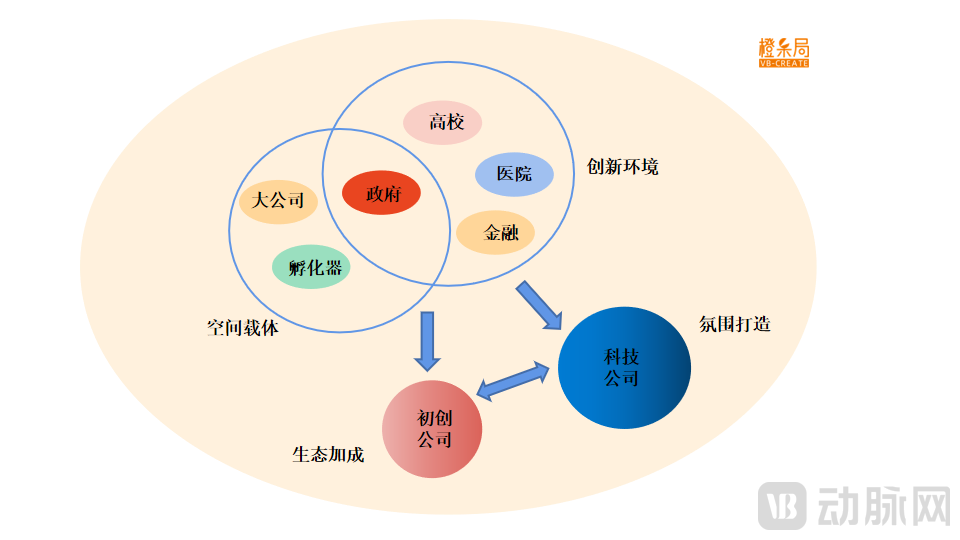 Composition of London's Innovation Ecosystem
Unlike the industry-led innovation ecosystem in Boston, the government has always played a significant role in the formation of London’s innovation ecosystem.
Reviewing its development trajectory, the London innovation ecosystem can be divided into several components as illustrated in the figure above. The government, universities, hospitals, and financial institutions constitute the soil of the innovation ecosystem, providing a foundation for the development and growth of innovative companies. Meanwhile, the physical spaces and innovation clusters built by the government and large corporations act like ink splashes on the innovation map, highlighting the core areas of innovation development with focused emphasis. Subsequently, the emerging innovation parks, life science centers, and incubators provide the necessary infrastructure for tech companies and startups to establish their presence. The establishment of these tech and innovative companies is akin to towering trees within the innovation ecosystem, drawing greater attention to the construction of the innovation circle and marking the formation of a vibrant industrial atmosphere.
Ultimately, the aggregation and growth of numerous startups from academia and industry signify the formation of a closed-loop innovation ecosystem. Startups incubated and spun out from university research have become emblematic of London’s life sciences innovation. In addition to Oxford Nanopore, companies such as Healx, which focuses on discovering and developing treatments for rare diseases; Feebris, which provides intelligent medical diagnostic and management tools; Fluidic Analytics, specializing in protein analysis technology; and Congenica, offering genomic data analysis and diagnostic services, are emerging as new hallmarks of London’s life sciences hub.
Today, London has become the mecca of life sciences in Europe. The emerging tech hub in East London is forming a life sciences industrial cluster that rivals those in Boston and Silicon Valley.
From the initial proposal of MedCity to the present-day European Star, success has been inseparable from the inherent advantages conferred by London’s academic and medical resources. However, innovation does not necessarily need to be implemented in its place of origin. The seeds of innovation were able to take root, sprout, and grow in London, starting with innovative advantages, thriving with policy support, and ultimately flourishing through a sustainable innovation ecosystem that connects government to industry, fostering a cycle of symbiosis.