

How Vaxcyte Defies Oligopoly: A Next-Gen Vaccine Innovator Surges 200% Amid Market Dominated by Four Giants

RA Capital
Life Sciences Venture Capital Firms
Vaxcyte
Novel Vaccine Developer

TPG Growth
Growth Equity Firms and Middle-Market Buyout Firms

CARB-X
Venture Capital Firm
The global vaccine market has long been characterized by an oligopolistic structure. According to data from Evaluate Pharma, in 2020, the combined revenues of the four vaccine giants—GlaxoSmithKline, Merck & Co., Pfizer, and Sanofi—accounted for 90% of the global vaccine market size. However, due to the COVID-19 pandemic in recent years, many new entrants have gradually emerged in the vaccine market.
Vaxcyte (NASDAQ: PCVX) is one such U.S. vaccine innovator that has taken off by capitalizing on this momentum.
In 2013, Janssen Biotech entered into an agreement with Sutro Biopharma (hereinafter referred to as “Sutro”) to establish a vaccine company: SutroVax (the predecessor of Vaxcyte). Initially, SutroVax primarily leveraged Sutro’s Xpress CF™ cell-free protein synthesis platform to develop novel vaccines against various diseases. In 2020, SutroVax was renamed Vaxcyte and listed on the Nasdaq, closing at $26.15 per share, representing a 63.44% increase over its initial public offering price.
In April this year, Vaxcyte’s key candidate drug—the 24-valent pneumococcal conjugate vaccine (VAX-24)—achieved success in its second Phase II clinical trial, prompting the company to raise $575 million through a public offering. Vaxcyte’s stock price surged to $45.1 per share, bringing its market capitalization to $3.7 billion, representing an approximately 200% increase from the $1.2 billion valuation on its IPO day.
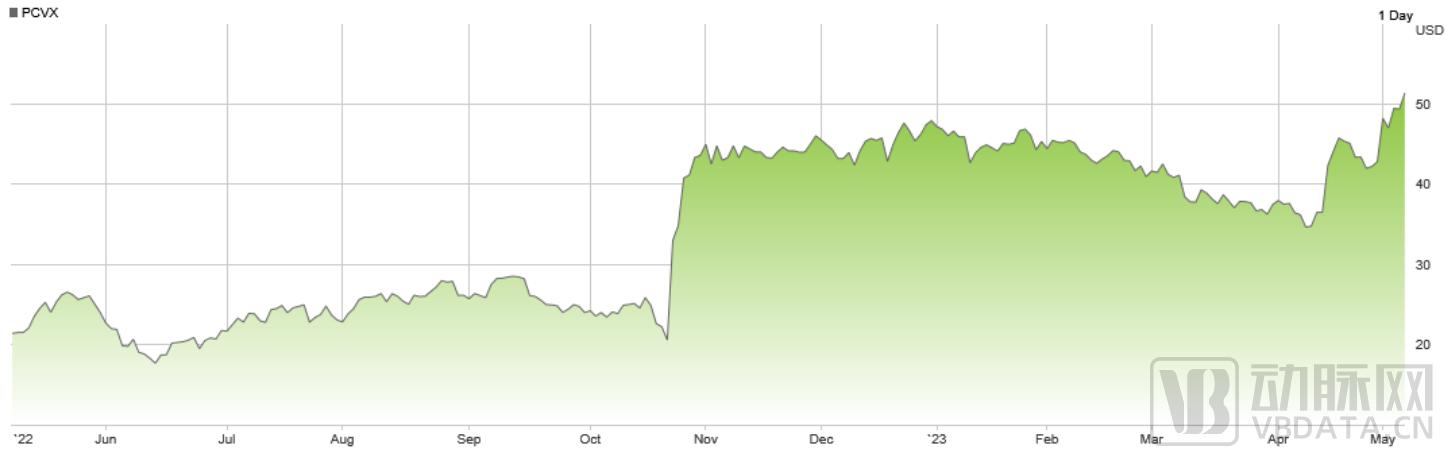
Vaxcyte Stock Price
Image source: Refinitiv official website
Regarding pneumococcal conjugate vaccines (PCVs), the U.S. Centers for Disease Control and Prevention (CDC) recommends pneumococcal vaccination for all infants and all adults aged 65 years or older. However, the current market is largely monopolized by vaccine giants. With Johnson & Johnson as its backer, what R&D capabilities does Vaxcyte possess to win market favor on the path of vaccine innovation?
Bacteria employ a multitude of physical, biochemical, and immunological mechanisms to evade attacks by host immune cells. Therefore, to overcome bacterial defenses, vaccines must incorporate multiple antigens, serotypes, or immunoadjuvants to precisely target a broader range of serotypes, while also preventing off-target effects to provide durable protection for the human body.
Therefore, Vaxcyte needs to leverage platforms to expand the number of vaccine targets. Sutro’s cell-free protein synthesis platform, XpressCF™, serves as the “pioneering tool” for Vaxcyte’s vaccine innovation.
Specific Bioconjugation Enables Broader Targeting with Lower Dosage
Through the XpressCF™ platform, Vaxcyte can specify the attachment sites of antigens (including polysaccharides) on carrier proteins, thereby ensuring optimal exposure of targets for immune cell recognition. This high-precision bioconjugation technology enables Vaxcyte to design candidate vaccines with broader coverage. Furthermore, site-specific bioconjugation allows more targets to be loaded onto the same carrier protein, reducing the amount of carrier protein required without compromising immunogenicity.
Covers vaccines that cannot be produced using traditional technologies, enabling a faster response to new pathogens
Through the XpressCF™ platform, Vaxcyte can design and synthesize antigens that cannot be produced using traditional technologies, enabling the development of novel vaccines to prevent and treat diseases not covered by existing vaccines. The XpressCF™ platform not only allows Vaxcyte to create vaccines from scratch but also enables the company to rapidly respond to emerging pathogens by quickly synthesizing candidate vaccines.
No Cell Viability Required: Accelerating Vaccine R&D and Scale-Up Manufacturing
Leveraging the XpressCF™ platform, Vaxcyte can rapidly screen candidate vaccines and produce their conjugates, thereby accelerating the vaccine synthesis and testing process. Protein synthesis on the XpressCF™ platform does not require cell viability, enabling Vaxcyte to employ a wider range of reaction conditions for protein optimization. Furthermore, this cell-free technology supports scalable expansion for commercial manufacturing.
Pfizer’s star vaccine, PCV13, was not originally developed by Pfizer. The prototype for PCV13 was actually Wyeth’s PCV7. Pfizer acquired PCV7 through its acquisition of Wyeth in 2009 and subsequently developed PCV13 based on the latter’s safety and efficacy profile.
However, innovative vaccine companies cannot compare with the major vaccine giants in terms of financial resources and experience. Therefore, if Vaxcyte aims to develop novel vaccines under the watchful eyes of the four major vaccine giants, it must stand on the “shoulders of giants” by fully leveraging the successful experiences of already marketed vaccines throughout various stages, including early-stage selection, research and development, and clinical trials, thereby increasing the success rate of its R&D efforts.
To this end, Vaxcyte has established three clear development criteria for candidate vaccines on its XpressCF™ cell-free protein synthesis platform.
Addressing the Unmet Demand in the Mature Vaccine Market
Regarding Streptococcus pneumoniae, there are 91 serotypes in total, of which approximately 30 are pathogenic. Currently, many pneumococcal serotypes that are prevalent worldwide remain uncovered by existing vaccines. Furthermore, many commercially available vaccines compromise the immunogenicity of immune cells in children and the elderly when exerting their efficacy.
Therefore, these patient populations with established size but unmet medical needs represent Vaxcyte’s starting point in the pneumococcal vaccine arena. To address these unmet vaccine market needs, Vaxcyte has developed its lead pneumococcal conjugate vaccine, VAX-24.
Leverage validated vaccine targets to reduce biological risks in R&D
Vaxcyte selects vaccine targets with well-defined mechanisms of action and positive, effective preclinical study results as its entry point, thereby improving the success rate of translating clinical trial outcomes for its candidate vaccines. Building on VAX-24, Vaxcyte has expanded the coverage of its second pneumococcal conjugate vaccine (PCV) candidate, VAX-31, to 31 serotypes, which is expected to cover approximately 95% of invasive pneumococcal disease (IPD) strains currently circulating in the United States.
“Replicate” the clinical development pathways of marketed vaccines to accelerate trial and approval processes
Drawing on the experience of currently marketed pneumococcal conjugate vaccines (PCVs) in clinical trials and regulatory approvals, Vaxcyte can rapidly establish its own vaccine development process and shorten time to market. For example, VAX-24 can adopt the clinical research methodology used for approved PCVs, employing immunological surrogate endpoints as the primary endpoint in clinical trials, rather than conducting more time-consuming field efficacy studies that require larger numbers of participants.
Immunization is widely recognized as one of the most successful and cost-effective health interventions. According to Vaxcyte’s 2022 annual report, the global vaccine market size (excluding COVID-19 vaccines) was approximately $45–50 billion in 2022, and is projected to grow at a compound annual growth rate (CAGR) of 10% to reach $67 billion by 2026.
Facing a future vaccine market nearing $70 billion, Vaxcyte has established five R&D pipelines targeting different pathogens since its inception in 2013, after clarifying its research directions and technological platforms. Among these, VAX-24 is Vaxcyte’s lead pipeline, followed by others including a 31-valent PVC vaccine, an influenza vaccine, and a periodontitis vaccine.
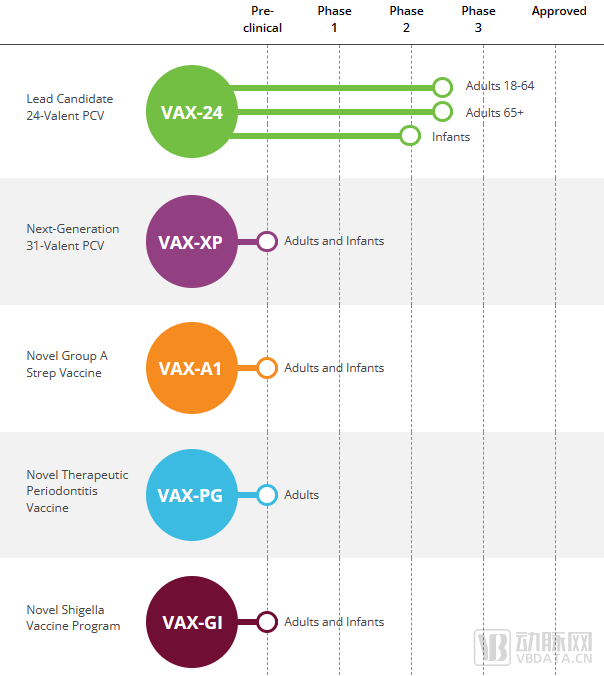
Vaxcyte's R&D Pipeline
Image source: Vaxcyte official website
VAX-24 targets the pneumococcal conjugate vaccine (PCV) market. Pneumococcal disease is an infection caused by Streptococcus pneumoniae. It can lead to a range of non-invasive and invasive diseases, including invasive pneumococcal disease (IPD), such as meningitis and pneumonia. According to statistics from the U.S. Centers for Disease Control and Prevention (CDC), pneumococcus causes approximately 320,000 cases of pneumonia annually in the United States (with elderly patients being the most severely affected), resulting in about 5,000 deaths and more than 150,000 hospitalizations.
Currently, there are two types of vaccines against pneumococcal disease: the polysaccharide vaccine (PPSV) and the polysaccharide conjugate vaccine (PCV). PCV can be used in individuals of any age and is generally believed to induce both antibodies and immune memory, providing significantly longer-lasting protection than PPSV. As such, it is the mainstream vaccine for pneumococcal prevention in the current market.
VAX-24 is a 24-valent pneumococcal conjugate vaccine (PCV) that utilizes an innovative, modified carrier protein, eCRM. The eCRM carrier protein allows for the site-specific insertion of multiple non-natural amino acids (nnAAs) as conjugation targets in regions outside of immune cell epitopes. Through specific covalent linkage at these nnAA sites, eCRM conjugates pneumococcal polysaccharide antigens while ensuring the presentation of immune cell epitopes, thereby inducing an optimal immune response.
Furthermore, eCRM can reduce heterostructures caused by conjugation, enabling the vaccine to cover more serotypes while reducing the amount of carrier protein used.Compared with Pfizer’s PCV13, the total amount of carrier proteins in both vaccines is similar, but VAX-24 covers twice as many serotypes as PCV13.
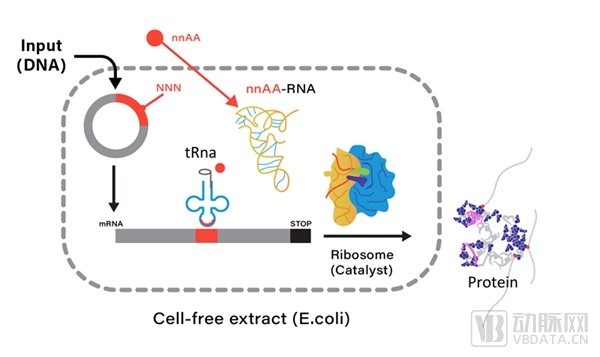
Methods for Inserting Non-Natural Amino Acids into Carrier Proteins
Image source: Vaxcyte 2022 Annual Report
Compared to other PCVs utilizing protein carrier technologies (Pfizer/GSK), VAX-24 also employs Nobel Prize-winning “Click Chemistry” technology, which enables more rapid and efficient specific conjugation of carrier proteins with polysaccharide antigens.
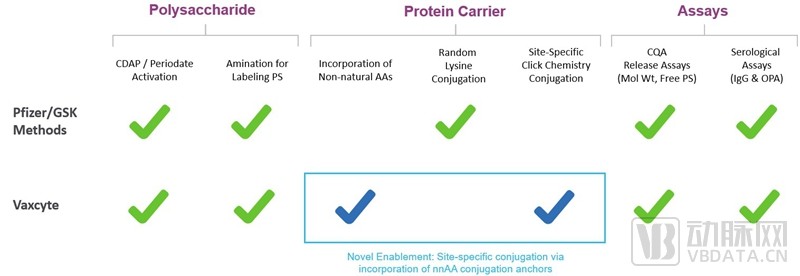
Differences Between VAX-24 and Other PCVs
Source: Vaxcyte 2022 Annual Report
In January 2023, the FDA granted Breakthrough Therapy Designation (BTD) to VAX-24 for the prevention of invasive pneumococcal disease (IPD) in adults. In April, Vaxcyte announced the success of its second Phase II clinical trial of VAX-24 in individuals aged 65 years and older.
The results of this clinical trial demonstrated that VAX-24 elicited robust immune responses across all dose levels against 24 serotypes, consistent with the findings from the prior Phase II trial in adults aged 50–64 years.These two sets of clinical data also indicate that the safety and tolerability profiles of VAX-24 at all studied doses were comparable to those of Pfizer’s Prevnar 20.
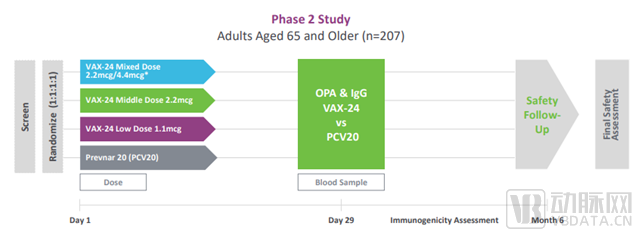
VAX-24 Phase II Clinical Trial in Adults Aged 65 and Older
Image source: Vaxcyte official website
*Streptococcus pneumoniae* is known as the “leading killer of children under five years of age.” According to WHO data, approximately 1.6 million people worldwide die from pneumococcal disease each year, including 700,000 to 1 million children under the age of five. In response, Vaxcyte is also advancing the development of other parallel PCV programs.
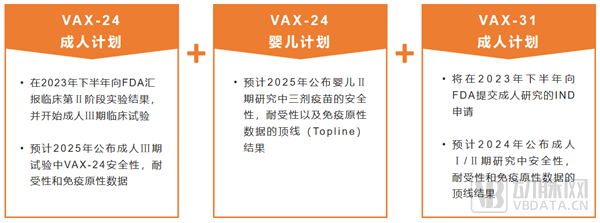
Key Milestones for Subsequent PVC Development
Produced by VCBeat
The renewed success of VAX-24’s Phase II clinical trial has also been directly reflected in the surging stock price. Although CEO and founder Grant Pickering anticipates that the company’s net losses will persist in the future, and there will be no form of stock dividends,However, Vaxcyte's current stock price is nearly three times its initial public offering price on the Nasdaq in 2020.
The market’s strong favor for Vaxcyte is inseparable from the company’s continuous increase in R&D investment.In 2022, Vaxcyte’s R&D investment reached $169 million, an increase of approximately $91 million, or 116.1%, from $78.41 million in 2021.
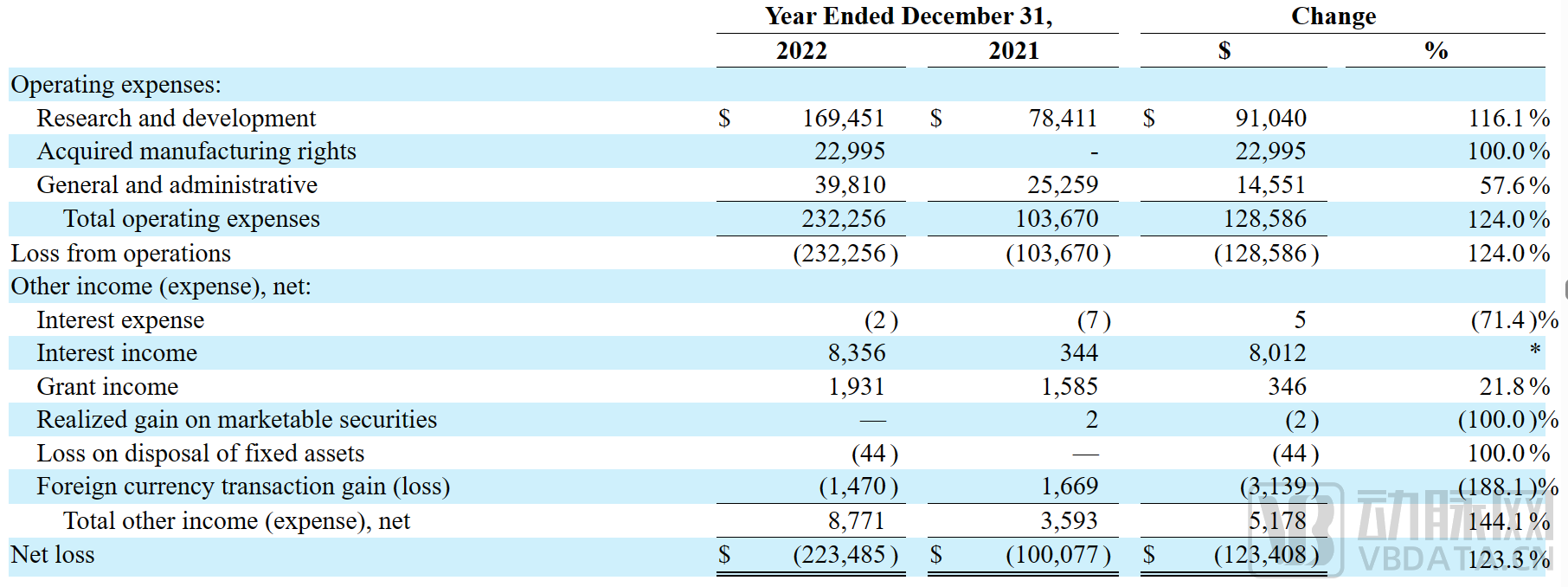
Vaxcyte Operating Data
Image source: Vaxcyte 2022 Annual Report
It seems that Vaxcyte has never faced a “cash crunch” along its journey. Backed by Johnson & Johnson’s financial support and Sutro Biopharma’s technological expertise, Vaxcyte has secured a steady stream of funding—from its establishment in 2013 to a $110 million Series D round, followed by a $575 million capital raise in April. Nevertheless, given the rapidly evolving landscape of vaccine development, the substantial cash-burning capacity required of innovative vaccine companies should not be underestimated.
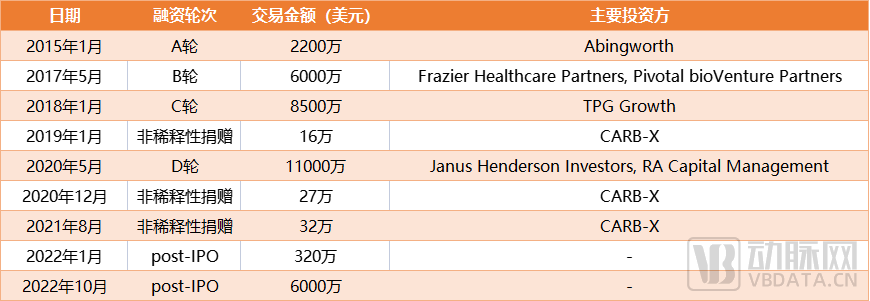
Vaxcyte's Financing History
Compiled and produced by VCBeat
This brings us to the world’s best-selling vaccine: Pfizer’s Prevnar 13. In 2020, Prevnar 13 generated $5.85 billion in sales, yet this nearly $6 billion revenue was achieved through substantial financial investment by Pfizer. The construction cost of the Prevnar 13 vaccine manufacturing facility alone reached $600 million, and each production batch requires approximately two years to complete.
Vaxcyte’s cash reserves in 2022 amounted to approximately $830 million, representing a roughly 20% increase from the $690 million reported in 2021. However, the company’s net loss in 2022 surged by approximately 120% compared with the previous year. As losses continue to mount and R&D expenditures keep rising, Vaxcyte faces the inevitable challenge of balancing its focus on vaccine development, reducing manufacturing costs, and advancing commercialization—a particular dilemma for innovative vaccine companies that have yet to bring mature commercial products to market.
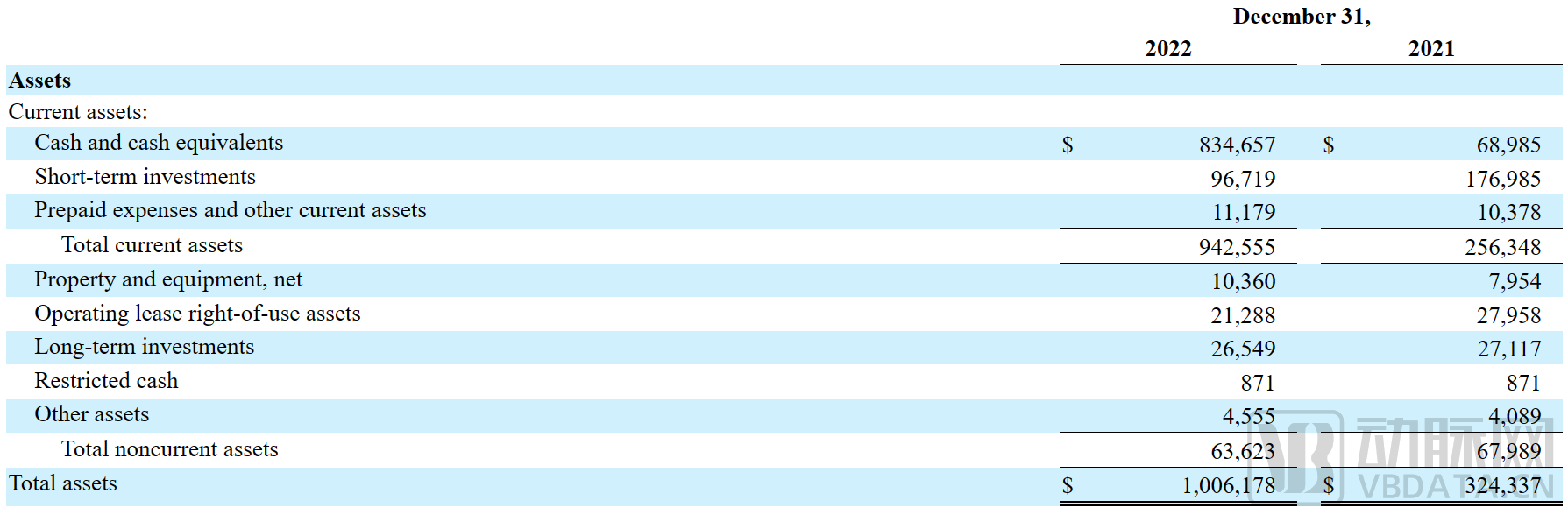
Vaxcyte Assets
Source: Vaxcyte 2022 Annual Report
To this end, Vaxcyte entered into a development and manufacturing services agreement with the CDMO giant Lonza Group as early as 2016. Under the agreement, Lonza is responsible for the process development and manufacturing of related components for VAX-24, including polysaccharide antigens and eCRM protein carriers.
Leveraging Lonza’s mature process platform, rigorous quality management system, and extensive regulatory registration experience, Vaxcyte will be better positioned to swiftly meet the scrutiny of the FDA and the market, both in the development of VAX-24 and in any future vaccine registration and commercialization.