

Chunsun: A Co-evolving Whole Genome Sequencing System Revolutionizing Rare Disease Diagnosis
On May 7, 2023, at the 2023 7th Future Healthcare Top 100 · Top 100 Summit held in Zhangjiang, Shanghai, Beijing Judao Technology Co., Ltd.(hereinafter referred to as: Judao Technology)with Genokon(hereinafter referred to as "Genokon")Major Release: “Rare"ChunSun" Whole-Genome Co-evolution System—A Comprehensive Solution for Clinical Whole-Genome Diagnosis of Rare Diseases
“Spring Bamboo Shoots” will establish a clinical whole-genome technology system to empower physicians, reducing the turnaround time (TAT) to under 20 days. Leveraging 40x (120 GB) deep sequencing per sample that complies with domestic and international clinical standards, and integrating in-hospital digital platforms, large-scale distributed computing, and AI-assisted decision-making technologies, it aims to achieve widespread clinical adoption of whole-genome sequencing for rare diseases—taking root and flourishing—and thereby benefiting over 50 million rare disease patients and their families in China.
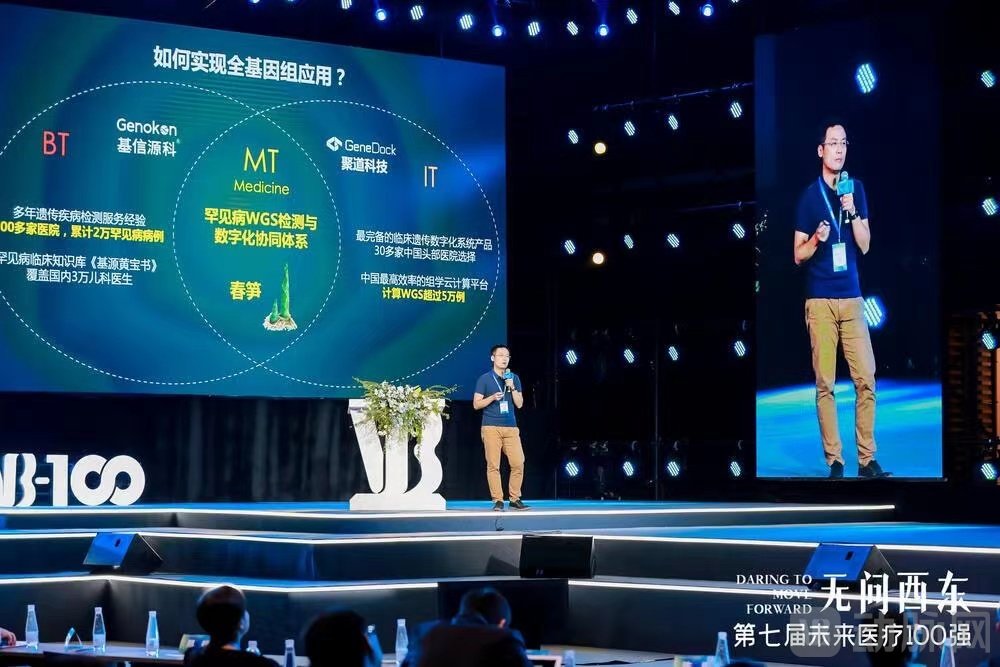
Li Xiarong, Founder and CEO of Judao Technology
Currently, there are over 7,000 known rare diseases in humans, approximately 80% of which are genetic disorders. The global number of patients with rare diseases is estimated to exceed 440 million. Based on population proportions, it is estimated that there are currently more than 50 million individuals with rare diseases in China.Meanwhile, among the 10 million newborns born in China each year, 5.6% present with birth defects of varying severity (Source: National Office for Birth Defects).
It is evident that rare diseases constitute a significant health challenge affecting the global population. From scientific research to clinical practice, attention to rare diseases has been rapidly increasing in recent years. According to data from Frost & Sullivan, 26 of the 50 new drugs approved for marketing in the United States in 2021 were designated for rare diseases.
Even so, in the United States, patients with rare diseases on average endure 7.6 years, consult eight physicians, and experience two to three misdiagnoses before receiving a definitive diagnosis. In China, 42% of patients with rare diseases have experienced misdiagnosis, and among the 50 million potential patients, more than 90% have yet to receive a confirmed diagnosis. The repeated quest for medical care across multiple institutions imposes substantial psychological and financial burdens on both patients and their families.
Therefore, how to break through the bottleneck in diagnostic efficacy for rare diseases has become the most closely watched topic in the field of rare diseases.
Previously, clinical diagnostic testing methods for rare diseases—including karyotyping, fluorescence in situ hybridization (FISH), chromosomal microarray analysis (CMA), Sanger sequencing, targeted region capture sequencing, and whole-exome sequencing—were unable to simultaneously detect various types of variants, such as copy number variations, structural variations, mitochondrial DNA variants, and single-nucleotide variants and insertions/deletions in both coding and non-coding regions. This limitation resulted in insufficient coverage of the pathogenic causes of genetic diseases and led to missed diagnoses. Therefore,There is a clinical need for a testing technology that provides comprehensive coverage across genomic regions, variant types, and disease categories.。
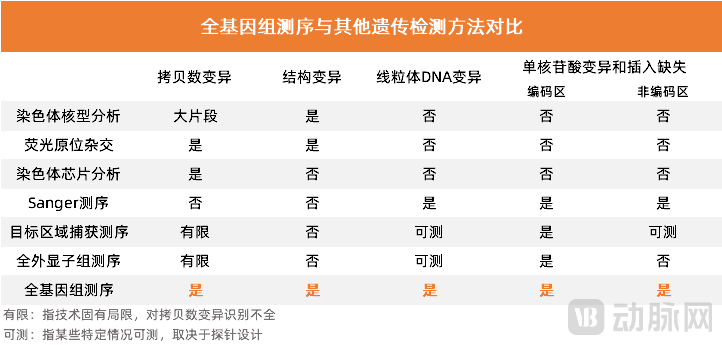
Source:
Report by Professor Yu Yongguo, Executive Director of the Clinical Genetics Center, Xinhua Hospital Affiliated to Shanghai Jiao Tong University School of Medicine
Through the above table comparison, we found that:Whole-genome sequencing (WGS) can simultaneously detect all the aforementioned types of variants, enabling comprehensive analysis of complex variants and multi-omics at the whole-genome data level. It nearly covers diagnostic needs across all scenarios and disease types, demonstrating significant advantages in detection rate, uniformity, GC content bias, time cost, and operational steps.
Whole-genome sequencing data can provide standardized data and algorithm interfaces, facilitating high-quality collaboration, and enabling sustainable expansion of complex variant generalization capabilities for multi-omics integrated analysis, including metabolomics and transcriptomics. Therefore, WGShas become a commonly used technical method in current scientific research。
As of now, inThe PubMed database of the NIH,The number of published scientific research articles applying whole-genome sequencing technology has reached nearly 51,000.That is to say, since the application of next-generation sequencing technology began in 2009, an average of more than 3,600 WGS-related articles have been published annually, laying a solid foundation for the clinical application of WGS.
Given the medical community’s strong endorsement and high expectations for whole-genome sequencing (WGS), along with repeated validation of its detection capabilities by the research sector, why has this technology yet to make a significant impact in routine clinical diagnostics?
In fact, WGS is also continuously “waiting” for an opportunity—lower sequencing costs.With the continuous advancement of sequencing technologies and intelligent analysis, the cost of whole-genome sequencing has been declining at a “super-Moore’s Law” pace since around 2008.
Data from the National Human Genome Research Institute shows that in 2001, the cost of human genome sequencing was as high as $95.263 million. After 2014, the cost of gene sequencing stabilized at around $1,000. In 2023, MGI Tech released the DNBSEQ-T20×2 sequencer, currently the highest-throughput model, reducing the cost of whole-genome sequencing from $1,000 to approximately $100.
With the advent of the “$100 era,” the maturation of whole-genome analysis algorithms, and the accumulation of genomic databases, whole-genome sequencing has finally opened the door to large-scale clinical application.。
How Can Clinical Applications of Whole-Genome Sequencing Be Implemented in China Following Cost Reductions? As the Highest Tier of Diagnostic Testing at the Genetic Level, How Can the Industry Chain Be Integrated and the Supply Chain Optimized? Which Area Represents a Suitable Choice for Promoting the Clinical Adoption of Whole-Genome Sequencing?
The “Spring Bamboo” Whole-Genome Co-Evolution System for Rare Diseases: Providing Answers for the Industry and Hope for Patients.
CurrentlyJudao Technology has completed bioinformatics analysis and computation for 40,000 WGS samples., continuously refining and optimizing comprehensive variant types, with a cumulative data volume exceeding 15 PB, making it the most cost-effective and technically reliable omics cloud computing platform currently available. In terms of medical digital systems, Judao Technology possesses the most complete suite of clinical genetics digitalization products, having partnered with over 30 leading hospitals in China, including West China Hospital, Shanghai Xinhua Hospital, and the Obstetrics and Gynecology Hospital of Fudan University.
Through years of clinical genetic testing services, Genokon has compiled over 20,000 rare disease cases from more than 100 hospitals.and compiled the renowned domestic clinical knowledge base for rare diseases, "Jiyuan Huang Baoshu," covering 30,000 pediatricians.
Built upon China’s leading expertise in medical services and omics data technology, “Chunsun” is poised for excellence. According to the launch event, “Chunsun” currently provides 40x deep sequencing (120 GB per sample) for over 5,000 rare diseases, with a turnaround time (TAT) of less than 20 days. It supports the testing of more than 100 samples per week on average and offers iterative analysis covering all genomic regions and variant types. Furthermore, it helps patients access multidisciplinary team (MDT) consultations, genetic counseling, follow-up management, and other diagnostic and therapeutic resources, truly achieving a combination of advanced technology, high efficiency, cost-effectiveness, and practicality.
“Spring Bamboo Shoots” links dispersed genetic testing technologies, data/bioinformatics analysis capabilities, leading genomics professors, clinicians across various regions, and patients with rare diseases, bringing together the technologies and stakeholders involved in rare disease diagnosis like “assembling a puzzle,” thereby establishing a comprehensive clinical whole-genome sequencing ecosystem for rare diseases.
Having addressed the challenges of technology, cost, and supply chain, whole-genome sequencing still faces one major hurdle to achieve widespread adoption in the clinical diagnosis of rare diseases—Standardized Use of Whole-Genome Sequencing by Clinicians。
In China, there is a relative lack of systematic education for clinicians in genomics and the theory of genetic diseases. Moreover, given their already heavy workloads, additional training would impose greater pressure and costs on these healthcare professionals. This represents another critical challenge that must be addressed to facilitate the widespread market adoption of whole-genome sequencing in China.
“ChunSun” reduces fluctuations in diagnostic accuracy caused by varying levels of theoretical knowledge and clinical experience by customizing whole-genome clinical diagnostic workflows for rare diseases to suit physicians in different clinical scenarios, while establishing standard operating procedures and integrating corresponding intelligent clinical decision support systems.
By leveraging diagnostic workflows tailored to diverse healthcare settings, along with premium resources such as genetic testing laboratories and genetics specialists, “Chunsun” integrates the “Medical Genetic Data Operating System” with “high-performance whole-genome sequencing analysis technology.” This integration ultimately establishes an efficient clinical collaboration loop between clinicians and genetics experts, fully bridging the last mile in applying whole-genome sequencing to the clinical diagnosis of rare diseases.
Over the past eight years, Judao Technology and Genokon have been dedicated to research in the field of genetic and rare diseases. Their focus on rare diseases is driven not only by the market potential and technical challenges associated with these conditions, but also by the fact that patients with rare diseases are the primary beneficiaries of clinical applications of genetic technologies. Currently, the long-term clinical needs of these patients remain unmet.
As a pioneer, "Chunsun" will adhere to the underlying logic of commercial applications, starting from the needs of application scenarios. By integrating complex supply chain systems, it will provide doctors and patients with minimalist standardized processes, thereby reaching and meeting the needs of doctors and patients earlier.
Congenital genetic disorders deprive patients with rare diseases of equal rights to health from birth. “Chunsun” aims to leverage gene technology to empower physicians in delivering equitable healthcare to these patients. In the future, the continuously co-evolving “Chunsun” ecosystem will expand access to medical services and technological solutions that benefit individuals with rare diseases.
1953: Discovery of the DNA Double Helix Structure.
In 2003, the Human Genome Project was completed.
In 2023, after 70 years of accumulation in molecular biology, we are on the verge of entering the era of universal genomics.
“The clinical application of whole-genome sequencing will undoubtedly have a far greater impact on humanity than we can currently imagine. Two decades ago, when smartphones first hit the market, no one could have predicted that they would become an indispensable part of people’s daily lives—covering clothing, food, housing, and transportation—transforming the entire business landscape and reshaping our understanding of the world. I believe that in 20 years, numerous publications and reports will commemorate this pivotal era in medical history. Yet what I most look forward to witnessing is the sight of children who are currently benefiting from ‘ChunSun’ living healthy and happy lives alongside their own children two decades from now.”
—— Yao Xun, Founder and CEO of Genokon