

Ge Junbo's Team Completes China's First PCI Procedure Using Atrio Medical's High-Pressure Triple-Wire Scoring Balloon System – Scoreflex TRIO Pivotal Clinical Trial Officially Launched

OrbusNeich
Cardiac Interventional Treatment Product R&D and Production Manufacturer
Recently, the team led by Academician Ge Junbo from Zhongshan Hospital, Fudan University, successfully applied the self-developed Scoreflex TRIO high-pressure triple-wire scoring balloon catheter system from OrbusNeich Medical Group Holdings Limited (“OrbusNeich”) to perform PCI intervention on a 65-year-old patient with severe coronary stenosis and calcification. The surgery was highly successful, with a stent expansion rate of 90% and good apposition, and no postoperative complications occurred in the patient.
The successful enrollment of the first patient in this clinical study marks the official launch of the Scoreflex TRIO National Multicenter Registry Clinical Study in China, with the team led by Academician Ge Junbo from Zhongshan Hospital, Fudan University, serving as the principal investigators. Following the first procedure using the Scoreflex TRIO High-Pressure Triple-Wire Scoring Balloon Catheter System, Academician Ge Junbo’s team highly evaluated the product’s performance, recognizing it as a safe and effective treatment option for operators.
It is reported that the patient undergoing this procedure was a 65-year-old male who presented to an outside hospital in October 2021 with sudden-onset chest pain and was diagnosed with acute non-ST-elevation myocardial infarction (NSTEMI). He underwent coronary angiography (CAG) and percutaneous coronary intervention (PCI), during which 80–90% stenosis of the posterior left ventricular branch and occlusion of the proximal-to-mid segment of the left circumflex artery (LCX) were observed. Two stents were implanted in the LCX. In January 2023, he underwent percutaneous transluminal coronary angioplasty (PTCA) of the posterior left ventricular branch. The patient subsequently visited Zhongshan Hospital, Fudan University, for follow-up coronary angiography.
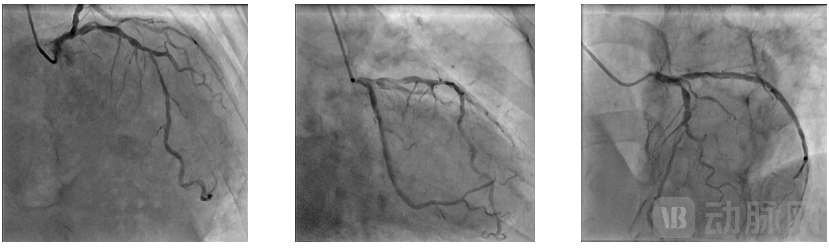
After evaluation, it was decided to perform PCI using the high-pressure three-wire scoring balloon catheter system. Coronary angiography was performed via the right radial artery. The angiographic results showed a right-dominant coronary circulation. The proximal segment of the left anterior descending (LAD) artery exhibited diffuse disease with a maximum stenosis of 70%. The mid-segment of the LAD showed diffuse disease with a maximum stenosis of 85% accompanied by calcification, involving a length of approximately 30 mm and a vessel diameter of 3 mm, with TIMI grade III flow. Stent shadows were observed in the proximal and mid-segments of the left circumflex (LCx) artery, with mild in-stent intimal hyperplasia and no evidence of restenosis. The mid-segment of the posterior left ventricular branch showed 70% stenosis. The ostium of the posterior descending artery (PDA) showed 95% stenosis, and its mid-segment showed 70% stenosis.
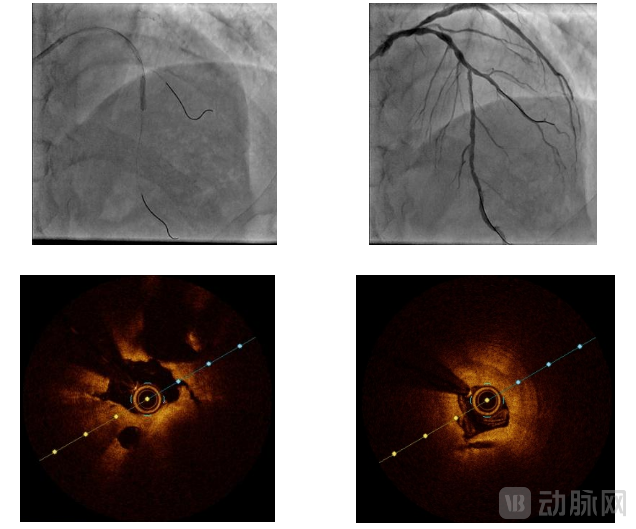
The target lesion for interventional therapy was the mid-segment of the left anterior descending (LAD) artery. A 6F EBU3.5 guiding catheter was advanced to the left coronary ostium, and guidewires were respectively advanced to the distal segments of the LAD and the first diagonal branch. An OCT catheter was introduced into the LAD and withdrawn for optical coherence tomography (OCT) imaging, which revealed lipid plaques with a minimum lumen area of 1.9 mm². Consequently, further percutaneous coronary intervention (PCI) of the LAD was decided upon. During the procedure, the lesion was predilated using a Scoreflex TRIO 2.5×15 mm balloon at 8 atm for 10 seconds. Follow-up angiography showed significant improvement in residual stenosis (<30%) with TIMI grade III flow. One stent was implanted at the lesion site and deployed at 10 atm for 10 seconds. Post-dilation was performed within the stent using a non-compliant balloon at 16 atm for 10 seconds to optimize stent expansion. Final angiography demonstrated satisfactory stent expansion, no residual stenosis, and TIMI grade III flow in the distal vessel.
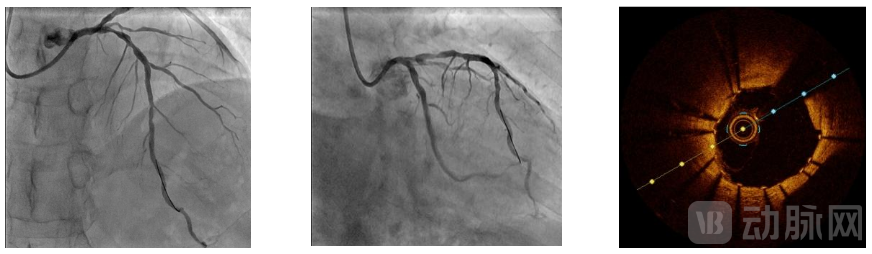
Follow-up OCT indicated satisfactory expansion of the left anterior descending (LAD) artery stent with good apposition; the stent expansion rate was 90%, confirming procedural success.
At the end of the procedure, the patient’s blood pressure was 138/82 mmHg, heart rate was 64 beats/min, and no complications occurred.
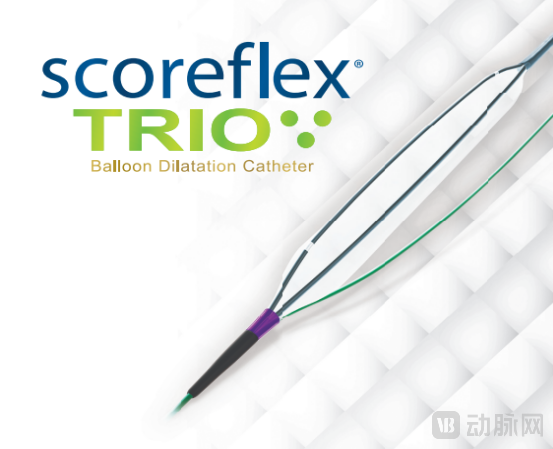
The procedure utilized Scoreflex TRIO, an independently developed original product of OrbusNeich Medical (Shenzhen) Co., Ltd., a wholly-owned subsidiary of OrbusNeich. This is the first domestically produced coronary triple-wire scoring balloon catheter. The device is delivered via the radial or femoral artery approach along a guidewire to the target lesion in the coronary artery. Its two integrated wires, together with the guidewire, form an external scoring assembly that generates localized high pressure on the balloon surface. This enables the balloon to open coronary lesions and dilate stenotic coronary arteries at lower pressures, effectively expanding the lesion while avoiding significant intimal tearing and dissection formation, thereby improving blood flow and myocardial perfusion.
As a predilation balloon for PCI procedures, the Scoreflex TRIO triple-wire scoring balloon catheter employs a focused longitudinal cutting expansion mechanism. This approach not only further reduces residual stenosis and improves procedural success rates compared to conventional balloon dilation, but also lowers the incidence of intimal tearing, minimizes vascular injury, attenuates inflammatory responses, enhances procedural safety, and reduces the rate of restenosis. The high-pressure triple-wire scoring balloon catheter utilizes concentrated, lower expansion pressures to perform focused longitudinal cutting on the vessel wall. Its longitudinal cutting follows a stepwise, progressive dilation and cutting pattern, which minimizes intimal damage, increases the minimal lumen diameter, and reduces residual stenosis.
The operational mechanism of Scoreflex TRIO minimizes intimal injury to the greatest extent, thereby enhancing procedural safety and success rates. Launched in Japan in 2021, Scoreflex TRIO not only drove substantial growth in OrbusNeich’s local sales last year but also provided effective and safe medical solutions to countless patients.
OrbusNeich has successively launched in mainland ChinaScoreflexandScoreflex NCScoring balloons; these two products are the first scoring balloon and the first high-pressure scoring balloon approved by the National Medical Products Administration (NMPA). With theScoreflex TRIO was launched inOrbusNeich has officially launched registered clinical studies in China, and it is believed that the company will continue to provide more treatment options for patients in mainland China in the future.。
About OrbusNeich
OrbusNeich is a leading global medical device manufacturer specializing in interventional devices for percutaneous coronary intervention (PCI) and percutaneous transluminal angioplasty (PTA). Headquartered in Hong Kong, China, OrbusNeich markets its products in over 70 countries and regions worldwide. According to a Frost & Sullivan report, in terms of PCI balloon sales volume in 2021, the Group was the only company headquartered in China to rank among the top six in all major overseas PCI balloon markets, including Japan (ranked second), Europe (ranked fourth), and the United States (ranked sixth). Furthermore, regarding PTA balloon sales volume in 2021, the Group ranked third in the Japanese market and fourth in the U.S. market. The Group also specializes in coronary stent products and is actively expanding its business into neurovascular intervention and structural heart disease fields. As of December 2022, OrbusNeich held more than 180 authorized patents globally. Its in-house R&D team boasts over 20 years of accumulated product development experience and has developed world-leading proprietary technologies.
About Ge Junbo
Director of the Department of Cardiology, Zhongshan Hospital, Fudan University; Academician of the Chinese Academy of Sciences; Chairman of the China Cardiovascular Health Alliance; Chief Physician; Professor; Doctoral Supervisor; Director of the Department of Cardiology, Zhongshan Hospital, Fudan University; Director of the Cardiac Catheterization Laboratory; Director of the Shanghai Institute of Cardiovascular Diseases. Executive Council Member of the World Heart Federation; Chairman of the Asia Pacific Association of Interventional Cardiology; Member of the Advisory Committee of the International Congress of Cardiology. He is dedicated to research on myocardial microcirculatory perfusion disorders in patients with coronary heart disease. His research on coronary slow flow syndrome has elucidated the mechanism of pseudonormal coronary flow reserve. He was honored as an Advanced Individual in the Fight Against the COVID-19 Pandemic by the Jiusan Society and named a National Advanced Worker.