

Haodf Online CEO Wang Hang: Internet Medical Services Entering the 'Harvest Phase'
On May 7, 2023, VCBeat’s “Top 100 Future Healthcare Companies Summit” was held at the Zhangjiang Hall in Shanghai. Wang Hang, Founder and CEO of Haodf Online, was invited to attend and deliver a keynote speech. Drawing on the landscape, key indicators, and trends of the internet healthcare industry, he identified critical drivers for the commercialization of medical services, outlined the future service landscape of internet healthcare, and shared his profound insights and forward-looking perspectives on industry development.

The following is the full transcript of the speech (abridged):
A special thank you to VCBeat for inviting us to attend the conference every year! Let me share a “truth” with everyone: my main purpose for attending each year is to let people know that we are still alive. Therefore, you should also make it a point to attend VCBeat’s conference annually, because if you skip a year, your peers may start to wonder whether your company is still in business.
All right, this joke stems from the most frequently asked question we’ve received over the years: “Are you still alive? Are you making money? Can you support yourselves?” Today, I am formally reporting to everyone that Haodf Online has already achieved break-even, and will be profitable for the full year. Please rest assured!
VCBeat proposed a speech topic for me titled “Practices and Reflections on the High-Quality Development of Internet Healthcare.” However, I would like to discuss how to generate revenue. Only with financial resources can we genuinely improve quality. Establishing a virtuous commercial cycle is essential to driving internet healthcare services toward high-quality development. Therefore, my presentation today will focus primarily on commercialization.
Why is the question of profitability the one we are asked most frequently? Because we operate in the healthcare services sector, where it is commonly believed that generating profits is challenging.
Professor Chen Qiulin of the Chinese Academy of Social Sciences has clearly delineated the distribution of business segments and the classification of business models in his “Landscape of the Internet Healthcare Industry.”
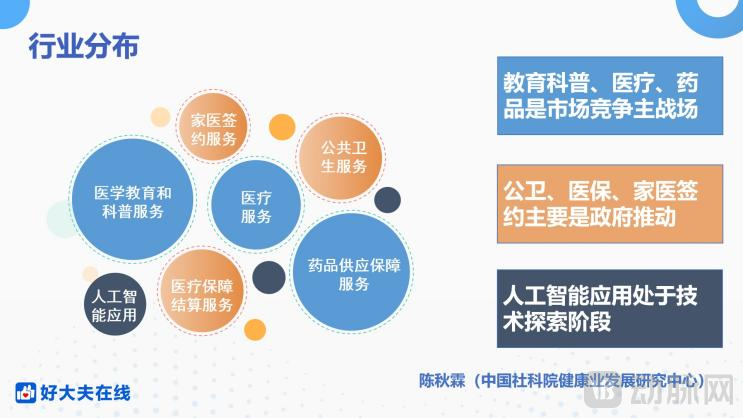
The first part covers the industry’s main battlegrounds, which consist of three areas: First, medical education and science popularization, i.e., knowledge services, with business models based on paid knowledge content and advertising. Second, pharmaceutical supply and assurance, such as B2C drug sales by Alibaba and JD.com, operating under an e-commerce model. Third, healthcare services, which will be discussed later.
The second part is the orange section, covering public health, medical insurance, and family doctor contracting. This segment primarily involves government procurement of software and IT services, with a clear business model and market size.
Finally, the AI segment represented by the dark blue portion is the future of the industry. Although ChatGPT is currently very popular, AI in healthcare as a whole remains in its growth stage, lacking scale and commercialization; thus, it is still in an exploratory phase.
Alright, let’s discuss separately the “medical services” sector in which we operate:
The circle labeled “Medical Services” is positioned at the very center of the diagram, indicating that it is the core of the entire industry, with all other business segments revolving around it. However, this circle is relatively small, suggesting that its current market size is not yet substantial.
Everyone wants to secure the best medical care for their families, often resorting to leveraging personal connections or offering bribes. Nevertheless, the market still lacks a supply of high-quality services that are both guaranteed in quality and reasonable in price. Current medical services are either prohibitively expensive, catering exclusively to privileged elites and thus impossible to scale across society, or priced so low as to be nearly charitable. In the latter case, service providers rely on gray income from pharmaceuticals, medical devices, and consumables to subsidize their costs, while service quality remains unguaranteed, with no dedicated efforts to study or implement improvements. This is the current state of healthcare services.
Many people have asked me, “Why doesn’t Haodaifu Online adopt a business model centered on selling medications? Why has it remained steadfastly committed to monetizing services?”
Take ChatGPT as an analogy: Why has ChatGPT become so popular? It is because people no longer want to perform traditional searches. Previously, one had to type in a query, click the search button, and then sift through a cluttered array of search results—straining to identify which information was correct, which was incorrect, and which was advertising—a process fraught with anxiety at every step. However, with the advent of ChatGPT, everyone hailed it as a breakthrough. It provides only the correct answer, eliminating the need to verify authenticity or filter out advertisements, thereby offering a sense of clarity and perfection.
Applying this scenario to the healthcare industry, the logic remains the same. To seek medical care, we must study extensive medical knowledge and popular science materials, while discerning their authenticity. We pay for medications, yet still worry whether physicians have prescribed unnecessary drugs due to kickbacks from pharmaceutical companies.For patients, the ideal scenario is: “Don’t make me bother thinking about all this; I just want a trustworthy doctor to give me one definitive answer, and by following it, I can be cured.” This represents the highest quality of medical care and is the vision of Haodf Online.“We will persevere relentlessly until we can deliver this medical service at scale. I firmly believe that this is the ‘Medical GPT’ everyone desires, a product for which people are absolutely willing to pay, representing the optimal business model in the healthcare industry. This is the sole direction we have set for ourselves.”
So, what changes took place in the environment of internet-based medical services in 2022? The following four key indicators are worth noting:
First, during the Shanghai epidemic in March, all public hospitals issued suspension notices using a standardized phrasing: “We have suspended in-person services, but our internet hospitals remain operational.” This standard formulation signifies that public hospitals, the mainstay of the healthcare industry, have fully embraced internet-based medical services, indicating the widespread adoption of telemedicine and a rapid expansion of its market size.
Second, the issuance of regulatory documents such as the "Detailed Rules for the Supervision of Internet Diagnosis and Treatment" signifies that the industry has entered a new stage of high-quality development.
Third, the statement in the Report to the 20th National Congress of the Communist Party of China, “expand the supply of high-quality medical resources and ensure their balanced regional distribution,” has charted a course for the digital healthcare industry. How can balanced distribution be achieved? We cannot physically relocate medical experts from eastern China to the west, but we can leverage digital technologies to deliver their diagnostic and treatment protocols to those regions. How can the supply of high-quality medical resources be expanded? What China lacks most is not the technical capability to perform highly sophisticated surgeries, but rather compassionate, patient-centered care. Achieving this requires the involvement of a large number of new service providers, such as physician assistants. This is an area where private enterprises, unconstrained by the staffing quotas that limit public hospitals, can provide solutions, thereby creating new opportunities for private companies.
Fourth, allowing initial consultations during the peak of the December epidemic signifies the integration of internet healthcare into core medical services. In public health emergencies, which are of utmost concern to the government, its risks can be tolerated, and it is accepted as a vital force offering innovative solutions.
Based on these observations, we offer three key insights and perspectives on industry trends:
First, the development model of internet healthcare prioritizes quality over scale. This differs from other internet sectors. A chaotic period of rapid expansion cannot be permitted, as healthcare involves human lives and cannot tolerate risks of this magnitude. This is a positive development, creating a favorable environment for companies committed to rigorous and responsible practices.
Second, public hospitals—the logical owners of service resources (i.e., physicians)—will collaborate with commercial third-party internet healthcare platforms, gradually unlocking service capacity and forming scaled-up supply.
Third, the commercialization of internet-based healthcare services has already begun. Companies in this sector are vigorously exploring business models, striving for high-quality development built upon a virtuous commercial cycle.
Let’s focus on the second trend: public hospitals and third-party platforms like ours will move toward collaboration.
The overarching logic of healthcare services is that the supply side dictates the demand side. High-quality resources on the supply side (China’s most distinguished physicians) are predominantly concentrated in public hospitals. Some are concerned about whether public hospitals will prohibit physicians from practicing on third-party internet healthcare platforms. Should this occur, third-party platforms would be left without a viable source of professional services.
Now, this question has been answered. As hospital directors put it, “As long as you do not operate offline hospitals, we are partners.” We maintain a collaborative relationship between upstream and downstream segments of the industry chain.
Imagine if only one company sold televisions; there would be no need for platforms like JD.com and Tmall. It is precisely because there are numerous brands and distributors that e-commerce platforms are necessary. Similarly, with over 2,000 internet hospitals affiliated with public hospitals now in operation, “choosing which hospital to visit” has become a complex decision. In this context, third-party platforms such as Haodafu are needed to provide a one-stop listing of various hospitals and all available physicians, enabling patients to compare options and make informed decisions. These platforms then triage patients to different doctors, directing those requiring in-person care to the respective hospitals where the doctors practice.
A public hospital director stated, “I have come to a clear understanding: as long as internet platforms do not establish offline hospitals, you and I are partners. After all, surgeries cannot be performed online; patients must come to my hospital for surgical procedures. Therefore, we represent upstream and downstream segments of the same industry chain. I do not oppose, and may even encourage, our physicians’ participation in third-party platforms, as this will bring patients to the hospital.”
Some argue that public hospitals’ internet hospitals are also providing online consultation services, supported by medical insurance reimbursement policies. Do third-party platforms still have opportunities? Why would doctors choose to work on third-party platforms?
My answer is that the business direction of third-party platforms should be to undertake tasks that public hospitals are unable to perform, thereby providing distinct support for physicians’ clinical practices. Only in this way can higher-quality services be delivered.
For example, pre-consultation triage. This is an innovation we have introduced over the past two years.
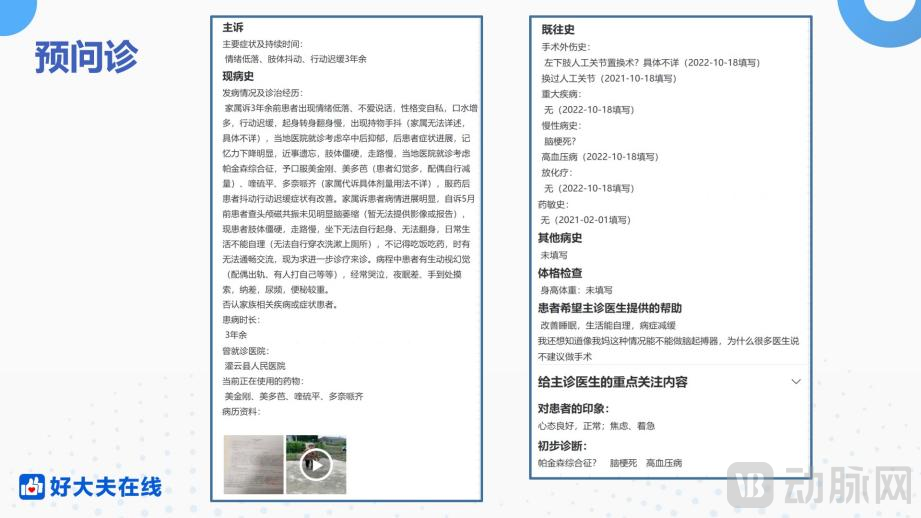
Take a look at this case. Such a complex medical record for an online consultation could certainly not have been written by an ordinary patient. So who wrote it? Was it drafted by the attending physician? In typical scenarios, the process unfolds as follows: The doctor asks, “Have you had a CT scan?” Three hours later, the patient logs on and replies, “I just had one last week.” Another four hours pass before the doctor logs back on and says, “Please upload the images.” This is followed by another prolonged wait… With this back-and-forth, 24 hours may elapse in a single consultation, yet the basic medical history may still remain unclear. Therefore, online consultations can sometimes be far less efficient than in-person clinic visits.
How can this be addressed? Prior to consultation by senior specialists, a pre-consultation process should be implemented, wherein junior physicians are dedicated to collecting basic patient information and organizing medical records, thereby enhancing the efficiency of these experts. As ChatGPT is not yet sufficiently mature or reliable, reliance on primary care physicians and junior doctors remains essential. Coordinating such cross-hospital physician collaboration is beyond the capacity of individual large public hospitals; instead, it requires third-party platforms, which serve as a foundational infrastructure for online diagnosis and treatment. With such services in place, physicians’ work efficiency and service quality on third-party platforms will undoubtedly be higher.
Take the physician team as another example. A chief physician typically has an offline medical team with established ward-round protocols, where task delegation to subordinates is clearly defined. Online, however, if the physician were required to handle all tasks personally, time constraints would make this unfeasible. Therefore, third-party platforms must assist physicians in establishing online team-based workflows. If physicians struggle to recruit online team members, these platforms should even provide physician assistant services. Such services will ultimately adopt a crowdsourcing model, attracting healthcare talent from across society and connecting them with specialists via the platform. This approach expands healthcare service capacity: a large pool of new personnel supports specialists—who focus primarily on medical decision-making—by delivering detailed peripheral services and bridging service gaps, thereby assisting specialists in enhancing the quality of care. Consequently, physicians can improve service quality on third-party platforms without needing to handle every task personally.
Let us further analyze this from the physician’s perspective. For non-standardized products such as medical services, a key to success lies in stimulating the enthusiasm of service providers. Both public healthcare institutions and third-party platforms need to motivate physicians’ willingness to provide services by improving mechanisms and regulations. However, the support provided by third-party platforms differs when delivering online diagnosis and treatment services.
First, doctors provide services on third-party platforms during their spare time. For society as a whole, this generates incremental service supply without increasing the number of physicians. The government welcomes this development, and doctors are highly motivated to participate.
Second, on third-party platforms, physicians leverage their personal brands to attract patients, which incentivizes them to be more proactive and deliberate in improving their services.
Third, on third-party platforms, physicians can price their services according to market demand, adhering to the principle of “premium quality, premium price.” This will establish a market-oriented service pricing model, which will significantly stimulate the provision of high-quality services.
Fourth, on third-party platforms, physicians can establish their own supply chains for pharmaceuticals and therapeutic supplies, thereby offering a diverse array of services. For instance, a dermatologist might observe that patients frequently experience treatment failures in anti-allergy therapies due to the indiscriminate use of facial masks. In response, the physician could carefully select a specialized facial mask and include it in their online pharmacy. When prescribing medications, the physician can also recommend this facial mask as an adjunctive therapeutic product. This approach provides patients with a more comprehensive treatment plan. Such a model is not feasible in public hospitals, as facial masks are not permitted in hospital pharmacies.
To drive the commercialization and scaling of online diagnosis and treatment services, there are two key points:
First, we must look to internists, who serve as the bellwether. Compared with surgeons, internists constitute a larger group, rely less on offline equipment, and depend more on their individual professional services. If third-party platforms can establish sound pricing mechanisms and provide user-friendly service tools—such as long-term follow-up tools—to enhance internists’ efficiency and enable them to earn decent incomes, they will be incentivized to deliver better and more extensive services. Only then can the scale of commercialization in healthcare services be truly expanded.
Second, if third-party platforms can establish open supply chain platforms, the therapeutic supplies required by internists—including pharmaceuticals, treatment materials, physician-approved rehabilitation products, and adjunctive therapy supplies—will truly become abundant, enabling every physician to wield a “full arsenal” of therapeutic tools. Physicians can prescribe these items via medical orders, with delivery companies shipping them directly to patients’ homes, thereby helping to close the loop in the treatment process for online services. This will undoubtedly drive genuine expansion in service scale.
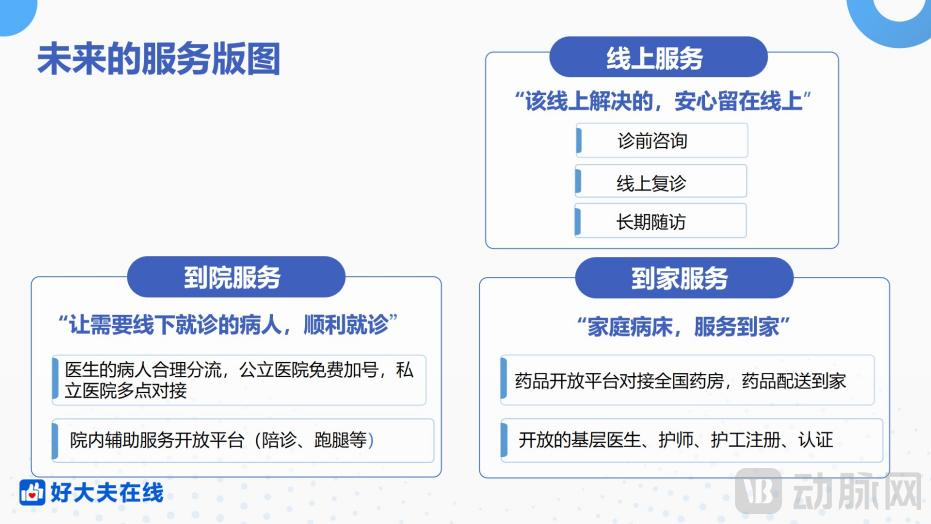
What will the landscape of future internet healthcare services look like? We believe it will consist of three components.
First, online services. Issues that can be resolved through online services should be handled online. This includes pre-visit consultations, post-discharge follow-up visits, and long-term patient monitoring. If these matters can be settled online, patients would naturally prefer to avoid the hassle of another trip to the hospital.
Second, in-hospital services. For patients who need to visit hospitals, we assist them with smooth admission. Procedures such as surgery, hospitalization, diagnostic tests, and physical examinations are indispensable; therefore, it is essential to establish streamlined processes that enable efficient coordination and appropriate triage of patients to offline hospitals. However, it is important to recognize that this segment is difficult to commercialize, as the majority of medical consultations still take place in public hospitals. We must not act as “scalpers” by reselling public healthcare resources.
Third, the most promising direction for the future is home-based healthcare services.The platform must establish an open mechanism to integrate service providers from across society—including primary care physicians, nurses, caregiving aides, and rehabilitation therapists—standardize service workflows, and ensure service quality, thereby addressing the substantial demand for in-home care in an aging society, which represents a vast service market.
Compared with the steady growth rate of these medical services, B2B corporate membership services will grow even faster. Purchasing such services for employees will become a standard welfare package offered by virtually every company. This bundled service includes on-site corporate clinics, family doctors, specialists, renowned experts, arranged in-person hospital visits, and gradually expanding home-based care services. There is stronger purchasing demand from the corporate side, driving faster growth. As long as high-quality services are universally desired, I believe their large-scale commercialization is just around the corner.
The above covers the core, high-value content. What follows is purely promotional: We are currently recruiting partners for our B2B enterprise membership program. If you are interested in becoming a channel sales partner and sharing in the business opportunities generated by Haodafu’s commercialization efforts, please contact us to explore how we can profit together.
That concludes the sharing session. Thank you all!