

Why Did the Gene Therapy Pioneer Fall Behind? Sangamo Therapeutics Struggles Amid Strategic Overhaul and Pipeline Setbacks

Sangamo Therapeutics
Genomic Medicine Developer
Sangamo Therapeutics, a gene therapy pioneer founded in 1995, has been facing numerous challenges recently.
Recently, Sangamo announced a strategic adjustment plan, which means the company will lay off 27% of its workforce in the United States.Through cost-reduction initiatives implemented via business and structural adjustments and other plans, Sangamo expects to save approximately $31 million annually, providing the company with operating capital for the next 12 months. Additionally, Dr. R. Andrew Ramelmeier, Executive Vice President of Technical Operations, will depart the company this July.
On March 17, the Company announced that Novartis and Biogen had each decided to terminate their respective collaboration agreements. The collaboration with Novartis, initiated in July 2020, focused on the joint development of three preclinical central nervous system (CNS) pipeline candidates based on zinc finger nuclease (ZFN) technology. The collaboration with Biogen, launched in February 2020, involved the joint development of four preclinical gene therapies using ZFN and adeno-associated virus (AAV) vector platforms, including ST-501 for the treatment of tauopathies, ST-502 for Parkinson’s disease (PD), and candidates targeting myotonic dystrophy type 1 (DM1).
In January last year, the company announced that Sanofi had decided to terminate the collaboration agreement. This partnership, which began in January 2014, focused on the co-development of a ZFN-based universal cell therapy for sickle cell disease (SCD) at the preclinical stage and had progressed into Phase I/II clinical trials prior to its termination.
Sangamo’s market capitalization has plummeted from a peak of $2.6 billion to $270 million.
Sangamo is known for its persistence in—or even monopoly over—the ZFN technology pathway,Dr. Sandy Macrae, President and Chief Executive Officer and member of the Board of Directors, was nominated for the Nobel Prize in Physiology or Medicine in 2013. With its broad scope, unique research platform, and impressive collaboration pipeline, Sangamo has long been a banner-bearer in the field of gene therapy. However, this once-lone standard now appears to have lost its luster and prestige.
As Sangamo and ZFN technology faced mounting uncertainty, CRISPR technology secured another major financing round: Orbital, a spinout from Beam Therapeutics, raised $270 million in Series A funding. Orbital integrates lipid nanoparticles (LNPs), virus-like particles (VLPs), and circular RNA to build a technology platform at the intersection of RNA technology, delivery methods, data science, and automation. The company is venturing into next-generation vaccines, protein therapeutics, and immunomodulators, and is currently engaging in discussions with potential partners, including large pharmaceutical companies.
ZFNs and CRISPR, as two generations of gene-editing tools, present a striking contrast in their current trajectories that warrants close examination.
ZFN Mavericks
Sangamo Therapeutics, headquartered in Richmond, California, went public in 2000. Under the efforts of then-CEO Edward Lanphier, Sangamo secured exclusive rights to the entire patent portfolio covering the design, optimization, and clinical application of zinc-finger nuclease (ZFN) technology, effectively precluding other institutions from engaging in ZFN research and development.
ZFN is a gene-editing tool equipped with a targeting system. Zinc finger proteins are used to recognize and bind specific gene sequences, while the FokI nuclease can specifically cleave target genes through dimerization, enabling the cleavage of any recognition sequence in eukaryotic genomes.
The primary advantages of ZFNs lie in their diverse gene repair mechanisms, precise gene replacement capabilities, and minimal impact on gene expression levels. Compared with CRISPR, the main disadvantage of ZFNs as a gene-editing tool is that developing high-quality gene-editing products is time-consuming and laborious. Although this significant disparity persists, Sangamo has improved its development process, shortening the cycle from three months to 10 days and reducing costs.
Thanks to Sangamo’s research and development efforts, zinc finger nucleases (ZFNs) have achieved several firsts in the field of gene editing: the first to edit genes in human cells, the first to edit genes ex vivo, and the first to edit genes in vivo.
Sangamo holds a first-mover advantage, yet nearly 40 years have passed since the discovery of zinc finger nucleases (ZFNs), and almost 30 years since Sangamo’s founding, without the company having brought any product to market. In contrast, CRISPR technology, which emerged later, is on the verge of commercial success this year. Vertex Pharmaceuticals and CRISPR Therapeutics have submitted a Biologics License Application (BLA) for exa-cel for the treatment of sickle cell disease and β-thalassemia. Meanwhile, Bluebird bio has submitted a BLA for its gene therapy lovo-cel for the treatment of patients aged 12 years and older with sickle cell disease (SCD) and a history of vaso-occlusive events.
According to Sangamo’s public disclosures, its most advanced pipeline asset is the hemophilia A program (formerly SB-525) developed in collaboration with Pfizer. This liver-targeted adeno-associated virus (AAV) gene therapy is currently being evaluated in a Phase III clinical trial led by Pfizer, which aims to assess its efficacy and safety in adult male patients with moderate or severe hemophilia A.
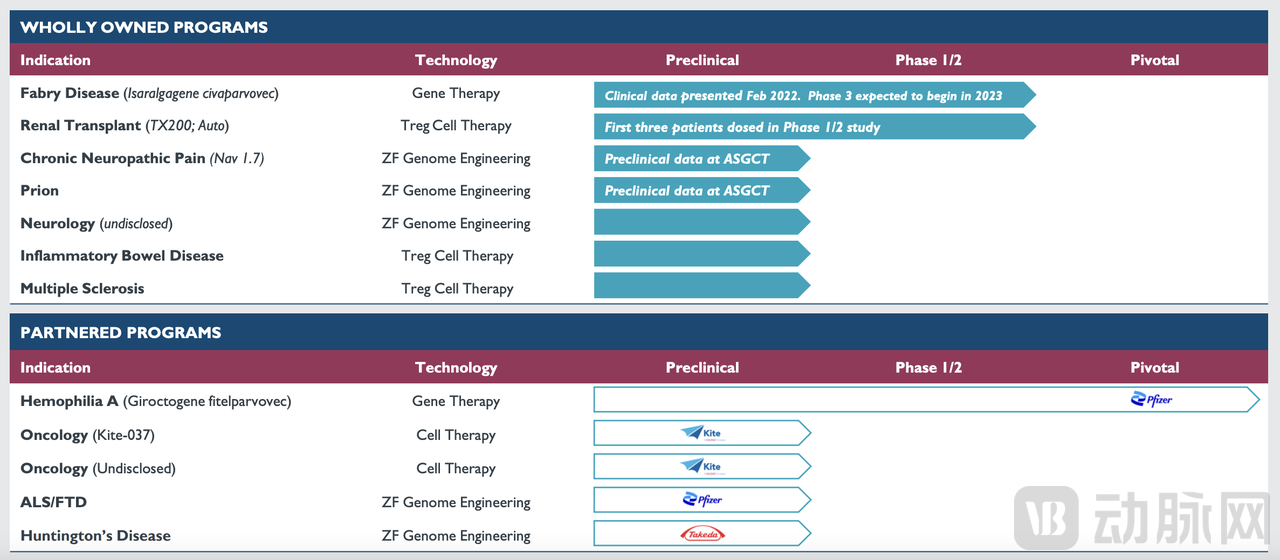
Sangamo’s Latest Pipeline Overview, Source: Company Q1 Earnings Report
During Sangamo’s first-quarter earnings conference call, the company announced its three key strategic priorities moving forward:
Nav1.7 and Prion are key preclinical programs in Sangamo’s neurology epigenetic regulation portfolio; Nav1.7 is being developed for the treatment of chronic neuropathic pain, with an IND submission expected in 2024, while the Prion program plans to submit its IND in 2025.
In preparation for the Phase III clinical trial of its therapy for Fabry disease (formerly ST-920), Sangamo noted that this X-linked genetic disorder is primarily caused by defects in the gene responsible for producing alpha-galactosidase A. The company stated that its product has demonstrated a favorable safety profile in Phase I/II trials and is currently advancing plans for the Phase III study.
TX200 CAR-Treg Clinical Study: TX200 for Solid Organ Transplantation. Sangamo plans to advance the application of TX200 in kidney transplantation through Phase I/II clinical studies and intends to accelerate dose escalation.
As evident from the company’s latest pipeline list, all of Sangamo’s key projects are proprietary assets, with collaborative projects being virtually nonexistent compared to previous periods. Sangamo appears to be increasingly pursuing an independent path.
Technological advancement requires branching out and diversifying.
When the industry compares ZFN with CRISPR, one major issue invariably mentioned is the patent blockade facing ZFN.
Patents have always been a key competitive barrier in the field of gene therapy. Sangamo simply avoided this issue from the outset, leaving it to navigate the ZFN landscape alone. As a result, ZFN technology has neither achieved large-scale application nor made any breakthrough progress since its inception.
CRISPR technology has advanced rapidly amid a “less-than-dignified” patent dispute.In November 2013, Feng Zhang, together with Jennifer Doudna and others, co-founded Editas Medicine. However, due to unresolved patent disputes, Doudna went on to establish Intellia Therapeutics in 2014. Meanwhile, Emmanuelle Charpentier also remained active, founding CRISPR Therapeutics in 2013. Today, these three companies have emerged as the leading players in the field of CRISPR gene-editing technology.
Amid ongoing patent disputes surrounding CRISPR, specialized technological pathways have continually emerged. For instance, base editing, introduced in 2016, enables targeted modification of one or several point mutations, allowing for the precise alteration of specific bases at designated genomic locations while affecting only the single target base without impacting others. In 2019, Dr. David Liu unveiled prime editing, which facilitates arbitrary conversions among the four nucleotide bases as well as precise insertions and deletions of small DNA fragments.
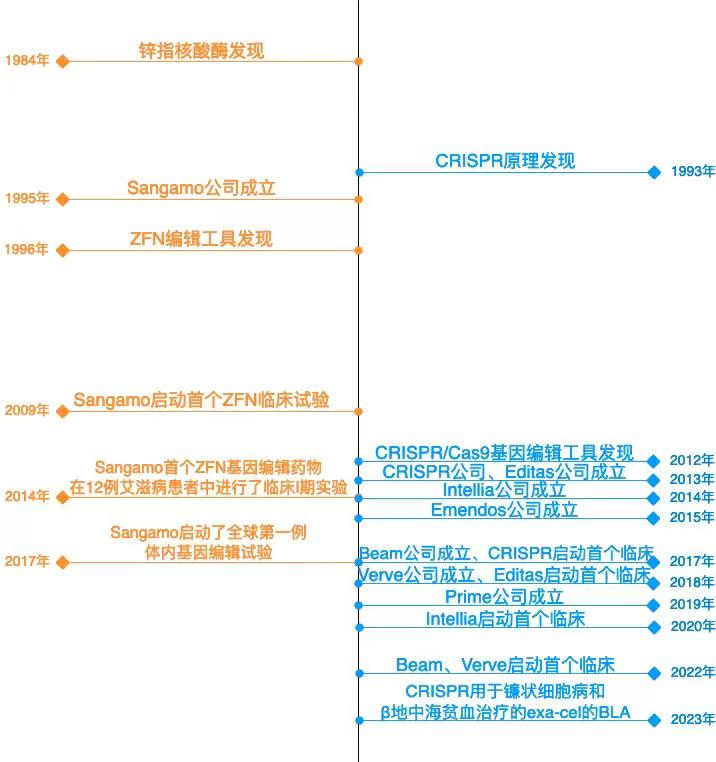
Timeline of Companies Related to ZFN and CRISPR Technologies / Compiled by VCBeat New Medicine
Regarding patent issues, the numerous companies deploying CRISPR technology are simultaneously seeking ways to circumvent CRISPR-Cas9 patents and striving to secure patents that have not yet been finalized. Huida Gene’s independently developed CRISPR-Cas13 systems—Cas13X (also known as Cas13e) and Cas13Y (also known as Cas13f)—can not only reduce the expression of target RNA genes but also achieve single-base RNA editing by engineering fusions with deaminases, with editing efficiencies approaching 80%. ToloBio has filed for patents in the United States covering Cas12 protein-based diagnostics. Leveraging the trans-cleavage activity of Cas12a, the company developed the HOLMES diagnostic system, engaging in intense patent competition with Mammoth Biosciences and ultimately prevailing over its rival.
All of this has made the CRISPR field even more vibrant and diverse.
In contrast, scientists outside Sangamo Therapeutics remain unable to access the detailed processes underlying its screening and optimization of zinc-finger nuclease (ZFN) technology, thereby precluding any further refinement or advancement based on these methods. The rapid maturation and fruitful development of this technology cannot be achieved solely by the small number of scientists within Sangamo. Even if academic researchers wish to leverage Sangamo’s technology for basic research—such as conducting site-specific mutagenesis in an organism to investigate its physiological functions—they must commission Sangamo to design and execute these tasks, a process akin to operating a “black box.” Although ZFNs initially demonstrated strong potential in both basic research and clinical applications, their confinement within Sangamo has prevented the full realization of their capabilities, causing the technology to lose its early-mover advantage.
In a sense, Sangamo’s extreme protection of its patents, as a business practice, may well be featured in many case studies taught at business and law schools and discussed for years to come; however, whether ZFN technology and its associated research will be remembered remains questionable.After all, whether in scientific debates or commercial competitions, the ultimate goal is to unlock the potential to benefit humanity.