

Digital Transformation as a Catalyst for Upgrading China's Dental Industry: Meiwei Dental’s Strategic Pathway

MEI WEI DENTAL GROUP
Oral Health Service Provider
The dental industry is undoubtedly a hot sector in recent years.
According to the “2023 Insight Report on Dental Medical Services” (hereinafter referred to as the “Report”) released by VCBeat at the beginning of this year, China’s dental medical services market reached RMB 145 billion in 2021 and has maintained an average annual growth rate of 20%. It is projected to reach RMB 300 billion by 2025, indicating broad market prospects.
However, due to issues such as a shortage of dental professionals and low levels of informatization, the efficiency of the dental industry still requires significant improvement. Reports indicate that China’s overall level of digitalization in the dental sector lags considerably behind that of developed countries in Europe and America. Yet, the level of digitalization often determines the upper limit of clinical dental service quality.
Consequently, numerous dental enterprises have stepped up their efforts to enhance operational efficiency within their own organizations and across the entire industry through digitalization, aiming to provide dental patients with an improved medical service experience.This team includes MEI WEI DENTAL GROUP (hereinafter referred to as “Meiwei Dental”), which has prioritized tech-driven healthcare since its establishment in 2016 and is the first dental chain in the industry to possess a self-developed digital system.
With outstanding performance, MEI WEI DENTAL GROUP has recently ranked highly on several prestigious lists, including the “Top 100 Innovative Medical Services for Future Healthcare” and the “Hurun Global Unicorn Companies 2023.”
“China’s digital healthcare development is gradually becoming a new focal point in the global medical sector. In the field of digital healthcare, MEI WEI DENTAL GROUP has been continuously accumulating expertise in standard output, supply chain optimization, management empowerment, finance, and data support.” Thus stated Ms. Zhu Liya, Founding Partner and CEO of MEI WEI DENTAL GROUP, at the “7th Future Healthcare 100 Conference,” hosted by VB100, VCBeat, and Eggshell Research Institute, with strategic partnership support from Shanghai Zhangjiang Group.
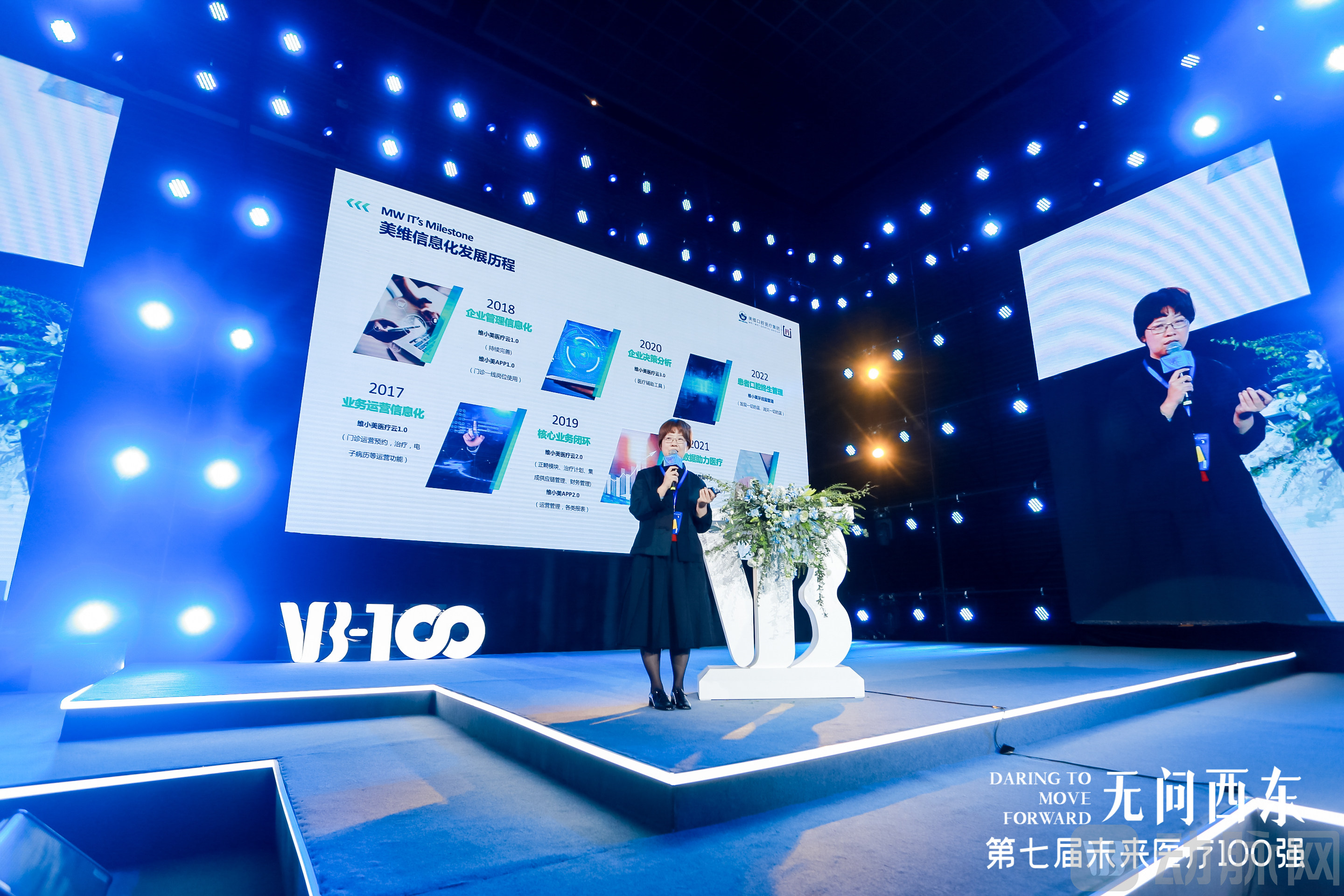 (Ms. Zhu Liya, Founding Partner and CEO of MEI WEI DENTAL GROUP, delivering a keynote speech at the "7th Future Healthcare Top 100 Conference")
Why Is MEI WEI DENTAL GROUP Doubling Down on Digitalization? What Is the Underlying Logic? What Other Key Industry Trends Does It Foresee? To explore these questions, VCBeat held an in-depth conversation with Ms. Zhu Liya.
Since the turn of this century, digitalization has been penetrating into the core sectors of the dental industry.
For instance, in the early stages, the application of digital technology in clinical dentistry was primarily limited to chairside fabrication of simple restorations and surgical guides for dental implants. In recent years, however, digital technologies have been extensively adopted across various dental specialties, including prosthodontics, orthodontics, and implantology, with the digital wave advancing ever deeper. This trend has profoundly transformed the dental industry, accelerating its transformation and upgrading.
However, from the perspective of enterprise distribution, digitalization is mainly concentrated in the upstream of the dental industry chain, while few enterprises have systematically implemented digital strategies at the midstream service provider level. This is because digitalization requires substantial investment and a considerable amount of time to yield significant results.
“For dental service providers to achieve chain expansion, they must address the issue of being “connected but not unified.”“Ms. Julia told VCBeat, ‘As dental institutions continue to expand in scale, maintaining profitability and achieving efficient management require the support of digitalization and intelligence. Therefore, digitalization is critically important.’”
That is to say,The information system required for unified management in the chain industry has become a threshold determining whether it can achieve rapid development.For instance, without digital support, dentists could only manually record medical records, making remote access to patient cases impossible. Additionally, the enterprise’s management span would be excessively broad, resulting in untimely statistical data analysis. Furthermore, the inability to share data across platforms among various functional departments hinders the development of comprehensive system solutions.
Consistent with this view, a 2022 survey conducted by VCBeat among 1,000 dental healthcare service providers revealed that nearly 90% of these institutions consider digital transformation to be highly necessary.
On one hand, institutions can streamline the consultation process through digital management, thereby enhancing the clinical experience for both patients and physicians. On the other hand, digitalization can, to a certain extent, alleviate the shortage of dental professionals and support their continuous professional development.
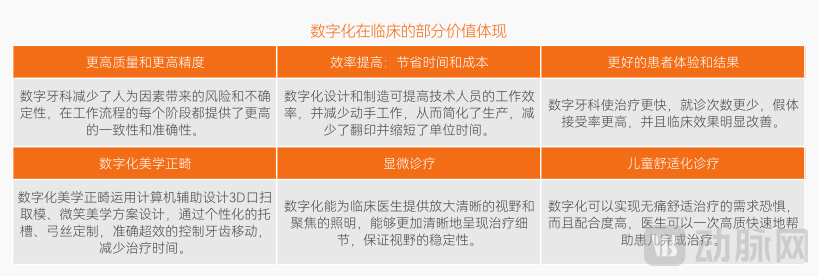 (Image source: VCBeat’s “2023 Insights Report on Dental Medical Services”)
In short, digitization can enhance efficiency and experience across the board—from device and case management to dentist training and consultation management, including patient care workflows.
In addition, the level of digitalization also affects the consistency and brand strength of dental service providers.This is because the operation of current dental medical services is no longer implemented solely through the connection between doctors and patients; the value enhancement created by digitalization has surpassed the traditional model of doctors merely conducting outpatient consultations. For example, in the past, it took 15–20 years to cultivate an experienced implant dentist. However, with technologies such as digital surgical guides and 3D printing, implant dentists can master the necessary skills in approximately five years, while ensuring a consistent experience for dental patients and delivering more standardized services.
It is precisely for these reasons that digital transformation in the oral healthcare services industry is imperative.
Approaches to digitalization vary among dental enterprises.For MEI WEI DENTAL GROUP, the core lies in being “patient-centric” and “care-centric,” thereby constructing a digital layout tailored to its distinctive DSO model.
“MEI WEI DENTAL GROUP is the first dental healthcare enterprise in China to develop under the DSO model. It requires technological empowerment across dimensions such as its platform, standards, and partnership structure; therefore, since its inception, MEI WEI DENTAL GROUP has placed particular emphasis on digitalization, including the development of IT systems,” stated Ms. Zhu Liya.
What is the DSO Model? It refers to Dental Service Organizations, a collective term for operational management companies that provide non-clinical business support services to dentists and dental clinics.The core mission is to help dentists launching dental clinics address a range of non-clinical business challenges encountered during clinic operations, including management, operations, finance, legal affairs, and training, thereby enabling them to devote more energy to enhancing their clinical expertise and patient care.This model originated in the United States, where Heartland Dental, the largest player, has grown into a chain operating over 1,000 clinics.
However, unlike the “DSO” model in the United States, MEI WEI DENTAL GROUP has undertaken localized innovative initiatives by empowering outstanding Chinese dental chain brands and experts through strategic investments, standardization, advancement of medical technologies, and brand management. It provides multi-level support in healthcare delivery, procurement, talent development, operations, and management, thereby facilitating their personalized growth.
It is worth noting that under MEI WEI DENTAL GROUP’s business partner model, dentist-owners have not been displaced; instead, they have become managers of the new institutions.
In Ms. Julia’s view,Comprehensive support spanning technology, IT, and middle- and back-office functions is the lifeblood of dental chains.“For us as a DSO, brands of different sizes have varying needs, and we aim to deliver robust mid- and back-office IT services. Thus, while dental chain brands can flourish in diverse forms, their underlying cohesion is driven by digitalization.”
To this end, MEI WEI DENTAL GROUP has developed the “Wei Xiao Mei Medical Cloud Intelligent Platform,” an information system centered on enhancing management and operational efficiency, which integrates systems such as HIS, finance, supply chain, human resources, and OA.
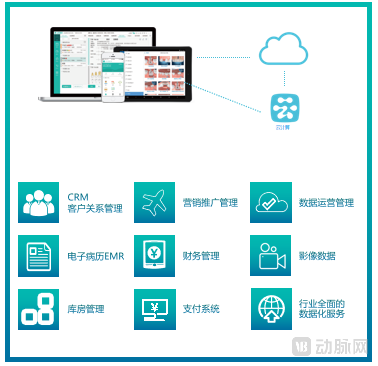
(MEI WEI SaaS Management Platform)
Leveraging a cloud-based platform, MEI WEI DENTAL GROUP has developed a comprehensive, one-stop information management solution centered on “patients, medical care, and efficiency.” By collecting data such as patient health records and medical imaging to build a big data repository, and integrating artificial intelligence, the solution enables clinical applications and efficient management. This approach facilitates a genuine upgrade to refined management in dental healthcare across multiple dimensions, including customer relationship management, medical efficiency and quality, patient safety, information sharing and collaboration, standardized operational management, supply chain management, and integrated financial management.
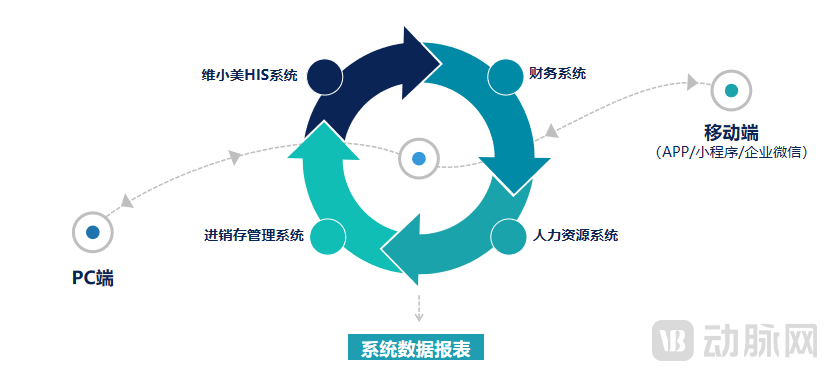 (MEI WEI Information Management System)
For example, MEI WEI DENTAL GROUP’s AI-powered technology performs multiple intelligent assessments based on patients’ oral conditions. Through AI analysis, it rapidly assists dentists in identifying oral health issues and generates customized patient reports. This not only helps enhance patients’ awareness of oral healthcare but also improves the accuracy and efficiency of dental diagnosis and treatment.
For another example, by leveraging big data technology, MEI WEI DENTAL GROUP can rapidly categorize customers to conduct patient follow-ups and tracking, thereby improving efficiency and maximizing the management of existing patient resources.
However, building an in-house IT system is no easy feat.Ms. Zhu Liya remarked in this regard that “there is no such thing as an IT system that escapes criticism.” “Fortunately, we have consistently received full support from both our shareholders and partners. In the early stages, Meivei Dental’s information systems were not yet fully mature and frequently encountered issues. However, frontline users actively provided feedback to help optimize the systems.”
So, how exactly is this implemented? MEI WEI DENTAL GROUP'sThe core logic is to translate the languages of IT personnel and frontline staff into a common language that everyone can understand.This enables IT personnel to understand how to conduct research and development, while also ensuring that frontline staff know exactly how to implement the resulting products. MEI WEI DENTAL GROUP has established a robust support system for this purpose, allowing every employee, manager, city general manager, and clinic director to recognize and understand how to leverage IT systems to deepen management practices, achieve paperless operations, and improve efficiency.
Taking Shanghai Weile Dental’s comprehensive push toward digitalization in 2021 as an example, some dentists at the time were accustomed to traditional workflows and found it difficult to shift their mindset. Furthermore, with full automation of processes, the system recorded areas where users performed poorly, thereby exposing entrenched bad practices among medical staff. As a result, many resisted adopting the new system.
To address this issue, Shanghai Weile organized competitions and offered substantial rewards to actively engage employees. For instance, regarding the use of intraoral scanners, the system backend records employees’ operation times. Through continuous training, staff gradually reduced their operation time to under three minutes, significantly enhancing patient experience.
Driven by continuous digital innovation, MEI WEI DENTAL GROUP boasts strong endogenous growth momentum. It currently operates 16 dental chain brands across 35 cities, with nearly 200 dental medical institutions, and has provided dental treatment to over 2.34 million patients.
As can be seen, by prioritizing the integration of “healthcare + technology,” MEI WEI DENTAL GROUP has steadily expanded its corporate boundaries, bringing new possibilities to the dental chain industry.
“I have always believed that the healthcare services industry cannot be rushed; it requires patience and perseverance,” Ms. Zhu Liya told VCBeat, “This is a “people-centric” field, so it is crucial to uphold a long-termist entrepreneurial mindset., it is essential to adhere to 'patient-centered' and 'healthcare-centered' principles.”
In line with this direction, MEI WEI DENTAL GROUP is advancing comfort-oriented dental care.
What is Comfort-Oriented Diagnosis and Treatment? It integrates minimally invasive therapy, precision medicine, and anesthetic techniques to enable patients to undergo medical examinations and treatments in a safe, painless, and comfortable state. This approach ensures that patients experience psychological and physiological comfort, freedom from pain, and absence of fear throughout the entire healthcare process. It is particularly effective for complex dental treatments in children with low compliance.
“Almost everyone reports a fear of pain during dental procedures, with some even avoiding treatment due to this fear,”Comfort-oriented diagnosis and treatment continue to resonate with patients and remain the core of future upgrades in consumer healthcare..” Ms. Julia stated.
However, advancing comfort-oriented diagnosis and treatment is no easy feat, as it places high demands on hardware equipment, anesthesiologists, and clinicians. Furthermore, greater market education is needed to improve patient awareness. For instance, while general anesthesia for pediatric dental care is widely adopted abroad, few hospitals in China offer this service, and it is particularly rare among non-public dental institutions.
To this end, MEI WEI DENTAL GROUP has made extensive preparations and devoted significant efforts.
Taking Nankai Aichi Stomatological Hospital as an example, this Level II specialized dental hospital is fully equipped with anesthesia, emergency resuscitation, and monitoring facilities. Its medical team boasts strong technical expertise, led by President Guo Pingchuan, an Associate Chief Physician with over 40 years of clinical experience in dental diagnosis and treatment. Additionally, the anesthesiologists on staff have extensive experience in administering general anesthesia to pediatric patients.
For another example, Shanghai Weile, a self-owned brand of MEI WEI DENTAL GROUP, has taken the lead in launching a pilot project to build a dental hospital centered on comfort and digitalization, and will introduce more cutting-edge high-tech equipment across its clinics in Shanghai. Meanwhile, it is fully integrating digital links with upstream and downstream partners to establish a digital remote diagnosis and treatment center, featuring remote consultation rooms to enable the sharing of top-tier medical expertise.
Moreover, Shanghai Weile Dental recently hosted the “Comfortable Care, New Future: 2023 Annual Forum on the Application of Comfortable Dentistry.” Focusing on the core theme of comfortable dental care applications, the forum featured discussions on hot topics such as dental implants, orthodontics, pediatric dentistry, root canal therapy, and tooth extraction, as well as explorations and innovations in comfortable care models for outpatient dental clinics. The event attracted more than 100 representatives from the dental community.
“We hope to truly improve the management of oral health across the entire lifecycle,” said Ms. Zhu Liya,Our strategic initiatives in technology and patient-centered, comfortable care are firmly centered on safeguarding the long-term oral health of the Chinese population.“From the initial consultation and treatment to follow-up visits and re-examinations, encompassing both family and social circles, and spanning comprehensive diagnostic evaluations, addressing chief complaints, developing integrated treatment plans, and ongoing oral health management to post-treatment satisfaction, this closed-loop approach truly achieves full-lifecycle management of patients’ oral health.”
It should be noted that,Oral health issues are garnering increasing attention among the Chinese population.Data published in the *China Health and Health Statistics Yearbook* show that from 2013 to 2021, the number of dental visits at stomatological hospitals in China increased from less than 25 million in 2013 to over 46 million in 2021, indicating a substantial total number of dental patients. Given the high incidence of oral diseases, conditions such as periodontal disease, dental caries, and bacterial infections may trigger or exacerbate systemic diseases. Therefore, maintaining oral health is of paramount importance.
Driven by immense demand, the oral healthcare services industry is poised for greater development opportunities, and more industry giants are certain to emerge in this field.
However, it is crucial to recognize the seriousness and rigor inherent in the healthcare industry. Only dental institutions that are patient-centric, continuously innovate, and embrace long-term value can achieve sustainable growth.