

Digital Empowerment of Medical Consortiums Emerges as Key Direction in China's 2023 Healthcare Reform Policies
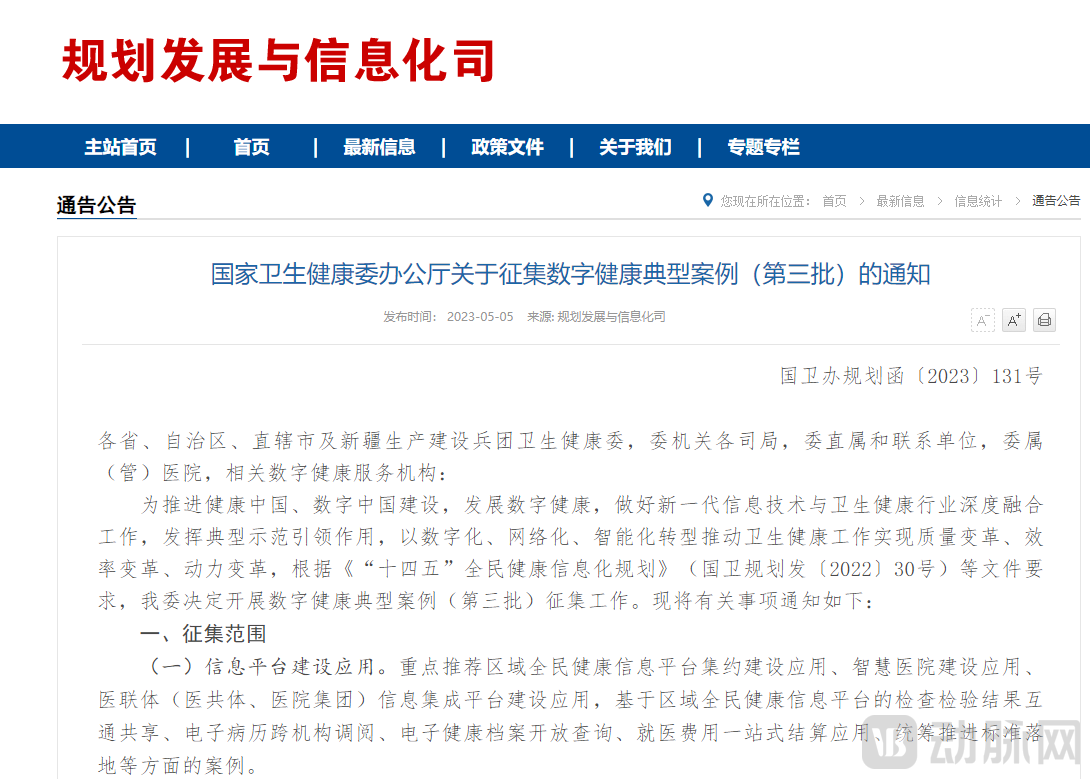
Recently, the General Office of the National Health Commission issued the "Notice on Soliciting Typical Cases of Digital Health (Third Batch)," with the scope of solicitation covering the construction and application of information platforms, "Internet + Medical Health," the application of health and medical big data, network information and data security, and the application of new-generation information technologies. Notably, it emphasized the application of digital health technologies in the development of regional medical consortia.
In fact, the construction of digital medical consortia has continued to gain momentum since the beginning of this year. Before half of 2023 had passed, China had successively issued several important guiding documents, including the “Opinions on Further Improving the Healthcare Service System” and the “Work Plan for Pilot Construction of Close-knit Urban Medical Groups,” with a focus on advancing the development of medical consortia and building an integrated healthcare delivery system. In response, various regions across the country have also accelerated the pace of constructing and upgrading their medical consortia.
From a practical perspective, various regions are increasingly emphasizing the supportive role of information technology while continuously improving resource-sharing models and coordinated division of labor. In particular, with pioneering initiatives such as Tianjin’s Primary Care Digital Health Community and Shandong’s Digital Chronic Disease Medical Consortium, the “Digital Medical Consortium” model—characterized by institutional innovation as its foundational framework and digital empowerment as its core feature—has gained significant traction. This model provides important references for the reform of tiered diagnosis and treatment systems and the development of the digital health sector across different regions.
Latest Healthcare Reform Policies Promote Tiered Diagnosis and Treatment
After years of healthcare reform practices, the shortcomings of China's medical and health service system have become clearly evident, most notably the insufficient supply and uneven distribution of high-quality medical resources.
To this end, the top-level design of healthcare reform has increasingly emphasized promoting the implementation of tiered diagnosis and treatment through the development of medical consortia, thereby expanding high-quality medical resources and achieving a balanced regional distribution. With the issuance of landmark documents such as the Guiding Opinions on Promoting the Construction of a Tiered Diagnosis and Treatment System (Guo Ban Fa [2015] No. 70), the Guiding Opinions on Promoting the Construction and Development of Medical Consortia (Guo Ban Fa [2017] No. 32), and the Implementation Opinions on Deepening Healthcare System Reform by Further Promoting the Experience of Sanming City, Fujian Province (Guo Yi Gai Fa [2021] No. 2), the reform of tiered diagnosis and treatment has continued to deepen.
In 2023, after three years of pandemic impact on the healthcare service system, the weaknesses in primary care capacity were further exposed. In response, China has continued to strengthen policy support for the development of medical consortiums.
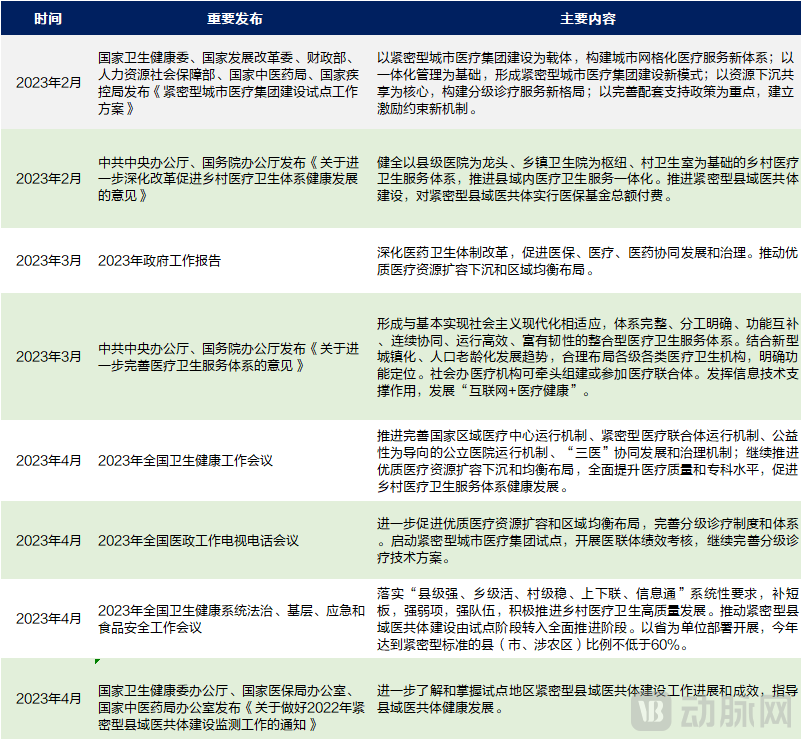
Key Healthcare Reforms Released in 2023 | Compiled from Publicly Available Online Information
In March 2023, the General Office of the Central Committee of the Communist Party of China and the General Office of the State Council issued the “Opinions on Further Improving the Healthcare Service System.” As a key roadmap for healthcare system reform over the next decade, the document mentioned “medical alliances” and “medical consortia” a total of 16 times, emphasizing that “privately operated medical institutions may take the lead in forming or participate in medical alliances.”
In addition, the “Work Plan for Pilot Projects on Building Close-Knit Urban Medical Groups” and the “Opinions on Further Deepening Reforms to Promote the Healthy Development of Rural Healthcare Systems” have been successively issued, providing specific arrangements for the development of urban medical groups and close-knit county-level medical consortia, respectively.
It can be said that leveraging the development of medical consortiums as a pivot to expand and decentralize high-quality medical resources, while promoting their balanced regional distribution, has become a key focus for localities in implementing healthcare reforms, thereby enabling more patients to conveniently access equitable and affordable healthcare services.
Digital Upgrading Becomes a Key Pathway for Medical Consortia
In recent years, various regions have continuously carried out pilot programs for the construction of medical consortiums based on the actual conditions of their local tiered diagnosis and treatment systems, resulting in the formation of diverse organizational models of medical consortiums.
For instance, the “Urban Medical Consortium” typically designates a leading hospital to coordinate with several secondary urban hospitals, rehabilitation hospitals, nursing homes, and community health service centers, thereby establishing a management model characterized by resource sharing and collaborative division of labor. The practical achievements of the Shenzhen Luohu Hospital Group have gained widespread recognition.
The “Medical Consortium” model focuses on exploring county-township integrated management, with county-level hospitals as the lead, township health centers as hubs, and village clinics as the foundation. This approach establishes a division-of-labor and collaborative mechanism among medical and health institutions at the county, township, and village levels, thereby building a three-tiered, coordinated county-wide medical service system. Tianchang in Anhui Province and Jia County in Henan Province are notable examples of the development of closely-knit county-level medical consortia.
“Specialty Alliances” leverage the strengths of specialized departments within regional medical institutions by centering on a flagship specialty from one institution and integrating similar specialized expertise from other institutions. This approach establishes several centers of excellence for specialized care within the region, enhancing the capacity to manage major complex conditions in those specialties and fostering a complementary development model. The Specialty Alliance established by Beijing Children’s Hospital can be regarded as a national benchmark.
“Telemedicine Collaboration Network” is a telemedicine service network established by lead institutions in partnership with medical facilities in grassroots, remote, and underdeveloped areas. It aims to leverage information technology to facilitate the vertical flow of medical resources, enhance the accessibility of high-quality medical resources, and improve the overall efficiency of healthcare services.
As the reform of tiered diagnosis and treatment deepens, various regions continue to explore pathways for upgrading medical consortia. In particular, against the backdrop of accelerating integration between digital technologies and the healthcare industry, the “Digital Medical Consortium” model—characterized by digital empowerment and leveraging innovations in mechanisms such as health insurance payment and performance evaluation—has come into prominence. Representative examples include Tianjin’s grassroots Digital Health Community and Shandong’s implemented Digital Chronic Disease Medical Consortium.
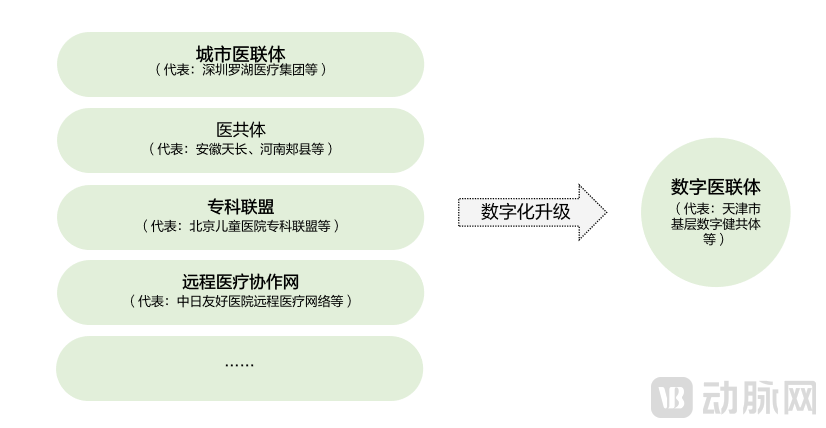
Major Models and Upgrade Pathways for Medical Consortium Development | Compiled from Publicly Available Online Information
The Tianjin Primary-Level Digital Health Consortium is a tightly integrated digital medical consortium jointly established by WeDoctor Internet Hospital of Tianjin, as the lead entity, in collaboration with 266 primary healthcare institutions across the city, under the guidance of the Tianjin Municipal Health Commission and the Tianjin Municipal Healthcare Security Administration. By implementing four cloud platforms—“Cloud Management,” “Cloud Services,” “Cloud Pharmacy,” and “Cloud Diagnostics”—alongside standardized chronic disease management centers, it provides residents with integrated online-and-offline medical and health services, innovatively exploring and constructing a value-based healthcare service system based on “payment for performance.”
In Shandong Province, the Tai’an Digital Chronic Disease Medical Consortium is led by WeDoctor Taishan Chronic Disease Internet Hospital. It connects 15 secondary-and-above medical institutions in Tai’an, integrating offline chronic disease specialty management at these 15 member hospitals with online internet hospital services. This model provides continuous, integrated care for chronic disease patients across the city, combining in-hospital and out-of-hospital settings as well as online and offline services. Building on Tai’an’s successful experience, Shandong Province is now promoting the digital chronic disease medical consortium model across all 16 prefecture-level cities in the province.
Practices in Tianjin and Shandong demonstrate that the “Digital Medical Consortium,” driven by digitalization, has established an integrated healthcare system featuring coordinated and efficient online-offline operations by improving the linkage mechanism among medical services, health insurance, and pharmaceuticals (“Three-Medical” linkage). This approach achieves the goals of alleviating pressure on large hospitals, enhancing the capabilities of primary care institutions, and improving payment efficiency. This innovative practice is not merely a digital “addition” to the existing medical consortium model; rather, it unleashes a “multiplier effect” through mechanistic innovation and technological empowerment. It provides an effective upgrade path for tiered diagnosis and treatment and is poised to become the mainstream model for future medical consortium development.