

Foresight Diagnostics Files IPO Prospectus for Ultra-Sensitive ctDNA-Based MRD Detection Platform

Foresight Diagnostics
Molecular Diagnostics Product Developer
Cancer is a leading cause of death worldwide. According to the report published by the American Cancer Society (ACS) in CA: A Cancer Journal for Clinicians, there were an estimated 19.3 million new cancer cases and nearly 10 million cancer-related deaths globally in 2020. The burden of cancer incidence and mortality is rising rapidly worldwide.
Traditional methods for early cancer screening mainly include ultrasound, spiral CT scans, biomarker assays, gastroscopy, and colonoscopy. However, these approaches are associated with high costs, difficult sampling, significant invasiveness, and low patient compliance. With the rapid advancement of biotechnology and molecular technologies, a series of novel techniques have emerged.
Liquid biopsy is an emerging in vitro diagnostic technology in recent years, encompassing multiple techniques such as circulating tumor cells (CTCs), circulating tumor DNA (ctDNA), microRNA, and microvesicles (exosomes). It enables the analysis and diagnosis of cancer and other diseases by detecting blood or other body fluids, including urine, saliva, pleural effusion, and cerebrospinal fluid.
Foresight Diagnostics is an early-stage molecular diagnostics company that has developed a novel liquid biopsy technology for the detection of minimal residual disease (MRD).
VCBeat has learned that on April 27, 2023, Foresight Diagnostics secured $58.75 million in Series B financing. The round was led by Foresite Capital, with participation from Civilization Ventures, Bluebird Ventures, Pear Ventures, Agent Capital, Stanford University, and the University of Colorado Healthcare Innovation Fund. The new funding will be used to accelerate the clinical development and commercialization of its cancer recurrence detection platform, PhasED-Seq.
ctDNA, or circulating tumor DNA, is a form of cell-free extracellular DNA, primarily consisting of fragmented genomic DNA released from ruptured, deceased tumor cells. MRD refers to the presence of residual tumor cells in patients with early- to mid-stage cancer following curative-intent treatment. ctDNA is an emerging biomarker for many cancers and has been validated across most cancer types.
However, the current limit of detection (LOD) for ctDNA analysis is imperfect and is often constrained by low DNA input and the background error rate of sequencing technologies.[1]. ctDNA levels in the blood are inherently low; the earlier the tumor stage, the lower the ctDNA concentration. While mid- to late-stage tumors may exhibit ctDNA levels of several percent or above 0.5%, early-stage tumors can have ctDNA concentrations as low as 0.01%. Furthermore, conventional imaging or endoscopy cannot detect minimal residual disease (MRD).
Although duplex DNA sequencing can reduce the background error rate, this method suffers from low duplex recovery efficiency, with only 20–25% of molecules having both original strands recovered simultaneously. PhasED-Seq, an analytical technology developed by Foresight Diagnostics, serves as an alternative to duplex sequencing. It enhances the sensitivity and specificity of ctDNA detection, improves genomic recovery efficiency, and reduces the background error rate.
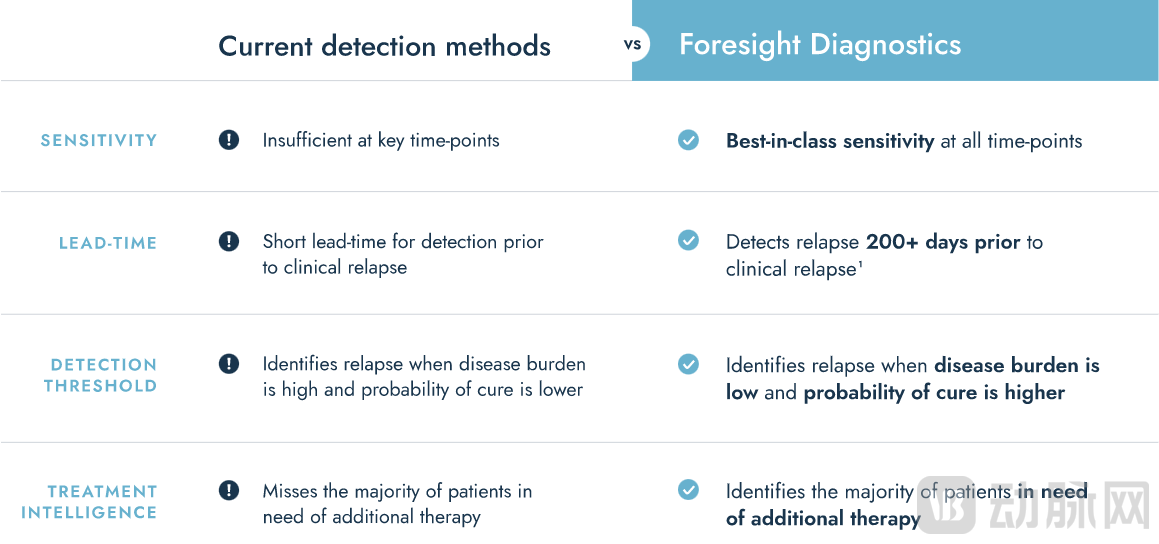
Comparison Between Traditional Detection Methods and Foresight Detection Methods. Image Source: Foresight Official Website
PhasED-Seq (Phased Variant Enrichment & Detection Sequencing) is a proprietary technology developed and licensed by Stanford University. This platform can detect multiple somatic mutations in individual DNA fragments from patient plasma, thereby accurately distinguishing ctDNA from normal DNA, and can be used for screening and diagnosing cancer MRD.
According to a report by Foresight Diagnostics, PhasED-Seq can detect ctDNA at levels as low as one part per million, enabling the detection of cancer recurrence an average of 200 days earlier than imaging-based methods, thereby providing patients with more personalized and timely effective cancer treatment regimens.[2]。
More than 20 clinical studies involving PhasED-Seq technology have been published in the fields of liquid and solid tumors.
According to public information, Foresight Diagnostics raised $12.5 million in its Series A financing round to launch its first chemiluminescent immunoassay (CLIA) test, supporting MRD-driven clinical trials for B-cell lymphoma (DLBCL), thereby entering the commercial development phase of PhasED-Seq technology.
Due to the high frequency of spontaneous and benign single-nucleotide variants (SNVs), which is sufficient to mask the low abundance of tumor-associated SNVs, the Foresight team proposed the detection of phased variants (PVs), defined as two or more SNVs located on the same DNA molecule. They analyzed whole-genome sequencing (WGS) data to assess the prevalence of PVs across different cancer types.
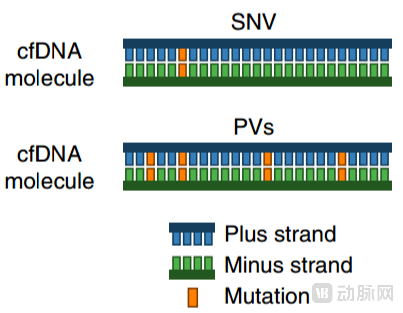
Schematic of SNVs and PVs on cfDNA. Image source: Nature Biotechnology
The evaluation results revealed that passenger variants (PVs) were most prominently expressed in two types of B-cell lymphomas and were distributed across specific genomic regions associated with these lymphomas. Notably, nearly one-third of these regions were located at sites related to physiological or aberrant somatic hypermutation in B cells. The distribution of PVs in each lymphoma type correlated with the known cancer signatures of the respective diseases. This study provides an innovative approach for the detection of B-cell lymphomas.
To validate the utility of PVs in ctDNA-based disease detection, the Foresight team designed a sequencing protocol to compare phasED-seq, which is based on PV detection, with other reported ctDNA detection methods (such as CAPP-seq, which is based on SNV detection).
The results showed that CAPP-seq failed to detect ctDNA after just one cycle of treatment, with ctDNA becoming detectable again only after 250 days. In contrast, phasED-seq was able to detect markers via PVs that were undetectable by SNV analysis. Meanwhile, they also conducted an assessment of MRD detection in patients with solid tumors to explore whether the phasED-seq technology could be extended beyond B-cell malignancies. The data demonstrated that, compared with SNV-based detection, phasED-seq was able to detect more ctDNA in the samples.[3]。
On July 22, 2021, a study by Foresight Diagnostics announced that PhasED-Seq had been extensively validated in hundreds of patients with B-cell lymphoma, demonstrating that the platform can be used to detect minimal residual disease (MRD) in B-cell lymphoma. It effectively increases the positive detection rate of circulating tumor DNA (ctDNA) in clinical samples during treatment and prior to relapse. Furthermore, PhasED-Seq is also applicable to patients with solid tumors.
Foresight Diagnostics was co-founded by four PhDs—Jake Chabon, Ash Alizadeh, Maximilian Diehn, and David Kurtz—who are scientists at Stanford University with extensive experience in developing innovative ctDNA detection technologies.

Foresight Founder | Image Source: Foresight Official Website
Jake Chabon is the Chief Executive Officer and Chief Strategy Officer at Foresight Diagnostics. He holds a Bachelor’s degree in Molecular Biology from the University of Denver and a Ph.D. in Stem Cell Biology and Regenerative Medicine from Stanford University. With extensive experience in the development of next-generation sequencing (NGS) technologies, particularly for non-invasive cancer diagnostics, he has published more than 20 related papers that have been cited over 2,700 times.
Ash Alizadeh holds a Bachelor’s degree in Biochemistry from the University of California, Los Angeles (UCLA), an M.D. from Stanford University School of Medicine, and a Ph.D. in Biophysics from Stanford University. He has served as Chair of the Lymphoma and Myeloma Scientific Committee of the American Society of Clinical Oncology (ASCO) and is a founding member of the International Consortium on ctDNA in Lymphoma. He has received scholar awards from organizations including the American Society of Hematology (ASH) and the Leukemia & Lymphoma Society (LLS).
Maximilian Diehn, like Ash Alizadeh, holds degrees in three specialized fields. He has extensive research experience in cancer genomics and cancer biology, was awarded the NIH Director’s Pioneer Award, and was elected as a member of the National Academy of Medicine in 2021.
The fourth founder, David Kurtz, holds a Ph.D. in Bioengineering from Stanford University and specializes in research on methods for detecting ctDNA. Like the first two founders, Dr. Kurtz also holds an M.D. and serves as a Professor of Oncology at Stanford University.
The team and laboratory led by Dr. Ash Alizadeh and Dr. Maximilian Diehn collaborated to develop a series of non-invasive cancer genomics technologies enabling “liquid biopsy,” including CAPP-Seq, PhasED-Seq, and EPIC-Seq. These technologies facilitate the detection of circulating cell-free DNA (cfDNA), supporting applications such as early cancer detection and non-invasive cancer monitoring. Both scientists served as doctoral advisors to Jake Chabon, who completed his graduate studies at Stanford University under their joint supervision. In 2020, the four of them co-founded Foresight Diagnostics.
As a startup focused on liquid biopsy, the founding team’s extensive research experience in ctDNA detection serves as a solid foundation for the company’s development. Under their leadership, Foresight Diagnostics will accelerate its path toward commercialization.
In recent years, liquid biopsy technology, which uses non-solid biological tissues as samples and is based on molecular diagnostic techniques such as digital PCR (dPCR) and next-generation sequencing (NGS), has developed rapidly, with a substantial market size. According to estimates by BCC Research and L.E.K. Consulting, the global liquid biopsy market was valued at $11.3 billion in 2019 and is projected to reach approximately $24 billion by 2023, while the potential market size in China will reach RMB 340 billion.
Liquid biopsy can be applied to multiple areas of cancer diagnosis and treatment, including early cancer detection, prognosis and recurrence risk assessment, selection of therapeutic regimens, and monitoring of disease burden. Currently, there are three main branches of liquid biopsy technology worldwide: circulating tumor cells (CTCs), circulating tumor DNA (ctDNA), and exosomes.
CTC detection is the earliest liquid biopsy technology applied in clinical practice, having accumulated more clinical data and technical feedback compared to ctDNA and exosome detection. ctDNA and CTC detection share commonalities, as both assess cancer risk by measuring the levels of ctDNA or CTCs in plasma; however, ctDNA testing generally offers higher sensitivity, while CTC analysis allows for a broader range of parameters. In contrast, exosome detection technology remains in its early stages of development regarding isolation, purification, and standardized production.
Currently, many liquid biopsy companies in the market are focusing on the research and development of CTC and ctDNA detection technologies. In the CTC detection sector, overseas companies such as Epic Sciences and Immunis.AI, along with Chinese companies including Ruisi Biotechnology, Lier Biotechnology, and Zhongke Natai, have actively explored this field. In the ctDNA detection sector, representative enterprises include overseas companies like Guardant Health, Grail, and Haystack Oncology, as well as Chinese companies such as AmoyDx, Genetron Health, and Berry Genomics.
References:
[1] Abbosh C, Birkbak NJ, Swanton C. Early stage NSCLC - challenges to implementing ctDNA-based screening and MRD detection. Nat Rev Clin Oncol, 2018, 15(9): 577-586.
[2] https://www.foresight-dx.com/news/foresight-diagnostics-announces-three-presentations-highlighting-clinical-studies-from-their-patented-phased-seq-mrd-platform-at-the64thamerican-society-of-hematology-annual-meeting-and-exposition
[3] Kurtz D M , Soo J , Keh L , et al. Enhanced detection of minimal residual disease by targeted sequencing of phased variants in circulating tumor DNA[J]. Nature biotechnology, 2021: 1537–1547.