

Mineralys Therapeutics Goes Public Just Four Years After Founding, Backed by Breakthrough Hypertension Candidate Lorundrostat
Andera Partners
Venture Capital Firms

Mineralys Therapeutics
Biopharmaceutical R&D Company for Hypertension Treatment

RA Capital
Life Sciences Venture Capital Firms

Rock Springs Capital
Venture Capital Firms
From a $40 million Series A financing round to a $118 million Series B financing round, Mineralys Therapeutics (“Mineralys”) has been consistently breaking its own fundraising ceilings.
Mineralys is a clinical-stage biopharmaceutical company that has developed lorundrostat, an oral aldosterone synthase inhibitor, for patients with hypertension. In its Series B financing round, prominent investors including RA Capital, Andera Partners, and Rock Springs Capital placed their bets on Mineralys’ future.
Less than a year after its Series B financing, Mineralys listed on the Nasdaq in February this year under the ticker symbol “MLYS.” In this IPO, it issued 13.8 million shares of common stock at $16.00 per share, raising a total of $202 million. As of press time, Mineralys’ market capitalization had reached $580 million (approximately RMB 4 billion).
What Gives It the Boldness to Continuously Attract Capital?
Mineralys’ initial appeal to investors was partly due to its high-caliber management team. In its prospectus, Mineralys explicitly acknowledged that the company is heavily reliant on its senior management and senior scientists.
Mineralys is headquartered in Pennsylvania, USA, and was founded in 2019 by Brian Taylor, the founder of Catalys Pacific. Catalys Pacific is an independent venture capital firm focused on early-stage investments in life sciences. The team specializes in creating and investing in biotech ventures to deliver healthcare solutions for patients worldwide.
Founder Brian Taylor graduated from Brown University, earned master’s and doctoral degrees in public health from Kyoto University and the University of Tokyo, and obtained his M.D. from George Washington University. CEO Jon Congleton has 20 years of experience in the pharmaceutical industry. Prior to joining Mineralys Therapeutics, he held management and marketing roles at Impel NeuroPharma, Nivalis Therapeutics, Teva, and other companies.

Founder Brian Taylor and CEO Jon Congleton
Image source: Mineralys Therapeutics official website
The management team’s extensive medical background signifies a clear understanding of the company’s industry and market, enabling the formulation of well-defined growth and profitability strategies, effective execution of business plans, and the creation of greater value for the company. This is why investors place such significant emphasis on the quality of the management team when making investment decisions.
In addition to its high-caliber management team, the scientists at Mineralys are equally formidable.
Chief Medical Officer David Rodman has previously conducted various biomedical research projects at miRagen, Vertex Pharmaceuticals, and Novartis Institutes. He was elected as a Fellow of the American Society for Clinical Investigation and appointed as a Senior Fellow and Member of the American Heart Association. The members of Mineralys’ Clinical Advisory Board are all from prestigious medical institutions such as Harvard Medical School and Vanderbilt University School of Medicine. Mineralys’ team of scientists, with their experience and proven track record, is more likely to earn investor trust.

Chief Medical Officer David Rodman
Image source: Mineralys Therapeutics official website
Mineralys has only one flagship product, Lorundrostat. This is a highly selective and potent aldosterone synthase inhibitor, licensed from Mitsubishi Tanabe Pharma, and is currently under investigation for the treatment of hypertension.
Even prior to approval, lorundrostat demonstrated outstanding performance: by selectively inhibiting the CYP11B2 pathway responsible for aldosterone synthesis, it significantly reduces plasma aldosterone levels without affecting other hormones such as cortisol, highlighting its potential for targeted treatment of hypertension in patients with elevated aldosterone secretion.
Abnormally elevated aldosterone levels are a key driver of hypertension in approximately 25% of patients with high blood pressure. Elevated aldosterone leads to increased blood volume and blood pressure, while also promoting inflammation and fibrosis, thereby raising the risk of stroke, kidney damage, and heart failure. Normalizing aldosterone levels offers an effective and more targeted approach to managing hypertension.
Mineralys Therapeutics targets the antihypertensive drug market through its aldosterone-targeting approach.
Persistently elevated blood pressure increases the risk of heart disease and stroke, which are leading causes of death in the United States. Hypertension and related health issues impose an average annual economic burden of approximately $130 billion in the U.S., underscoring a substantial market size. According to a report published by Facts Factors, the global market for antihypertensive drugs was valued at approximately $20.5 billion in 2021 and is projected to reach around $39.5 billion by 2030, with a compound annual growth rate (CAGR) of approximately 2.95% from 2022 to 2030.
Similar products based on comparable technological pathways have already been successfully launched on the market and have undergone decades of market validation.
Micardis is an angiotensin II receptor blocker (ARB) approved by the FDA in 2000 for the treatment of hypertension. As an ARB, Micardis helps regulate blood pressure by modulating the renin-angiotensin system. While most antihypertensive drugs provide efficacy for no more than 10 hours, Micardis offers 24-hour blood pressure control, boasting the longest duration of action among its class. According to a report by Allied Market Research, the global market size for Micardis was $3.453 billion in 2019 and is projected to reach $4.258 billion by 2027, representing a compound annual growth rate (CAGR) of 3.4% from 2020 to 2027.
Notably, in May 2023, Mineralys Therapeutics initiated the pivotal ADVANCE-HTN trial, with the first patient having received treatment.In the prior Phase 2 Target HTN trial, Mineralys demonstratedLorundrostat demonstrated clinically meaningful blood pressure reduction in patients with uncontrolled hypertension. The placebo-adjusted reduction in systolic blood pressure with lorundrostat was statistically significant, with mean placebo-adjusted systolic blood pressure reductions of 9.6 mmHg and 7.8 mmHg at once-daily (QD) doses of 50 mg and 100 mg, respectively.
Cash reserves are typically a critical factor to consider when evaluating pharmaceutical companies. Robust cash reserves not only provide the necessary funding for research and development but also enable pharmaceutical companies to pursue strategic acquisitions or investments, while offering a buffer during periods of economic uncertainty.
The prospectus disclosed by Mineralys shows that the company's full-year R&D expenses in 2022 were $26.3 million. Compared with 2021, clinical supply, manufacturing, and regulatory costs increased by $1.7 million. The company's net loss for the full year of 2022 was $29.8 million.
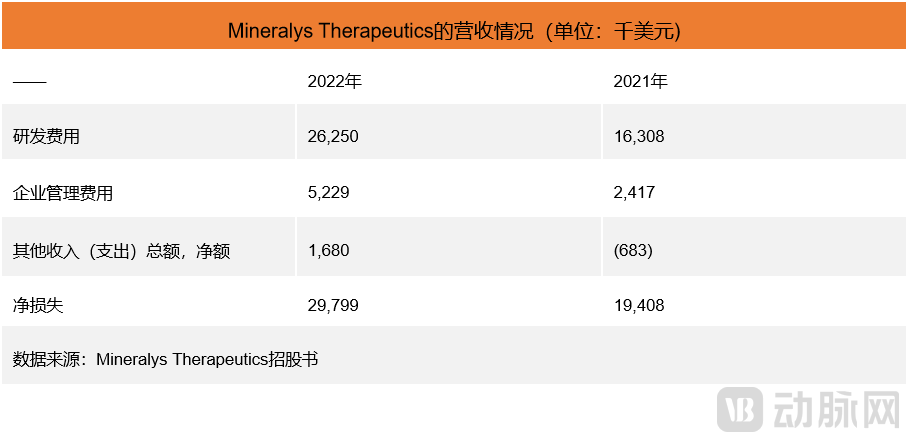
Mineralys Therapeutics' Revenue Performance
VCBeat Graphics
However, as of December 31, 2022,The company’s cash, cash equivalents, and marketable securities totaled $110.1 million. A year ago, this figure stood at $10.6 million, meaning Mineralys’ cash position increased tenfold in just one year.Following a $202 million IPO, Mineralys’ cash reserves have reached $300 million.
Meanwhile, the relationship between cash reserves and investors resembles an ink-wash Tai Chi, mutually influencing each other in an endless cycle. Cash reserves demonstrate a company’s financial strength and stability, while also providing potential for future growth opportunities, thereby attracting investors to join the company. The capital brought by these investors, in turn, further enriches the company’s cash flow.
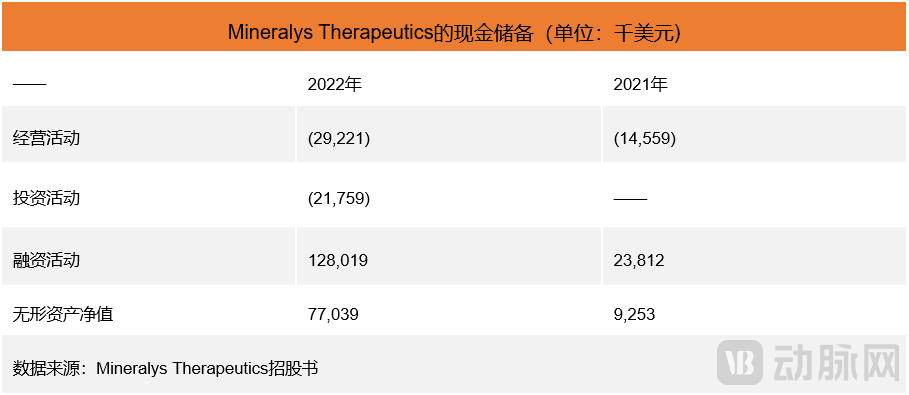
Mineralys Therapeutics' Cash Reserves
Graphic by VCBeat
According to Crunchbase statistics, Mineralys has raised a total of $162 million across four funding rounds since its inception. Following a $4 million seed round, Mineralys saw its funding amounts and investor base multiply, securing $40 million in Series A and $118 million in Series B. Fourteen investment institutions, including Boulder Ventures, HBM Healthcare Investments AG, Andera Partners, and RA Capital Management, have participated in these funding rounds.
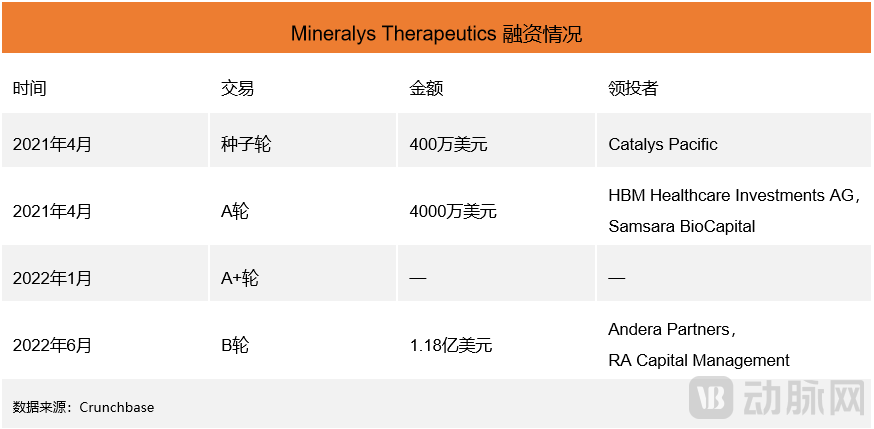
Mineralys Therapeutics Financing Overview
VCBeat Graphic
The fact that its flagship products hold significant potential and it has ample R&D funding does not mean that Mineralys is limited to the single path of research and development followed by drug commercialization.In the antihypertensive drug landscape, predecessors have provided a roadmap for Mineralys: beyond evolving from a biotech into a biopharma through gradual growth and development, it can pursue industry consolidation via M&A (Mergers and Acquisitions) to become part of the product pipeline or technological portfolio of a large pharmaceutical company.
CinCor Pharma, a strong competitor of Mineralys Therapeutics, went public on NASDAQ in January 2022. The company is dedicated to developing novel therapies for hard-to-control hypertension and chronic kidney disease. Just one year after its IPO, CinCor Pharma sold baxdrostat, an aldosterone synthase inhibitor designed to lower blood pressure in patients with resistant hypertension, to AstraZeneca. Through this transaction, CinCor Pharma was successfully acquired and became part of AstraZeneca’s product pipeline.
Similar to Mineralys’ product, baxdrostat exhibits high selectivity for aldosterone synthase and reduces activity in the cortisol pathway. AstraZeneca completed its acquisition of CinCor Pharma by purchasing all outstanding shares of CinCor Pharma, with an upfront payment of approximately $1.3 billion.
Beyond Embracing Cash Flow and M&A, Mineralys Has More Paths to Pursue in the Future.