

Who Dominates the RMB 400-Billion Medical Device Export Market? Key Players and Product Insights

Mindray
Medical Device R&D Manufacturer
“In the future, for medical device companies, the domestic market will cover basic survival needs, while the overseas market will drive substantial profitability.”
This was the earlier forecast by Wang Junfeng, Managing Director at Legend Capital, regarding the medical device industry. This prediction was soon corroborated by the 2022 and Q1 2023 performance results of major listed companies in China.
An analysis of the financial performance of medical device companies listed on China’s A-share market reveals that firms with outstanding results share a common trait: overseas revenue accounts for more than 40% of their total income.
Export data for 2022 shows that China’s medical device exports surged once again. According to the General Administration of Customs, the total value of China’s medical device exports from January to November 2022 reached RMB 444.179 billion, with the full-year export value projected at RMB 478.5 billion.
China’s medical device exports have traditionally been dominated by low-value consumables (such as gloves and masks). However, financial report data from 2022 show a significant increase in the export share of medical equipment, in vitro diagnostic (IVD) products, and vascular intervention devices. In high-end overseas markets with substantial entry barriers, multiple Chinese manufacturers have successfully increased their market penetration and secured a notable market share.
In a market pie approaching RMB 500 billion, which companies have seized growth opportunities and successfully “gotten their share of the meat”? VCBeat (WeChat ID: vcbeat) has compiled an analysis on how these firms have shifted their growth logic from domestic substitution to overseas expansion.
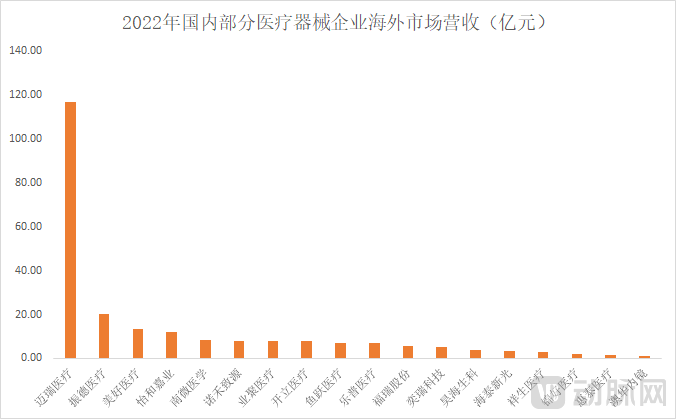
Chinese medical device companies expand overseas through three main channels: acquiring foreign companies, OEM contract manufacturing, and establishing independent brands. Among these, OEM contract manufacturing is the predominant mode for Chinese enterprises, which makes it difficult for them to build brand recognition in overseas markets. Developed countries possess strong local production, R&D, and service capabilities, granting them significant pricing power. Consequently, most Chinese products enter developed markets via OEM arrangements or trade channels, without holding core pricing power.
Mindray, the leading domestic medical device manufacturer, is the enterprise that has secured core pricing power overseas and achieved tens of billions in revenue. Mindray’s overseas income primarily derives from patient monitoring, in-vitro diagnostics, ultrasound products, and total solutions. The highlight of Mindray’s global expansion in 2022 was its breakthrough into high-end markets.
In the field of patient monitoring and life support, Mindray’s major orders come from hospital groups in the Middle East and Europe. The company has secured orders from leading institutions such as the Pantheon Group, one of Europe’s largest private hospital groups; Seha, the public healthcare system in Abu Dhabi, United Arab Emirates; and the Sunway Group, Malaysia’s third-largest private hospital group.
In the field of in vitro diagnostics (IVD), we successfully penetrated nearly 70 third-party chain laboratories, driving annual growth of over 35% in our international IVD business.
In the field of medical imaging, Mindray’s primary overseas revenue comes from the European market, where it has secured more than 80 new high-end customers. In addition, over 80 existing high-end customers have achieved horizontal expansion by adopting a broader range of products.
In 2022, Mindray’s international revenue was approximately RMB 11.7 billion, yet its corresponding market share remained in the low single digits. There is still substantial room for penetration growth for Mindray in overseas markets.
Over the past two years, Mindray’s overseas revenue has remained at the level of tens of billions of yuan, far outpacing other Chinese medical device companies excluding those focused on COVID-19 antigen tests. However, beneath Mindray, other enterprises whose overseas revenues have surpassed the 100-million-yuan mark are also worthy of attention.
Excluding low-value consumables and COVID-19-related products, the representative Chinese medical device companies with overseas revenues reaching the billion-yuan level are Haohai Medical and BMC Medical. Interestingly, both companies operate in the ventilator sector.
Even in the domestic market, where imports still monopolize over 75% of the ventilator market share, Chinese-made ventilators have achieved a remarkable turnaround overseas.
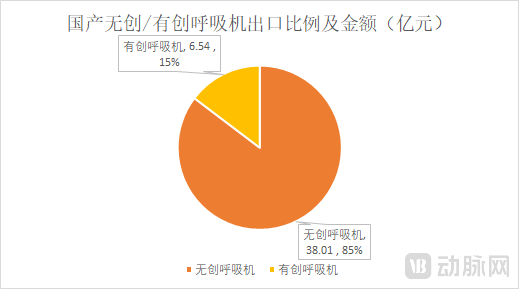
China’s ventilator trade has shifted to a surplus. In 2022, the total import value of invasive and non-invasive ventilators amounted to RMB 1.15 billion, while exports during the same period reached RMB 4.45 billion, with non-invasive ventilator exports accounting for RMB 3.801 billion.
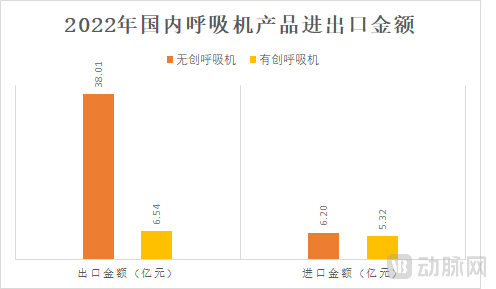
In 2020, the export market size of home non-invasive ventilators in China was only RMB 300 million; two years later, the export volume reached RMB 3.8 billion, achieving a tenfold increase.
Why Are Chinese-Made Ventilators Able to Achieve a Trade Surplus in Developed Countries?
The core reason remains the enhanced competitiveness of domestically produced products, coupled with their significant price advantage.Another major factor was the opportunity created for domestic manufacturers to expand their market share following Philips’ recall incident. In 2021, Philips recalled millions of ventilator units worldwide due to health risks.
The overseas market for home-use ventilators is significantly larger than the domestic market, with China’s market size amounting to only one-seventh of that in North America. As Chinese enterprises expand their share in the overseas market, the resulting revenue growth far exceeds that driven by domestic market expansion. Consequently, although full import substitution has not yet been achieved in the ventilator sector, a trade surplus has already been realized.
Among listed companies, the enterprises capturing this wave of growth dividends include BMC Medical and Meihao Medical, which manufactures products under contract for ResMed.
BMC Medical’s overseas revenue reached RMB 1.199 billion in 2022, a year-on-year increase of 194.95%, accounting for 84.72% of its total operating revenue. In the first quarter of 2023, BMC Medical reported operating revenue of RMB 480 million, representing a year-on-year growth of 131.85%. Leveraging its cost-performance advantage, BMC Medical has successfully secured a significant market share in overseas markets.
Meihao Medical supplies ventilator components to ResMed, a global leading brand in ventilators. Due to multiple recalls experienced by the Philips brand, ResMed’s market share has increased significantly, indirectly driving the performance growth of Meihao Medical. In 2022, Meihao Medical’s revenue from home ventilator components reached RMB 1.058 billion, representing a year-on-year increase of 38.73% and accounting for 74.80% of its total revenue. In the first quarter of 2023, Meihao Medical reported operating revenue of RMB 367 million, a year-on-year increase of 29.24%.
Although imported products continue to dominate the mid-to-high-end ventilator market, Chinese-made ventilators have entered a golden period of development in both import and domestic markets, driven by enhanced product competitiveness and shifts in the competitive landscape abroad. There remains substantial growth potential for Chinese-made ventilators, particularly in the higher-priced mid-to-high-end segment and the invasive ventilator market.
In the gene sequencing market, the overseas performance of China’s diagnostic testing sector in recent years has been primarily driven by the COVID-19 pandemic.
However, beyond the context of the COVID-19 pandemic, some Chinese domestic enterprises have successfully entered overseas markets by relying on gene sequencing services, rather than depending on contract manufacturing or being driven by COVID-19-related products.
Annual report data from Novogene, a domestic provider of gene sequencing services for basic research, shows that overseas revenue drove its revenue growth in 2022.
By providing professional gene technology products and services to nearly 6,500 clients worldwide, including research-intensive universities, scientific research institutes, hospitals, pharmaceutical R&D enterprises, and agricultural companies, Novogene generated RMB 807 million in revenue from Hong Kong, Macao, Taiwan, and overseas markets in 2022, representing a year-on-year increase of 21.15%.
Gene sequencing is a technology-intensive industry, with core technologies encompassing sequencing methodologies and bioinformatics analysis for data interpretation. This sector is characterized by high technical barriers, complex manufacturing processes, significant challenges in mastering and innovating technologies, and stringent quality control requirements. Consequently, it is difficult for new entrants to rapidly acquire the necessary technical expertise and establish competitiveness within a short timeframe. Furthermore, the high barriers formed by advanced data analysis and interpretation capabilities, accumulated through extensive project experience over prolonged periods, also restrict market entry.
Why Novogene Generated Over RMB 800 Million in Revenue and Gained Recognition from Numerous Research Institutions in the High-Barrier Overseas Market for Basic Research Gene Sequencing Services
First is the price advantage; outsourcing sequencing services to Europe and the United States can reduce research costs.
Research institutions in Europe and the United States developed earlier, often adopting the model of establishing their own sequencing laboratories. The drawbacks of small-scale laboratories include slow updates of reagents and instruments, non-operation during holidays, and long project cycles. As the scale and depth of life science research have expanded significantly, the contradiction between this small-scale central laboratory sequencing model and the scientific research sequencing demands for high efficiency, high quality, and short turnaround times has become increasingly prominent.
In addition to helping customers reduce costs, Novogene’s competitive edge in attracting clients also lies in its data interpretation and analytical capabilities, honed through deep market engagement, enabling it to deliver professional and efficient services.
The service advantages offered by Novogene have become even more prominent against the backdrop of broader economic challenges affecting the overseas scientific research market. In 2022, European and American markets were impacted by inflation, heightened social conflicts, and the Russia-Ukraine war, which adversely affected Europe’s overall economy. Under these circumstances, universities and research institutions may opt to discontinue in-house platform operations and instead favor outsourced sequencing services. This trend has driven the growth of Novogene’s overseas performance.
Novogene is currently increasing its investment in overseas markets. At present, Novogene operates three overseas laboratories in the United States, Singapore, and the United Kingdom. Moving forward, Novogene plans to establish two third-party laboratories in the United States and a new third-party laboratory in Europe.
Among companies with overseas revenues ranging from RMB 300 million to RMB 700 million, there are four enterprises: Acotec Medical, iRay Technology, Haohai Biological Technology, and OptoMedic. Of these, Haohai Biological Technology’s overseas revenue is primarily driven by contributions from acquired foreign entities. Acotec Medical exports vascular interventional balloons to Japan, Europe, and the United States. Meanwhile, iRay Technology and OptoMedic have expanded globally by leveraging their core technologies, supplying high-value-added components to overseas companies.
Juyi Medical is one of the earliest domestic vascular intervention companies to pursue overseas expansion. Leveraging its international business, the company has achieved performance growth despite the impact of volume-based procurement on its domestic peers. In 2022, Juyi Medical recorded significant growth in both revenue and net profit. Revenue reached a new high of USD 137 million, with overseas income accounting for over 80% of the total. Adjusted net profit surged by 25% to approximately USD 26.7 million.
Meril Medical’s strategy for penetrating the European and American markets lies in launching exclusive products that address clinical needs. To expand coverage in newer markets, the primary step is to introduce the company’s proprietary products. In 2018, Meril Medical entered the U.S. market with the first 1.00 mm chronic total occlusion (CTO) balloon approved by the FDA. In 2022, Meril Medical launched Scoreflex NC, the world’s smallest scoring balloon, in the U.S. market. Owing to its unique competitive advantages, the product gained significant market recognition, driving a 122.6% increase in Meril Medical’s overall revenue in the U.S. market.
iRay Technology manufactures X-ray detectors. Digital X-ray detectors have a wide range of applications, spanning healthcare, industrial non-destructive testing, and security inspection. They serve as core upstream components for imaging equipment such as digital radiography (DR) systems, full-field digital mammography (FFDM) systems, intraoral imaging systems, digital subtraction angiography (DSA) systems, C-arm X-ray machines, and dental cone-beam computed tomography (CBCT) systems.
iRay Technology is one of the few companies worldwide that simultaneously master amorphous silicon, IGZO, flexible, and CMOS sensor technologies for X-ray detectors, with mass production capabilities. Leveraging its in-house manufacturing capability for core components of imaging products, iRay Technology has secured orders from multiple global industry leaders, including Konica, Carestream, Fujifilm, and Siemens.
In 2022, approximately 36% of iRay Technology’s products were sold to overseas markets such as the United States and Europe, with overseas main business revenue reaching RMB 525 million, a year-on-year increase of 19.52%.
Haitai New Optics Supplies Optical Components to Global Endoscopy Giant Stryker. Since 2015, it has been the sole supplier of core optical components to Stryker, a U.S.-based endoscopy company, which has become the undisputed leader in the fluorescence endoscopy market, with annual sales reaching $1 billion and accounting for nearly 90% of the global market.
By supplying core components for endoscopes, Haitai XinGuang has also achieved rapid growth. In 2022, Haitai XinGuang reported revenue of RMB 480 million, a year-on-year increase of 53.97%. Among this, medical endoscopes saw even higher growth, with revenue reaching RMB 360 million, up 60.78% from the previous year, accounting for 76.90% of its main business revenue. In the first quarter, Haitai XinGuang’s operating income was RMB 148 million, representing a year-on-year increase of 58.76%.
Among enterprises with overseas revenues exceeding the 100 million yuan mark, the majority are in the low-value consumables sector.
Among low-value consumables, syringes and needles represent a strong export segment for Chinese manufacturers, with export value exceeding RMB 10 billion in 2022. This sector has given rise to several publicly listed companies, including Kangdelai, Caina Shares, and Hongyu Wuzhou. In addition to these three, Beipu Shares is also striving for listing on the ChiNext board in the field of syringe needles.
Syringes and needles are often regarded as low-value consumables, characterized by high volume but low gross margins. However, in this sector, some domestic companies have identified niches with high gross margins.
Taking Beipu Medical, which is racing to list on the ChiNext board, as an example, its needle tubes account for approximately 10% of the global market, with an annual output reaching 10 billion units. In the German market, where insulin pen needles have a high penetration rate, Beipu Medical’s “Hummingbird Needle” holds a market share exceeding 50%.
For low-value consumables, securing recurring orders and long-term dependency from key accounts, as well as reducing costs, are key to improving gross profit margins.
Beipu Medical has secured a certain market share in high-end hospitals across Europe and the United States, primarily driven by its insulin needles. These needles are designed for use with insulin pens and are dedicated to insulin injection, offering higher value-added benefits. While ordinary injection needles typically yield a gross profit margin of around 30%, that of insulin injection needles can reach nearly 70%.
According to Beipu Medical's prospectus, the revenue from insulin injection-related products was RMB 78.3619 million in January–June 2022, and the annual operating revenue for 2021 was RMB 163.4714 million.
The medical device industry features high customer entry barriers, with products typically requiring an evaluation period of over three years before being accepted by globally renowned healthcare companies. Beipu Medical has secured continuous orders from major overseas medical distributors through two key strategies: first, product innovation, exemplified by its development of insulin needles thinner than human hair to reduce injection pain; and second, independent supply chain manufacturing, which lowers production costs and expands profit margins.
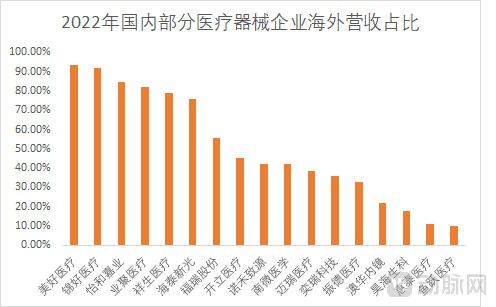
Observing the patterns among listed medical device companies with a high proportion of overseas revenue. Companies that achieve substantial revenue and gain strong recognition in overseas markets generally share three key characteristics.
1. No Generational Gap in Technological Development, Enhanced Core Competitiveness of Products. For products with strong overseas revenue, such as ultrasound systems, patient monitors, non-invasive ventilators, and injection needles, Chinese manufacturers have achieved significant improvements in product quality through decades of accumulation. During the COVID-19 pandemic, a large volume of pandemic-related products entered overseas markets, subtly shifting international perceptions of Chinese brands. This has become the cornerstone of the current surge in global expansion.
Secondly, companies that have successfully expanded overseas often possess clear insights and understanding of foreign markets.Global expansion is not merely about selling products from the Chinese market overseas. Whether it is Novogene targeting the vast overseas basic research market or Beipu Medical entering the extensive overseas insulin market, their strategies are closely aligned with the characteristics of their respective international markets.
Identifying capable business partners is also an essential capability for global expansion.In increasingly competitive overseas markets, securing large, stable key accounts not only lowers market entry barriers but also generates consistent and steady revenue. Winning orders from such key clients tests a company’s cost-control capabilities and product innovation prowess.
Beyond the inherent capabilities of the products themselves, the surge in global expansion is also driven by favorable historical opportunities.In the post-pandemic era, healthcare systems worldwide increasingly favor cost-effective product solutions, a trend that has further highlighted the competitive advantages of Chinese enterprises. The large-scale export of relevant products during the COVID-19 pandemic also enabled Chinese companies to establish and streamline export channels to overseas markets.
Global expansion cannot remain merely at the strategic level; it requires a genuine understanding of overseas market and customer needs to deliver truly valuable products and secure a certain market share in a highly competitive landscape.