

Boston Scientific's $615M Acquisition of Apollo Endosurgery: Accelerating the Shift from Standalone Endoscopy Devices to Integrated Therapeutic Solutions
Innovex
Provider of Integrated Solutions for Non-Vascular Interventional Surgery
In April, Boston Scientific completed its acquisition of Apollo Endosurgery, a manufacturer of endoscopic consumables, for a total transaction value of $615 million (approximately RMB 4.2 billion). Apollo’s product portfolio includes various devices for endoluminal surgery, such as endoscopic suturing systems, which aligns with Boston Scientific’s strategic focus in its endoscopy business. This acquisition further deepens Boston Scientific’s footprint in the endoscopy sector.
In a similar vein, this February, Olympus announced the acquisition of Taewoong Medical at a high premium of $370 million (approximately RMB 2.5 billion) to enhance its gastrointestinal surgical instrument solutions.The Logic Behind Boston Scientific’s and Olympus’s Major Acquisitions: Transitioning from Standalone Endoscopes to an “Endoscope + Endoscopic Therapeutic Devices” Product Portfolio to Fully Dominate Niche Surgical Fields。
Lessons from Others Can Help Polish One’s Own Jade: Trends Among Leading Endoscopy Market Players Outline New Directions for the Industry—Comprehensive Endoscopic Diagnosis and Treatment Device Solutions. Measured against the above criteria, most domestic companies are still deeply engaged in niche vertical segments, but some “pioneers” are actively laying out their strategies, with Innovex being a highly representative enterprise among them.
Judging by Innovex’s growth trajectory, the company took an early lead as far back as 2014 by implementing comprehensive solutions for endoscopic diagnostic and therapeutic devices. It provides single-use endoscopes, energy-based medical devices, and passive consumables for non-vascular interventional procedures in departments such as urology, gastroenterology, and pulmonology, gradually becoming one of the few medical device companies worldwide capable of offering an integrated portfolio of products for non-vascular interventions.
Compared with traditional open surgery, endoscopic non-vascular interventional procedures have achieved significant improvements in safety, patient experience, and prognosis. With the rising incidence of non-vascular diseases such as urolithiasis, chronic obstructive pulmonary disease (COPD), and gallbladder and biliary tract disorders, the volume of non-vascular interventional procedures has grown rapidly. According to statistics from Frost & Sullivan,The global volume of non-vascular interventional procedures increased from 77 million in 2016 to 113 million in 2021, and is projected to reach 256 million by 2030., with a compound annual growth rate of 9.5% since 2021.
The growth in the volume of non-vascular interventional procedures is driving the development of the related medical device market. Endoscopes, energy-based devices, and passive consumables are the most commonly used medical devices in non-vascular interventional surgeries. With the advancement of minimally invasive non-vascular interventional techniques, endoscopes and energy-based devices are gradually replacing scalpels and sutures used in traditional open surgeries.
According to Frost & Sullivan, the global market size for endoscopes used in non-vascular interventional procedures is projected to exceed US$30 billion by 2030, with the disposable endoscope segment reaching over US$7 billion. In 2021, China’s market size for endoscopes used in non-vascular interventional procedures was nearly RMB 20 billion, of which disposable endoscopes accounted for RMB 300 million. By 2030, the market size for disposable endoscopes in China is expected to experience explosive growth, surpassing RMB 12 billion.
The global market size for energy-based medical devices was approximately USD 32 billion in 2020 and is projected to exceed USD 50 billion by 2030, with the plasma electrosurgical device segment approaching USD 20 billion. Meanwhile, the global market for passive consumables used in non-vascular interventional procedures is also expected to reach approximately USD 60 billion by 2030.
Overall,The Global Market Size for Devices Related to Non-Vascular Interventional Procedures Will Exceed $100 Billion by 2030The market for comprehensive solutions in endoscopy-driven non-vascular interventional procedures is expanding rapidly. An increasing number of endoscopy giants are extending their product portfolios through in-house R&D or acquisitions, with companies such as Olympus and Boston Scientific moving in this direction. Domestic enterprises, including Innovex, have also established a presence in the fields of endoscopic consumables and energy-based devices.
As non-vascular interventional procedures in China started relatively late, the market for related diagnostic and therapeutic devices remains dominated by imports, with a low rate of domestic production. For endoscopy companies seeking to develop comprehensive solutions, it is essential to first haveComprehensive R&D Capabilities, deeply engaged in the fields of medical imaging, consumables, and electrosurgery, developing products tailored to the needs of specialized departments; secondly,Seizing the Trend, such as seizing the trend toward disposable endoscopic consumables by developing single-use endoscopes; thirdly,Cost Control and Quality Assurance, the high prices of imported products once hindered the development of non-vascular interventional procedures in China, but domestic manufacturers need to improve quality while reducing costs.
As a leading enterprise in the disposable endoscope industry, Innovex strategically laid out its comprehensive solutions for endoscopic intervention several years ago.Innovex possesses an inherent aptitude for developing passive consumables, having entered the passive consumables market as early as 2009. Seizing the trend toward the commoditization of endoscopic supplies, the company incorporated the development of single-use endoscope products into its business strategy as early as 2014.
The commoditization of endoscopic consumables is an irreversible trend. Single-use endoscopes, designed for one-time use, completely eliminate the risk of cross-infection and offer plug-and-play convenience, thereby enhancing physicians’ diagnostic and treatment efficiency to a certain extent. Furthermore, given the differing business models between reusable and single-use endoscopes, the expertise of established giants in the reusable endoscope sector cannot be fully replicated in the single-use endoscope market. Meanwhile, as no monopolistic landscape has yet emerged in China’s single-use endoscope market, domestic manufacturers have greater room for innovation and more opportunities for development.
Domestic Manufacturers of Disposable Endoscopes Concentrate on “Breaking Through” in Urology Applications. In 2022, a total of 48 domestically produced disposable endoscopes were approved by the National Medical Products Administration (NMPA) of China, among which 32 were urological endoscopes such as disposable electronic cystoscopes and disposable electronic ureterorenoscopes.
Disposable endoscopes target vertically specialized departments. Companies with more comprehensive product lines have greater revenue-generating potential; therefore, after achieving initial success in urology, some companies are gradually expanding their applications into pulmonology, gastroenterology (the traditional stronghold of reusable endoscopes), gynecology, and hepatobiliary surgery.
Innovex boasts a comprehensive portfolio of single-use endoscope products. Its single-use ureterorenoscopes, single-use choledochoscopes, single-use bronchoscopes, and single-use cystoscopes have already been commercialized. Meanwhile, the company is developing additional products such as single-use nasopharyngolaryngoscopes and single-use hysteroscopes, covering multiple medical specialties including urology, gastroenterology, hepatobiliary surgery, pulmonology, otolaryngology, and gynecology.According to statistics from Frost & Sullivan,Based on 2021 sales revenue, Innovex’s disposable ureterorenoscope ranks among the top three globally in its niche market.。
Innovex’s single-use endoscopes employ algorithm-optimized CMOS image sensors, incorporating image processing enhancement algorithms and automatic exposure algorithms, achieving image quality comparable to that of reusable endoscopes. Globally, Innovex was the first to launch a single-use ureterorenoscope with an image resolution of 400×400, as well as single-use high-definition cystoscopes and bronchoscopes with an image resolution of 800×800.
Innovex’s independently developed welding technology enables CMOS sensors to be packaged into more compact dimensions, thereby reducing the size of endoscopes and lowering production costs. Meanwhile, Innovex is the first globally to design the insertion section of disposable endoscopes with a full articulated vertebral structure, enhancing flexibility when operating within narrow human body cavities while maintaining angulation capability, thus improving passability and operability.
An article published in the renowned journal *Urologia Internationalis* in May 2022 evaluated the performance metrics of single-use ureterorenoscopes manufactured by Innovex and other vendors from a standardized perspective. Innovex’s single-use ureterorenoscope received the highest scores across multiple dimensions, including visibility, deflection angle, operational flexibility, image quality, and overall assessment.
In the field of passive consumables for non-vascular interventional procedures, Innovex also boasts a comprehensive product portfolio tailored to the distinct needs of various specialized clinical disciplines.The product portfolio includes guidewires, balloon catheters, stone retrieval baskets, occlusion catheters, and sheaths, covering major departments such as urology, hepatobiliary surgery, gastroenterology, respiratory medicine, general surgery, and gynecology, making it the “only one of its kind” among domestic endoscope manufacturers.Moreover, Innovex’s passive consumables are highly compatible with most endoscope brands on the market, offering a wide range of applications.
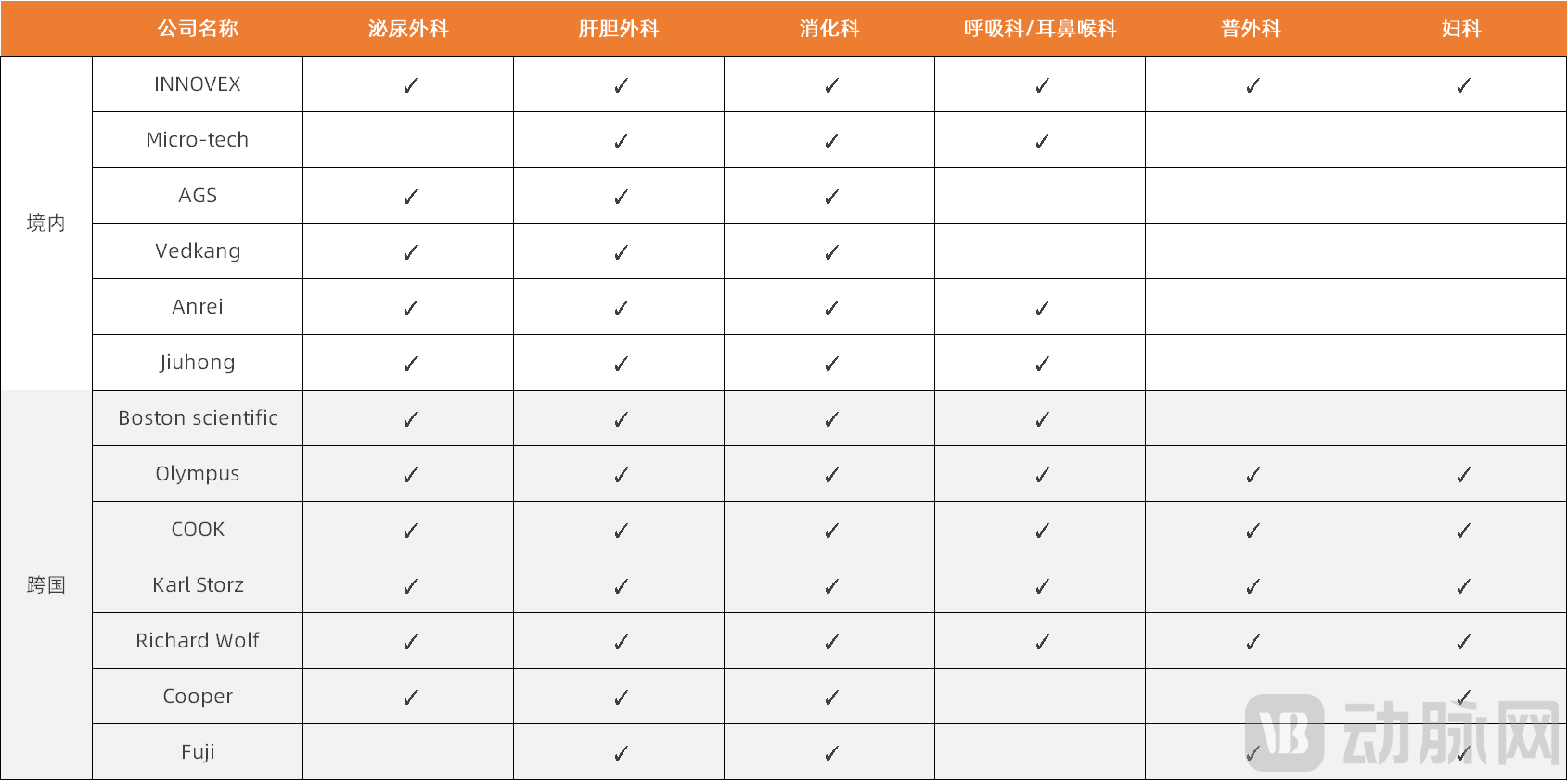
Coverage of Non-Vascular Interventional Passive Consumables by Domestic and International Companies
As a key component of its comprehensive solutions for non-vascular interventional procedures, Innovex has long been strategically positioned in the field of energy-based devices. With digestive interventions as its entry point, Innovex obtained NMPA approval and CE certification for its high-frequency sphincterotome as early as 2017.In 2022, the plasma surgical equipment and consumables also received approval from the National Medical Products Administration (NMPA) for market launch. It is understood that this is the world’s first approved plasma surgical device for interventional procedures in gastroenterology.Beyond gastroenterology, Innovex is also developing energy-based devices for other medical specialties.
The development of non-vascular interventional procedures has driven the diversification of product categories and sales growth in endoscopic diagnostic and therapeutic equipment and consumables. Endoscopic consumables represent one of the fastest-growing segments within the global medical device industry. Addressing clinical needs and deepening market presence, some companies provide comprehensive surgical instrument solutions centered on minimally invasive non-vascular interventional procedures.
From the perspective of clinical application,Clinicians and hospitals tend to use compatible and synergistic surgical instruments to improve the quality of surgery.From the perspective of the industry environment,Under the trend of centralized procurement, suppliers offering comprehensive solutions for non-vascular interventional surgical instruments possess greater risk resilience and bargaining power.Meanwhile,Under the DRG payment policy reform, one-stop solutions are also more conducive to hospitals’ cost control and enable vendors to gain greater comprehensive pricing autonomy and profit margins.
This acquisition by Boston Scientific further solidifies its leading position as a provider of comprehensive solutions for endoscopic surgical instruments. Innovex, as a domestic enterprise, has leveraged its first-mover advantage and technological accumulation to build upCollaborative R&D Platform for Four Core Technologies: Disposable Endoscopes, Energy-Based Devices, Passive Consumables, and Raw Material Design, and by leveraging its robust patent technology barriers and accumulated expertise in large-scale mass production processes, the company has gained full recognition in both domestic and international markets.Particularly affected byIncluding Mayo Clinicincluding Mayo ClinicFavored by the world's top medical institutions, which is extremely rare among Chinese medical device manufacturers.
As of now,Innovex has obtained approval for over 40 products in China, the United States, the European Union, and Japan, including a range of single-use endoscopes, energy-based devices, and passive consumables, with its products covering nearly 70 countries and regions worldwide.。
With the successive launch of dozens of products and the establishment of a global sales network, Innovex’s revenue has experienced explosive growth since 2020, reaching RMB 255 million in 2021. Overseas revenue accounted for more than 30% of the total, with over 70% of that derived from developed markets such as Europe and the United States., demonstrating the recognition of the company's products by mainstream developed country markets, as well as showcasing Innovex's global development strength.
The non-vascular interventional market offers broad prospects amid intense competition from industry giants. Comprehensive, end-to-end solutions, specialized vertical products, robust production capacity, and stringent quality control enable innovative companies to “gain a firm foothold” in this competitive landscape. Leveraging its first-mover advantage, Innovex has built a moat through its proprietary product design and development capabilities, as well as its excellent large-scale manufacturing and quality control prowess, propelling it forward in the global blue ocean of non-vascular interventions.
Reference: “An in vitro Comparative Assessment of Single-Use Flexible Ureteroscopes Using a Standardized Ureteroscopy Training Model” — Urologia Internationalis, June 16, 2022