

Neusoft Medical Surges to the Forefront of Domestic Innovation with Launch of Ultra-High-End CT and DSA Systems

Neusoft
Comprehensive Solution Provider for Clinical Diagnosis and Treatment
The wave of independent R&D in domestic medical equipment has intensified over the past five years. At the first CMEF held after the pandemic, cutting-edge Chinese-made medical devices—including CT scanners, DSA systems, endoscopes, and surgical robots—dominated the exhibition floor, marking the transition of high-end manufacturing from aspiration to reality.
Neusoft Medical, which developed China’s first CT scanner for clinical use, stands at the forefront of this wave of innovation. At the conference, Neusoft Medical unveiled a range of cutting-edge devices, including the “world’s first 0.235s whole-body spiral CT,” “China’s first fully self-developed fiber-optic distributed MRI,” and the “wide-bore Angio-CT with integrated diagnosis and treatment,” thereby leading the charge in the independent research and manufacturing of high-end imaging equipment in China.
However, it is somewhat outdated to describe today’s Neusoft Medical merely as a “high-end medical equipment manufacturer.” By integrating cutting-edge devices, comprehensive AI capabilities, and innovative clinical imaging solutions, Neusoft Medical is redefining not only its own identity but also the landscape of domestically produced medical devices.
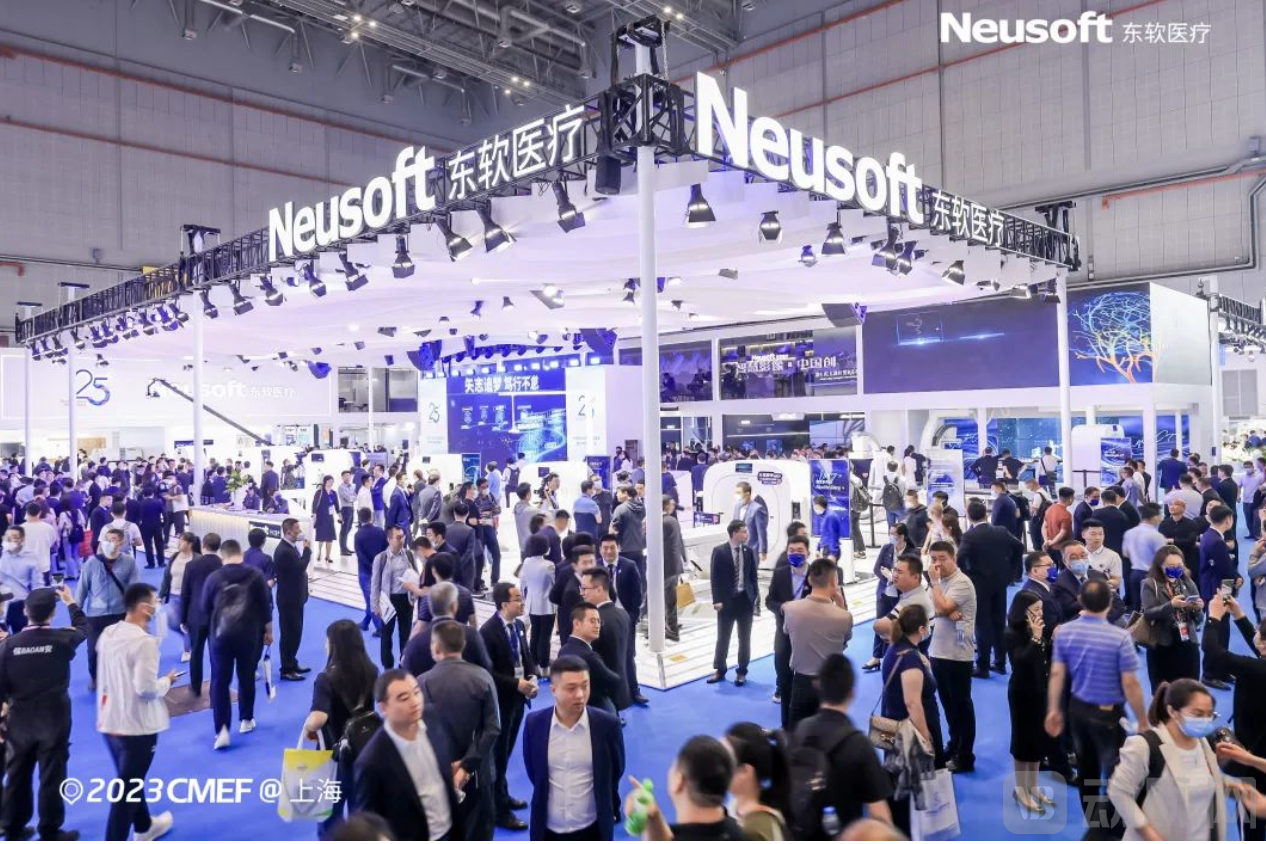
Neusoft Medical’s Exhibition Area Bustles with Crowds
0.235s Rotation Speed: Neusoft Medical Breaks Through the Boundary of CT Rotation Speed Capability
The first level of redefinition concerns the positioning of domestically produced medical devices. Due to a late start in overall technological development, the configuration of domestic medical imaging equipment has relied on multinational corporations for the past century. Although some enterprises achieved breakthroughs after the millennium, the vast majority of devices they manufacture still struggle to rival a century of accumulated technology, thereby only meeting the configuration demands of the mid-to-low-end market.
The lack of core proprietary technologies has constrained the development of clinical medicine in China. On one hand, domestic medical institutions struggle to access the most advanced imaging equipment in a timely manner for prospective research; on the other hand, the development of such equipment is often driven by the clinical contexts of European and American hospitals, making it difficult to meet the specific healthcare needs of the Chinese market.
Since its establishment in 1998, Neusoft Medical has been striving to break the constraints facing medical imaging in China, enabling domestic hospitals to access world-leading imaging equipment at the earliest opportunity. At this exhibition, Neusoft Medical achieved another breakthrough in "rotation speed," developing the "world's first whole-body spiral CT with a rotation time of 0.235 seconds."
Gantry rotation speed refers to the time required for the CT gantry to complete one full rotation. In clinical practice, a faster rotation speed can accelerate scanning and reduce sensitivity to motion artifacts. This is particularly important in cardiac imaging, where clinicians often utilize the scanner’s maximum rotation speed to enhance temporal resolution, mitigate respiratory artifacts, and obtain high-precision images.
Therefore, increasing rotation speed has always been a key objective in the iterative development of spiral CT. Over the past 30 years, the maximum rotation speed of CT scanners has gradually decreased from 1 second per rotation to 0.25 seconds. In 2018, the CardioGraphe, a cardiac-dedicated CT scanner, achieved a rotation speed of 0.24 seconds at the expense of bore size (60 cm), approaching the physical limit of CT rotation speed.
Neusoft Medical’s NeuViz Glory+ CT Breaks Through This Limit. Leveraging a supersonic platform with an aviation-grade integrated lightweight structure and a variable-speed gantry drive system, Neusoft Medical has reduced the CT rotation time to an impressive 0.235 seconds while maintaining a standard bore diameter of 72 mm.
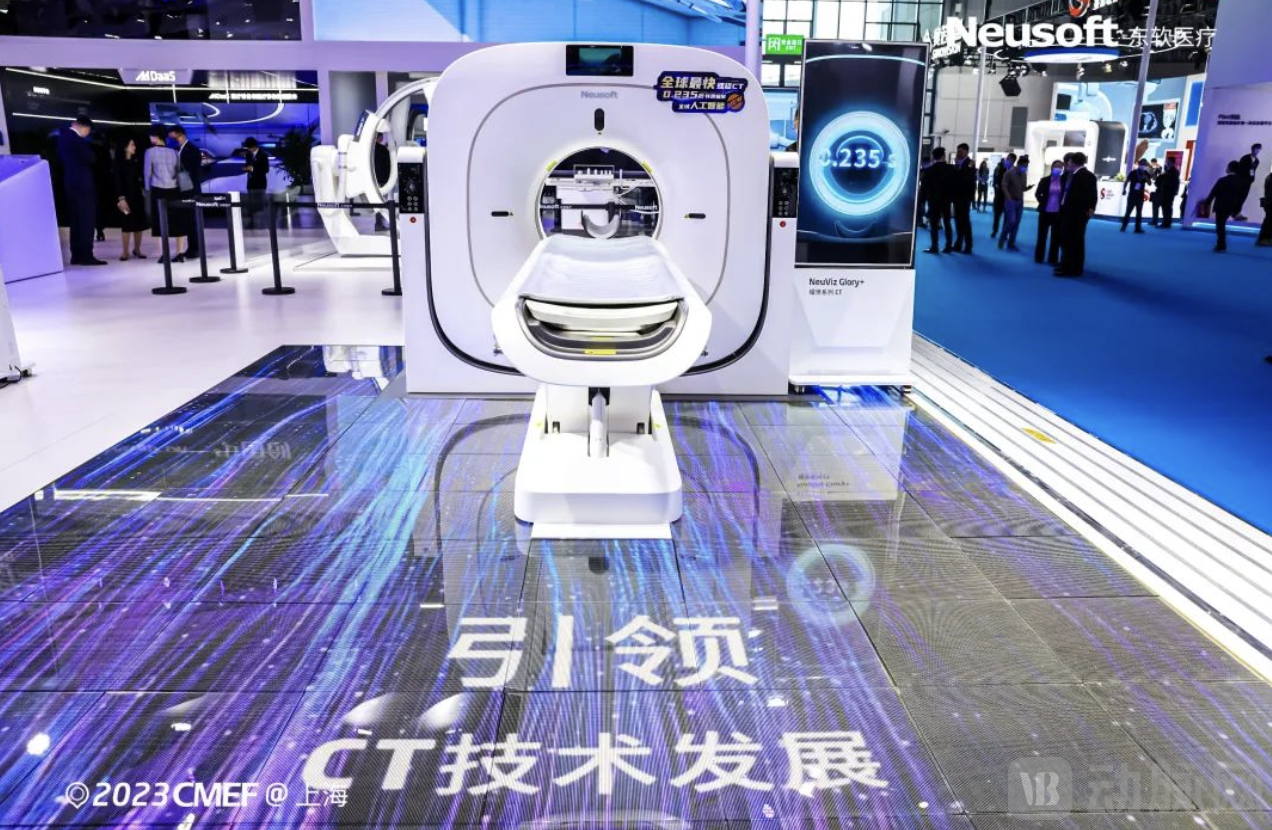
NeuViz Glory+
“A simple number may not intuitively reflect the value of this technology, but much like a car engine today, where every 0.1-second improvement in 0–100 km/h acceleration requires overcoming an extremely difficult physical limit, the same applies to CT rotation speed,” said Han Donglong, Senior Vice President and Chief Marketing and Operations Officer of Neusoft Medical, in an interview. “While a 0.1-second improvement in 0–100 km/h acceleration is hardly noticeable to drivers, a 0.1-second reduction in CT rotation time enables physicians to obtain clearer cardiac images, thereby driving iterative advancements in clinical research.”
Furthermore, the NeuViz Glory+ Yaoshi Series incorporates Neusoft Medical’s full-domain AI workflow. The term “full-domain” refers to the application of AI across the entire patient examination process. For instance, the A-Eye intelligent positioning system can automatically identify anatomical landmarks to achieve precise positioning, thereby avoiding errors associated with manual positioning and significantly improving physicians’ work efficiency. Meanwhile, the intelligent scanning protocol utilizes automatic field-of-view (FOV) technology to automatically delineate and determine the scanning range, preventing ineffective and excessive radiation exposure. Other intelligent features integrated into the equipment include iCentering intelligent isocenter technology, Auto-kV and intelligent mA technologies, the ClearInfinity deep reconstruction algorithm, and AI-assisted diagnostic systems for pulmonary nodules and stroke. These configurations assist technologists and physicians in optimizing operation and diagnosis.
Empowered by AI, the efficiency and accuracy of image interpretation in high-end CT scanners have significantly improved, while the operational threshold has been substantially lowered. As a result, both tertiary hospitals and leading medical institutions at the county level benefit from AI integration.
Eliminating the Gap in Domestic DSA Production,
Neusoft Reaches the "Peak of the World"
Although Neusoft Medical has secured its position as the leading domestic CT manufacturer through technological innovation and accumulated experience, the current competitive landscape of medical imaging equipment demands a dual strategy. On one hand, the company must pursue diversified R&D initiatives and advance the high-end localization of various devices to mitigate sales risks associated with reliance on a single product line. On the other hand, it needs to promote integration across different device platforms to provide innovative support for the increasingly complex clinical needs of hospitals.
In addition to CT, Neusoft has achieved high-end independent manufacturing in its product lines for Magnetic Resonance Imaging (MRI) systems, Digital Subtraction Angiography (DSA) systems, General X-ray Imaging (GXR) equipment, Ultrasound Diagnostic (US) equipment, Nuclear Medicine Imaging (PET/CT) equipment, Radiotherapy (RT) products, and In Vitro Diagnostic (IVD) equipment and reagents. The AI-enabled strategic product line, MDaaS, is integrated across these eight hardware product lines, providing innovative data services and solutions.
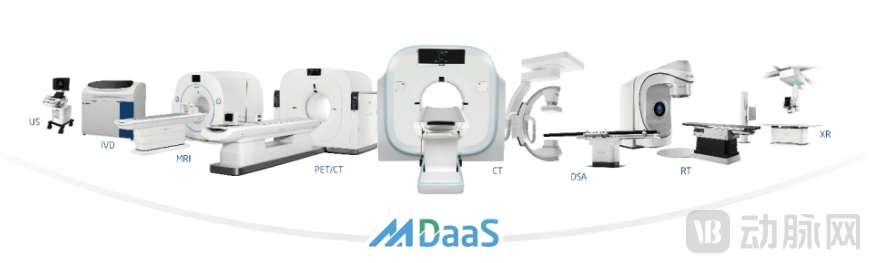
Neusoft Medical's Full Product Line
Digital Subtraction Angiography (DSA) systems represent a distinctive product line under Neusoft Medical. Since their inception, this series has been developed with the aim of achieving ultra-high-end specifications.
In 2021, Neusoft Medical broke through the technological gap in the domestic production of Angio-CT systems by launching China’s first multimodal one-stop high-end Angio-CT imaging system, which integrates a 126-slice CT scanner with a high-end angiography system. Within two years, Neusoft Medical achieved a market share of over 8%, successfully breaking the monopoly held by imported brands in the DSA sector.
Following its breakthrough, Neusoft Medical did not rest on its laurels. While imported brands were still offering low-end ACT devices with 64-slice or fewer configurations in their CT portfolios, Neusoft Medical had already launched the ultra-high-end wide-bore Angio-CT equipped with a 512-slice panoramic multi-modal CT system, far surpassing comparable products from traditional international manufacturers in terms of diagnostic and therapeutic performance, technical specifications, and product design.
Today, ultra-high-end wide-bore Angio-CT seamlessly integrates diagnostic imaging with interventional procedures, creating a one-stop comprehensive solution for diagnosis and treatment that covers preoperative imaging planning, intraoperative guidance, and postoperative assessment. This technology is applied in the diagnosis and treatment of oncological, cardiac, and neurological conditions. Specifically, this one-stop solution eliminates transit time between diagnostic examination and surgical intervention, thereby avoiding adverse factors such as infection risks and hemodynamic instability during patient transfer. It significantly increases the effective time available for therapeutic intervention, thus improving the success rate of interventional surgeries, enhancing clinical quality and efficiency, and establishing a robust safeguard for patient safety.
Regarding the DSA product series, Wu Shaojie, CEO of Neusoft Medical, regards it as a key driver for future innovation. At the CMEF, Neusoft Medical specially set up a demonstration sandbox for its “One-Stop Emergency and Critical Care Solution,” interpreting the construction philosophy of “Large Platform, One-Stop Service, and Multi-Center Integration” from both horizontal and vertical perspectives to promote high-quality development in hospitals. Among these, DSA is the core element that makes the one-stop emergency and critical care solution a reality.
Neusoft Medical defines horizontal design as the organic physical integration of hardware facilities. Taking its one-stop diagnosis and treatment platform for emergency scenarios such as stroke and chest pain as an example, Neusoft Medical has achieved integrated integration of ultra-high-end CT and DSA from hardware to operating systems, enabling the invocation and fusion of multimodal data, which significantly improves in-hospital rescue efficiency. Meanwhile, by combining intelligent tools and platforms with professional competency training, Neusoft Medical helps clinicians and technicians, particularly grassroots medical personnel, enhance their diagnostic and therapeutic capabilities.
In terms of longitudinal design, Neusoft Medical leverages the informatization capabilities of Neusoft Group to support the standardization and integration of emergency treatment processes through information sharing and interoperability. It is gradually building a whole-course management and collaborative system that spans from pre-hospital emergency care to in-hospital emergency triage and green channel management, and further to post-discharge rehabilitation follow-up and quality control reporting. Empowered by AI, the entire process features real-time quality control, significantly reducing randomness in emergency procedures. As beneficiaries, patients now gain more critical "golden time" for treatment, leading to markedly improved prognoses.
Under its dual horizontal and vertical strategy, Neusoft Medical has continuously expanded the clinical scenarios it covers. Today, the footprint of Neusoft Medical’s comprehensive solutions is evident in stroke centers and chest pain centers alike. Meanwhile, flagship products from multiple product lines have achieved deep integration in response to clinical needs, with the value generated throughout this process helping Neusoft Medical continually push beyond its own capability boundaries.
The Next Decade
On the history wall of the Neusoft Medical exhibition area, 15 images capture every key milestone in the company’s journey since its inception. The 16th image, labeled “Neusoft Medical in 2030,” departs from a documentary style; featuring vibrantly colored, unconventional CT equipment, it appears to envision the future of medical imaging devices.
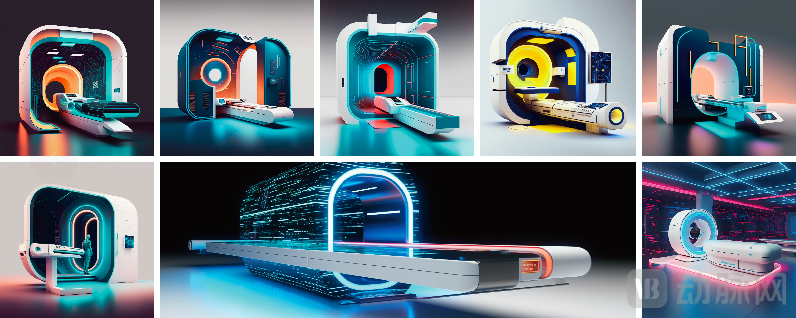
GPT-Generated Future Neusoft CT
According to Wu Shaojie, this image was not created by a human but was generated by an AI artist powered by GPT. After all, in the era of digital intelligence, every technology is advancing at a rapid pace, and no one knows what medical imaging equipment will look like in 2030.
One thing is certain. Stripping away the surface appearance of AI-generated artwork, we can easily discern the lingering influence of traditional CT scans and the blue-purple color palette employed to evoke a sense of futurism.
However, Neusoft Medical, born of innovation, possesses the capability to transcend past experience over the next decade and develop truly epoch-making medical imaging products.