

From Nature Paper to $1.1B Deal: Volastra Therapeutics' Rise in Chromosomal Instability-Targeted Cancer Therapy
How to Target Tumors with Targeted Therapy?
Synthetic LethalityUndoubtedly, it has been one of the hottest topics in recent years. In April 2021, Novartis entered into an agreement with Artios Pharma, a company focused on DNA damage response, to combine synthetic lethality with targeted radiotherapy, with a deal value exceeding $1.3 billion. In August 2020, Gilead Sciences reached a strategic collaboration worth over $6 billion with Tango Therapeutics, a “synthetic lethality” platform company, to jointly develop new targets based on synthetic lethality. In May 2020, Bristol-Myers Squibb partnered with Repare Therapeutics, a precision therapy company specializing in synthetic lethality, in a deal valued at nearly $3.8 billion, aiming to co-develop new synthetic lethality targets...
In addition, the capital market has also paid considerable attention to this direction. Emerging biotechnology companies focused on synthetic lethality therapies, such as Schrödinger, Tango Therapeutics, and Repare Therapeutics, have all received substantial financial support from investors.
In the commercialization race for “synthetic lethality,” we have also identified an innovative company that has attracted significant attention from top-tier investors and pharmaceutical giants—Volastra Therapeutics. On March 7, 2023, Volastra Therapeutics announced the completion of$60 Million Series A Financing, investors in this round includePolaris Partners, ARCH Venture Partners, and Eli Lillyand other investment institutions focused on frontier innovation.
In 2022, the company also entered into an oncology drug development agreement with Bristol Myers Squibb valued at up to $1.1 billion. The collaboration leverages Volastra’s CINtech technology platform to identify synthetic lethal targets associated with chromosomal instability as drug candidates. As a result, Volastra Therapeutics was recognized by Fierce Biotech as“FIERCE 15” Biotech Companies,"The youngest company on the list"。
Volastra Therapeutics’ technology and methodology are derived from research findings generated through the collaborative efforts of the Cantley Laboratory, the Bakhoum Laboratory, and the Elemento Laboratory—Chromosomal Instability Drives Cancer Cell Metastasis and Dissemination via Cytosolic DNA Responses。
In 2018, Dr. Lewis Cantley and colleagues published an article titled “Chromosomal instability drives metastasis through a cytosolic DNA response” in Nature, which pointed out thatChromosomal instability can promote cancer metastasis by sustaining tumor cell autonomous responses to cytosolic DNA。
Chromosomal instability (CIN) refers to the propagation and division process characterized by genomic chaos and genetic heterogeneity. During mitosis, chromosomes in cells typically segregate in an orderly manner; when mitotic errors occur in normal cells, they often lead to cell death. However, cancer cells possess unique adaptive mechanisms that allow them to evade these intrinsic cellular defense systems and continue dividing, thereby generating chromosomally unstable daughter cells. The ongoing division of these daughter cells, which propagates this state of genomic chaos and genetic heterogeneity, is termed chromosomal instability (CIN).
It is estimated that chromosomal instability (CIN) accounts for 60% to 80% of human tumors. Prevalent in human cancers, CIN not only drives disease progression but also enhances drug resistance in cancer cells, remaining one of the major unresolved challenges in cancer therapy.
Addressing this critical unmet medical need, Dr. Lewis Cantley, Dr. Samuel Bakhoum, and Dr. Olivier Elemento founded Volastra Therapeutics in 2020, aiming to discover novel cancer therapies by researching chromosomal instability (CIN).
These three physicians have dedicated many years to the field of oncology treatment. Among them, Dr. Lewis Cantley hasThe phosphoinositide 3-kinase (PI3K) signaling pathway was discovered in the 1980s., and jointly determined with the laboratoryThe Link Between Chromosomal Instability and Cytosolic DNA Signaling in Cancer Metastasis, this finding lays a solid foundation for research on cancer metastasis.
Dr. Samuel Bakhoum is a practicing radiation oncologist specializing in breast cancer treatment and a leading investigator studying the role of chromosomal instability in metastatic cancer.
Dr. Olivier Elemento has a strong interest in new technologies. During his tenure as Director of the England Institute for Precision Medicine, he integrated big data analytics with experimental research in his laboratory at Weill Cornell Medicine, leveraging ultra-fast DNA sequencing, proteomics, high-performance computing, mathematical modeling, and artificial intelligence/machine learning to develop novel approaches for the prevention, diagnosis, understanding, and treatment of cancer. Within the Volastra Therapeutics team, he consistently serves as the guiding force who proposes technical solutions.
The three PhDs complement each other in terms of research capabilities and technical expertise, and their team’s strength has laid a solid foundation for the success of Volastra Therapeutics.
After identifying chromosomal instability (CIN) as a key driver of metastatic cancer, Volastra Therapeutics continues to expand its research and exploration of CIN, betting onSynthetic Lethality and Immune ActivationTwo Major Directions.
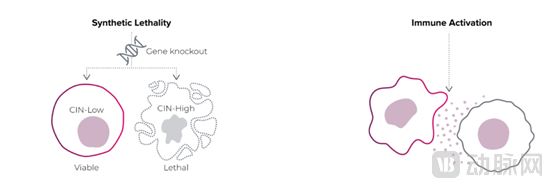
Synthetic Lethality and Immune Activation. Image source: company official website
As a mature genetic approach for target discovery,Synthetic LethalityBy exploiting the vulnerabilities of tumor cells to induce their death while sparing normal cells. Notably, in synthetic lethality approaches, researchers can select for cells with increased mitotic error rates—a hallmark of high chromosomal instability (CIN)—to more precisely target tumor cells. Therefore, Volastra Therapeutics combined computational analysis with genome-wide experimental screens using paired high-CIN/low-CIN cancer cell lines, identifying targets involved in mitotic checkpoint control, centrosome regulation, kinetochore–microtubule dynamics, and several other pathways, toIdentify Tumor Cell Targets。
andImmune Activationis another cancer therapy approach that Volastra Therapeutics focuses on researching. When extrachromosomal DNA is found in normal cells, it stimulates an effective anti-tumor immune response; however, tumor cells with high chromosomal instability (CIN) often produce extrachromosomal DNA, indicating that these CIN-high tumor cells can evolve immune evasion mechanisms. It was precisely the discovery of the impact of chromosomal instability on cancer cell drug resistance that led Volastra Therapeutics toIntegrating Computational and Experimental Approaches to Identify Novel, Targetable Immune Evasion Mechanisms Utilized by CIN-High Tumor Cells。
Additionally, inCINtech Technology PlatformWith this support, Volastra Therapeutics has achieved the ability to accurately identify genetic mutations that cause chromosomal instability, as well as those that distinguish cancer cells from healthy cells. At the 2023 American Association for Cancer Research (AACR) Annual Meeting held in Orlando, Volastra Therapeutics presented clinical data on its KIF18A inhibitor combinations. Volastra’s KIF18A portfolio comprises two highly differentiated, novel, first-in-class KIF18A inhibitors in clinical development: the recently licensed sovilnesib (formerly AMG650) and the internally developed VLS-1488.
AMG650 is a first-in-class inhibitor of the mitotic kinesin KIF18A. It has demonstrated potent anticancer activity in a subset of human ovarian and breast tumor models at tolerated doses, with evidence of durable tumor regression. Data from human studies show that combining sovilnesib with the PARP inhibitor olaparib further enhances anticancer activity compared to olaparib monotherapy.
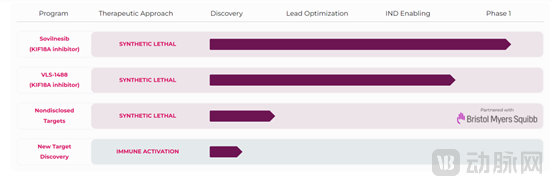
Volastra Therapeutics Product Pipeline, Image Source: Company Website
The convergence of technologies may drive industrial upgrading. Clearly, both Microsoft and Volastra Therapeutics adhere to this principle.
April 2021,Volastra TherapeuticsAnnounced a partnership with Microsoft to leverageAzure AIInvestigating the Drivers of Cancer Metastasis.Azure AIIt is an AI algorithm developed based on big data models to identify markers associated with tumor metastasis behavior. Empowered by big data,Volastra TherapeuticsThe ability to rapidly and accurately obtain insights from datasets, including pathological slides and three-dimensional tumor-derived organoids, plays a breakthrough role in cancer research.
Coincidentally, targetingVolastra TherapeuticsThis dark horse is far from being just Microsoft. On March 26, 2022,Bristol Myers SquibbAnnounces R&D Collaboration with Volastra Therapeutics; Bristol Myers Squibb to Leverage Volastra’s Proprietary CINtech Platform for the Discovery and Development of Oncology Therapies. The Partnership Will Also Provide Volastra Therapeutics with $1.1 Billion in Development Funding to Support the Expansion of Scientific Research Collaborations.
WithVolastra TherapeuticsAs research findings gradually advance toward clinical application, a growing number of industry investors are placing high expectations on it. On the same day it announced its collaboration with Amgen on sovilnesib, Volastra Therapeutics revealed that it had completed a $60 million Series A financing round. Reportedly, the company intends to use these funds to support the clinical development of KIF18A inhibitor combinations and to advance its pipeline of research programs targeting chromosomally unstable cancers.
Humanity’s struggle against cancer has spanned millennia, with each victory and deepening understanding accompanied by advances in science and technology.Volastra TherapeuticsThe cause to which we are devoted not only demonstrates humanity’s relentless pursuit of health but also reflects our fervent commitment to innovative scientific research. While no one may be able to accurately predict the ultimate endpoint in the fight against cancer, we firmly believe that advancements in science and technology will eventually make the “terror of cancer” a thing of the past.