

ACELYRIN Completes Largest Biotech IPO in Two Years with $540 Million Raise

ACELYRIN
Antibody Drug Developer
Earlier this month, ACELYRIN, a late-stage clinical biopharmaceutical company focused on accelerating the development and delivery of transformative immunology medicines, officially listed on the Nasdaq. In its initial public offering (IPO), ACELYRIN issued 30 million shares of common stock, significantly exceeding its originally planned 20.6 million shares. The offering price was set at $18.00 per share, at the top of the indicated range, raising $540 million for ACELYRIN based on this pricing.
Notably, ACELYRIN’s IPO is the largest by a biotechnology startup since Sana Biotechnology raised $588 million in February 2021, and it ranks as the third-largest IPO on the U.S. stock market in 2023 to date.
Amid the continued chill in biotech IPOs, what is it about ACELYRIN, founded less than three years ago, that has captured the attention of so many investors? Does its public listing signal a market rebound? Let’s take a look back at ACELYRIN’s journey to going public.
Dr. Shao-Lee Lin is the Founder and Chief Executive Officer of ACELYRIN. Prior to founding ACELYRIN, she served as Chief Scientific Officer at Horizon Therapeutics. During her tenure, she led the research and development of teprotumumab (brand name Tepezza), the first monoclonal antibody approved by the U.S. Food and Drug Administration (FDA) for the treatment of thyroid eye disease (TED), driving a more than threefold increase in Horizon’s market capitalization within two years.
Prior to joining Horizon, Shao-Lee Lin served as Head of Therapeutic Area Research and International Development at AbbVie, where he led the development and expansion of drug pipelines in neuroscience, immunology, virology, and basic medicine. Additionally, Shao-Lee Lin has held faculty positions at Cornell University, the University of California, Los Angeles (UCLA), Stanford University, and Northwestern University Feinberg School of Medicine.
As the saying goes, “A single tree does not make a forest.” A strong company cannot thrive without the support of a professional team. ACELYRIN’s leadership team comprises seasoned executives from the biopharmaceutical industry, with extensive experience in drug identification, acquisition, development, and commercialization. These leaders have played pivotal roles in securing initial approvals or expanding indications for medications including Humira, Tepezza, Rinvoq, Skyrizi, Mavyret, and Enbrel, thereby providing patients with novel therapies offering differentiated efficacy.

ACELYRIN’s Executive Team (Image source: ACELYRIN)
Unlike other biotechnology companies that conduct end-to-end independent research and development,ACELYRIN’s three current drug candidates—Izokibep, Lonigutamab, and SLRN-517—were all acquired through acquisitions.Moreover, ACELYRIN’s pipeline is predominantly composed of late-stage assets, with a focus on autoimmune diseases.
Izokibep: A Novel Interleukin-17A (IL-17A) Inhibitor
Izokibep is ACELYRIN’s core candidate drug.It was acquired by ACELYRIN in November 2021 from the Swedish biotechnology company Affibody for an upfront payment of $25 million.This investigational drug is a therapeutic protein containing two IL-17A-binding domains and one albumin-binding domain. Compared with conventional monoclonal antibodies, Izokibep has the following key characteristics:
High Affinity: The lower the dissociation constant (KD), the higher the antibody affinity. Izokibep exhibits a dissociation constant of only 0.3 pM for human IL-17A. In comparison, the KD values for secukinumab (developed and marketed by Novartis) and ixekizumab (developed and marketed by Eli Lilly), both FDA-approved anti-IL-17A agents, are 200 pM and 1.8 pM, respectively.
High Efficiency: Izokibep can efficiently bind to both subunits of the IL-17A dimer simultaneously, thereby completely blocking IL-17 signaling. Moreover, the albumin-binding domain extends the plasma half-life of Izokibep and enhances its ability to target sites of inflammation.
Small MoleculesIzokibep has a molecular weight of 18.6 kDa, approximately one-tenth the size of a monoclonal antibody. Its lower molecular weight enables Izokibep to penetrate tissues that are difficult for monoclonal antibodies to access, such as the dense and poorly vascularized entheses in psoriatic arthritis (PsA) and the abscesses and inflammatory nodules in hidradenitis suppurativa (HS). Furthermore, the lower molecular weight allows for a higher number of Izokibep molecules per unit volume, facilitating administration via a single subcutaneous injection rather than intravenous infusion.
Izokibep has been evaluated in multiple clinical trials for the treatment of various immune-mediated indications, including hidradenitis suppurativa (HS), psoriatic arthritis (PsA), uveitis, and axial spondyloarthritis (AxSpA). In a statement, ACELYRIN noted that, bolstered by its substantial cash reserves, the company will continue to develop izokibep for the treatment of hidradenitis suppurativa (HS) and uveitis, while also exploring several potential new indications. Specific R&D progress is as follows:
Hidradenitis Suppurativa (HS): The efficacy of HS treatment is typically measured by improvement in the Hidradenitis Suppurativa Clinical Response (HiSCR). A higher HiSCR score indicates better efficacy. In Part A of the Phase 2b/3 clinical trial of izokibep for HS, izokibep demonstrated high levels of HiSCR among the 30 enrolled patients, and its safety profile was consistent with previous trials as well as the overall data for the IL-17Ai class. Part B of the trial is ongoing based on the data from Part A. Data from the Phase 2b/3 clinical trial are expected to be released in the second half of 2023.
Psoriatic Arthritis (PsA): ACELYRIN evaluated the safety and efficacy of izokibep in adult patients with psoriatic arthritis (PsA) in a randomized, double-blind, placebo-controlled Phase 2 clinical trial. The results demonstrated that izokibep was generally well tolerated over time, with safety data at Week 46 consistent with previously observed findings. Currently, a Phase 2b/3 clinical trial of izokibep for the treatment of PsA is ongoing, with top-line data expected to be announced in mid-2024.
Uveitis: There are currently no completed clinical trials of izokibep for the treatment of uveitis, and therefore no result data are available. Its Phase 2b/3 clinical trial is ongoing, with top-line data expected to be released in mid-2024.
Axial Spondyloarthritis (AxSpA): ACELYRIN plans to initiate a Phase 3 program based on dosing data from its ongoing Phase 2b/3 trial in psoriatic arthritis (PsA), without conducting early-phase trials. This strategy is subject to further discussions with regulatory authorities, including the FDA and EMA.
Lonigutamab: An IGF-1R Antibody for the Treatment of Thyroid Eye Disease (TED)
Lonigutamab is ACELYRIN’s second drug candidate, a monoclonal antibody targeting IGF-1R administered via subcutaneous injection. Preclinical studies have shown that Lonigutamab exhibits stronger inhibition of IGF-1R signaling than Teprotumumab when equimolar amounts of both agents are injected into biopsy samples from patients with TED. Furthermore, the maximum serum concentration (Cmax) lower than the maximum serum concentration achieved with intravenous injection, which can reduce side effects such as hearing impairment.
Currently, the study of Lonigutamab for the treatment of TED is in Phase I clinical trials, with top-line data from the MAD portion of the Phase 1/2 trial expected by late 2023 or early 2024.
SLRN-517: A c-KIT Monoclonal Antibody with Lead Indications for Chronic Urticaria (CU)
c-KIT is a validated target for inhibiting mast cell activation in patients with chronic urticaria (CU). SLRN-517 is designed as a potent inhibitor of the c-KIT pathway, aiming to address the root cause of mast cell-driven diseases by blocking mast cell proliferation and degranulation.
SLRN-517 and lonigutamab are both R&D pipeline assets added by ACELYRIN through its acquisition of ValenzaBio in January 2023. Currently, ACELYRIN has submitted an Investigational New Drug (IND) application to the U.S. Food and Drug Administration (FDA) for SLRN-517 in the treatment of chronic urticaria (CU), which was approved in April 2023. Proof-of-concept data from the multiple ascending dose (MAD) portion of its Phase I clinical trial is expected to be announced in the second half of 2024.
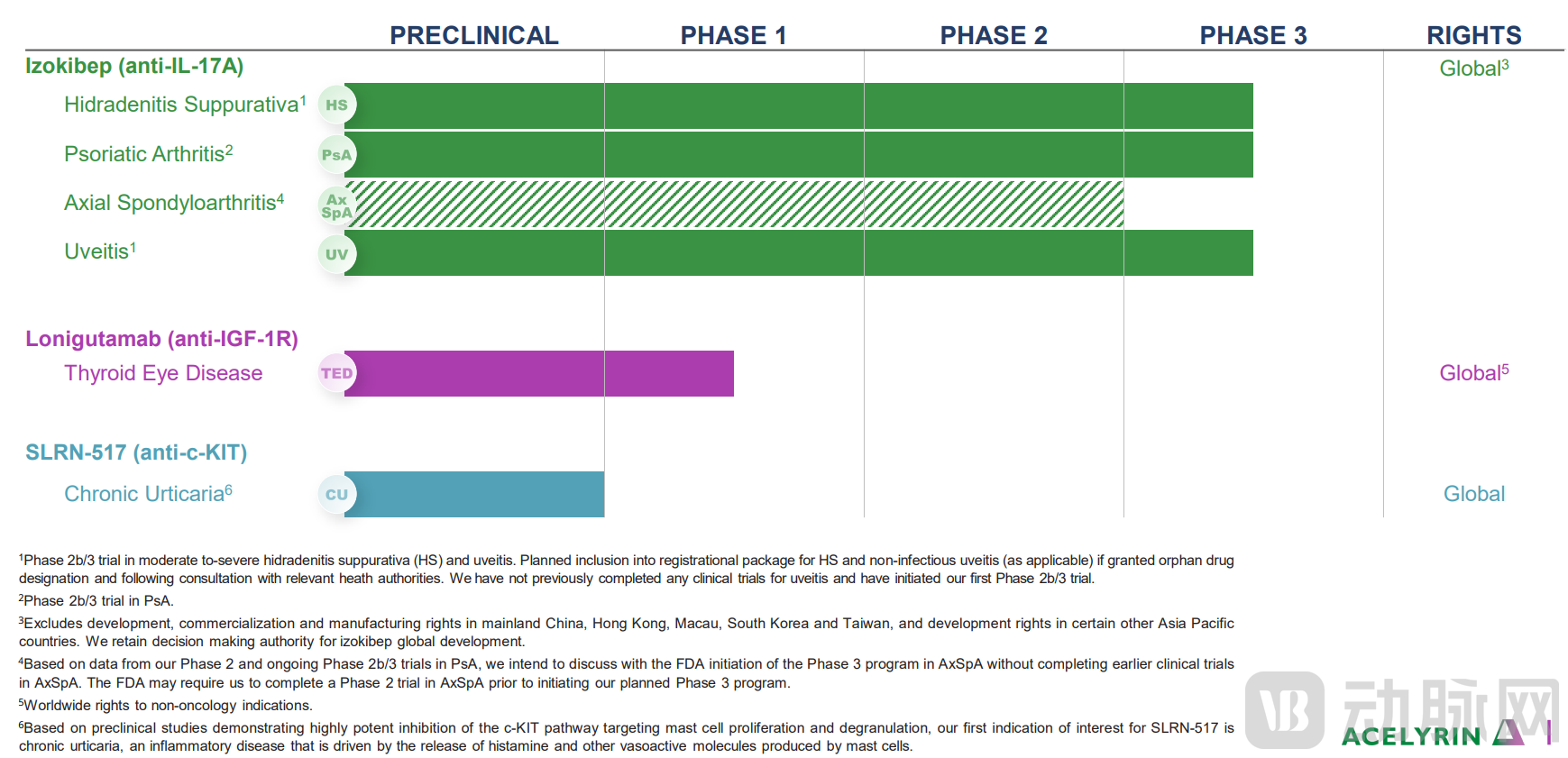
Overview of ACELYRIN’s R&D Pipeline (Source: ACELYRIN)
On May 5, ACELYRIN went public with an IPO price of $18 per share and an opening price of $23 per share. The closing price rose 30.56% above the IPO price, bringing the market capitalization to $2.097 billion. The company sold 30 million shares at $18 per share, exceeding its expectations.
Since 2021, the pace of biotechnology initial public offerings (IPOs) has slowed significantly. In 2020, nearly 100 biotech companies went public, and in 2021, a record 104 startups flocked to Wall Street. In 2022, the number of new listings dropped by approximately 80%. As interest rates rose, the biotechnology sector plummeted, with growth stocks broadly impacted. The SPDR S&P Biotech ETF (XBI) fell 50% from its peak in February 2021.
But now, the sharp decline in biotech stock valuations appears to have stabilized. The XBI has fallen by only 1% year-to-date and has risen by 11% over the past 12 months.
Nevertheless, the pace of biotech IPOs this year remains the slowest start in nearly five years. Prior to ACELYRIN’s listing, IPOs in the pharmaceutical industry were rare. According to statistics from BioPharma Dive,Among the 15 biotechnology startups that recently went public, nine raised no more than $15 million. In contrast to the broader market’s struggles, ACELYRIN’s fundraising process proceeded quite smoothly.
ACELYRIN was founded in 2020 and is headquartered in Los Angeles. In less than three years, ACELYRIN rapidly completed three rounds of financing, successfully raising $558 million. Investors included Westlake Village BioPartners, Matrix Capital Management, Surveyor Capital, Access Biotechnology, and OrbiMed, among others.
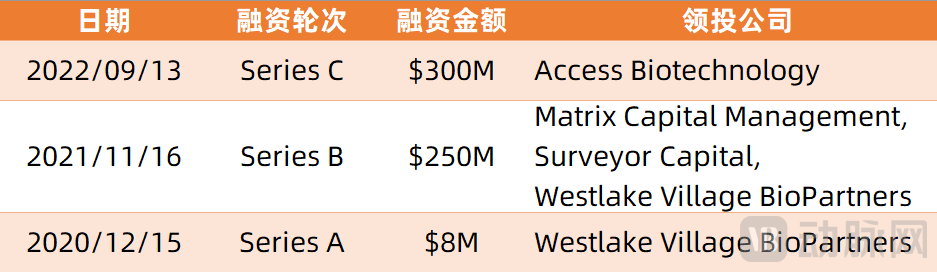
ACELYRIN’s Historical Financing Rounds (Compiled from Public Information)
Why is ACELYRIN favored by the market?
Among companies that went public in 2020 and 2021, nearly two-thirds had drug candidates either in the preclinical stage or in Phase I clinical trials. In contrast,Among the six startups that recently went public, including ACELYRIN, four had at least one drug candidate in Phase II clinical trials at the time of their IPOs. Half of ACELYRIN’s pipeline has already advanced to Phase III clinical trials.
Meanwhile, analysis suggests that ACELYRIN’s appeal may stem from the market’s focus on immunology drugs, an area where several leading biopharma companies have generated significant output in recent years.Blockbuster Druga hot sector. Merck’s April announcement of its $10.8 billion acquisition of Prometheus Biosciences (RXDX) isA company focused on immunology drugs, andThis may also help to spark investor interest in ACELYRIN.
Furthermore, financial data disclosed in ACELYRIN’s prospectus reveals that the company has been operating at a loss for the past two years. In the absence of any candidate products approved for commercial sale, this deficit is expected to persist for some time. As of December 31, 2022, ACELYRIN held approximately $316 million in cash and short-term marketable securities. Based on total operating expenses of $69 million for the fiscal year 2022,Its assets are sufficient to support ACELYRIN’s normal operations for the next four years.
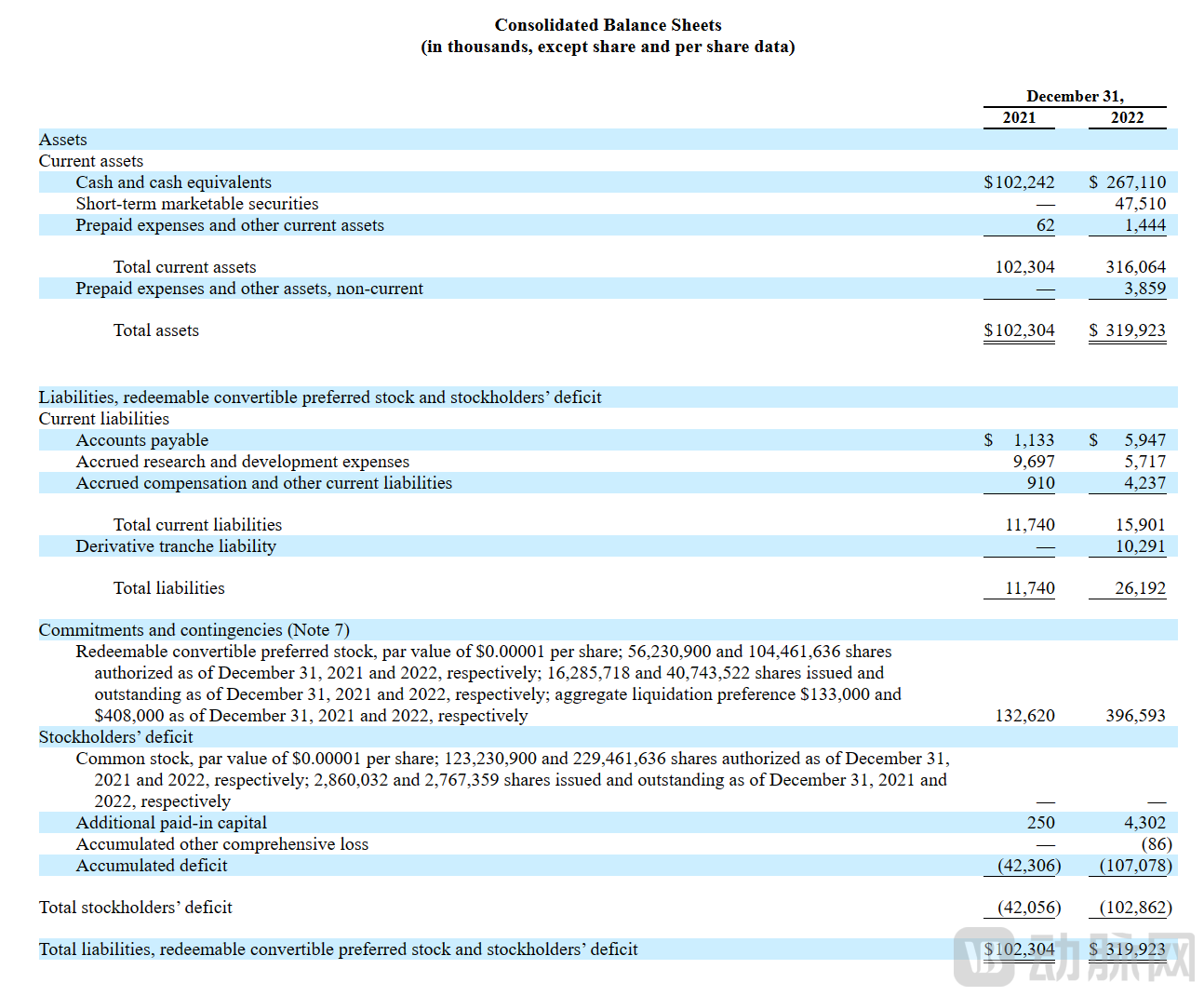
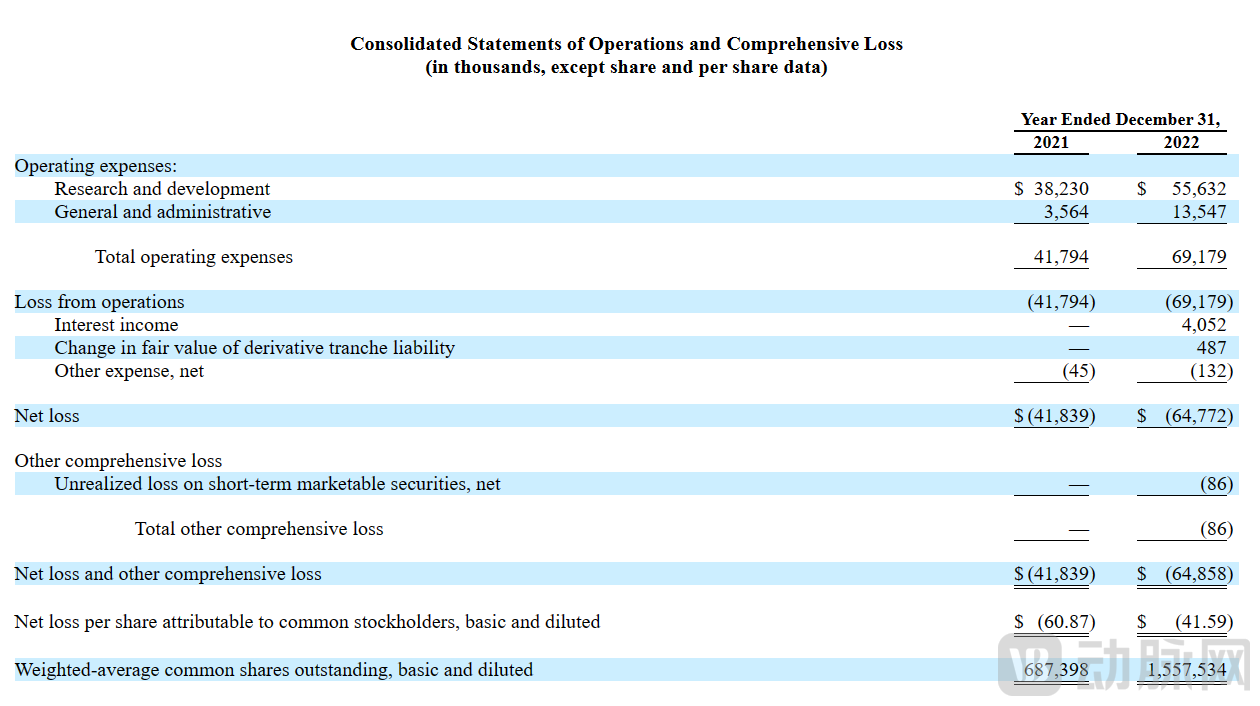
ACELYRIN’s Financial Data for 2021–2022 (Image source: ACELYRIN)
Although biotech IPO activity has been sluggish this year and the IPO window remains closed, ACELYRIN’s public listing, following in Kenvue’s footsteps, is already viewed by industry observers as a potential catalyst for other companies seeking to go public.If their market capitalizations remain stable or rise in the coming period, it could signal a recovery in the public markets.
As of the press date, ACELYRIN’s stock price stood at $20.81, still above its IPO offering price.