

How Japan Forged an Innovation Path After Western 'Tech Restrictions'
When it comes to Japan,"Top-Tier Influencers in the Asian Healthcare Industry"The title always comes to mind. Japan’s medical standards are renowned worldwide, not only due to its healthcare system but, more critically, because it has mastered innovative technologies that lead the world. We can gauge its level of innovation fromNumber of PatentsInsights.
In 2015, according to the World Economic Forum"The Global Competitiveness Report", in 2014, Japan's innovation index ranked globally4th, with its corporate R&D investment and number of patent applications both ranking among the topNo. 2, the number of scientists and technical personnel ranksNo. 3. To this day, Japan still ranks among the top on this list., which is no small feat for an island nation currently grappling with “declining birthrates” and “population aging.”
However, Japan’s innovation capability did not emerge overnight. Prior to the 1980s, the country’s research and development efforts were primarily focused on imitation; it was only later that Japan gradually shifted toward independent innovation, with a concomitant improvement in patent quality.
At its core, the rise of Japanese innovation began with “imitation.”
I. From “Technology-Based Nation” to “Science and Technology Innovation-Based Nation”
“Learning through imitation” has been a consistent theme throughout Japan’s history. From the missions to Tang China to the arrival of the Black Ships, Japan has excelled at selectively learning from advanced civilizations around the world. Today, its awakening to innovation and transformation also owes much to this tradition of “imitative learning.”
Shortly after the end of World War II, Time magazine published a photograph of Tokyo reduced to ruins, with a caption beneath it:The Doom of a Nation Without Technology—This has also become a source of deep anguish for many Japanese researchers. As a defeated nation, Japan’s economy was devastated, and revitalizing the economy through technological advancement emerged as its only hope for resurgence. Soon, Japan established“Technology-Based Nation”Development Strategy:Relying on the large-scale introduction of advanced technologies from Europe and the United States, we actively promote secondary innovation.
Guided by this policy orientation, Japan introduced more than 30,000 technologies from Europe and the United States during the two decades from the 1950s to the 1970s.Course“Introduction and Absorption” has led to the mastery of major technological achievements developed by European and American countries over more than half a century, bringing industrial technology up to an advanced global level.. Meanwhile, with technological support, Japan's economy also recovered rapidly, with its major economic indicators reaching pre-war levels.
In 1968, Japan’s gross national product (GNP) rose to second place in the capitalist world, trailing only the United States. Japan’s rapid ascent also aroused vigilance among the United States and other Western countries. Motivated by self-interest and considerations of international status, the U.S. enacted regulations restricting technology exports to Japan. As a result, Japan’s access to new technologies dwindled, and its technological development temporarily faced significant difficulties.
Under the restrictions imposed by European and American countries, Japan had to seek alternative paths, with the importance of “innovation” gradually becoming evident.
Time moves toNovember 1998, the Japanese Diet unanimously passed an important law “with legal force intermediate between the Constitution and special statutes”—"Basic Law on Science and Technology", and explicitly stated in documents such as the Explanatory Statement on the Bill for the Basic Science and Technology Act that Japan’s basic national policy would shift from the previous “technology-based nation” to a “nation built on scientific and technological innovation.” In this regard, Japanese scientific research entered a turning point toward independent innovation.
II. Mobilize the nation’s full strength to enhance independent innovation capabilities
To enhance the quantity and quality of independent, original technological innovations, the Japanese government has implemented reforms across various domains, including the economy, policy frameworks, and urban planning.
The Japanese government, through various channels, organized large groups of experts and scholars to conduct repeated comparisons and deliberations, thereby identifying fields and topics for original research and development, and influencing the direction of scientific research through policy measures.
as1980s, the Japanese government has encouraged researchers to conduct scientific research on cutting-edge technologies with broad applications, such as very-large-scale integration (VLSI) circuits, optical fibers, and new ceramics, while providing more generous welfare benefits to researchers in these fields; by1990sFields with significant future potential, such as artificial intelligence (AI) computing, bioengineering, aerospace technology, and ocean development, have become key areas of focus for the Japanese government. To this end, a series of policy guidelines have been introduced, including the “10-Year Development Plan for Fifth-Generation Electronic Computers (i.e., AI Computers),” the “Advanced Information and Communication Systems Construction Plan,” the “10-Year Plan for Research and Development in Bioengineering,” and the “Future Information and Communication City Research Plan,” thereby clearly defining the scientific research directions for this era.
In addition to influencing research directions through policy,The Japanese government has also established additional agencies and departments., exerting internal “pressure” to influence societal emphasis on scientific research in key fields.
In Japan, the primary government agencies responsible for science and technology and economic affairs includeMinistry of International Trade and Industry, Ministry of Finance, Economic Planning Agency, Science and Technology Agencyetc. They often serve as the primary window through which the public gains insight into the nation’s economic and technological landscape. Their publication of the latest domestic and international scientific and technological developments, analyses, and forecasts exerts considerable influence on the business community. In light of the authority and influence of these departments, the Japanese government has specifically established new departments and restructured existing ones; for instance, the Ministry of International Trade and Industry (MITI) added"Information Systems Development Section", the Ministry of Construction newly established“Symposium on the Application of Cutting-Edge Technologies”and so forth, thereby increasing the exposure of domestic innovative research and highlighting the level of national emphasis.
Whether from the research or corporate sector, the Japanese government has continuously used policy measures to deepen societal emphasis on innovative scientific research, thereby enhancing public awareness of innovation and fostering a favorable social climate for innovation.
It is far from sufficient to merely foster a culture that “values innovation”; all scientific research relies on financial support. As Japan’s economic trend began to improve,The Japanese government has invested substantial funds in supporting innovation.
According to the 1990 edition of the “Survey Report on Science and Technology Research” published by Japan’s Management and Coordination Agency, Japan’s expenditure on science and technology research has increased year by year since the 1980s. The total amount was approximately 4.5 trillion yen in 1979 and surged to 11.8155 trillion yen in 1989.The growth rate exceeds 160%.。
In terms of the growth in the ratio of total expenditure on scientific and technological research to GNP, it accounted for only about 2% in 1979, rising to 2.91% by 1989. Whether measured by growth rate or overall proportion,Compared with developed countries such as Japan, the United States, Germany, and France, it has the highest total amount and growth rate.
In addition to government appropriations,Government-affiliated banks have successively launched loan programs specifically dedicated to innovative scientific research.For instance, the Development Bank of Japan contributed JPY 8 billion to establish the “Organization for Promoting Industrial Technology Development,” stipulating that the organization could provide 90% of the funding when two or more private enterprises jointly undertake research and development projects approved by it. Additionally, several banks offer conditional interest-free loans to researchers engaged in cutting-edge technology studies, thereby establishing a stable funding supply chain for scientific personnel.
Moreover, for projects with significant scientific research value but whose risks are too great for individuals to bear, the Japanese government proactively assumes the associated research risks. Each year, the Japanese government selects a batch of large-scale projects with substantial scientific merit and designates them as government-led initiatives.Provide funding, resources, and other support to the research team, while sharing the project sponsor's risks.
With substantial financial investment from the Japanese government, Japan’s innovative scientific research has entered a phase of rapid development, while enterprises incubated from these research initiatives have sprung up like mushrooms after rain.
However, researchers are not the sole participants in scientific research activities. The Japanese government has long recognized that research institutions, enterprises, and the government should collaborate closely to jointly maintain the vitality of the research market. Therefore, in the early 1980s, Japan established a comprehensiveA research system centered on enterprises, with close collaboration from research institutions and coordination by the government.
To facilitate tripartite cooperation, the Japanese government has alsoOita Prefecture, KyushuImplemented in nine counties, including“Techno-City” InitiativeThe so-called "technological city" is a new type of local urban model that integrates industry, academia, and residential functions. While possessing certain advantages in scientific research and enterprise development, it also meets the living needs of researchers and corporate employees. This urban model not only fosters the formation of research-intensive hubs but also helps innovation participants develop a sense of belonging to the city, thereby enabling them to fully devote themselves to scientific research and innovative work.
Overall, Japan undertook bold reforms in policy, funding, and even urban planning to break free from the research and development trap of “importation–imitation–innovation.” Driven by such determination and execution, Japan shed the curse of being labeled a “nation without technology” and embarked on a path of independent innovation.
III. TLO Localization Drives a Leap in Conversion Rates
The surge in innovative technologies has also spurred a wave of technology transfer. In the same year that the Basic Act on Science and Technology was promulgated, the Japanese government began to focus on the commercialization of scientific and technological achievements from universities.
How can more research projects be transformed from a single academic paper into a product and a company? Japan has chosen to continue learning from Europe and the United States. After reviewing thousands of commercialization models, Japan ultimately selected the approach pioneered by the so-called “forerunner in translating scientific achievements into practical applications.”Stanford University, USAPerform imitation.
Beyond policy and financial support, the most valuable reference point in Stanford University’s technology transfer model is its proposal ofTLO Model. Under this model, universities directly manage patent affairs by filing patents for various inventions in their own name and then licensing these patents to industry, thereby generating substantial revenue for the institutions. Japan introduced the TLO model domestically and adapted it to local conditions.
Similar to the U.S. TLO model, Japanese TLOs are required to be responsible forTechnological Achievement Evaluation, Capital Operation, Information Matching, Patent Application, Intellectual Property Protection, Tax and Financial Consultingand related tasks, while universities focus solely on R&D, enterprises are responsible for commercialization, and the government handles review and financial support. Each of the four parties fulfills its respective role, emphasizing their professional expertise within the industry.
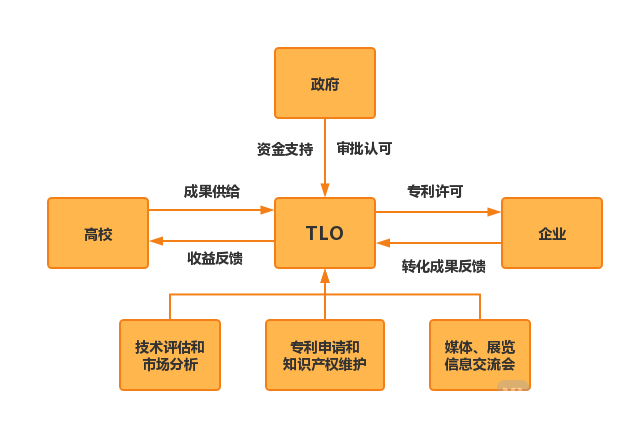 Operational Process of Japanese TLOs
What sets it apart is that Japan categorizes universities into three major types based on their respective characteristics, research orientations, and other factors, namelyInternally managed TLOs operated autonomously by universities, externally established single-entity TLOs majority-owned and funded by universities, and wide-area TLOs with full legal personality independent of universities,Each of these three TLO models has its own strengths.
As the name suggests, an internal model refers to a technology transfer office established within a university, namelyComposed of personnel specially assigned by the university to engage in the commercialization of scientific and technological achievements, it is capable of independent operational management and exercising legal person authority externally.. Universities that typically adopt this TLO model are private institutions such as Keio University and Waseda University. Because private universities possess significantly greater financial strength and social resources than some public universities, autonomy becomes the primary focus for private institutions when their initial resource levels are comparable.
The internal TLO model not only facilitates university management but also involves fewer stakeholders, making it easier to clarify the ownership of intellectual property rights for scientific and technological achievements. Whether establishing a spin-off company or commercializing products, both universities and researchers stand to gain greater financial returns under the internal TLO model.
However, a notable drawback is that when universities initially established the internal Technology Licensing Office (TLO) model, they often lacked professionals with relevant market expertise. Consequently, both the professionalism of technology transfer activities and their success rates were low in the early stages. Furthermore, as these offices are required to be financially self-sustaining, universities tend to adopt a more conservative approach to investing in research projects. Therefore, researchers must engage in an “internal game” to secure support from the internal TLO, with only the most promising projects gaining access to the best resources.
The counterpart to the internal-type TLO is the single-externality TLO.A single-externality TLO and a university maintain a one-to-one service relationship.Universities that adopt a single external TLO model are typically national universities, such as the University of Tokyo.
Prior to 2004, in order to safeguard the academic exclusivity of national universities and avoid a series of issues arising from state-owned assets, Japanese legislation prohibited the establishment of such entities within national universities, thereby blocking the path for these institutions to set up internal Technology Licensing Organizations (TLOs).
In contrast to internal TLOs, external TLOs are more specialized and exhibit higher conversion efficiency. However, as external entities, TLOs cannot exercise legal authority on behalf of universities; therefore, many critical steps in the translation process still require university approval. Since universities must consider issues such as profitability and ownership, the translation cycle is longer compared to internal models. This extended timeline can also impact the technological advancement of projects and researchers’ motivation to continue their work.
However, a greater number of Japanese universities lack the financial resources of private institutions and the prestige of national ones, while also producing a limited volume of scientific research outcomes per institution. To achieve technology transfer,These universities have pooled their resources to jointly establish a regionally segmented Technology Licensing Office (TLO) model, known as the Wide-Area TLO.
Among all TLO models, the wide-area TLO model offers the highest degree of autonomy, combining the expertise of technology transfer professionals with retained managerial authority by universities over their projects. Furthermore, patents from various universities are consolidated into a centralized pool, making them more attractive than individual projects during technology transfer and bundled licensing transactions. Currently, the majority of Japanese universities have adopted the wide-area TLO model.It is also the TLO model most strongly advocated by the Japanese government.
Each of the three models has its own advantages and disadvantages, but their original intention is toTo facilitate the transformation of scientific and technological achievements in universities into real productive forces, and to promote the upgrading of national industrial technology levels, data also proves the success of Japan's "imitative learning."
IV. Final Remarks
It has been only slightly more than 20 years since Japan enacted the Basic Science and Technology Law in 1998, yet Japan has already achieved a transition from"Imitation Superpower"To“A Powerhouse of Original Innovation”The transformation he underwent was undeniably arduous, yet it is fortunate that he has identified a development path suited to his own innovative technological advancements.
Looking at China, our current scientific research and innovation still mostly adopt"Introduction-Absorption-Innovation"pattern, or“Domestic Substitution”Original innovation remains a capability that we must continue to strengthen. It is undeniable that imitation is the most cost-effective approach to exploration; however, we need to learn how to leverage external insights to refine our own practices. Whether in research projects or research models, we must align with national realities and forge our own clear path forward.