

Lidite Medical Aims to Replicate the Digital Success of Clear Aligners in Implant and Prosthetic Dentistry Through CAD Innovation
“Our goal is to migrate the proven production and delivery models from the field of clear aligner orthodontics to the fields of dental implants and restoration,” said Zhang Bo, founder of Nanjing Lidite Medical Technology Co., Ltd. (hereinafter referred to as “Lidite”).
Zhang Bo graduated from Nanjing University with a degree in Computer Science and Technology and holds an MBA from CEIBS. Perhaps more critically, he has spent many years working extensively in medical fields with advanced digital applications, such as orthopedics and neurosurgery, accumulating profound experience in the application of informatics and digitalization within the healthcare sector.
Dr. Zhao Tiecheng, co-founder of Ledit, is also a prominent figure. Like Zhang Bo, he holds an MBA from CEIBS (China Europe International Business School) and has led or participated in numerous industrial internet projects and the formulation of industry standards. One notable achievement is China’s first flexible production line for zirconia dental crowns.
With backgrounds in both digitalization and industrialization, the two entrepreneurs firmly believed from the outset that digital technology has transformed the patient journey and product delivery model in orthodontics. It is this digital tailwind that has accelerated clear aligner therapy’s rise to dominance in the dental field. As implantology and prosthodontics are also key scenarios for digital applications in dental care—similar to clear aligner therapy—the successful replication of the clear aligner delivery model would inevitably further fuel their already rapid growth.
Moreover, beyond driving a more promising market size, the application of end-to-end digitalization will deliver multi-dimensional value to doctors, clinics, dental laboratories, and even upstream industry players, creating a win-win scenario. This is the original intention behind the founding of Lidite, as well as the mission it is currently fulfilling.
Even in the context of centralized procurement, the market for dental implants and restoration remains highly lucrative.
Taking the dental implant market as an example, according to Guohai Securities’ in-depth report on the dental implant industry, the market size reached RMB 29.7 billion in 2020. The sector is expected to maintain strong and rapid growth over the next decade, with the total addressable market projected to reach RMB 106 billion.
According to Leadit, the market size of China's dental prosthetics processing industry is expected to exceed RMB 30 billion in 2023, with a compound annual growth rate (CAGR) of approximately 15%. Furthermore, with the implementation of centralized procurement policies and improved payment accessibility, the market potential for dental implants is poised for further expansion.
ButAs market demand continues to be unleashed and market potential further expands, the supply of some high-quality medical resources appears somewhat inadequate.
For example,China’s most critical resource in oral healthcare—professional dentists—has remained in a state of “shortage.”According to Zhongtai Securities’ in-depth report on the dental implant industry, China has only 131 dentists per million people, a figure that lags far behind those of developed countries such as Japan, the United States, and South Korea. Furthermore, the proportion of dentists in China qualified to perform dental implant procedures is relatively low, at just 11%, representing a significant gap compared with 80% in South Korea and 22% in the United States.
andAccording to Zhang Bo, within the limited pool of physician resources, each doctor must maximize their potential and bear a heavy workload. This has indirectly led to clinics becoming highly reliant on dental laboratories to provide comprehensive solutions. Unfortunately, however, the development of the laboratory sector remains at the downstream end of the entire industry chain, characterized by weak customization capabilities and inconsistent quality.
Is there a way to enhance the efficiency of the entire workflow, reduce physicians’ workload, and achieve personalization and customization? The answer is almost self-evident: integrated digitalization.
But as for the specific approach, Zhang Bo and Zhao Tiecheng turned their attention to clear aligner orthodontics.
Undoubtedly, Invisalign has brought about a revolution to the global orthodontic field—a revolution in terms of product, as well as in the processes and philosophy of product delivery.
In the integrated digital delivery systems of Invisalign and Angelalign, user requirements and oral data are transmitted to the design centers of Invisalign or Angelalign. Upon completion of the personalized treatment plan, the data is immediately sent to manufacturing facilities for production, with the final products delivered to customers via courier. The most transformative aspect of this model is the separation of design from manufacturing, leading to the emergence of independent design centers.
The emergence of independent design centers means a certain reduction in workload and an improvement in work efficiency for doctors. It also enables more effective communication with patients; compared to the previous “abstract descriptions,” visualized treatment plans undoubtedly facilitate smoother dialogue between doctors and patients. Furthermore, for junior orthodontists who are new to the field, design centers built upon the extensive clinical experience of specialized orthodontists and a vast repository of case data undoubtedly help produce more mature and professional treatment plans.
The independence and distinct responsibilities of the design center and the manufacturing plant enhance design professionalism and production efficiency. In other words, delegating specialized tasks to dedicated business units not only boosts efficiency but also ensures product quality.
However, the realization of all this depends on the promotion and widespread adoption of information technology hardware and software. This is true for clear aligner orthodontics, as well as for implant-supported restoration.
In other words,Digital implant restoration has established the foundation for full-process digital application; all that remains is the final catalyst.
Among these, the “foundation” can be divided into two parts: the “front-end” and the “back-end.” The “front-end” refers to the clinic side, where market promotion of data acquisition and imaging examination equipment, such as intraoral scanners and CBCT devices, has already accelerated. Future market penetration is promising, indicating that the data acquisition segment is becoming increasingly widespread and mature in the market.
“The back-end” can be further divided into “materials” and “equipment.” Among these, materials such as zirconia, glass ceramics, and additive manufacturing resins have achieved domestic substitution in China and are being exported in large volumes. Their supporting processing techniques are more suitable for automated production. Meanwhile, the increasing prevalence of automated milling equipment and 3D printing devices has accelerated the upgrade of implant restoration products from traditional processes to automated and digital solutions.
“Actually,In China, the development of both input and output ends for dental data acquisition and processing (referring to 3D printing technology and material innovation) has become relatively mature. However, how to process raw data obtained from intraoral scanning and CBCT into manufacturable data? The key technologies in this step are relatively lagging. Nevertheless, it is undeniable that this step is crucial for the digital application of dental implantology and prosthodontics.“Zhang Bo remarked with emotion, ‘And that is precisely why Ditte strives to bridge this gap.’”
Therefore, dental CAD became Lidite's entry point into the digital field of oral implant restoration.
Dental CAD is indeed a weak link in the development of dental implantology and prosthodontics.
According to Zhang Bo,Currently, the design software used by clinics in China is mostly foreign standalone CAD software, which cannot achieve medical-technical collaboration, let alone support the unique division of labor between medical and technical staff in China. Meanwhile, domestic CAD software is mostly still in the early stages of development, and many issues need to be resolved for practical application.Therefore, against the backdrop of a dental implant restoration market exceeding RMB 100 billion, domestically produced CAD software also holds immense potential for growth.
However, it should be noted that,In the interview, Zhang Bo repeatedly emphasized that dental CAD is merely the entry point to Lidite’s digital business in implant-supported prosthodontics, not the core business itself. “What Lidite truly aims to achieve is to build an integrated digital platform, leveraging dental CAD as a strategic foothold, and to launch a series of delivery systems covering aesthetic restoration, fixed prosthodontics, removable prosthodontics, and implant planning.”
The integrated digital platform encompasses technologies such as data acquisition from intraoral scanners and CBCT, preprocessing, comprehensive analysis, AI-based segmentation and recognition, graphic image processing, point cloud model processing, device interoperability, and clinician-technician communication.
In other words, on Lidite’s digital restoration platform and digital implantology platform, users can not only perform data acquisition and preprocessing but also handle treatment planning, dentist-technician communication, doctor-patient communication, and production progress management. This means that the entire workflow—from data acquisition to treatment planning and product manufacturing, including dentist-technician communication during the design and fabrication process—can be achieved in a one-stop manner on the Lidite platform.
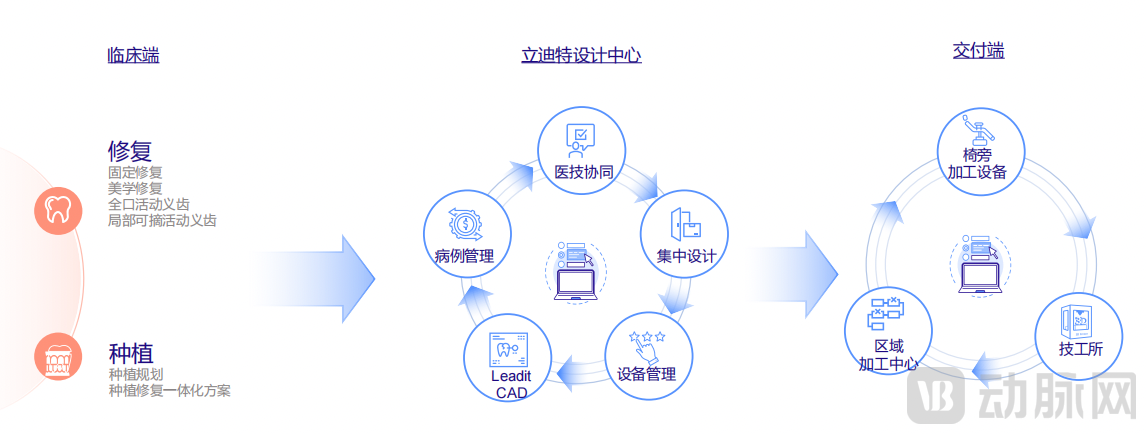
Lidite Restorative and Implant Digital Solution Schematic Diagram
Overall, by integrating and continuously refining technologies across all stages, Lidite will empower the industry to replicate the digital delivery workflow for clear aligner orthodontics. After clinicians upload intraoral digital scan models, CBCT data, and photographs to the cloud, the Lidite Design Center will leverage intelligent CAD software to complete personalized designs for restorations, tooth preparation guides, and surgical implant guides. Subsequently, following thorough online communication and review between clinicians and technicians, the design outcomes will be remotely distributed via a distributed manufacturing network to chairside processing equipment at clinics or specialized machining centers for digital fabrication. Finally, the products will be delivered to the clinics, accompanied by continuous post-treatment tracking and analytical services for patients.
Such a comprehensive “acquisition–design–fabrication–treatment implementation–follow-up” service not only enhances the efficiency and conversion rate of doctor–patient communication through visualized treatment plans, but also improves communication efficiency between the fabrication end and clinics when data interoperability is enabled. In terms of clinical quality, it not only enables personalized customization of treatment plans, but also makes them more scientifically robust by internalizing physicians’ clinical experience and accumulating case data.
Clearly, achieving fully integrated digital delivery across both implantology and prosthodontics is no easy feat; indeed, even completing the full-process digital “transformation” of a single service line and refining it to maturity is itself a considerable challenge.
In the interview, Zhang Bo also introduced thatCurrently, Leadit has established a fully closed-loop digital delivery process for aesthetic restorations. The company has also launched DSD (Digital Smile Design) software based on AI and 3D digital technologies, along with its “0.2” series of aesthetic restoration veneer products.Including aesthetic design, digital wax-up, crown lengthening guides, tooth preparation guides, and ultra-thin digital veneers, it assists dentists in completing the entire process of aesthetic assessment, smile design, doctor-patient communication, minimally invasive tooth preparation, and aesthetic reconstruction.In addition, implant planning and removable prosthetic products are also expected to be gradually launched this year.
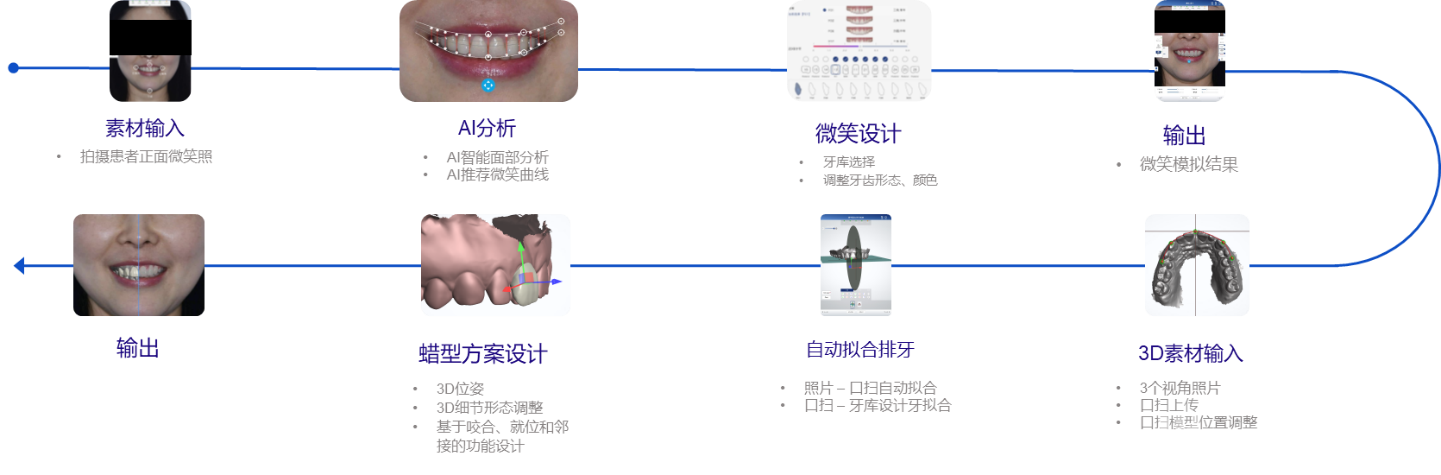
Lidite Digital Aesthetic Restoration Business Process Diagram
According to Zhang Bo,Currently, all of Lidite’s core underlying technologies have been fully developed, and the Lidite Intelligent Design Center has commenced operations in parallel. Its intelligent processing center for aesthetic restorations is scheduled to be completed in 2023. By 2024, Lidite plans to complete the strategic layout of its intelligent 3D printing center for removable prosthetic restorations and its distributed 3D printing centers for implant-supported restorations.

Lidite Technical Foundation
A more granular wave of integrated digitalization in dental healthcare is sweeping across the industry. And Lidite is ready.