

Digital Healthcare Enters Growth Phase, WeDoctor Leads High-Potential Segment with New IPO Filing
China’s Digital Healthcare Sector Enters a Golden Age, with High-Potential Niche Segments Emerging as New Blue Oceans.
Recently, the “Blue Book on the Development of the Global Digital Health Industry Economy (2023–2027)” (hereinafter referred to as the “Blue Book”), released by Qianzhan Research Institute, pointed out that in recent years, with the continuous advancement of digital technologies and the strategic deployment of policies related to the digital economy and digital health, the integration between digitalization and healthcare application scenarios has become increasingly tight. As a result, the global digital health sector has rapidly developed and entered a new “growth phase.” In the future, health-oriented digital healthcare service models are expected to expand to more regions and cover broader populations, while online-plus-offline digital chronic disease management services are anticipated to experience rapid growth.
The newly released “2023 Top 100 Future Healthcare Companies” list reveals that companies in related sectors have demonstrated exceptionally high growth potential. Among them, WeDoctor topped the list thanks to its integrated innovative practices in chronic disease management and other areas. The “Growth Analysis Report on the Top 100 Future Healthcare Companies” suggests that digital health unicorn enterprises possess highly promising and certain growth potential in both the B-to-B (B-end) and B-to-C (C-end) markets.
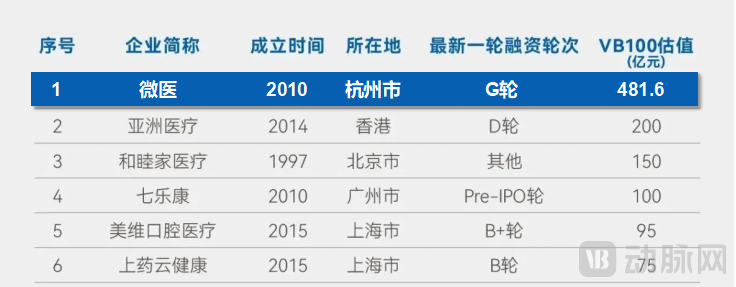 Figure | Future Healthcare 100
According to Grand View Research, the global digital health market size was $211 billion in 2022 and is projected to reach $809.2 billion from 2023 to 2030, with a compound annual growth rate (CAGR) of 18.6%. Meanwhile, the penetration rate of digital health in China’s healthcare expenditure remains relatively low, particularly in core areas such as chronic disease management, which still have significant room for improvement.
Operational data from internet hospitals in China show that in 2021, the penetration rates for convenient services such as appointment registration, online payment, and report inquiry exceeded 80%, while the rate for medication delivery also surpassed 60%. In contrast, the penetration rates for core healthcare services, such as chronic disease management, remained relatively low, generally below 60%.
Meanwhile, chronic diseases have become the greatest threat to national health, accounting for over 80% of all deaths and approximately 70% of the total disease burden in China. As the population ages further, there is a surging demand among the public for digital chronic disease management.
The Blue Book analysis indicates that the overall low maturity of internet hospitals in China is the primary reason for the low penetration rate of core digital medical services. In particular, during the previous development of digital medical service platforms, driven by the inertia of the traditional internet industry, there was a long-standing emphasis on online services at the expense of offline operations, making it difficult to truly complete the closed loop of healthcare services.
As regulatory oversight of internet-based diagnosis and treatment continues to improve, internet medical services are returning to their core role in serious clinical care, with integrated digital healthcare that combines online and offline services emerging as the prevailing direction.
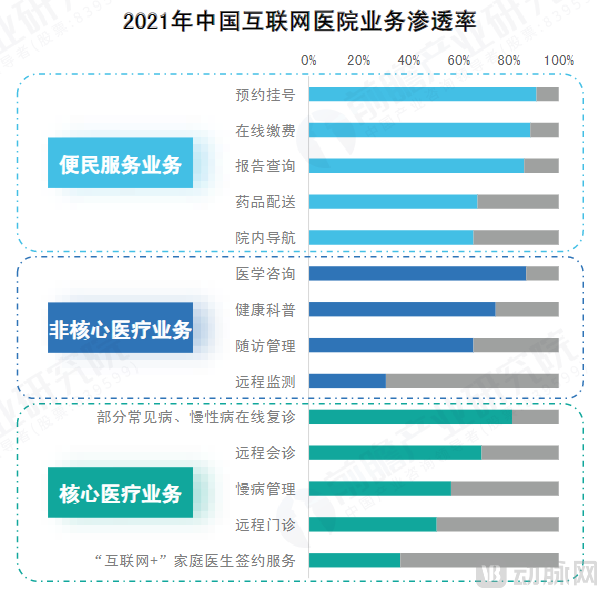
Figure | Internet Hospital Business Penetration Rate
The industry has already recognized this trend: digital healthcare services, such as chronic disease management, will command a substantial share of the future market, making the industrial layout of “digital-physical integration” a key priority. In this context, the emergence and development of innovative healthcare service entities that integrate digital platforms with medical service capabilities—known as “Digital Hospitals”—are becoming a critical “variable” for comprehensively breaking through industry bottlenecks.
Taking WeDoctor as an example, as a pioneer that spearheaded the development of internet hospitals, it has explored and upgraded a digital medical consortium model centered on digital hospitals through its digital health practices across various regions. In Tai’an, Shandong Province, it piloted China’s first city-level digital chronic disease management service model enabling direct settlement via medical insurance, achieving full-process chronic disease management integrating “internet + medical insurance + healthcare + pharmaceuticals.” This model has since been promoted across all 16 prefecture-level cities in Shandong Province. In Tianjin, it launched China’s first tightly integrated digital medical consortium led by a digital hospital, connecting all 266 primary healthcare institutions in the municipality. This initiative provides digital chronic disease management services to over 111,000 diabetes patients, establishing a novel health accountability mechanism. Pilot results demonstrated that the standardized management rate for diabetes patients in primary healthcare institutions reached 81.5%, while the blood glucose control rate improved by more than 12.1%.
It is worth noting that digital hospitals, driven by robust digital platforms, possess medical insurance accreditation and the capability to deliver standardized clinical pathways, thereby creating a “cloud platform” that achieves full interconnectivity among medical care, pharmaceuticals, and medical insurance data. In this process, digital hospitals generate multiplicative benefits through the mutual reinforcement of digital technologies and medical services, introducing new technological and model-based increments to regional healthcare systems and empowering traditional medical services to achieve intelligent upgrades and integrated innovation.
The first meeting of the 20th Central Financial and Economic Commission, held recently, emphasized the need to prioritize the real economy, prevent a shift away from real economic activities toward virtual ones, and promote the intelligent, green, and integrated development of industries. Industry innovations by companies such as WeDoctor also demonstrate that digital hospitals, by evolving from “Internet Plus” to “digital-real integration,” have provided a powerful lever for the intelligent, green, and integrated upgrading and transformation of the healthcare industry.