

Abdera Therapeutics Files for IPO to Advance Its Tunable Radiopharmaceutical Pipeline

Abdera Therapeutics
Biopharmaceutical Manufacturer
On April 20, 2023, Abdera Therapeutics, a Canadian startup focused on radiopharmaceutical R&D, announced that it had secured $142 million in Series A and B financing. The Series B round was led by VenBio Partners, while the Series A round was led by Amplitude Venture Capital and Versant Ventures. The funds raised in this round will be used to advance the development of its novel antibody-based radiopharmaceuticals.
Abdera Therapeutics was founded in 2021. At its inception, the company secured CAD 8 million in seed funding. To date, Abdera has raised a total of USD 148.3 million in financing.
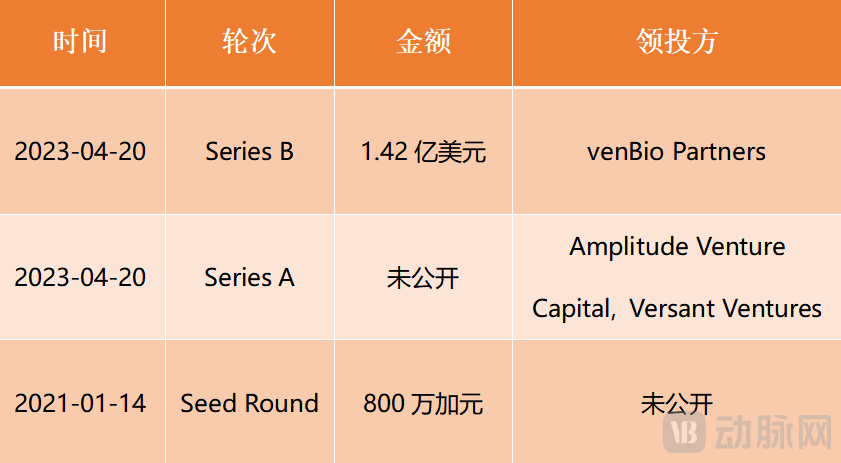
Abdera Funding Rounds Data Source: Crunchbase
To understand the full story behind Abdera’s development, we must first begin with the tale of its founding.
In 2021, Canadian venture capital firm adMare BioInnovations and publicly traded antibody biotechnology company AbCellera jointly established Abdera Therapeutics in Vancouver, aiming to achieve breakthroughs in radioisotope therapy.
Abdera’s founding team consists of three executives from the biopharmaceutical industry. Dr. Adam Judge, Co-founder and Senior Vice President of Research, earned his Ph.D. in Cellular Immunology from the University of Birmingham Medical School. With deep expertise in immunology, RNA therapeutics, and related fields, he has developed more than 30 patents. Prior to joining Abdera, Dr. Judge held technical leadership positions at Genevant Sciences and Tekmira Pharmaceuticals, where he successfully advanced oncology programs into clinical trials.
Dr. Lana Janes, a co-founder of Abdera Therapeutics, brings over 20 years of expertise in drug development. After earning her Ph.D. in Biochemistry from McGill University, Dr. Janes held executive positions at companies such as adMare BioInnovations, where she oversaw FDA approvals for therapeutic candidates across multiple indications.
Another co-founder, Michael Abrams, holds a Ph.D. in Chemistry from the Massachusetts Institute of Technology (MIT) and has over 35 years of experience in drug development. Prior to joining Abrams, he held executive positions at multiple companies. Dr. Abrams is also the founder and CEO of AnorMED, which developed Mozobil, an FDA-approved stem cell mobilizer, and was acquired by Genzyme for more than $500 million. In addition, Dr. Abrams received the Nuclear Medicine Pioneer Award from the Society of Nuclear Medicine for his work on the development of Cardiolite, a radiopharmaceutical imaging agent.

Abdera’s Three Co-Founders, From Left to Right: Adam Judge, Lana Janes, and Michael Abrams
Image source: Abdera official website
The three founders, each leveraging their respective strengths, have steered Abdera Therapeutics toward steady and sustained growth.
Leveraging AbCelera’s antibody discovery platform, they are developing novel radioisotope-conjugated drugs targeting clinically validated tumor antigens, aiming to revolutionize the radiopharmaceutical market.
Abdera Therapeutics’ radiopharmaceutical designs are all based on its platform—the ROVEr platform. To elaborate on its value, we must first discuss radioligand therapy.
In recent years, radioligand therapy has emerged as a key direction in the field of precision oncology. Compared with traditional cancer treatments,Radioligand therapy offers the advantages of potent cytotoxicity, precise targeting, and limited damage.Radiopharmaceuticals, or nuclear medicines, typically consist of four components: a ligand, a linker, a chelator, and a radionuclide. The ligand, which can be an antibody or a peptide, exhibits varying affinities for different organs or tissues, thereby enabling the delivery of the radionuclide to the target site. The chelator is used to “trap” the radionuclide, while the linker connects the ligand to the chelator complex.
Currently, radioligand therapy typically employs small-molecule ligands or large proteins; however, both options have inherent limitations.Small-molecule ligands (peptides or small molecules)Although rapid absorption and excretion of the tumor can be achieved, it is accompanied byLow Tumor Accumulation, the high uptake of radioisotopes by the kidneys also bringsNephrotoxicity。MacromoleculeIt may avoid renal uptake, but its large volume and long half-life may limit tumor absorption, and systemic radiation exposure may lead to potentialMyelotoxicity。
Therefore, achieving a balance between drug absorption and metabolism has long been a challenge for this therapy.
To address this pain point, Abdera developed the ROVEr platform,This platform enables the customized design of drugs with tunable pharmacokinetic (PK) properties to enhance tumor uptake and penetration while avoiding high renal accumulation, thereby reducing systemic radiotoxicity.
The ROVEr platform advances on multiple fronts, starting with ligands.
Advanced Antibody Engineering
The cell-targeting vector of the ROVEr platform is a heavy-chain-only antibody, designed for the pharmacological and PK properties required for the delivery of radioisotopes. It is generated by fusing a high-affinity antigen-binding domain with the human Hc fragment, producing an antibody (VHH-Fc) with optimal size and PK properties.This antibody can avoid renal filtration, reduce radioactive substances in the bloodstream, and enhance tumor uptake and penetration of the drug.
Notably, the modular antibody format of the ROVEr platform supports the swapping of different antigen-binding domains into the platform to create novel antibodies with predictable pharmacokinetics and pharmacology.
Chelating Agent Library
The chelating agent of the ROVEr platform is compatible with a range of therapeutic radioisotopes, including actinium-225, lutetium-177, and imaging isotopes (such as indium-111), ensuring stable binding between the radioisotopes and antibodies.
Highly Radioactive Isotopes
The selection of radioisotopes depends on the desired cancer targets and indications. Drugs designed using the ROVEr platform incorporate radioisotopes that emit alpha or beta particles, such as Actinium-225 and Lutetium-177, both of which possess potent tumor-killing capabilities.
Imaging and Therapy
The ROVEr platform supports pairing with corresponding imaging isotopes, assessing healthy tissue exposure (dosimetry), selecting appropriate patients, and guiding clinical development. The imaging agent utilizes the same antibody-chelator conjugate as the therapeutic regimen, facilitating direct data comparison and streamlining development.
Through this platform, radiopharmaceuticals can selectively destroy tumor cells while preserving healthy cells to the greatest extent possible. The delivery of potent radioisotopes and the therapeutic index are thereby optimized.
All precision-targeted drugs developed by Abdera are designed based on the ROVEr platform, with the most advanced ones beingForSmall Cell Lung Cancerthe drug ABD-147。
According to WHO statistics, lung cancer is the second most commonly diagnosed malignancy worldwide. Although small cell lung cancer (SCLC) accounts for only 15–20% of all lung cancer cases, it is associated with poor surgical outcomes, high rates of recurrence following chemotherapy, and limited therapeutic options. In recent years, targeted therapy and immunotherapy have emerged as highly promising treatment modalities for small cell lung cancer.
Delta-like ligand 3 (DLL3) is a protein in the Notch pathway. DLL3 is upregulated and exhibits low-level, specific expression on the cell surface in some high-grade neuroendocrine cancers, including small cell lung cancer (SCLC). In contrast, DLL3 is absent or rarely expressed in non-malignant cells. ABD-147 targets this antigen to precisely attack tumors.
In fact, AbbVie had already acquired the DDL3 target through its acquisition of Stemcentrx in 2016, but the related clinical trials ended in failure. Abdera stated that the failure was due to issues with the drug's cytotoxicity.
Currently, Abdera Therapeutics is advancing the preclinical studies of ABD-147 and expects to submit an Investigational New Drug (IND) application to the U.S. FDA in 2024.
Additionally, Abdera has four pipelines based on the ROVEr platform, with two in lead optimization and two in the drug discovery stage.
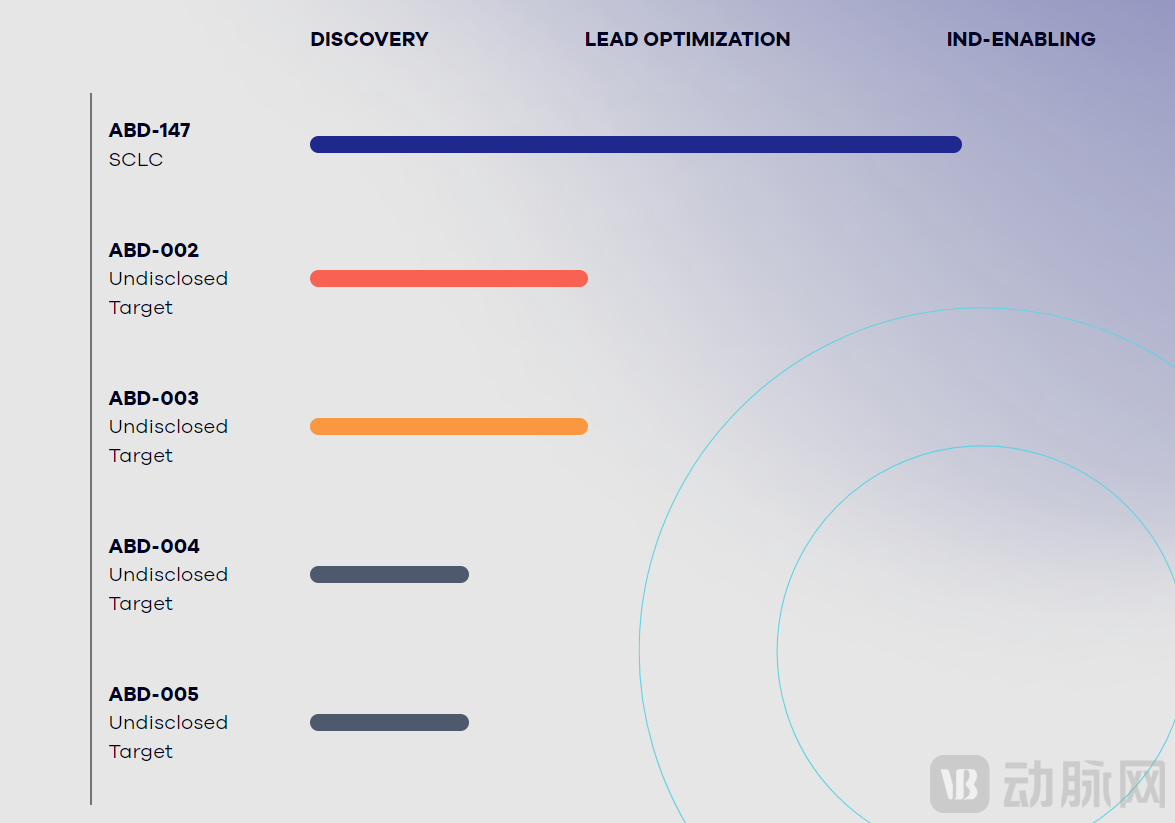
Abdera’s Pipeline Progress | Source: Abdera Official Website