

How Long Does It Take for Innovative Medical Devices to Go from Concept to Market?
How Long Does It Take for Innovative Medical Device Achievements to Be Commercialized?
By searching Baidu or summarizing industry consensus, we can arrive at a theoretical standard answer—the most difficult Class III innovative medical devices to obtain registration certificates for take only from R&D to market launch.5–6 years. But in reality, is this figure still reliable?
FromDr. Sun Hui, Academy of Opto-Electronics, Chinese Academy of SciencesHe did not directly answer the question; instead, he told Chengguo Bureau that it was not until the ninth year after his return to China that he developed the principle prototype of the femtosecond laser corneal refractive surgery device.

▲ Image sourced from Baidu Search
In this light, a gap remains between the ideal and reality in the translation of innovative medical device achievements into practical applications; identifying and bridging this gap constitutes our next challenge.
What Pathways Must Innovative Medical Devices Traverse from 0 to 100?
Whether for innovative drugs or innovative medical devices, the process of translating their achievements can be broadly divided into three stages: “ideation – productization – commercialization.” Upon further analysis, we find that each sector has its own distinct landscape during this translation process. This section focuses on analyzing the details involved in the achievement translation of innovative medical devices.
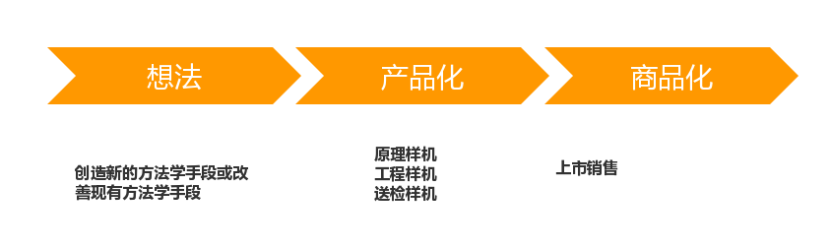
▲ The Entire Process of Transforming Innovative Medical Device Achievements
Every new discovery begins with a bold or pragmatic idea. This is also the starting point for the translation of innovative medical device achievements, researchersLeverage fundamental technical principles to create new clinical methodologies or improve existing ones.
As the more daring party, “creating something new” often makes it easier to capture a blue-ocean market. Taking surgical robots as an example, they involve foundational technologies such as precision instrumentation and embedded control systems. In China, on one hand, these underlying technologies have yet to achieve original innovation; on the other hand, the complexity of integrating multiple technologies into a cohesive system presents significant challenges, resulting in extremely high technical barriers. An industry insider also noted that once surgical robots become commercially widespread, clinical surgical procedures will undergo a major transformation.
“Improvement,” by contrast, is more pragmatic: it enhances the efficiency of existing clinical methodological approaches based on established technical principles, thereby identifying breakthrough opportunities in a highly competitive (“red ocean”) market. As a widely used technology in ophthalmology, optical coherence tomography (OCT) is a fourth-generation technology that was invented several decades ago. Currently, many researchers continue to innovate its underlying principles to improve OCT performance metrics such as scanning speed and imaging depth.
Therefore, when the commercialization of innovative medical devices is still at the conceptual stage, the R&D team must first map out its commercialization pathway. As the process advances to the productization stage,Principle prototype, engineering prototype, and submission-for-testing prototype are the three key elements.
First is the proof-of-concept prototype. This stage clarifies the core product definition and represents the initial step in materializing a technological concept. It should be noted, however, that proof-of-concept prototypes lack both clinical testability and engineering significance. They are typically developed independently by research teams, often originating from universities, hospitals, and research institutes with richer scientific and technical expertise and resources.
If a proof-of-concept prototype represents progress from 0 to 0.5, then an engineering prototype marks a leap from 0.5 to 10. The engineering prototype is a milestone in the early stage of product engineering. This is because, unlike the proof-of-concept prototype, the nature of the engineering prototype changes fundamentally. It has achieved a certain level of clinical testability and serves as a hallmark of the entire development team’s comprehensive technical capabilities in optics, mechanics, electronics, materials, manufacturing processes, and software algorithms.
The development team here refers not only to the research team. In fact,Engineering prototypes are often the product of collaboration between research teams and enterprises.
From the perspective of management objectives, university professors in laboratories naturally prioritize novelty. This mindset makes it difficult for laboratory teams to establish a strong awareness of milestone-driven goals, whereas engineering development is inherently a systematic endeavor requiring close collaboration. In terms of funding acquisition and allocation, research institutions often face limited research budgets subject to numerous restrictions. Furthermore, medical device development is not merely an engineering task but a systematic undertaking constrained by various regulatory boundaries. Requirements such as quality management systems, safety management, and electromagnetic compatibility (EMC) compliance necessitate execution by experienced professional teams.
Therefore, during the protracted process of translating scientific achievements into practical applications, engineering teams serve as the primary force for most of the duration—excluding the initial phase—undertaking supply chain planning, system integration, and breakthroughs in key technical challenges.
The next stage is the preparation of prototypes for regulatory testing. From the perspective of medical device registration standards, engineering prototypes still differ considerably from standard commercial products. Therefore, active involvement of clinicians is essential in the transition from engineering prototypes to test-ready prototypes. The development team must further optimize the prototype’s performance based on clinicians’ feedback to produce the final prototypes for submission to regulatory testing.
Upon completion of the prototype submission for testing, the development team can submit the medical device registration application. For Class III medical devices, the registration process, including clinical trials, typically takes approximately 18 to 36 months or longer.
Finally, there is the commercialization stage. Bringing a product to market for sale is not a simple process. The CEO of a medical device company told VCBeat: “"The product needs to gain market recognition before it can be commercialized."In addition to making substantial investments, the development team must conduct thorough market research to gain a deep understanding of the market and customers, collaborate closely with the marketing team, monitor market feedback, continuously upgrade and iterate new products, and sustain ongoing innovation.
With this, the commercialization of innovative medical devices has completed the entire journey from 0 to 100. Throughout this process, the development of innovative medical devices involves not only R&D but also multi-party collaboration.
Who Is Choking the Neck of Innovation Commercialization?
After mapping out the entire process of translating innovative medical device achievements into practical applications, let us revisit Dr. Sun Hui’s predicament. At which stage does the commercialization process encounter bottlenecks, and who is holding back the translation of these achievements? After interviewing and consulting multiple industry experts, VCBeat has found that the main challenges in the commercialization of medical devices lie in people, funding, and the projects themselves.
1People—Issues of Capability and Perspective
Early innovations in medical devices primarily stemmed from physicians’ innovation projects, most of which remained at the conceptual stage, with insufficient consideration given to technical feasibility. Li Jinping, Chief Physician of the Department of Neurosurgery at Beijing Chaoyang Hospital, stated: “Physicians’ innovative ideas may involve expertise from various fields, such as automation and materials science; therefore, it is difficult for them to independently oversee research and development.。”
Meanwhile, medical devices are closely linked to human health, and their regulatory requirements are extremely stringent. Manufacturers must comply with various regulations and standards, including the FDA’s approval process and the EU’s CE certification. These procedures often take years or even decades to complete. Researchers or physicians who possess the relevant technology frequently lack an understanding of market dynamics and regulatory compliance, making it difficult for them to navigate the complex processes and rigorous standards required for the marketing authorization review of medical device products. In this regard, Director Li Jinping also stated, “We can conduct clinical trials, but the administrative and approval procedures are rather cumbersome. We are unable to follow through on the entire process, nor do we have the resources to do so.”
For researchers at universities and research institutes, although they are often more bold in their scientific research, they generally do not have direct contact with patients, which is likely to lead to theirResearch fails to align with patients’ actual needs and the realities of clinical practice。
Due to a lack of clinical context, researchers may fail to fully understand patients’ actual symptoms and treatment needs, or overlook certain key factors, resulting in treatment regimens that cannot be effectively translated into clinical practice. Furthermore, for some researchers, the focus lies on discovering new scientific knowledge rather than translating such knowledge into therapeutic interventions and treatment strategies.
Consequently, in universities and research institutes, the orientation of project research toward the industrialization of inventions and innovations remains suboptimal. Relevant personnel from a certain university told VCBeat that only a very small fraction of scientific and technological achievements are suitable for commercialization by enterprises. Meanwhile, universities and research institutes lack clarity on what types of technological outcomes businesses actually need, making it difficult for their research and development efforts to be truly demand-driven, application-oriented, and market-focused. This means that many projects deviate from market needs right from the outset, thereby hindering effective technology transfer and commercialization.
2Money—Fierce Competition and Rare Investment Opportunities
Funding constraints are a predicament faced by the vast majority of physicians and researchers. Dr. Sun Hui also candidly acknowledged that the initial phase is the most challenging in translating innovative medical devices from concept to commercialization, as it is difficult for researchers to secure financial support during this stage.
For doctors and researchers, research funding is often the primary source of financial support, butNot all applicants can receive research funding.First, applying for research funding is a highly complex process. Applicants are required to submit detailed materials, including research proposals, budgets, and work schedules. If the submitted materials are not clear, detailed, and persuasive, the review committee is likely to reject the application.
Secondly, competition in the fields of medicine and scientific research is extremely intense, with many individuals vying for limited funding. The scarcity of funds, coupled with a large number of applicants and fierce competition among them, may prevent some doctors and researchers from securing financial support for their projects. In such circumstances, applicants lacking sufficient experience or reputation may be eliminated from the race.
Finally, certain research directions may be deemed insufficiently important or unpopular, resulting in the rejection of funding applications. In such cases, applicants need to reconsider their research direction or seek financial support from early-stage investment institutions.
Amid the surge in sci-tech innovation in recent years, early-stage investment has become particularly vibrant. For innovative projects at stages where technology or products are not yet fully developed or brought to market, early-stage investment firms not only provide financial support but also place greater emphasis on post-investment management and incubation.
However, securing early-stage investment is no easy feat. Compared to mid- and late-stage investments, early-stage investing, which relies on cognitive insights for returns, involves greater uncertainties and higher risks. After several years of advocating the “invest early” mantra, early-stage investment has evolved alongside the increasingly comprehensive layout of ecosystems and industrial chains.Investment firms will increasingly strengthen their control over risks associated with early-stage projects.An early-stage investor in the healthcare sector stated that current investment criteria have become significantly more stringent than before. Investors now need to comprehensively evaluate both specific technologies and their application scenarios, as well as conduct a holistic assessment of professors and researchers, ensuring thorough due diligence is completed prior to making any investment.
3Projects: Implementation as the Key to Commercialization
The key to a project’s success in standing out from the market lies in its possession of innovations that are difficult to replicate. Although this is no longer a secret, very few projects truly achieve this amidst homogeneous research initiatives. Therefore, under such circumstances, small-scale projects may tap into large markets. Compared with innovative projects that are detached from practical application, small projects characterized by timeliness and clinical relevance have greater potential markets and a higher likelihood of successful translation.
“A good product doesn’t necessarily have to be high-tech or sophisticated, but it must be practical and implementable.“, the product’s necessity, safety, and stability must be excellent. Only in this way can it attract substantial capital investment and successfully achieve the commercialization of research outcomes,” said Li Baowei, Deputy General Manager of Peking University Medical Innovation Valley, in an interview.
In this context, mindset plays a crucial role in project implementation. During the research process, it is important to avoid relying solely on a technical mindset for thinking and problem-solving. Since the ultimate goal of translating research achievements is to develop them into products, product-oriented and commercial mindsets are indispensable. This requires physician-researchers to conduct more market research, engage more with enterprises, and pursue more practical, application-driven studies.
Therefore, we often hear that the translation of scientific and technological achievements involves multiple factors such as technology, talent demand, capital participation, and enterprise management. The absence of any one factor will lead to the failure of the translation of scientific and technological achievements.
How to Bridge the Chasm?
Identifying problems and then solving them, the constraints hindering the translation of medical device achievements are being broken one by one.
When clinical institutions, research organizations, innovative enterprises, and capital are effectively “connected in series,” the current of innovation generates an invisible magnetic field that radiates over a broader scope and exerts strong attraction. The translation and implementation of academic achievements, coupled with corporate innovation and application, will further strengthen this magnetic force.
At the university level, renowned Chinese institutions such as Tsinghua University, Peking University, Fudan University, and Sichuan University have successively established de-Technology Transfer System, addressing the three major challenges mentioned earlier. WithTsinghua UniversityFor example, since 2015, Tsinghua University has established a Leading Group for Intellectual Property Management, along with specialized entities to promote the commercialization of scientific and technological achievements, including the Office for Achievement and Intellectual Property Management, the Institute for Technology Transfer, and the Office for University-Local Government Cooperation. These bodies provide researchers with commercialization services such as patent portfolio strategy, value assessment, proof of concept, technology promotion, business negotiations, and solution design.
Furthermore, Tsinghua University established Tsinghua Holdings, a decision-making and management center responsible for major operational activities including industrial investment and financing, technological development, achievement transformation, incubation of high-tech enterprises, foreign trade, and economic and technical cooperation. It accelerates the industrialization of scientific research achievements through measures such as building financial platforms and establishing investment companies.
Meanwhile, hospitals are intensively establishing their infrastructure.Medical-Engineering Integration and Translation Model. In 2015,The First Hospital of Jilin UniversityA partnership has been established with the Suzhou Institute of Biomedical Engineering and Technology (SIBET) to assist clinicians in completing project engineering designs and jointly advancing medical-engineering integration initiatives. Furthermore, The First Hospital of Jilin University (Bethune First Hospital) has not only built a technology transfer and commercialization system—leveraging the R&D platforms of its Institute for Medical-Engineering Collaborative Innovation and its Institute for Translational Medicine—but also established a market-oriented service entity, Zhongchuang Medical Translation Institute Co., Ltd. This entity acts on behalf of the hospital to execute translation efforts, manage liaisons with third parties for project matchmaking, and oversee and support incubated projects, ultimately forming a new integrated chain encompassing scientific research, innovation, translation, and application.
From the perspectives of the technology transfer system and medical-engineering integration, it can be demonstrated thatIf hospitals, universities, and research institutes allocate more resources to early-stage, source innovation projects, greater social benefits and economic value will be generated.。