

China's First-Ever Provincial Alliance Procurement of Traditional Chinese Medicine Decoction Pieces Selects 100 Enterprises, Accelerating the Formation of a 'Quality-Based Pricing' Market
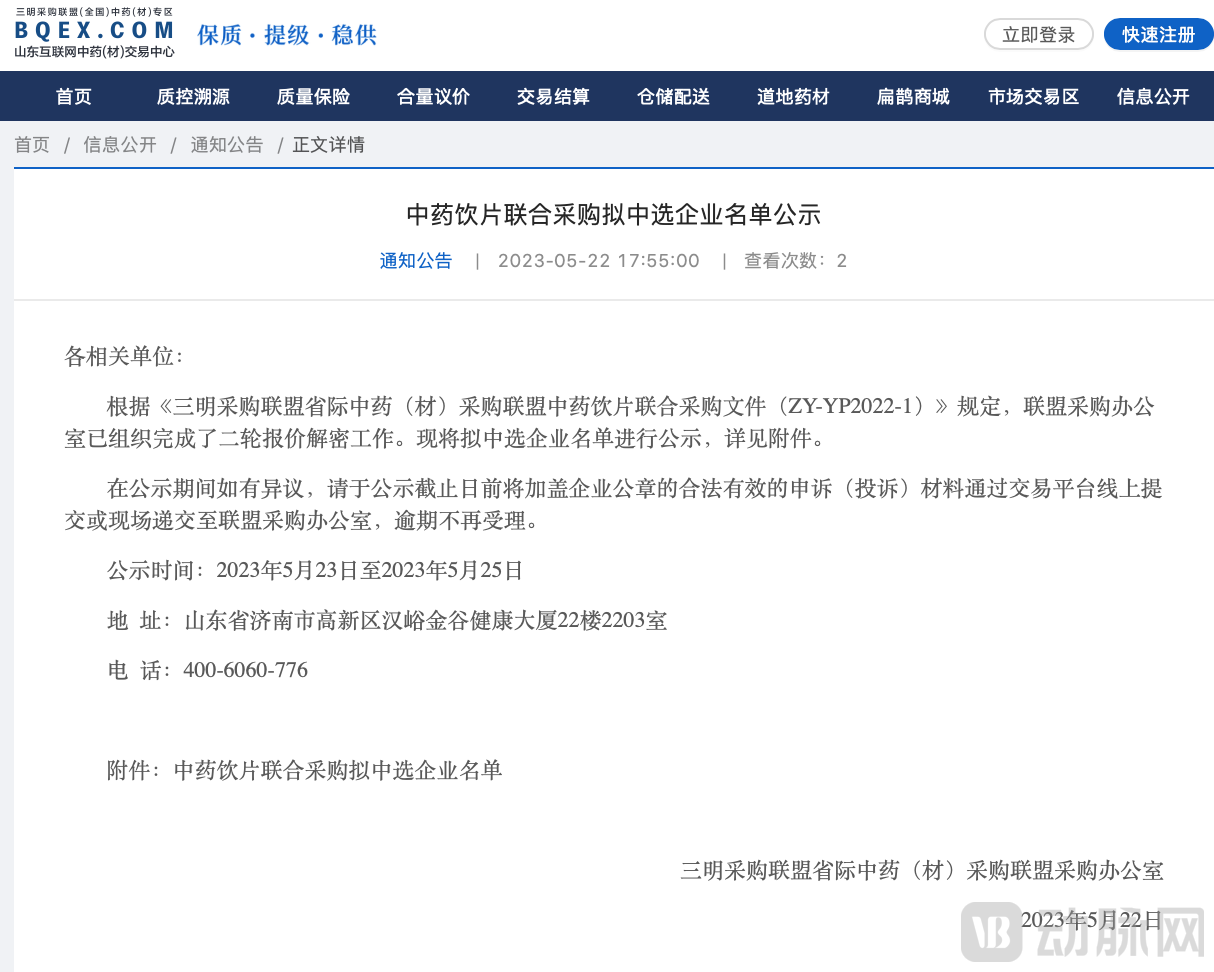
On May 22, the proposed winners of China’s first inter-provincial alliance procurement for traditional Chinese medicine (TCM) decoction pieces were announced in Jinan, Shandong Province. A total of 100 enterprises were selected for 21 TCM decoction piece varieties, with an average price reduction of 29.5% and a maximum reduction of 56.5%. As the inaugural initiative in cross-regional centralized volume-based procurement for TCM decoction pieces, this joint procurement achieved its anticipated goals of “ensuring quality, upgrading standards, and stabilizing supply,” while leveraging volume to secure lower prices.
In 2022, Shandong Province took the lead in establishing the Inter-provincial Alliance for Traditional Chinese Medicine (TCM) Decoction Pieces Procurement under the Sanming Procurement Alliance, with participation from 15 provinces. Experts were organized to select 21 varieties of TCM decoction pieces with substantial clinical usage and broad patient coverage, including Astragali Radix (Huangqi), Angelicae Sinensis Radix (Danggui), and Ophiopogonis Radix (Maidong), thereby pioneering cross-regional alliance-based procurement for TCM decoction pieces. With strong support from authoritative experts across relevant departments, universities of traditional Chinese medicine, research institutions, medical facilities, and industry associations, and based on repeated deliberations and extensive consultation with all stakeholders, the inaugural cross-regional alliance procurement of TCM decoction pieces adopted the guiding principle of “ensuring quality, upgrading standards, and stabilizing supply.” Each TCM decoction piece variety was categorized into two grades—standard grade and selected grade—with corresponding quality standards established for each. A comprehensive evaluation index system comprising 15 core indicators was developed, covering factors such as suppliers’ capacity to provide the declared varieties, planting (or breeding) bases, traceability systems, production management capabilities, quality control capabilities, authenticity of geo-authentic herbs, and alliance procurement demand. The procurement documents were publicly released in November 2022.
A total of 6,050 medical institutions from 15 alliance provinces participated in the volume declaration for this centralized procurement of traditional Chinese medicine (TCM) decoction pieces, with a total procurement demand reaching 6.5588 million kilograms. The initiative attracted active participation from 328 TCM decoction piece manufacturers, which submitted 7,647 products and involved 56,000 data points related to evaluation criteria. Following processes including expert evaluation of criteria, decryption of initial bids, public announcement of initially shortlisted enterprises, submission of product samples by enterprises, expert sample evaluation, and decryption of second-round bids, 782 products from 100 enterprises were proposed as winning bidders. The average proposed winning bid price represents a 29.5% reduction compared to current market prices. All 42 specifications across 21 varieties of TCM decoction pieces had successful bidders; among these, 31 specifications had more than 10 proposed winning enterprises, and 11 specifications had over 30 proposed winning enterprises.
In the pharmaceutical sector, the design and implementation of procurement plans for traditional Chinese medicine (TCM) decoction pieces present the greatest challenges. Building on extensive consultations with stakeholders and drawing upon the successful experience of national centralized drug procurement, this joint procurement initiative not only guides enterprises to reduce prices reasonably but also places greater emphasis on quality assurance. It integrates a whole-industry-chain policy framework encompassing TCM herbal cultivation, processing of decoction pieces, sales, clinical use, and quality traceability, thereby exploring an effective pathway for conducting joint procurement of TCM decoction pieces. Meanwhile, leveraging joint procurement as an entry point, the initiative strives to promote the healthy development of the TCM industry, ultimately benefiting the public.
First, it meets the public’s demand for high-quality herbal slices. The unified procurement standards for general-grade products established in this initiative exceed the current requirements of the Chinese Pharmacopoeia, while the standards for premium-grade products are set at an even higher level. This approach not only enhances the quality of herbal slices meeting basic market demand but also addresses the market’s need for high-quality products. By leveraging the price-reducing and price-stabilizing effects of joint procurement, the public can purchase higher-quality traditional Chinese medicine (TCM) herbal slices at the same or even lower costs.
Second, promote the high-quality development of the traditional Chinese medicine (TCM) industry. Joint procurement of TCM decoction pieces helps foster a unified national market that is efficient, standardized, fairly competitive, and fully open. It guides decoction piece manufacturers to source directly from regions of origin, thereby enhancing the intensification and scale of production in these areas, ensuring greater product quality assurance, promoting benign competition based on “premium quality at premium prices” in the decoction pieces market, and facilitating the healthy development of the entire industry.
Third, to promote standardized market circulation order. This joint procurement of traditional Chinese medicine (TCM) decoction pieces is conducted on a product-specific basis, evaluating enterprises’ quality control and supply capabilities for each individual product. Selected enterprises shall distribute their products to hospitals in accordance with contractual agreements, thereby encouraging greater emphasis on the quality of single products and further standardizing market order.
Fourth, promote the improvement of the quality traceability system. For the joint procurement of TCM decoction pieces, establishing a traceability system will be included as a key evaluation criterion. Leveraging the digital platform of the Shandong Internet Traditional Chinese Medicine (Materials) Trading Center, market-oriented approaches will be employed to advance the development of systems for quality standards, quality traceability, and quality-assured warehousing, thereby ensuring that TCM decoction pieces are safe, effective, and traceable, and strengthening whole-process management of TCM decoction pieces.
Shandong will collaborate with allied provinces to accelerate the implementation of the initial batch of selected results from the joint procurement of traditional Chinese medicine (TCM) decoction pieces. It will organize selected enterprises and medical institutions to expedite production, supply, and procurement preparations. It is expected that by the end of August, the public will have access to 21 types of jointly procured TCM decoction pieces that are high in quality and reasonably priced.