

Apnimed, Rooted in Harvard Research, Advances Toward First Oral Therapy for Obstructive Sleep Apnea with AD109

Apnimed
Researcher on New Therapies for Sleep Apnea and Related Diseases
Many men are unconcerned about their loud snoring during sleep, even boasting that it is a sign of “sleeping soundly.”
Later, they were frequently awakened from sleep by sensations of breathlessness and suffocation, accompanied by palpitations and profuse sweating. Upon waking, they felt exhausted and remained excessively sleepy during the day.
Which step went wrong?
In fact, snoring is often a key feature of obstructive sleep apnea (OSA). OSA is a common condition and a significant public health concern. According to the "Multidisciplinary Diagnosis and Treatment Guidelines for Obstructive Sleep Apnea in Adults," the prevalence of OSA is 2%-4%. OSA can cause extensive and severe health impairments and may induce cardiovascular diseases, leading to patient mortality.
Continuous positive airway pressure (CPAP) is the first-line therapy for moderate to severe obstructive sleep apnea (OSA), but discomfort from wearing the mask makes long-term patient adherence difficult. Oral appliances can serve as an alternative to CPAP in certain cases, but they are only suitable for patients with mild to moderate OSA. Some patients opt for surgery to remove anatomical abnormalities in the airway (such as hypertrophic tonsils and adenoids). However, surgery is not a permanent cure; OSA symptoms are likely to recur if the patient’s body shape changes postoperatively (e.g., due to obesity).
The limitations of conventional therapies have left a large population untreated or with suboptimal treatment outcomes.Currently, no effective pharmacological treatment for OSA has been identified.
US pharmaceutical company Apnimed brings hope for pharmacological treatment to patients with obstructive sleep apnea (OSA). Their newly launched medication not only alleviates nocturnal airway obstruction in OSA patients but also relieves their daytime fatigue.
The story behind the founding of Apnimed begins at Harvard Medical School.
In 2015, Dr. Luigi Taranto Montemurro, a pulmonologist, joined Harvard Medical School to conduct postdoctoral research on sleep medicine and circadian rhythm disorders. Prior to this, he had extensive clinical experience in sleep medicine. This background enabled him to work under the supervision of Dr. Andrew Wellman, Director of the Sleep Disordered Breathing Laboratory at Brigham and Women’s Hospital, where he was responsible for the development of pharmacological treatments for obstructive sleep apnea (OSA).

Luigi Taranto Montemurro Image source: Apnimed official website

Andrew Wellman. Image source: Official website of Harvard Medical School
Dr. Larry Miller seized this opportunity, and in 2017, he joined forces with Luigi Taranto Montemurro and Andrew Wellman to co-found Apnimed. Dr. Larry Miller serves as CEO and Chairman of the Board at Apnimed.
In fact, this is not Dr. Miller’s first foray into the healthcare industry. After earning his Ph.D. from Harvard Medical School, Dr. Miller completed his clinical training in internal medicine and respiratory diseases at Massachusetts General Hospital. Prior to joining Apnimed, he founded nine healthcare-related companies, two of which went public through initial public offerings (IPOs) and seven of which were acquired.

Larry Miller. Image source: Apnimed official website
Dr. Miller is well aware that, in addition to identifying the right strategic direction, the successful development of pharmaceuticals hinges on financial support. Beginning in its second year of operation, Apnimed actively pursued fundraising, and to date, the company has secured a total of $207.8 million in funding. These resources have been instrumental in steadily advancing the research and development of Apnimed’s various pipelines.
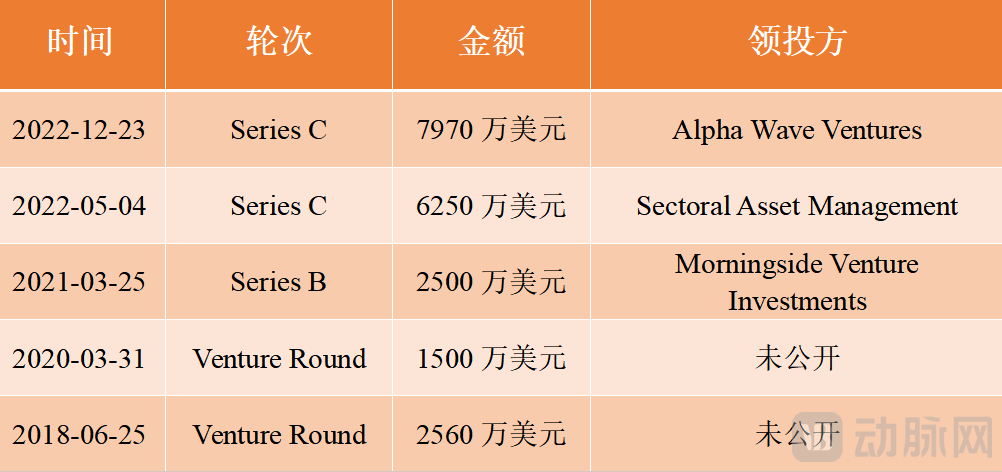
Apnimed Funding History | Data Source: Crunchbase
During sleep in patients with OSA,Partial or complete collapse of the muscles that maintain upper airway patency, which can lead to narrowing or complete closure of the airway, apnea, and hypoxemia. The underlying cause is driven by the central nervous system.Sleep-Related Muscle Relaxation. Apnimed is seeking pharmacological treatments for OSA based on this biological factor.
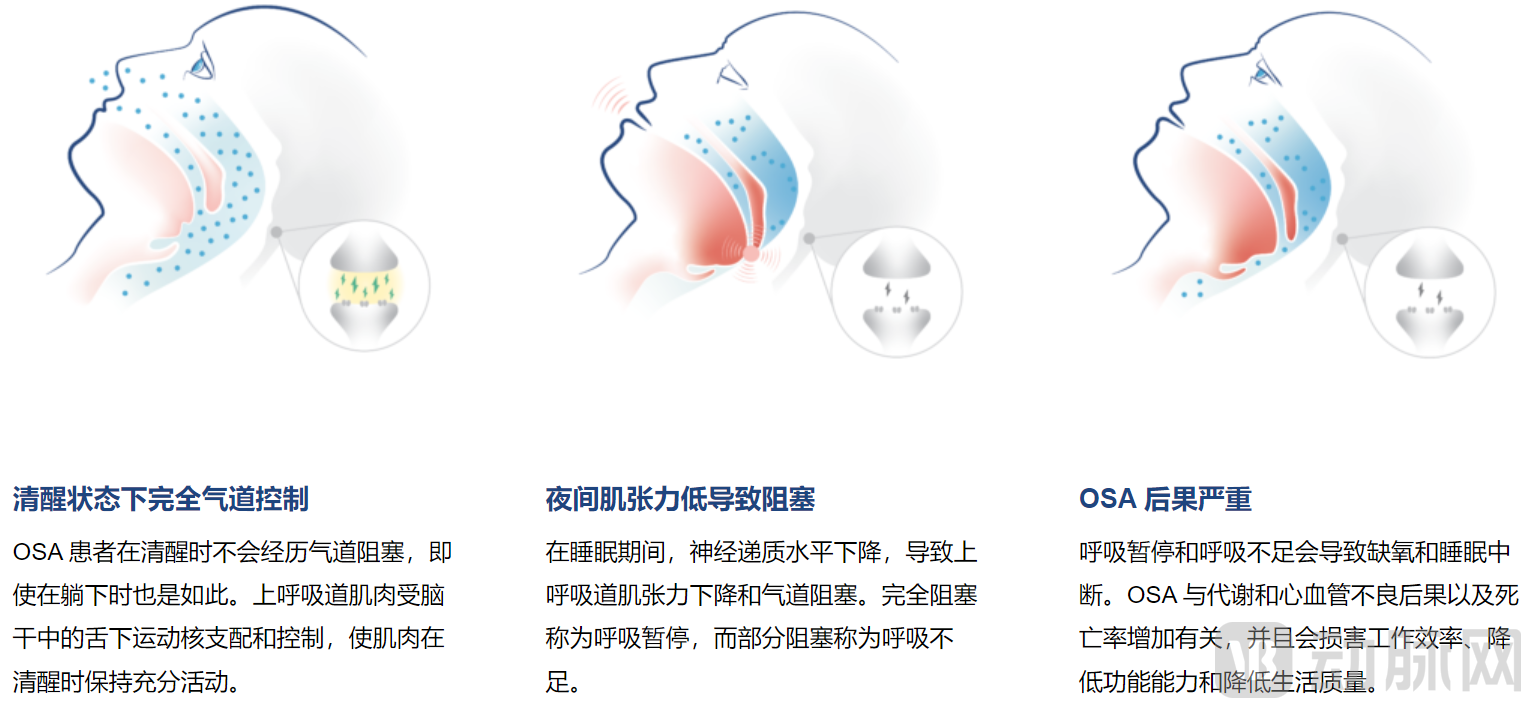
Schematic of Airway Obstruction in OSA Patients. Image source: Apnimed official website
In 2019, the research by Luigi Taranto Montemurro and Andrew Wellman began to yield promising results. They published their findings in the American Journal of Respiratory and Critical Care Medicine.The article states that the combination of atomoxetine and oxybutynin can be used to treat OSA, potentially even serving as an alternative to CPAP.These groundbreaking research findings have laid the foundation for Apnimed’s drug development.
Studies have shown that during non-rapid eye movement (NREM) sleep, sleep-related endogenous noradrenergic withdrawal is the primary cause of genioglossus muscle hypotonia. During rapid eye movement (REM) sleep, inhibitory mechanisms mediated by active muscarinic receptors lead to pharyngeal muscle hypotonia.
Apnimed's flagship drug is AD109, which works byDual MechanismControls the muscle tissue of the upper airway during sleep. AD109 willCombination of a selective norepinephrine reuptake inhibitor (atomoxetine) and a selective antimuscarinic agent (oxybutynin), reactivating the muscles of the upper airway via two neurochemical pathways to maintain the tone of the airway dilator muscles.
OSA patients only need toTake once daily before bedtime., breathing and oxygenation during sleep can be improved, potentially allowing them to discontinue the uncomfortable CPAP therapy.
In addition to nocturnal airflow obstruction, frequent cortical arousals also contribute to sleep fragmentation in patients with obstructive sleep apnea (OSA), preventing them from entering deeper stages of sleep. Under the combined influence of these factors, OSA patients are more prone to excessive daytime sleepiness and impaired concentration.
Some approved medications can address certain symptoms of OSA, such as excessive daytime sleepiness. However, no single medication can simultaneously resolve both nocturnal ventilation issues and daytime sleepiness in patients with OSA.
The emergence of AD109 has broken this impasse.Apnimed’s lead drug candidate, AD109, not only improves nocturnal ventilation in patients with obstructive sleep apnea (OSA) but also holds the potential to alleviate daytime symptoms.
To verify the safety and efficacy of AD109, Apnimed conducted a one-month, randomized, double-blind, single-dose clinical trial (MARIPOSA 2b). The company enrolled 294 patients with obstructive sleep apnea (OSA) at 25 sites across the United States. Most of these patients were unwilling or unable to tolerate continuous positive airway pressure (CPAP) therapy.
In the MARIPOSA trial, the AD109 group showed a significant reduction in the apnea-hypopnea index (AHI) compared with the placebo group.41% of participants who completed the study had an AHI below 10 after receiving AD109 treatment; 44% of patients experienced a reduction in AHI of more than 50%; and 15% of patients achieved a reduction in AHI of 80% or greater.
Nighttime symptoms have improved significantly; how are daytime symptoms?
The Epworth Sleepiness Scale (ESS) can assess patients' excessive daytime sleepiness, with higher scores indicating a more severe condition.Within one month,of the AD109 groupThe median ESS score decreased from 12 to 7, whereas the placebo group showed a decrease of only 2 points.
The trial results also demonstrated that AD109 had a favorable safety and tolerability profile. No serious adverse events occurred during the MARIPOSA trial.
Apnimed stated that the results from the MARIPOSA trial were highly encouraging. The company will begin enrolling patients for its Phase 3 clinical trial in the second quarter of 2023 and submit a marketing application to the FDA as soon as possible.FDA Has Granted Fast Track Designation to AD109。
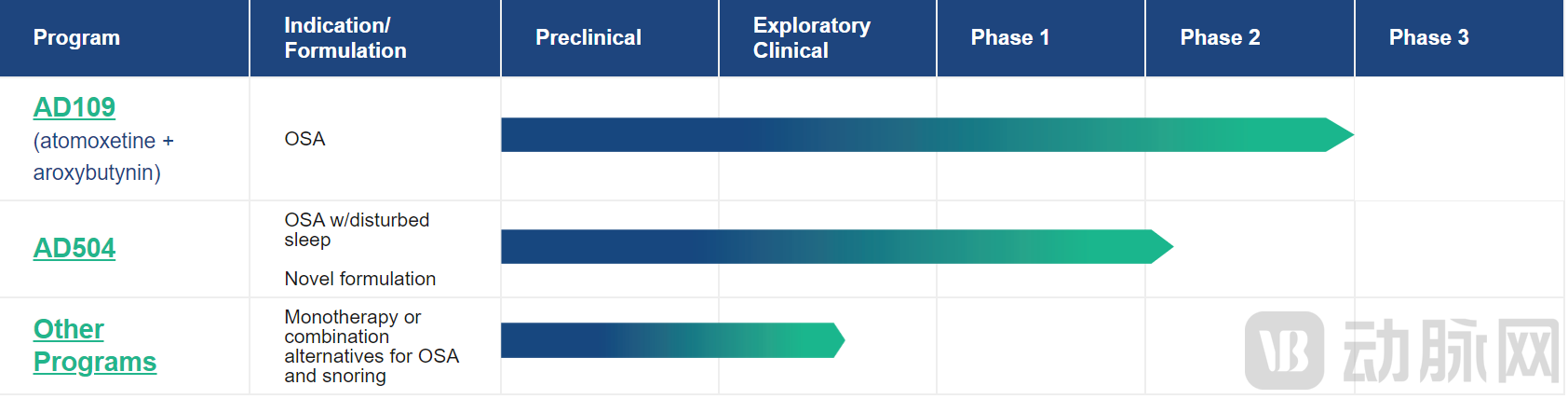
Apnimed’s Investigational Pipeline | Source: Apnimed Official Website
In addition to AD109, Apnimed’s second core pipeline candidate, AD504 (an oral combination of atomoxetine and trazodone), also targets obstructive sleep apnea (OSA). AD504 has currently entered Phase II clinical trials. Phase I clinical trial data for AD504 demonstrated that patients experienced not only a significant reduction in the Apnea-Hypopnea Index (AHI) (median 18.2 in the placebo group vs. 7.4 in the AD504 group) but also a marked decrease in hypoxic burden (HB) (median 46.3 in the placebo group vs. median 18.7 in the AD504 group).
According to the American Academy of Sleep Medicine, the global number of individuals with obstructive sleep apnea (OSA) is projected to rise to 1.16 billion by 2025. China has the largest number of OSA patients worldwide, followed by the United States, Brazil, and India. Reportedly, the global market for continuous positive airway pressure (CPAP) ventilators reached USD 2.7 billion in 2021 and is expected to reach USD 3.6 billion by 2028.
The 2021 European Guidelines on Narcolepsy recommend modafinil, pitolisant, sodium oxybate, solriamfetol, and methylphenidate as adjunctive therapies for excessive daytime sleepiness in adults with obstructive sleep apnea (OSA). Among these, modafinil is currently the only drug approved in China for the treatment of narcolepsy. Another medication, pitolisant, has been marketed in the United States and Europe, while Langhua Pharmaceutical is responsible for its development, production, and other commercialization activities in China. Currently, this drug is undergoing Phase III clinical trials in China.
There are very few medications available for the adjunctive treatment of daytime sleepiness associated with obstructive sleep apnea (OSA), and there is virtually a complete lack of pharmacological options directly targeting the nocturnal symptoms of OSA.
Faced with a vast market and unmet clinical needs, numerous pharmaceutical companies beyond Apnimed have targeted this high-potential sector, which is projected to reach a multi-billion-dollar valuation. Industry leaders such as Eli Lilly, Bayer, Incannex, RespireRx, SciSparc, and Takeda have all established their presence in the obstructive sleep apnea (OSA) space, with their respective drug pipelines already in clinical trials.
Furthermore, domestic traditional Chinese medicine (TCM) enterprises are also rising to the challenge. According to TCM theory, obstructive sleep apnea (OSA) is closely associated with the syndrome of phlegm and blood stasis coagulation. Sanbei Zhuhans Capsule, a patented proprietary TCM drug independently developed by Baorentang Pharmaceutical and formulated with Panax notoginseng and Fritillaria, aims to treat OSA using TCM therapies and is currently undergoing Phase III clinical trials.