

Who Will Win the Imminently Booming 'Children's Facial Management' Market?

ANGELAIGN
Dental Medical Consumables Supplier and Service Provider
Recently, Smartee, a clear aligner company, completed its tutoring registration with the Zhejiang Securities Regulatory Bureau, marking the official launch of its IPO process. Following ANGELAIGN, the second domestic brand in the clear aligner market may soon emerge.
In recent years, there has been a surge in domestic clear aligner products and companies. Although the overall market remains a blue ocean, intensified competition is inevitable as approved products are progressively commercialized. Companies are differentiating their product portfolios, with early-phase orthodontic treatment emerging as a key strategic focus for many players.
As parents increasingly prioritize their children’s oral health and facial aesthetics, a growing number of children in the primary and mixed dentition stages are undergoing early orthodontic treatment, making it a popular segment within clear aligner therapy and pediatric dentistry.
Currently, early orthodontic treatment for children is showing a trend of high-speed growth.
According to a survey conducted by the Orthodontics Professional Committee of the Chinese Stomatological Association on more than 20,000 Chinese children and adolescents, the prevalence of malocclusion in the primary dentition stage, mixed dentition stage, and permanent dentition stage was 51.84%, 71.21%, and 73.97%, respectively, in 2015, with an overall prevalence rate of 67.82% across the three groups.
For a long time, the notion that “orthodontic treatment should only begin after all permanent teeth have erupted” was deeply ingrained in the public consciousness, resulting in a lack of timely intervention for most children with malocclusion during the primary dentition and mixed dentition stages.
In recent years, as new media platforms have become increasingly embedded in daily life, dental institutions, orthodontic product manufacturers, and academic organizations have conducted extensive and professional public education on early orthodontic treatment, leading to a shift in public perception. Against this backdrop, growth in the pediatric early orthodontic treatment market has become inevitable.
Taking ANGELAIGN as an example, the number of cases treated with its pediatric aligners has been steadily increasing, accounting for a growing proportion of total cases year by year. In 2021, the growth rate in the number of cases for ANGELAIGN’s pediatric version reached as high as 116.0%, far exceeding the overall growth rate of 33.1%, making it the fastest-growing among the company’s four major product categories. ANGELAIGN’s annual report also revealed that despite a weak macroeconomic consumption environment in 2022, market demand for early orthodontic treatment remained robust.
How Early Is “Early” Orthodontic Treatment? VCBeat has learned from multiple pediatric dental institutions that, over the past two years, an increasing number of patients aged 6–8 have sought orthodontic care. With good patient cooperation, early orthodontic treatment in children as young as 4–5 years old is not uncommon.
In 2021, the Expert Group of the “Standardized Diagnosis and Treatment Project for Early Orthodontic Correction in Children” under the Hospital Management Institute of the National Health Commission released the *Expert Consensus on Early Orthodontic Correction of Malocclusion in Chinese Children* (hereinafter referred to as the *Expert Consensus*), which outlined the principles and fundamental components of early orthodontic intervention in children. The *Expert Consensus* advocates for implementing appropriate preventive or interventional measures for malocclusion at different stages of pediatric growth and development. Specifically, for primary dentition anterior crossbite, comfortable and safe orthodontic appliances can be selected for treatment around the age of four; timely therapeutic interventions should also be undertaken during the mixed dentition stage and the early permanent dentition stage before the age of 12.
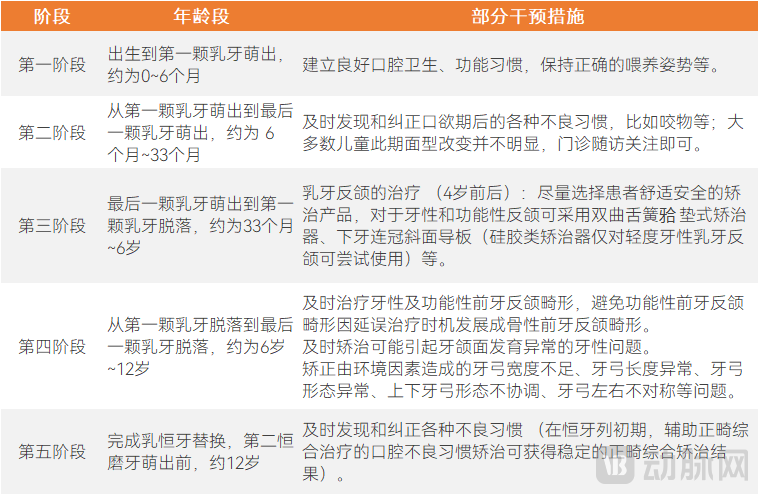
Prevention, Guidance, and Interceptive Orthodontic Measures for Malocclusion in Children at Different Stages. Source: Expert Consensus on Early Orthodontic Treatment of Malocclusion in Chinese Children
The "Expert Consensus" also points out that early orthodontic treatment can prevent, guide, and interrupt the occurrence and development of malocclusion in children, effectively reduce the incidence of malocclusion in children, promote the coordinated growth and development of children's dentofacial structures, reduce the severity of malocclusion in children, simplify its complexity, reduce the proportion of clinical tooth extractions, reduce the proportion of craniofacial skeletal deformity surgeries, contribute to stable oral function and harmonious, aesthetically pleasing dentofacial morphology after malocclusion correction, alleviate the physical and psychological burden on patients and their parents, and promote the healthy physical and mental development of children.
Overall, under the premise of ensuring children's comfort and safety, scientific early orthodontic treatment offers advantages such as simplifying complex cases and reducing extraction rates.
On the upstream device side, companies are frequently launching new products centered around clear aligners and myofunctional appliances.
Previously, companies such as Invisalign and ANGELAIGN had already launched pediatric versions of clear aligners. Brands like Ailemu, Aipulisi, and JPF have specifically focused on early orthodontic treatment, while imported products such as Nule EF and MRC are also available. Since 2022, a variety of new products and solutions for early orthodontic treatment have emerged, with accelerated product iteration. These new products exhibit numerous distinctive features.
First, it offers richer functionality.
Malocclusion is often accompanied by abnormal tongue posture, atypical swallowing, or mouth breathing, which can further exacerbate the severity of the malocclusion, thereby necessitating more comprehensive intervention.
In 2022, ANGELAIGN launched functional products such as invisible tongue spike technology, tongue position guidance technology, and new labial-buccal muscle barriers, centered on the concept of preventive and interceptive treatment, to provide more comprehensive intervention methods for orthodontic treatment during the primary dentition period in children.
In 2023, Smartee will also launch its perioral myofunctional therapy products based on digital diagnostics. These products target common myofunctional issues in children, such as mouth breathing, incompetent lip seal, low tongue posture, insufficient tongue muscle strength, weak mastication, unilateral chewing, and tongue-thrust swallowing. Through systematic training in breathing, lip closure, tongue positioning, and swallowing, the therapy promotes normal craniofacial development.
Secondly, greater attention is paid to the dynamic growth and development of children's oral cavities.
In 2022, Lepu Leqi launched the efree Trend Aligner, which utilizes the jaw growth curve prediction method to reserve differential growth space for aligners based on jaw growth predictions across various age groups, thereby guiding tooth eruption while achieving alignment. The efree Trend Aligner initiates treatment by guiding the anterior teeth, adjusting anterior tooth relationships, relieving crowding, correcting overbite and overjet, and regulating intraoral occlusal function.
It is understood that this product has taken the lead in achieving anterior tooth guidance, meeting the aesthetic needs of many patients and parents, instilling confidence in treatment, and facilitating the implementation of subsequent treatment plans.
Following the launch of its occlusal guidance and early treatment aligners in 2022, Smartee introduced the S20 Comprehensive Full-Cycle Management Solution for Early Correction of Concave Facial Deformity in 2023. Given the complex patterns of jaw growth and development in patients with concave facial deformity, determining appropriate early intervention and subsequent treatment has posed significant challenges. This solution provides a systematic treatment approach for patients with early-stage concave facial deformity by employing key assessment methods, including evaluation of mandibular morphology, diagnostic classification, and prediction of growth trends.
During children's growth and development, oral conditions undergo more complex changes compared to adults. Incorporating growth and developmental factors into early orthodontic treatment can achieve more ideal therapeutic outcomes.
Again, throughout the entire treatment cycle, the application of aligners is more diversified.
Removable appliances, space maintainers, fixed functional appliances, partial fixed multi-bracket appliances, clear aligners, and myofunctional trainers are all options for early orthodontic treatment in children. When selecting an appliance, the principles of balancing wear comfort with treatment efficiency, as well as balancing therapeutic effectiveness with cost-effectiveness, should be followed.
Selecting the most suitable orthodontic appliance at different stages is not only the responsibility of orthodontists but has also been integrated into the solutions provided by upstream manufacturers.
In 2022, Angelalign launched the EM3 Personalized Comprehensive Treatment Solution for Children, which includes silicone appliances, clear aligners, and conventional appliances. The overall solution is divided into two series, EM3 and EM3 Pro, corresponding to Phase I (early) treatment and two-phase treatment, respectively. These two series are interrelated and sequential, both adhering to the orthodontic philosophy of eliminating the root causes of malocclusion, flexibly utilizing various appliances to leverage their respective strengths, and achieving balanced development of teeth, bones, and muscles.
Furthermore, public information indicates that the pediatric version from Zhengli Technology is also set to launch soon. The product integrates silicone-based appliances, removable functional appliances, and clear aligners throughout the full-cycle treatment process.
Another trend is that orthodontic appliances are beginning to incorporate oral healthcare functions.
According to the medical device registration information from the National Medical Products Administration, three fluoride-containing dental aligners were approved in 2023, originating from ANGELAIGN and Aipulisi.
ANGELAIGN’s products are bracketless transparent anti-caries aligners coated with a transparent functional layer on the inner surface, which enables slow release of fluoride during use to help prevent dental caries. iPrevent’s products are made from medical-grade silicone containing sodium fluoride, suitable for children in preventing dental caries, correcting adverse oral habits, and guiding occlusion; one of their products is also indicated for the treatment of malocclusion.
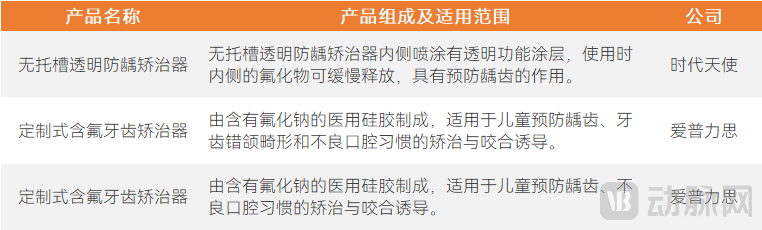
Early Orthodontic Products with Anti-Caries Function, Source: National Medical Products Administration
Although the aforementioned products have just received approval and it will be some time before they are adopted by healthcare institutions, this already reflects one of the trends in early orthodontic products for children: addressing common pediatric oral health issues while incorporating additional targeted functionalities.
According to incomplete statistics, more than 20 companies currently offer clear aligners and myofunctional appliances for early orthodontic treatment. To date, brands such as Meilike, Zhenshimei, Vincialign Da Vinci, and Hibeauty Yinxiu (under Topchoice Medical) have also launched products for early orthodontic correction.
Overall, with the emergence of new products and technologies, early orthodontic intervention can address a more comprehensive range of pediatric oral health issues, cover a broader age spectrum, and offer extended service cycles tailored to the unique characteristics of the mixed dentition period.
Due to the complexity of the knowledge system in early orthodontic treatment, practitioners must undergo specialized training to master the characteristics of craniofacial growth and development in children and continuously update their understanding of early intervention. The training framework should be progressive, establishing a tiered certification system tailored to clinicians with diverse backgrounds, thereby ensuring they acquire the corresponding clinical competencies.
Pediatric dentists, general dental practitioners, and orthodontists should all actively participate in basic treatment for prevention and interceptive intervention, while highly specialized and complex treatments should be led by orthodontic specialists.
Currently, pediatric dental brands such as Qingmiao Dental, Jicheng Dental, Zhengfangxing Dental, Ruilei Dental, and DUANG DUANG Pediatric Dentistry under the Meiwei Group have segmented their customer base, enabling them to provide targeted early orthodontic treatment.
Meanwhile, comprehensive dental healthcare institutions have also intensified their strategic focus on early orthodontic intervention, either by establishing specialized departments or dedicated business units.
As early as 2020, Taikang Bybo established the Center for Pediatric Dental and Facial Development Management. In 2022, Arrail Group founded the Center for Early Pediatric Orthodontic Development, adopting an integrated online-offline approach to conduct case consultations and discussions, thereby enhancing the overall clinical proficiency of its early orthodontic treatment team. In 2023, Hangzhou Stomatological Hospital, under Topchoice Medical, launched the Oral Care Joint Diagnosis and Treatment Center at its Pinghai Campus, offering services such as digital orthodontics, early pediatric orthodontic intervention, and comfortable pediatric dental care.
Furthermore, numerous dental medical institutions across China have partnered with the orthodontic brand ClearCorrect to establish Children’s Full-Cycle Facial Management Centers.
For comprehensive oral healthcare service providers, early orthodontic treatment can generate significant value.
The most direct manifestation of value is performance growth. In pediatric dental services, procedures such as fluoride application, pit and fissure sealants, and primary tooth extraction have also seen rapid growth in recent years. However, these procedures have low average transaction values and are often used for patient acquisition. In contrast, early orthodontic treatment for children can command average transaction values ranging from several thousand to tens of thousands of yuan, directly boosting the revenue of medical institutions.
Furthermore, with the comprehensive implementation of centralized procurement for dental implants in 2023, private medical institutions have also participated. While some implant-related services included in the procurement program may be affected, early orthodontic treatment can help offset this impact to a certain extent.
Early intervention can also drive consumer conversion toward pediatric or adult dental services. Orthodontic treatment requires multiple follow-up visits, which serve not only to monitor treatment progress in a timely manner but also to screen for other emerging oral health issues in children. Many pediatric oral conditions are asymptomatic or present with mild symptoms, resulting in low consultation rates; however, these can be identified and treated promptly during the course of orthodontic care. Furthermore, while accompanying their children for initial consultations or follow-up appointments, parents’ own dental service needs can be addressed concurrently.
Finally, the segmentation of early orthodontic treatment services also facilitates talent development. As previously mentioned, the knowledge system for early childhood orthodontics is extensive and complex, which contributes to the scarcity of pediatric orthodontists. Early intervention integrates specialized medical resources from pediatric dentistry, general dentistry, and orthodontics, thereby strengthening inter-specialty communication among clinicians, accumulating case studies, and establishing a more systematic framework for pediatric orthodontic experience and service delivery.
Examining the strategic shifts among healthcare providers and upstream device manufacturers, early orthodontic intervention is no longer limited to dental alignment and myofunctional training; “facial management” has become a prominent industry buzzword, with many dental institutions establishing “Children’s Facial Management Centers/Clinics” dedicated to early treatment.
“Facial management” is a term that encompasses various approaches to maxillofacial intervention, not limited to existing types of orthodontic appliances; this terminology better aligns with consumer expectations and is easier for consumers to understand. It is foreseeable that, under the broader concept of “facial management,” early orthodontic treatment will see further product and technological innovations.
Multiple investment institutions and securities firms believe that early orthodontic treatment will become a niche sector experiencing explosive growth in the coming years, with the market currently still in its early stages.
It is worth noting that some mainstream media outlets have previously argued that an excessive emphasis on early orthodontic treatment constitutes “anxiety-mongering.” Given that children in the primary dentition and mixed dentition stages are young and their cooperation cannot be fully guaranteed, the development of orthodontic products for this age group should prioritize comfort. If a child truly finds the treatment difficult to tolerate, medical institutions should avoid excessively encouraging parents to proceed with orthodontic intervention. Furthermore, against the backdrop of current demographic structures, early orthodontic products and services need to be stratified to meet the demands of different consumer segments. Both the age at which correction begins and the pricing of products and services should be guided primarily by clinical necessity, with differentiated strategies tailored to patients across various income levels. Only “facial management” approaches that refrain from manufacturing anxiety can achieve sustainable long-term growth.
Returning to the field of clear aligner orthodontics, with Invisalign and ANGELAIGN already capturing the majority of market share, how will Smartee, which is planning an IPO, leverage product and technological innovations to reshape the market landscape beyond merely differentiating on price? Will early-phase orthodontic treatment emerge as a breakthrough point? These developments are certainly worth watching.