Brilliance Biotech Submits IPO Prospectus for BRL-201: World’s First Non-Viral, PD-1 Site-Specific Integrated Anti-CD19 CAR-T Therapy
BRL-201 is developed using RayBiotech’s next-generation non-viral site-specific integration CAR-T technology (Quikin CART®) developed byThe World’s First Autologous CAR-T Cell Product Capable of Site-Specific Genomic Integration Without the Use of Viral Vectors, enabling one-step site-specific integration of CAR elements into the genome and regulatory intervention of endogenous genes in T cells. This approach can significantly reduce the production cost of CAR-T cells, shorten the preparation time, and substantially improve the safety and efficacy of CAR-T cell therapy, thereby benefiting more patients. It is fair to say that BRL-201 has the potential to replace existing traditional CAR-T therapies, becoming a safer, more effective, and more accessible therapeutic product. In the future, we will continue to advance the clinical translation of this product and strengthen Quikin CART®the development of technology, enabling it to benefit more cancer patients.”
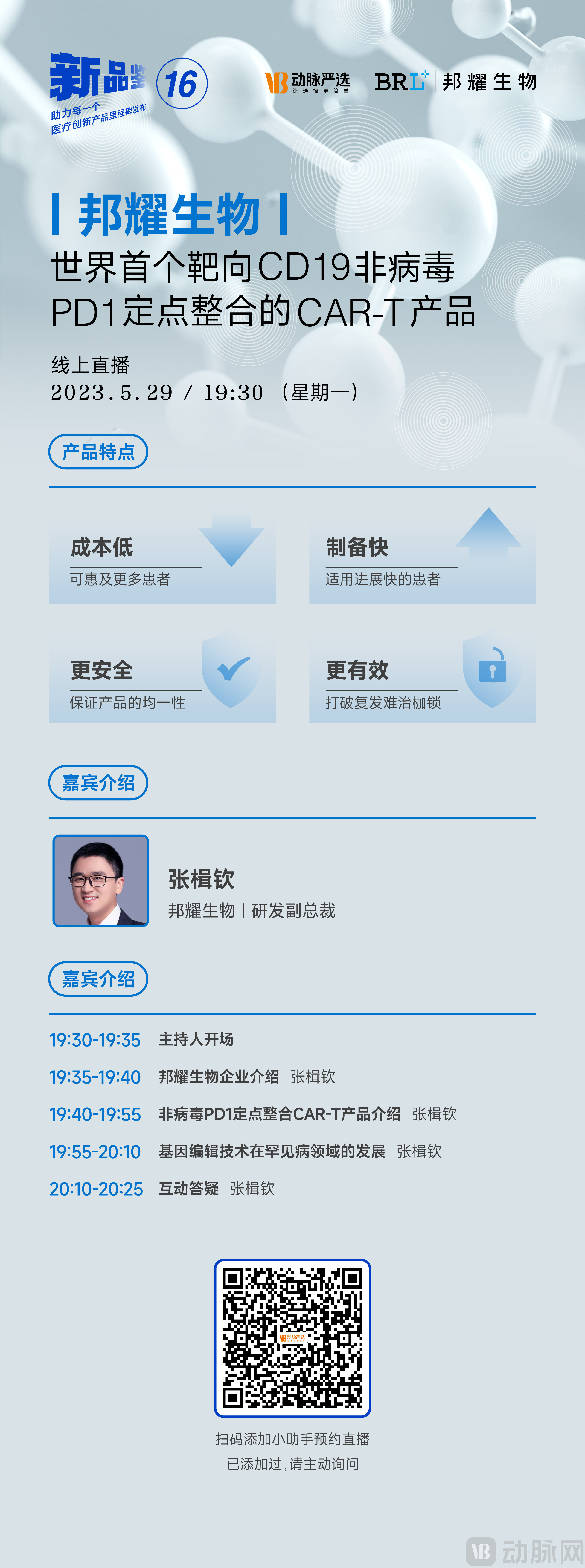
VCBeat Selects New Product Review Issue 16 InvitesZhang Jiqin, Vice President of R&D at Bangyao BioDr. Presents Bioray Labs' Product Promotion.
1. Low cost, benefiting more patients
BRL-201 employs the CRISPR/Cas9 gene-editing technology, which was awarded the Nobel Prize in 2020, to precisely edit the PD-1 locus in T lymphocytes and insert a chimeric antigen receptor (CAR) molecule targeting CD19 on tumor cells at the specific site, all without using viral vectors. This non-viral manufacturing process significantly reduces the high costs associated with viral vector use, as well as the expenses related to complex manufacturing processes and production testing.
2. Rapid preparation, suitable for patients with rapidly progressing conditions
From a manufacturing perspective, traditional CAR-T products require lengthy preparation times, which significantly prolongs the waiting period for patients and renders such therapies unsuitable for those with rapidly progressing tumors. In contrast, BRL-201, developed by Bonacell Biosciences, utilizes a non-viral manufacturing approach with a streamlined, single-step process that simultaneously achieves sustained CAR expression and modulation of endogenous T-cell genes. This innovation substantially reduces the overall CAR-T production timeline, enabling completion in as little as three days. Furthermore, it allows for concurrent multi-batch cell production, significantly boosting manufacturing capacity and ensuring timely availability for patients with fast-progressing tumors.
3. Safer, ensuring product uniformity
Non-viral site-specific integration enables precise insertion of each CAR sequence into a defined genomic locus, thereby avoiding the tumorigenic risks associated with random integration and maximizing the safety and efficacy of CAR-T products. In the ongoing clinical trial of BRL-201 for the treatment of relapsed or refractory non-Hodgkin lymphoma, no CAR-T-related neurotoxicity or grade ≥2 cytokine release syndrome was observed among the eight patients treated, demonstrating the excellent clinical safety profile of BRL-201.
4. More Effective: Breaking the Cycle of Relapse and Refractoriness
Among patients with refractory/relapsed lymphoma treated with BRL-201, the objective response rate reached 100%, and the complete response rate was 87.5%. These results demonstrate the outstanding clinical efficacy of PD1-19bbz CAR-T cells, representing the best clinical outcomes to date globally for CAR-T cell therapy in refractory/relapsed lymphoma, characterized by high response rates and low adverse reactions. Furthermore, patients achieved significantly greater long-term benefits compared to existing viral vector-based products, with median progression-free survival (mPFS) increasing from 2.9–12.8 months (for existing viral CAR-T therapies) to 20 months (for Raybree BRL-201 CAR-T). Additionally, further single-cell sequencing results revealed a high proportion of memory T cells within the PD1-19bbz CAR-T cell product. In vivo, PD1-19bbz CAR-T cells exhibited enhanced anti-tumor functionality, and the long-persisting CAR-T cells displayed characteristics of memory cells. This comprehensively elucidates the mechanism underlying the superior clinical efficacy of non-viral, PD1 site-specifically integrated CAR-T cells.
Viewing Methods: Scan the QR code on the poster below to add our assistant and reserve your spot for the live broadcast.

Dr. Zhang Jiqin
Bonay Bio | Vice President of R&D
He received his Bachelor of Science degree from Tongji University in 2007; obtained his Ph.D. in Biochemistry and Molecular Biology from East China Normal University in 2012, and subsequently served as an Assistant Researcher at the Shanghai Cancer Institute; in September 2016, he joined the School of Life Sciences at East China Normal University as an Associate Researcher. His research primarily focuses on gene editing and tumor immunotherapy. In recent years, he has published papers as the first author, corresponding author, etc., inNature、Nature Communications、Cell Research、Molecular Cancer、HypertensionPublished more than 20 SCI papers in internationally renowned journals. Pioneered the world’s first non-viral site-specific integration CAR-T technology, and developed Quikin CART, which features independent intellectual property rights owned by Bangyao Biotechnology.®The platform offers new approaches to addressing the pain points in the CAR-T field.
About Bonano Bio
Shanghai Biocytogen Co., Ltd. is committed to becoming a globally leading cell and gene therapy company in the era of new business civilization. With the mission of “leading innovation through gene editing, developing breakthrough therapies, and benefiting all humanity,” Biocytogen relies on its independent R&D center and the jointly established “Shanghai Research Center for Gene Editing and Cell Therapy” with universities. Over the past seven years, the company has generated more than 100 patent achievements, launched investigator-initiated clinical trials for five projects across eight renowned hospitals, obtained Investigational New Drug (IND) approval for two projects—officially entering registered clinical trial stages—and advanced multiple additional projects into the IND application phase. Notably, projects such as gene-editing therapy for beta-thalassemia, non-viral PD-1 site-specific integration CAR-T, and UCART have already demonstrated excellent clinical outcomes, showcasing global leadership, and inNature、Nature Medicine、Nature biotechnologyhas published multiple academic papers in renowned scholarly journals. Bangyao Biotechnology has established five proprietary technology platforms: a gene-editing technology innovation platform, a hematopoietic stem cell platform, a non-viral site-specific integration CAR-T platform, a universal cell platform, and an enhanced T-cell platform. With a 7,000-square-meter GMP pilot-scale production base and an operational team of nearly 200 professionals, the company effectively ensures the rapid translation and application of innovative research outcomes. Driven by patient needs and clinical feedback, Bangyao Biotechnology continuously accelerates the iterative development of its R&D products. Upholding principles of openness, sharing, and mutual benefit, the company collaborates with enterprises across the global innovative biopharmaceutical ecosystem to expedite the translation and commercialization of novel therapeutics, thereby benefiting patients worldwide suffering from genetic disorders, malignant tumors, and autoimmune diseases.
About Artery Select's New Product Launch
"Artery Select New Product Showcase" is a live-streaming program under the "Artery Select" brand, dedicated to supporting medical enterprises in launching innovative products. The program's mission is: to empower every milestone launch of innovative medical products.
Scan the QR code above to contact the assistant and schedule a live stream.
(If already added, please proactively contact the assistant)