

Breaking Through Barriers in Life Science Research: Navigating a Path Forward Amid Over RMB 100 Billion in Annual Investment
The latest Nature Index data shows that Chinese authors made the largest contribution to high-quality natural science research in 2022, with their share of papers published in high-quality journals ranking first for the first time, surpassing the United States.
In terms of disciplines, China became the leading country in the fields of physical sciences and chemistry in 2021; the latest data from January to April 2023 show that China has also surpassed the United States for the first time in the field of earth and environmental sciences.
Major Breakthroughs in Scientific Research Are Exciting.
No pain, no gain; every stroke of writing and every figure or table in scientific research outputs require researchers to devote considerable effort. However,Researchers in the life sciences sector continue to face significant challenges in acquiring knowledge and expertise, procuring experimental products, and engaging in efficient, academically oriented exchanges.
There is no smooth path in scientific research. From major tasks such as experimental design and manuscript preparation to minor ones like expense reimbursement and form filling, researchers’ journey is a continuous process of “overcoming obstacles.”
The procurement of research products, such as reagents and consumables, constitutes the most fundamental need of researchers.
“Before conducting experiments, we typically refer to papers published by top global laboratories in this field in leading journals and select products based on the ‘Materials and Methods’ sections. More than a decade ago, some reagents were not readily available in China,” said Zhou Li, who holds a master’s degree in cell biology from Xiamen University. He noted that purchasing these reagents relied mainly on distributors, who often had to scour various channels to source them.
In the traditional offline procurement model, researchers accessed product information through a variety of channels, including distributors, direct sales representatives, and senior colleagues in their laboratories. To procure the most suitable products, they needed to gather product information from multiple sources, obtain quotations, and compare offerings from different suppliers. Procurement was primarily conducted through distributors. On the sales side, companies specializing in research products mainly established sales and service outlets in areas with concentrations of research institutes and universities, while relying on distributors to cover regions with dispersed demand.
In this model, the information asymmetry between supply and demand leads to inefficient procurement.
With the widespread adoption of the internet, it has also become an important channel for researchers to obtain product information.
At that time, online forums were among the primary venues for social interaction on the internet. Some academic exchange forums in medicine and biology even featured dedicated sections for purchasing requests of reagents. Against this backdrop, a number of online platforms for procuring research products emerged, with DXY Mart, launched in 2008, being one of them.
Online inquiry and procurement of research products enable researchers to save substantial time previously spent on sourcing suppliers and obtaining quotes from multiple vendors.
Notably, similar to the early e-commerce landscape, the research products sector once grappled with information overload and inconsistent quality, with counterfeit and substandard goods even circulating in the market.
In 2009, Science News magazine reported an incident of fraudulent biological reagents: experiments conducted in the laboratory of Xi Jianzhong, a researcher in the Department of Biomedical Engineering at Peking University, encountered problems. Black spots repeatedly appeared in the culture flasks, and the cultured cells died within a week. Xi Jianzhong repeatedly adjusted conditions, replicated the experiments, and ruled out other interfering factors, but failed to identify the cause of the experimental failures. By chance, it was discovered that the DMEM cell culture medium used in the laboratory might be counterfeit. After purchasing a new batch of reagents from a reputable distributor, the cell lines resumed normal growth.
Such phenomena are not isolated cases; at academic exchange forums, many researchers have shared their experiences of purchasing problematic reagents that led to experimental failures or raised doubts about the reliability of their data.
To ensure that researchers can purchase qualified, high-quality products, DXY.cn launched the Counterfeit Exposure Platform in 2011 and the Procurement Assurance Program in 2012.Crackdowns on counterfeit research products have shrunk the market space for fake and substandard goods, freeing up this capacity for compliant enterprises. In a healthy market ecosystem, a large number of companies offering high-quality research products and services have emerged and grown rapidly.; To this day, life sciences has become a hot industrial sector.
Meanwhile, research product companies are also leveraging online procurement platforms such as Dingxiangtong to continuously reach a broader customer base.
Vazyme, founded in 2012, is one of the enterprises that have grown amid opportunities in the life sciences market and successfully completed its initial public offering (IPO) on the STAR Market in 2021.
In the view of Wang Minwen, Brand Director at Vazyme, the boundaries of the scientific research community remain relatively stable, yet internal dynamics continue to feature flow and iteration. This is precisely why we must consistently strengthen our brand presence.
Tiangen Biotech has always prioritized online channels, launching its store on Dingxiang Tong shortly after the platform went live. Jiang Yanbo, Marketing Director at Tiangen Biotech, stated, “Dingxiang Tong has helped us better reach our customers; over the past 15 years, our store has averaged an annual traffic of 160,000 to 170,000 visits.”
Researchers must also continuously acquire and update their knowledge, particularly in the context of the significant growth in research investment in recent years.
According to Frost & Sullivan statistics, from 2015 to 2020, funding for basic life sciences research, drug discovery, and preclinical drug studies conducted by Chinese universities, research institutes, hospital laboratories, and pharmaceutical companies increased from RMB 43.4 billion to RMB 100.4 billion, representing a compound annual growth rate (CAGR) of 18.3%, which is significantly higher than the global growth rate of research funding in the life sciences sector.
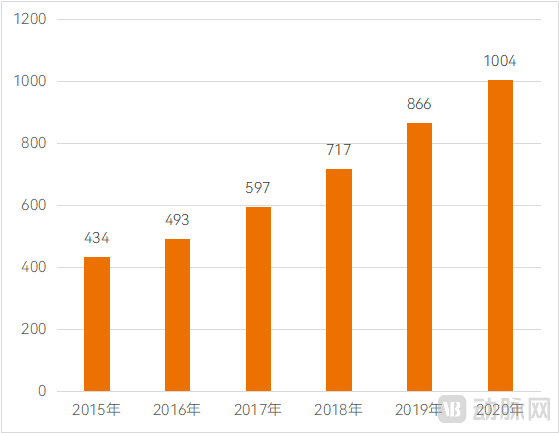
Growth in Research Funding Investment in China’s Life Sciences Sector (RMB 100 Million); Source: Frost & Sullivan
With more abundant research funding, researchers are increasingly focusing on new technologies, novel experimental methods, and emerging research advances, leading to a more urgent demand for accessing cutting-edge knowledge.
However, researchers have limited time and already bear a heavy workload in their daily routines. According to the "Researcher Insights Report" released by Dingxiang Tong, researchers at academic and scientific institutions spent an average of 8.3 hours per day on research-related work in 2021. This included not only tasks closely associated with research, such as experimental procedures, learning new techniques, and manuscript writing, but also meetings and administrative chores.
The heavy workload is not a short-term situation for researchers, but a long-standing issue. Administrative tasks such as reimbursement, form-filling, and coping with inspections have consumed considerable energy of researchers.This situation has become so prevalent that policy intervention is required; to date, the Ministry of Science and Technology and other departments have issued three rounds of documents aimed at reducing the burden on researchers.
The time saved from tedious administrative tasks can be utilized by researchers for professional knowledge acquisition, with a demand for more efficient and convenient learning channels.The increasingly advanced new media have facilitated the dissemination of scientific research knowledge, enabling researchers to access information and acquire knowledge in more scenarios during their fragmented time.Platforms such as DXY’s “Biology Master” and “DXY Academic” WeChat official accounts, along with the “DXY Society” video platform, have established a comprehensive content matrix spanning from text-and-image articles to videos, delivering continuous, high-value professional content to users. This new media content covers both foundational skills and cutting-edge trends, ensuring that users across the spectrum—from graduate students in laboratories to senior research professionals—can derive substantial benefit.
Research product companies can also extensively participate in the co-creation of professional content, disseminating knowledge to users while showcasing product features and addressing experimental inquiries; this serves to attract user interest in new technologies and products or directly drive sales conversions.
“Animations, instructional videos, and other multimedia content can more clearly convey the differentiated features of our products, enabling users to get up to speed faster when conducting experiments and thereby achieve optimal results. When the DXY Learning Community section was launched, Tiangen Biotech was among the first companies to join, uploading a series of technical lecture videos and visualized operational guides. To date, these resources have been accessed by hundreds of thousands of learners,” said Jiang Yanbo, Marketing Director at Tiangen Biotech.
Over the past three years, the pandemic has had a certain impact on offline learning channels, making the value of new media platforms more prominent.Despite the intensive schedule of offline conferences since 2023, demand for online activities has not waned among either researchers or enterprises, with lectures and seminars continued to be held via new media platforms.
In April 2023, Nasri, in collaboration with OE Biotech and expert lecturers from DXY, co-hosted an online webinar titled “Learning from High-Impact Publications: Study Design and Technical Applications of Single-Cell Spatial Omics.” The session shared multidisciplinary omics expertise and attracted over 1,500 attendees. Zhang Yi, Marketing Manager at OE Biotech, stated, “We saw substantial user engagement during the webinar. Thanks to the in-depth exchanges held throughout the event, we received a steady stream of follow-up inquiries from users, which ultimately led to sales conversions.”
When asked about the remaining challenges in scientific research experiments, Zhou Li, who holds a master’s degree in cell biology and has been graduated for many years, still gave a crisp answer: “The reproducibility of experiments!”
According to the “Researcher Insights Report” by DXY, “experimental results that do not meet expectations with no way to understand the reasons” is the most troubling issue for researchers.
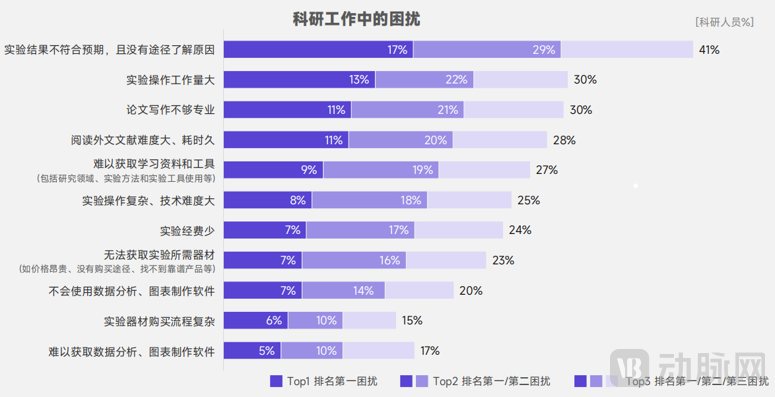
Challenges in Scientific Research, Image Source: DXY’s “Insights Report on Researchers”
Inconsistent results from multiple runs of the same experiment, and discrepancies between experimental data and findings reported in authoritative literature, are recurring challenges that loom large before researchers; failure to overcome these obstacles may render all prior efforts futile.
“Research carries significant psychological pressure, particularly when repeated experiments yield unsatisfactory results. With project deadlines approaching, anxiety intensifies; heightened stress often leads to poorer outcomes, creating a vicious cycle.” Li Mengyu, a researcher in clinical anesthesiology, has articulated the sentiments shared by many scientific researchers.
To address anomalies in experimental results, researchers not only troubleshoot their own materials and methods but also seek external assistance.The aforementioned “Researcher Insights Report” also found that 69% of researchers had used online consultation services, but were hindered by low-quality responses and untimely replies.
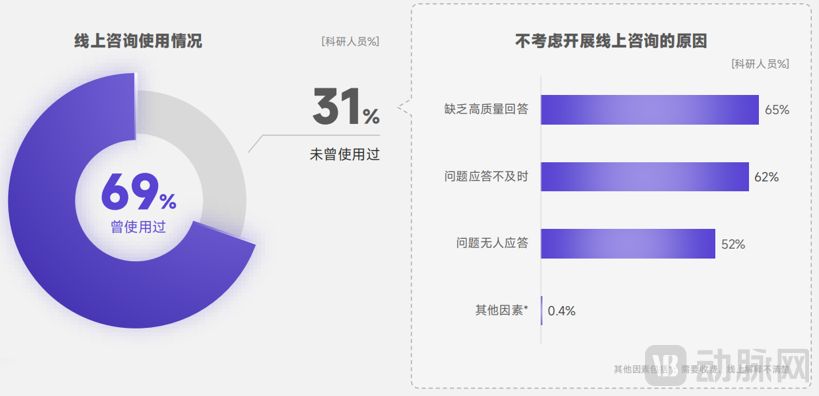
Status of Researchers’ Use of Online Consultation and Reasons for Not Considering It; Source: DXY’s “Researcher Insights Report”
“Within the scientific research community, there are over two million individuals engaged in biological research, yet their research topics vary significantly, making it extremely difficult to find peers conducting similar experiments,” said Wang Hui, head of Dingxiang Tong. “Could we develop a tool for experimental learning and communication to help researchers locate information, exchange experiences, and share solutions?”
In 2021, Dingxiang Tong launched the mini-program “Dingxiang Lab,” which compiles popular experimental protocols and features a Q&A section to address experimental issues and facilitate experience sharing, earning it the reputation among professionals as the “Zhihu” for scientific research. To date, Dingxiang Lab has indexed more than 10,000 experimental protocols, with content reviewed and corrected by a professional team.
Yang Yaocheng, a researcher specializing in oral tumors, has been a DXY user for five years and took notice of the DXY Lab tool when it was first launched. “When I first conducted stem cell experiments, I was unfamiliar with the procedures. I initially used my own methods and posted any questions that arose on DXY Lab for community discussion. Afterward, I tried methods suggested by others and found, through comparison, that they better aligned with the expected experimental outcomes.”
On such a communication platform, researchers both gain insights and contribute knowledge. Yang Yaocheng mentioned that he has begun co-creating content with Dingxiang Shiyanshi (DXY Lab), such as writing experimental protocols and summarizing his own experiences to help others.
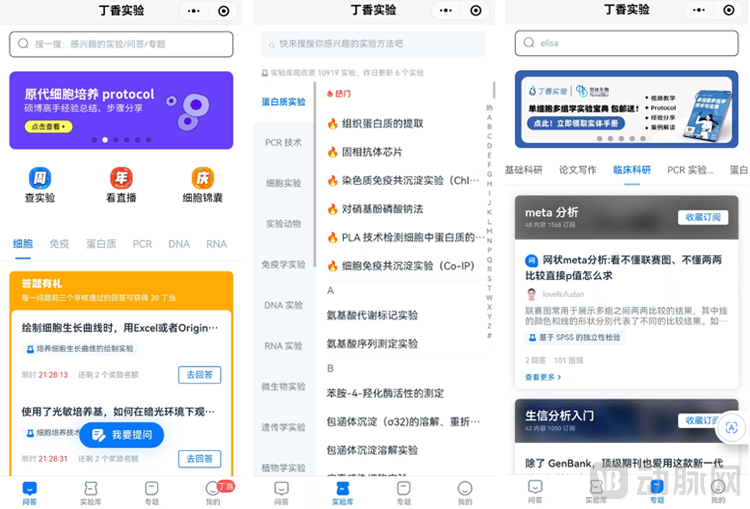
DXY Lab Main Page
To date, accessing information and knowledge and engaging in communication have become increasingly easy. However, as research content continues to accumulate, its scale has grown substantially and sources have become fragmented. It is therefore necessary to integrate this content through a “rigorously curated” approach to precisely meet the practical needs of researchers.
Wang Hui, head of Dingxiangtong, stated that an effective approach is to build upon the experiments themselves by connecting researchers’ experiment-related needs, including experimental knowledge, product selection and procurement, Q&A support, and academic exchange.
In November 2022, attentive research users noticed that the Dingxiang Lab mini-program had added a new section titled “Lab Manual.” Upon entering this section, users can access a comprehensive range of resources, including instructional videos, experimental protocols, experience sharing, and illustrated interpretations. The platform intelligently presents content highly relevant to the specific experiment users wish to learn about, eliminating the need to sift through extensive lists of methods or videos. Additionally, a physical handbook is provided, allowing users to “carry experimental protocols in their pocket” for convenient reference and learning at any time.
New technologies related to experiments can also be featured in the column. Wang Minwen, Brand Director at Vazyme, stated that when new technologies were previously released through the “Experiment Bible,” online lectures gave researchers an impression of their advanced nature, while subsequent interactions and quizzes further reinforced this perception, resulting in precise and effective overall engagement.
The “14th Five-Year Development Plan” of the National Natural Science Foundation of China states that the 14th Five-Year Plan period is a crucial phase for China to advance into the forefront of innovative countries and to accelerate the expansion of the new round of scientific and technological revolution and industrial transformation. In accordance with the plan, the National Natural Science Foundation of China will structure its funding layout across four sectors: basic sciences, technical sciences, life and medical sciences, and interdisciplinary integration.
Life science research is entering a new phase of accelerated growth. Researchers striving for scientific breakthroughs are still on their journey, and DXY.cn, which has been supporting scientists for 15 years, remains alongside them, working hand in hand with all industry practitioners to “navigate the challenges.”
As research activities become more vibrant, there are higher demands for research quality. To pursue original innovation and avoid unhealthy competition, researchers need to conduct clearer and more feasible project planning, delivering research outcomes with high innovativeness and strong application value.
Over the past 15 years, PCs and mobile internet have provided researchers with powerful tools to overcome challenges. In the future, as digital transformation deepens, how can we make the path of scientific research smoother? It is worth looking forward to.
(The name “Zhou Li” in this article is a pseudonym, as requested by the interviewee.)
References:
Science & Technology Review: Cracking Down on Counterfeit Research Reagents
Xinhua News Agency: For the First Time! China Ranks No. 1