

HKU Shenzhen Hospital Doctor Breaks Through Key Surgical Challenge in Pelvic Organ Prolapse, Potentially Benefiting 22.4 Million Patients
In the languages of every country and ethnicity, “mother” is the embodiment of greatness, selflessness, and devotion. Women pay a tremendous price for childbearing; beyond the hardships and pain of gestation and childbirth, the sequelae resulting from delivery may persist throughout their lives.Pelvic Organ Prolapse (hereinafter referred to as POP) is one of them.
An epidemiological survey by Professor Zhu Lan, Member of the Academic Division of the Chinese Academy of Medical Sciences and Director of the Department of Obstetrics and Gynecology at Peking Union Medical College Hospital, shows that:9.6% of Chinese women aged over 20 and 17.4% of those aged over 60Symptomatic pelvic organ prolapse (POP) of stage II or higher requires surgical treatment. Based on data from China’s Seventh National Population Census, the number of POP patients aged 60 and above requiring surgical treatment in China reaches as high as22.399 million, and these data do not yet include POP patients under 60 years of age.
Pelvic organ prolapse (POP) can significantly impair women's quality of life. Mild cases may present with urinary incontinence, fecal incontinence, and urinary tract infections, while severe cases can progress to voiding difficulty and even renal failure. Moreover, POP can cause psychological distress in affected women.The powerlessness of aging, the shame of incontinence, the threat of disease, and even the fear that “no filial child remains at the bedside of the chronically ill”… “Helpless, I only wish to cause less trouble” is one of the most poignant and humble emotions in human nature.
Dr. Zhang Wenju, Director of the Department of Obstetrics and Gynecology at The University of Hong Kong-Shenzhen Hospital, has been engaged in clinical practice in obstetrics and gynecology for 20 years. Over these two decades, he has witnessed too many mothers lose their quality of life due to pelvic organ prolapse (POP). To address the challenges faced by these “mothers,” Dr. Zhang has decided to pursue innovation in this field.
Dilemmas and Challenges of Existing Surgical Procedures
Throughout medical history, the treatment of POP has been continuously explored.
Initially, physicians attempted to reinforce the pelvic floor by suturing the patient’s own tissues to provide support for the pelvic organs. Although this approach could alleviate symptoms of pelvic organ prolapse (POP) in patients, it was not a long-term solution. According to postoperative follow-up statistics, the success rate of this surgical procedure was only54%—81%, but the recurrence rate over a decade was as high as17—20%。
Researchers have found that the primary cause of failure for this surgical procedure isInsufficient support from the patient's own tissuesTo address this issue, researchers have designed synthetic meshes to reinforce the pelvic floor and provide support. With the use of these meshes, the surgical success rate has increased to92—97%。
However, this surgical procedure still presents certain challenges. As the mesh is a permanent implant, the human body may exhibit a degree of rejection response: seven years after transabdominal mesh placement, the rejection rate reaches 10%, whereas the rejection rate for transvaginal mesh placement can be as high as 42%. Mesh rejection can lead to severe complications such as vesical, intestinal, and ureteral fistulas, as well as infections. Furthermore, the removal of implanted mesh is difficult, causing irreversible secondary harm to patients.
In 2019, the U.S. FDA required mesh manufacturers to cease production of vaginal mesh, while Australia and New Zealand have banned vaginal mesh implantation procedures.
To avoid the harm caused by mesh-based procedures to patients, Dr. Zhang redirected his research focus on pelvic organ prolapse (POP) treatment back to non-mesh suspension techniques. After reviewing numerous non-mesh suspension approaches, Dr. Zhang finally determinedSacral spinous ligament suspension, with a cure rate as high as 89-98%, fewer complications, and lower anesthesia risk, serves as the starting point for this study.
Although sacrospinous ligament suspension offers numerous benefits, its widespread adoption remains challenging, primarily due to the technical difficulty of its key step: suture fixation of the sacrospinous ligament.The sacrospinous ligament is located deep within the pelvic cavity. This surgical procedure requires accessing the sacrospinous ligament via a deep transvaginal approach, which is technically very challenging due to the limited operative space and inadequate illumination.
Secondly, the depth of ligament suturing also places high demands on the operating physician:Excessively deep suturing may injure nerves and blood vessels, leading to postoperative buttock pain or severe intraoperative hemorrhage that is difficult to control; whereas excessively shallow suturing provides insufficient strength, predisposing to tissue tearing and resulting in surgical failure.For the aforementioned reasons, sacrospinous ligament suspension is rarely performed in China, with many hospitals below the tertiary level unable to offer this procedure. Consequently, mesh suspension remains the predominant surgical approach for treating pelvic organ prolapse (POP) in China.
Innovation: Bringing Complex Surgeries to Grassroots Hospitals
How to Make This Procedure Simple and Easy to Master, While Improving the Success Rate?
Dr. Zhang has designed a sacrospinous ligament puncture guide that improves suturing techniques. During the procedure, the surgeon only needs to insert a finger into the patient’s body to palpate the sacrospinous ligament, then advance the guide along the finger to the target site. After proper positioning, a simple press of the switch produces an audible “click,” completing the most challenging step of sacrospinous ligament fixation—suture-based anchoring of the sacrospinous ligament.
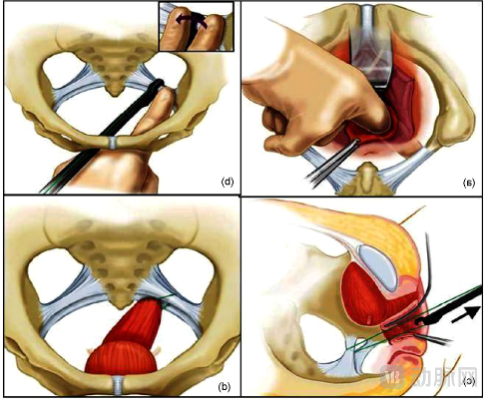
▲ Illustration of the Sacrospinous Ligament Puncture Guide in Operation
Steps for Sacrospinous Ligament Suture Fixation with the Support of a GuideTakes only 15 minutes, and compared with the traditional suturing method of sacrospinous ligament suspension that takes more than 1 hour, it simplifies the surgical procedure, shortens the operation time, and greatly alleviates the work pressure on surgeons.
In addition to its short procedure time, Dr. Zhang summarized three other advantages of the sacrospinous ligament puncture guide.
First and foremost, the most critical factor is safety.The sacrospinous ligament puncture guide enables point-to-point suturing with a fully automated process, thereby preventing inaccuracies or inadvertent injury to blood vessels, nerves, and other tissues that may result from insufficient surgical experience.
Secondly, it is to reduce harm to patients.The sacrospinous ligament puncture guide requires a smaller operative space, thereby reducing the surgical dissection area. This helps avoid unnecessary surgical trauma to the patient and shortens postoperative recovery time.
Finally, there is the ease of promoting the surgical procedure.Effective surgical techniques must be widely disseminated to benefit a larger patient population. With the aid of the sacrospinous ligament puncture guide, surgeons are freed from the need for direct visualization and associated lighting concerns. The procedure features simple operation, standardized workflow, low surgical risk, and a short learning curve, making it easy to learn and use. Even primary-care physicians can master the technique after just half a day of training, thereby extending the benefits to more patients with pelvic organ prolapse (POP) in remote areas.
Dr. Zhang told VCBeat’s Orange Bureau:“The sacrospinous ligament puncture guide has entered the final design-finalization stage prior to mass production and is about to be submitted for regulatory testing. In the near future, it may be included in the national medical insurance reimbursement list, enabling more patients to benefit from insurance coverage.”
According to estimates by Dr. Zhang’s team, compared with the currently prevalent mesh suspension surgery, the use of a sacrospinous ligament puncture guide can reduce medical costs by approximately RMB 11,000 per procedure. From both a cost perspective and in light of national policies encouraging innovation, the inclusion of the sacrospinous ligament puncture guide in the national medical insurance reimbursement list is consistent with policy directives and demonstrates considerable feasibility.
The sacrospinous ligament puncture guide developed by Dr. Zhang has stood out among thousands of medical research achievements in Guangdong Province, having been selected for inclusion in the 2022 Guangdong Provincial Excellent Medical Research Achievements Database and recognized as one of the projects with the greatest market and scientific value among all entries.
The Path of Transformation Is Not a Lonely One
Lacking professional training in bio-design and marketing principles, Dr. Zhang’s path to commercialization has proven far more complex than anticipated; bringing scientific research to market is no easy feat.
First, due to the standardized requirements for market access, project certification is not only a cumbersome and time-consuming process but also demands an extensive reserve of market knowledge.As physicians, clinical duties already consume the majority of their time; being able to carve out time for scientific research is tantamount to being a “master of time management.” Requiring them to further delve into laws and regulations related to medical devices and become familiar with the certification process is truly an unreasonable demand.
Additionally, a lack of funding is another “insurmountable gap.”Moving scientific research achievements from the laboratory to the market requires strong financial support, whereas doctors’ limited incomes are merely a drop in the bucket. Coupled with a lack of professional assessments, few investors are willing to bear the substantial uncertainties associated with such large investments. Even if researchers are willing to take out loans, they often lack the necessary creditworthiness. Consequently, many scientific research projects stall at the financing stage.
Not surprisingly, Dr. Zhang also encountered challenges such as insufficient funding, limited market understanding, and unfamiliarity with the commercialization process, creating an urgent need to identify a compliant professional technology transfer platform with robust technical service capabilities to take on the project.
Talented individuals are common, but those who can recognize talent are rare. Just as Dr. Zhang was facing rejection at every turn, he met his “Bo Le”—Aozhida Company.Recognizing the market potential of the sacrospinous ligament puncture guide, the company entered into a patent development and cooperation agreement with The University of Hong Kong-Shenzhen Hospital. Driven jointly by the hospital and Osida, Dr. Zhang and medical device angel investor Mr. Liu Zhiwei co-foundedJianing Company, specializing in the R&D and manufacturing of sacrospinous ligament puncture guides.
Leveraging 19 years of experience in the global commercialization of medical devices, Ozda provided Dr. Zhang with a one-stop, full-chain service covering professional patent review, intellectual property protection, commercialization planning, financing and investment, equity structure design, and company establishment, as well as product design and R&D, prototype manufacturing, testing and inspection, clinical trials, and quality system audits. Freed from the burden of navigating complex and obscure medical device regulations and approval processes, Dr. Zhang was able to refocus his energy on clinical practice and scientific innovation. With Ozda’s support, the sacrospinous ligament puncture guide developed by Dr. Zhang is poised to enter the market.
Dr. Zhang expressed some anticipation: “Seeing one’s own research achievements have the opportunity to enter the market is a tremendous encouragement for any scientific researcher. Only by personally experiencing the process of commercialization can one realize that a compatible partner is more important than anything else.” It is reported that,Jianing Medical has just completed its first angel round of financing,The company’s current market capitalization stands at nearly RMB 25 million. The successful financing marks a decisive step in transitioning the project from an R&D initiative to a market-ready product, thereby securing ample funding for future research and development.
Some say that the path of translational medicine is a lonely one, but this is not the case. Today, we are seeing growing attention devoted to translation, with an increasing number of professional service organizations continuously supporting medical-engineering translation and advancing the principle of “derived from clinical practice, applied in clinical practice.” It is believed that China’s innovative healthcare sector will usher in a new wave of rapid growth in the near future.