

Engineered Influenza Virus Platform Delivers Personalized Cancer Vaccines with Potent Anti-Tumor Efficacy
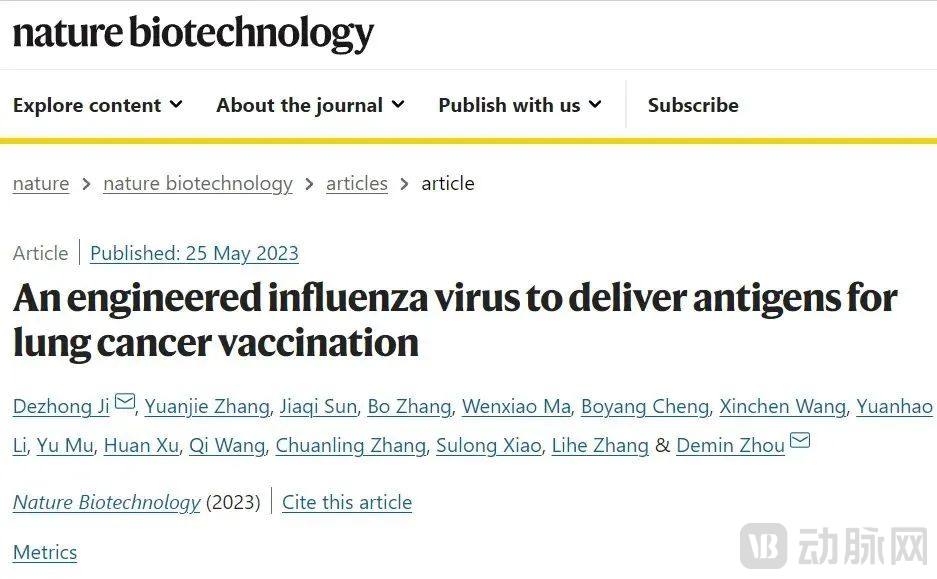
On May 25, 2023, the team led by Zhou Demin from the State Key Laboratory of Natural and Biomimetic Drugs published their research findings titled “Antigenic Peptide-Chimeric Influenza Viruses as Personalized Cancer Therapeutic Vaccines” in the prestigious international academic journal Nature Biotechnology. The study demonstrated that this approach could treat lung cancer via influenza virus infection without causing cold-like symptoms in mouse models, and also prevented metastasis to the lungs from melanoma, breast cancer, and colorectal cancer.
More than a century ago, clinical observations revealed that tumors in some cancer patients mysteriously regressed following influenza infection, albeit at the cost of the patient suffering from a severe case of the flu. Transforming the influenza virus into a cancer therapeutic without jeopardizing patient safety has long been the centennial aspiration of medical researchers. With the advancement of multi-omics technologies, including genomics and proteomics, various tumor neoantigens have been continuously identified and discovered. Consequently, scientists have endeavored to chemically synthesize peptide sequences of these tumor neoantigens to induce tumor-specific immune responses for treating cancer and preventing recurrence. However, over three decades of efforts have largely come to naught, primarily due to factors such as the low uptake efficiency, weak presentation capacity, and poor immunogenicity of chemically synthesized small peptides, as well as the suppression of their efficacy by the complex tumor immune microenvironment.
Zhou Demin’s team has long been engaged in research on novel technologies and methodologies for drug discovery at the intersection of chemistry and biology. As early as six years ago, the team mimicked the phenomenon whereby the probability of reinfection in healthy individuals within a short period following influenza virus infection is significantly reduced. Leveraging the fundamental theory of viral synthetic biology—specifically, the incorporation of non-natural amino acids via stop codon recoding—they transformed the influenza virus into a live virus with impaired replication capacity (PTC).[1], achieving a breakthrough in the concept of viral vaccines that elicit combined mucosal, humoral, and T-cell immunity! Six years later, the team advanced further by transforming live influenza virus into a therapeutic cancer vaccine, which was validated in mouse models.
The team chimerized the immune adjuvant CpG oligonucleotides into the lipid membrane of the previously developed PTC virus via cholesterol molecules, and conjugated chemically synthesized small peptide molecules to the hemagglutinin (HA) protein of the lipid membrane through click chemistry (Figure 1a). Leveraging the natural tropism of influenza virus for lung tissue, this approach enables efficient absorption, uniform distribution, and tight adhesion of antigenic peptides to lung cells via the respiratory route, thereby establishing influenza virus as an excellent delivery system for antigenic peptides. The study found that antigenic peptides chimerized onto the PTC virus could efficiently activate dendritic cells (DCs), characterized by significantly enhanced uptake of antigenic peptides, lysosomal escape, and cell membrane presentation capabilities. A substantial amount of antigenic peptides was presented on the surface of DCs after 24 hours (Figure 1b), accompanied by a significant increase in DC activation markers and cytokine secretion. Furthermore, the study revealed that in mice injected with melanoma cells via the tail vein, inhalation of CpG-chimerized PTC virus induced a "non-cytopathic inflammatory environment," converting cold tumors at the infection site into hot tumors. This resulted in extensive infiltration of CD4+/CD8+ T cells into tumor tissues (Figure 1c), thereby altering the immunosuppressive tumor microenvironment. More importantly, antigenic peptides chimerized onto the PTC virus efficiently induced the expansion and activation of tumor-specific T cells, and even achieved a four-order-of-magnitude increase in the activation of antigen-specific B cells (Figure 1d). The body recognized the antigenic peptides as integral components of the virus, triggering a robust adaptive immune response. In mouse models, this strategy successfully inhibited the formation of lung cancer following influenza virus infection and prevented the metastasis of melanoma cells to the lungs (Figure 1e).
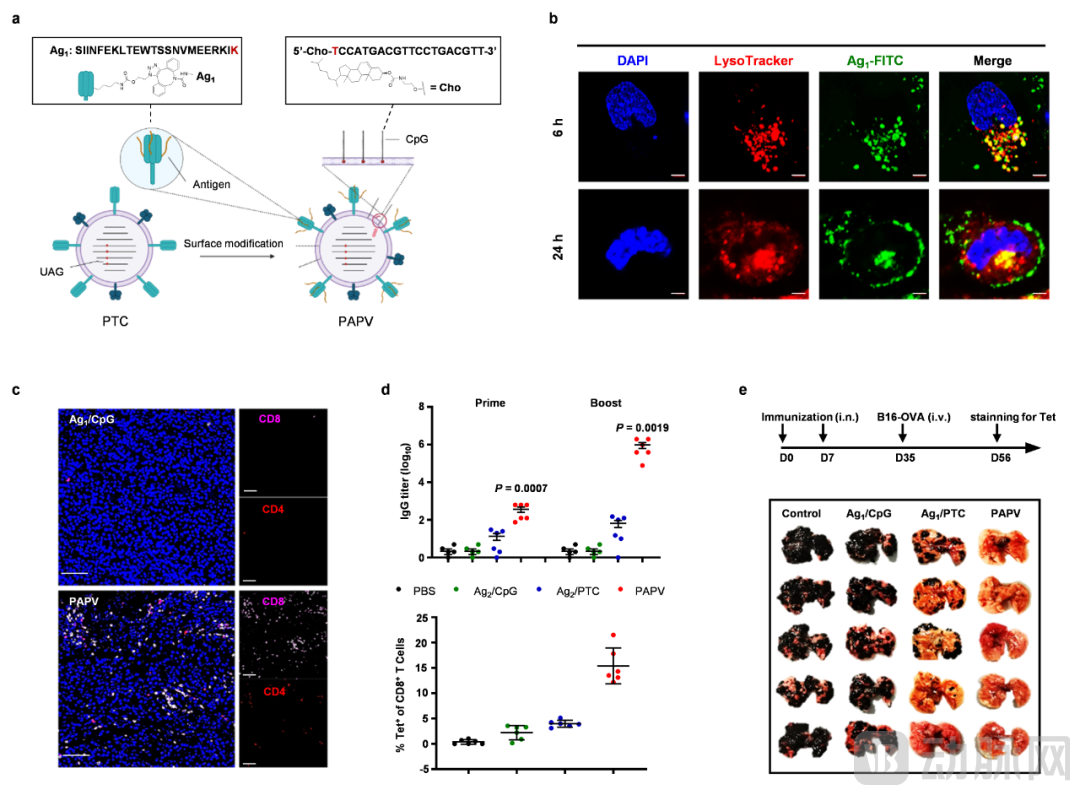
▲ Figure 1: Antigen peptide-chimeric influenza virus achieves targeted pulmonary delivery for effective treatment of melanoma lung metastasis
The researchers further engineered the influenza virus genome by inserting a gene encoding an anti-PD-L1 nanobody into the PB2 gene sequence. This modification enabled highly efficient, localized expression of the anti-PD-L1 nanobody exclusively at the site of infection following intranasal administration (Figure 2a). The study demonstrated superior therapeutic efficacy in a mouse model of melanoma lung metastasis (Figure 2b). Furthermore, by swapping the carried tumor neoantigens, the researchers achieved comparable therapeutic effects in models of colorectal and breast cancer lung metastases (Figure 2c). These findings provide a novel therapeutic strategy for personalized cancer treatment, holding significant potential for clinical translation and application.
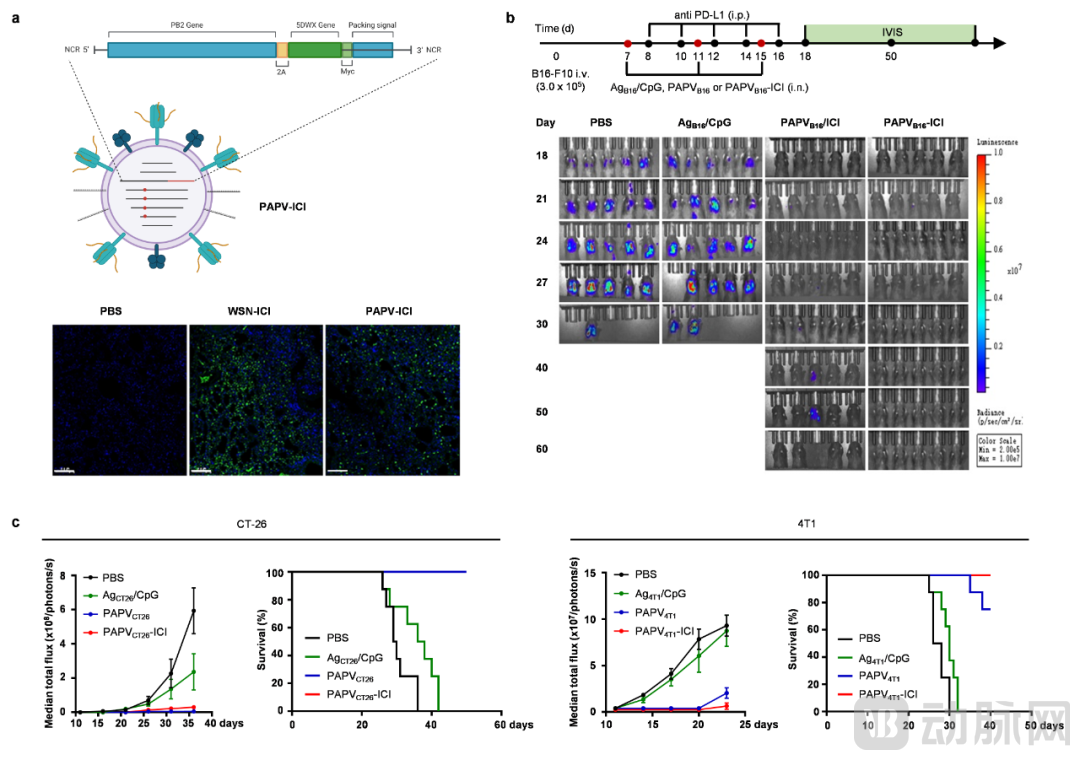
▲ Figure 2: Antigen peptide-chimeric influenza virus for enhanced nanobody delivery
This study was supported by the National Natural Science Foundation of China, the National Major Special Project for Innovation Drugs, the China Postdoctoral Science Foundation, the Ningbo Major Scientific and Technological Task Project, and the Ningbo Yongjiang Talent Introduction Program. Dezhong Ji, Assistant Researcher in Professor Demin Zhou’s team, and Yuanjie Zhang, a doctoral candidate, are co-first authors of the paper. Dr. Dezhong Ji and Professor Demin Zhou are the corresponding authors. The State Key Laboratory of Natural and Biomimetic Drugs at Peking University School of Pharmaceutical Sciences is the primary affiliated institution, with Shenzhen Bay Laboratory and Peking University Ningbo Institute of Marine Drug Research as collaborating institutions.
Paper link:
https://www.nature.com/articles/s41587-023-01796-7
References:
[1] Si LL., et al. Generation of influenza A viruses as live but replication-incompetent virus vaccines. Science. 2016, 354, 1170-1173.
Profile of Professor Zhou Demin

Zhou Demin is the Dean of the School of Pharmaceutical Sciences at Peking University, Director of the State Key Laboratory of Natural and Biomimetic Drugs, Dean of the Peking University Ningbo Institute of Marine Medicine, and Senior Research Fellow at the Institute of Chemical Biology, Shenzhen Bay Laboratory. He has long been engaged in research on new technologies and methods for novel drug discovery based on the intersection of chemistry and biology, including the development of long-acting, low-immunogenicity endogenous macromolecular drugs, site-specific antibody–drug conjugates, targeted low-immunogenicity AAV viral vector preparation, live influenza virus vaccines, and personalized therapeutic cancer vaccines. He has led major national projects such as the National Major Project for New Drug Innovation, the Ministry of Science and Technology’s 973 Program, the National Natural Science Foundation of China’s Innovative Research Group Project, as well as key, major, and international cooperation projects. He has published over one hundred papers in journals such as *Science*. His research on live influenza virus vaccines was selected as “Paper of the Year” by the International Society for Vaccines, recognized as one of the “Top Ten Scientific Advances in China,” and awarded the WuXi AppTec Life Chemistry Research Outstanding Achievement Award.
Profile of Dr. Ji Dezhong
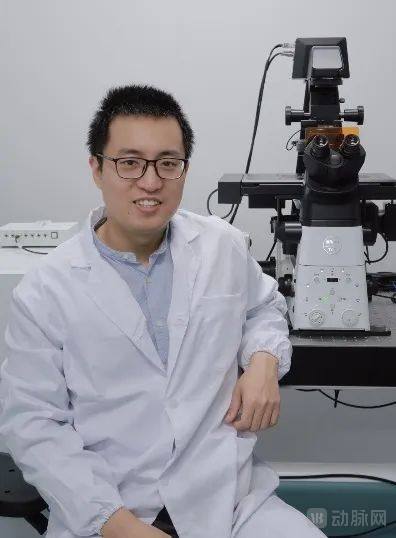
Ji Dezhong, Assistant Researcher at the School of Pharmaceutical Sciences, Peking University, and Executive Director of the Biotech Drug Research Center at the Ningbo Institute of Marine Medicine, Peking University. In recent years, his research has primarily focused on tumor immunotherapy based on the intersection of chemical biology, including studies on cytokine drugs and viral vaccine vectors. He has received support from various talent programs and projects, such as the Postdoctoral Innovative Talent Support Program (2018), the Yongjiang Talent Introduction Scheme for Young Talents (2022), and the National Natural Science Foundation of China Youth Fund (2023). Over the past five years, he has published multiple high-impact papers in journals such as Nature Biomedical Engineering and Signal Transduction and Targeted Therapy.