

Himaging Advances Professional-Grade Single-Use Endoscopy with High-Performance, Low-Cost Imaging Technology
Addressing the frequent occurrence of cross-infection incidents marks the origin and significance of disposable endoscopes.
Even Olympus, the leading endoscope manufacturer, has been frequently cited for cross-infection incidents. In 2015, Olympus’s duodenoscopes were linked to more than 12 deaths, shocking the world; just one year later, the company was fined $648 million by U.S. authorities for paying kickbacks to secure equipment purchases and concealing cross-infection incidents; two years after that, Olympus was again fined $85 million by the U.S. FDA for failing to adequately address risks associated with its duodenoscopes and for not taking appropriate corrective actions following the incidents.
Disposable products, as a solution to completely eliminate the threat of cross-infection, have become a key focus for manufacturers. Ambu has launched disposable bronchoscopes, Boston Scientific has introduced disposable cholangiopancreatoscopes, and Chinese manufacturers are also making significant strides in areas such as ureteroscopes. The impact of disposable endoscopes on the traditional reusable endoscope market peaked over the past three years.
Taking Ambu as an example, its single-use endoscopy business grew by 150% in fiscal year 2021/22 compared to fiscal year 2018/19. The company almost single-handedly raised the replacement rate of single-use bronchoscopes to over 20%. In the Chinese market, in addition to early movers such as Pusen and Anqing, a large number of innovative manufacturers have entered the field, focusing on single-use endoscope products for smaller scopes such as ureteroscopes. However, Ambu’s bronchoscopy business experienced slowed growth in fiscal year 2022/23 and implemented a 4% workforce reduction in the third quarter of 2022. Given that even the bronchoscopy segment, which has the highest replacement rate, is facing such challenges, the single-use ureteroscope industry, represented by Chinese manufacturers, is also embroiled in intense price wars.
Why Has the Disposable Endoscope Market Undergone a Sudden Shift? Industry insiders point out that while the global pandemic over the past three years accelerated the shift toward disposable bronchoscopes, the post-pandemic market has lacked new drivers to sustain continuous growth. Furthermore, as the trend toward disposable endoscopes becomes increasingly dominant, manufacturers have engaged in cost-cutting and price wars, leading to a decline in key performance indicators, including image quality. This makes the market contraction easier to understand.The substitution of medical devices with disposable alternatives is truly beneficial and sustainable, achieved without compromising basic performance. If one loses sight of the primary objective and sacrifices performance for cost considerations, such disposable devices will remain only a minor segment of the market and fail to disruptively replace traditional reusable instruments.
Based on the above analysis of underlying logic,iCONNECT (Shanghai) Information Technology Co., Ltd. (hereinafter referred to as:iCONNECT) Since its inception, the company has adhered to the R&D principle of “low cost, high performance” for disposable endoscopes.
“Low cost” refers to making disposability commercially viable by minimizing the overall cost of the disposable components. “High performance” means that iCONNECT benchmarks its products against the key performance indicators of major reusable-device manufacturers, enabling users to enjoy the convenience, safety, and hygiene of disposable products without compromising on performance.
How to balance low cost and high performance, achieving equilibrium between product performance and ultimate cost efficiency? iCONNECT has achieved this through multiple foundational original innovations.
First, the company has independently developed core ISP image processing technologies based on high-definition CMOS, specifically designed to support endoscopic application scenarios.
ISP (Image Signal Processor) is an image signal processor whose primary function is to perform post-processing on signals output from front-end image sensors. Relying on the ISP, images can accurately reproduce scene details under various optical conditions. The ISP plays a crucial role in image quality.
iCONNECT’s core ISP (Image Signal Processing) technologies include basic functions such as demosaicing, white balance, dark current correction, automatic gain and exposure control, color correction, color space conversion, histogram equalization, gamma correction, structure and color enhancement, and frame rate conversion. Building on this foundation, iCONNECT has also developed an electronic staining technique based on white-light illumination, providing a basis for early cancer screening during endoscopy.
Leveraging full-pipeline ISP image processing technology and FPGA development, iCONNECT controls image processing latency to within 80 ms, laying a solid foundation for the professional performance of single-use endoscope products.
Second, it pioneered a global imaging technique for rolling shutter sensors to eliminate the jelly effect, ensure clear imaging, prevent front-end heating, and reduce the risk of thermal injury to the mucosal surface.
Most mid-to-low-end CMOS sensors currently on the market employ rolling shutter technology. The most distinctive feature of a rolling shutter is that each row of pixels has an identical exposure duration, but the start times differ. When moving objects are present in the scene, vertical distortion occurs; the faster the object moves, the more severe the distortion, resulting in the so-called "jello effect." In still images, this manifests as object warping, while in videos, it appears as frame discontinuities. Although high-speed dynamic motion is rare in endoscopic procedures, rolling shutters can still cause distortion during examinations such as laryngoscopy for vocal cord vibration, thereby affecting diagnostic accuracy.
To address this pain point, iCONNECT has pioneered a rolling shutter CMOS global imaging technology tailored to the unique requirements of endoscopic applications. By performing real-time analysis of underlying data, it dynamically and rapidly controls various components of the imaging system, successfully achievingLowAchieved global exposure imaging effects based on cost-effective rolling shutter sensors.
This technology completely eliminates the jelly effect and significantly enhances the clarity of static images. Meanwhile, its implementation effectively suppresses heat generation at the distal tip under LED illumination, thereby reducing the risk of thermal injury to the mucosal surface. Under equivalent average illumination brightness, a higher image signal-to-noise ratio is achieved.
The global imaging technology for rolling shutter sensors also establishes a solid technical foundation for iCONNECT’s subsequent research and implementation of a series of advanced imaging technologies.
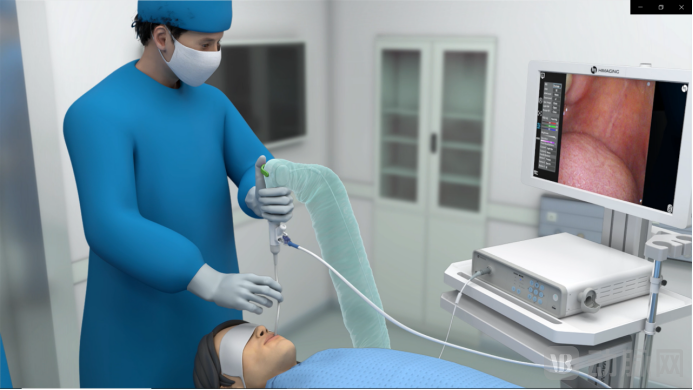
Image source: Hanmei Medical
Third, by integrating environmental protection concepts with innovative technologies, we continuously explore technological potential to reduce the costs associated with disposable components.
In single-use endoscopy systems, cost control of the disposable components plays a pivotal role in product commercialization. Adhering to the principles of green and sustainable development, iCONNECT has established clear criteria for distinguishing between disposable and reusable components based on detailed classifications of cross-infection risks, aligned with clinical practices across various departments. By striking a balance among user experience, elimination of cross-infection risks, and environmental protection, iCONNECT provides momentum for the sustainable commercialization of single-use products.
iCONNECT also actively encourages cost reduction through innovative technologies. For instance, to enable low-cost transmission cables to transmit high-speed, high-definition endoscopic images over long distances while ensuring stable data transmission and controlling bit error rates, iCONNECT has independently developed real-time bit error rate monitoring and dynamic phase adjustment technology, reducing the unit price of data transmission cables from per meterHundreds of yuan transferred toPer Meter20 yuanBelow.
Since its establishment in 2016, iCONNECT has dedicated itself to intensive research and innovation over the past seven years, successfully entering the commercialization phase.Harvest Period.
In 2018, iCONNECT reached a licensing agreement for an endoscopy system platform based on high-definition CMOS image sensors, empowering the technological iteration of reusable endoscope products;
In November 2019, the company completed a RMB 15 million Pre-A financing round, with investments from Beisen Medical Industry Investment Enterprise, Ningbo Mihe No. 3 Equity Investment Partnership (Limited Partnership), and Suzhou Historical and Cultural City Development Group Venture Capital Co., Ltd.
In 2021,Hanmei Medical won the Excellent Enterprise Award at the 10th China Innovation and Entrepreneurship Competition in 2021;
In August 2021, the company completed a RMB 49 million Series A financing round, jointly led by Hangzhou Taiyu Phase III Venture Capital Partnership (Limited Partnership) and Jiaxing Yuanlai Yuanqi Venture Capital Partnership (Limited Partnership), with participation from existing shareholders.
In November 2022, iCONNECT exhibited at MEDICA in Germany and reached cooperation intentions with multiple distributors and medical institutions from the European Union, North America, the Middle East, South America, and Asia.
Hanmei Medical is rooted in China and aligned with international standards, adopting tailored market promotion and sales strategies for different markets.
Anchored in the domestic market, iCONNECT collaborates with departments of renowned hospitals on academic research and product demonstrations to build its brand influence. In terms of sales model, it adopts a hybrid approach combining distributors and direct sales, establishing a distribution mechanism for consumables to end customers. Furthermore, in the field of reusable endoscopes, iCONNECT appropriately licenses its technology to key clients, thereby strengthening the technological barriers of its endoscopy platform.
Targeting overseas markets, the company has prioritized the European Union and Southeast Asia as its initial focus, gradually expanding into the Middle East, South America, and North America.
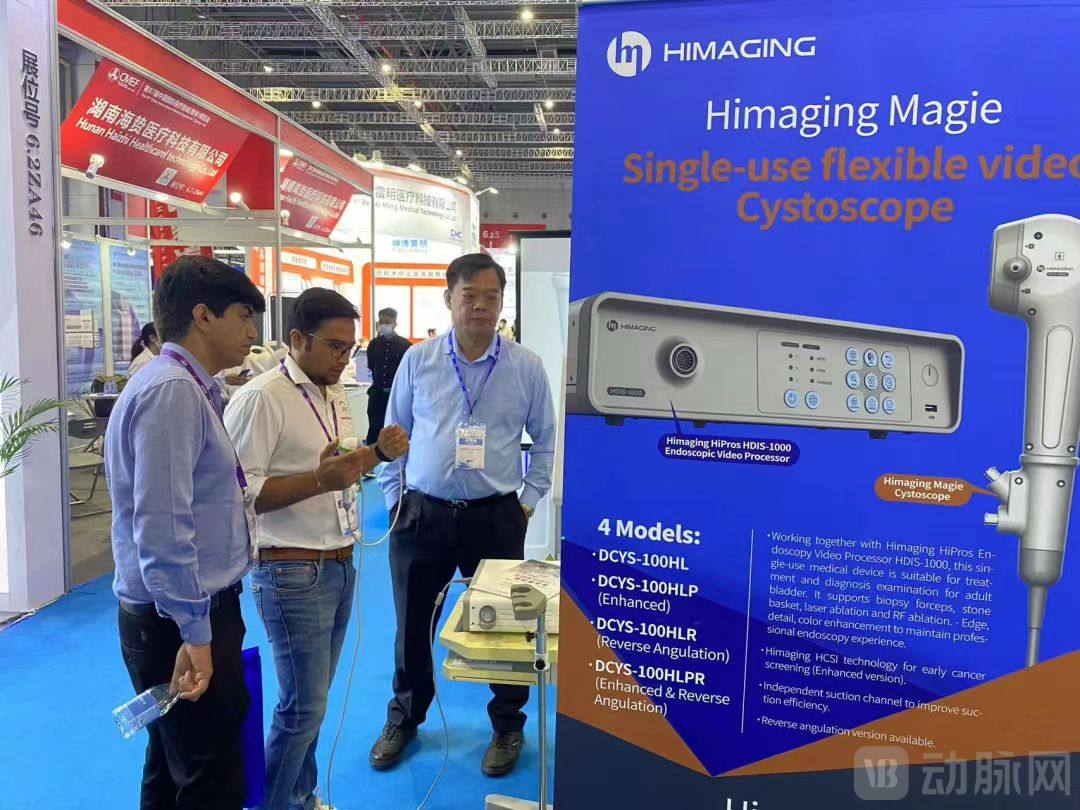
Foreign manufacturers understand iCONNECT's products
Finally, the author is quite curious: Have the major manufacturers of reusable endoscopes never considered producing single-use endoscopes? If these industry giants, with their profound technological expertise, financial resources, and clinical experience, were to shift their focus toward single-use endoscopes, would this exert competitive pressure on Chinese manufacturers of single-use endoscopes?
Hanmei Medical’s founder, Chen Xingwang, shared his insights with us—
It is undeniable that leading international manufacturers such as Olympus, Fujifilm, and Pentax have cultivated the endoscopy field for many years, accumulating extensive expertise in technical control, clinical needs, production and R&D, and image processing. However, this very strength poses the greatest challenge when transitioning from reusable endoscopes to single-use endoscopes.
As disposable endoscopes encroach upon the market share of reusable endoscopes, manufacturers of reusable devices must make a firm commitment to cannibalize their existing reusable product lines if they wish to pivot toward disposables. For leading foreign enterprises that built their empires on reusable endoscopes, there is little proactive incentive to adjust their business strategies unless they face an existential threat.
On the other hand, the biggest challenge facing disposable endoscopes is reducing costs while maintaining performance metrics. In contrast, manufacturers of reusable endoscopes spare no effort in pursuing superior final performance metrics through their choice of production materials, which prevents cost reduction and may even drive costs up. If reusable endoscope manufacturers attempt to implement cost-down initiatives within their existing technical frameworks, they will face significant challenges, an area in which they hold no competitive advantage.