

GeneCore BioPharma Advances Next-Generation Theranostic Radiopharmaceutical JH02 with IND Approvals from CDE and FDA

Bivision Pharmaceuticals
Developer of Visualization Diagnosis and Treatment Integrated Targeted Radionuclide Therapy
In May 2023, VCBeat noted a latest development in the radiopharmaceutical sector: Bivision Pharmaceuticals announced that its Investigational New Drug (IND) application for “Lutetium [177Lu] JH020002 Injection” (pipeline code: JH02), developed using its proprietary technology platform, had been formally accepted by the Center for Drug Evaluation (CDE).
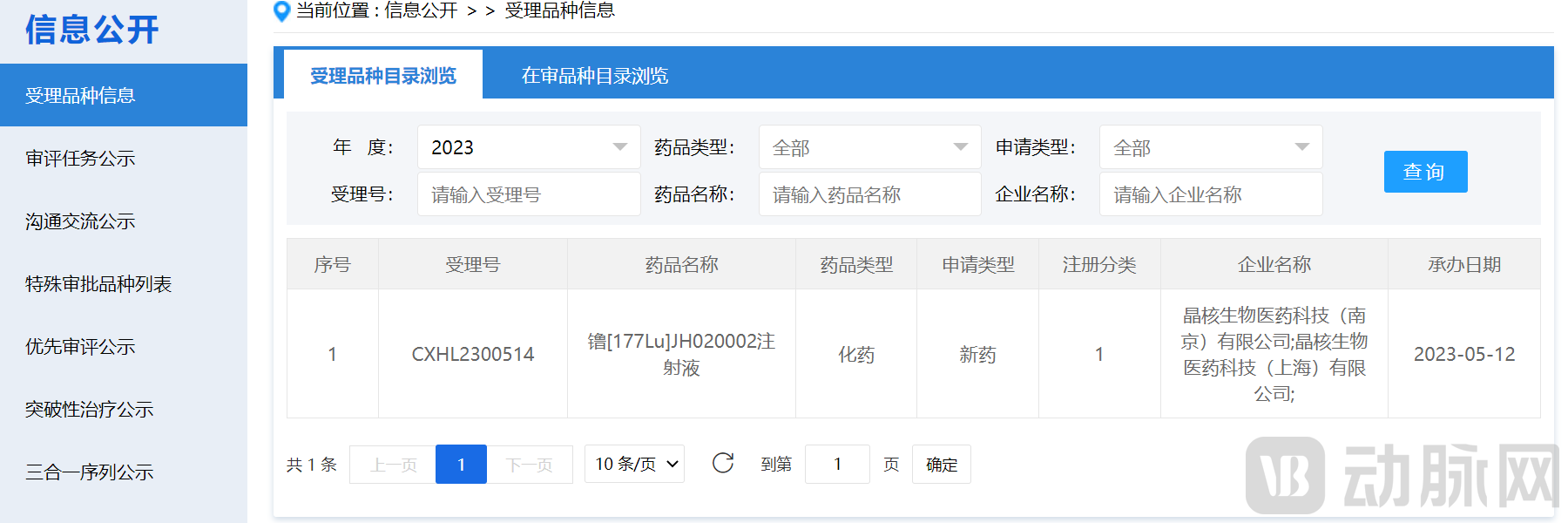 CDE Public Information
JH02 is indicated for prostate cancer and falls under the category of radiopharmaceutical drug conjugates (RDC), also known as targeted radionuclide therapy (TRT)—currently the only therapeutic modality in clinical practice capable of integrated diagnosis and treatment. As an innovative PSMA-targeted radiopharmaceutical, JH02 belongs to the same class as Novartis’ Pluvicto, which received FDA approval in 2022. Reportedly, JH02 has demonstrated a higher safety profile at elevated doses, superior therapeutic efficacy, and a more streamlined manufacturing process in animal studies.
JH02 has been accepted for review by the CDE, marking an acceleration in the independent R&D of China’s innovative targeted radiopharmaceuticals toward clinical stages and filling the domestic gap in the development of theranostic radiopharmaceuticals.
Founded in 2021, Bivision Pharmaceuticals completed two rounds of financing exceeding RMB 100 million within a single year and advanced JH02 to the stage of submitting Investigational New Drug (IND) applications in both China and the United States within just one and a half years, demonstrating rapid growth. Seizing this opportunity, VCBeat had the privilege of interviewing Dr. Wang Yu, Co-founder and Chief Technology Officer of Bivision Pharmaceuticals, to explore the company’s development trajectory.
Pluvicto, approved by the FDA in 2022 for the treatment of patients with PSMA-positive metastatic castration-resistant prostate cancer (mCRPC) who have been previously treated with taxane-based chemotherapy and androgen receptor pathway inhibitors, is the first FDA-approved targeted radioligand therapy (RDC) for this mCRPC patient population.
Pluvicto is the second radiopharmaceutical drug launched by Novartis, with revenue of $271 million in 2022. Novartis projects that Pluvicto’s peak annual sales will exceed $2 billion, positioning it as the next blockbuster drug.
Pluvicto was initially developed by the German company ABX and was acquired by the U.S. company Endocyte in 2017. Endocyte is a biopharmaceutical company specializing in the development of small molecule-drug conjugates (SMDCs), with its earliest work focusing on folate-conjugated therapies for tumors with high folate receptor expression. “We took notice of this project while ABX was conducting its Phase I clinical trial. After gaining an understanding of the background and experimental data, we assisted ABX in completing the Phase I trial and other subsequent clinical studies,” said Dr. Wang Yu, who served as a Research Mentor at Endocyte at the time.
Prior to the acquisition of Pluvicto, Dr. Wang Yu’s team conducted extensive research and jointly sponsored multiple clinical trials to validate the drug. “First, we collaborated with ABX to evaluate preclinical and clinical data to assist in indication selection. Second, we formulated a clinical trial strategy while simultaneously developing backup drug candidates to mitigate potential issues with the original compound during clinical development,” said Dr. Wang Yu. In the drug development process, clinical trial strategy is paramount. It is essential to devise a comprehensive, coordinated, and integrated clinical trial strategy that enables trial implementers to better meet the needs of all stakeholders—including patients, investigative sites, and principal investigators—thereby facilitating the successful achievement of clinical endpoints.
Following the completion of the Phase II clinical trial for Pluvicto, Novartis acquired Endocyte in 2018 for $2.1 billion, thereby securing the rights to Pluvicto. In March 2022, after completing the Phase III clinical trial, Novartis successfully obtained FDA approval for market launch. The success of Pluvicto is attributable, on one hand, to PSMA being a well-established target in prostate cancer therapy, and on the other, to the fortuitous discovery of a natural peptide precursor with high affinity and high endocytic activity, which underwent a series of optimizations to enhance its druggability.
Dr. Wang Yu, who spearheaded the advancement of Pluvicto at Endocyte, earned his degree from Queen’s University in Canada, where he studied under Professor Erwin Buncel, a Fellow of the Royal Society of Canada. After graduation, Dr. Wang held positions at three U.S. pharmaceutical companies. At Eli Lilly, he contributed to the development of the blockbuster antidepressant duloxetine (Cymbalta). During his more than ten years at Endocyte, he focused on the development of small-molecule conjugates and targeted radioligand therapies for various diseases, including cancer, autoimmune disorders, and inflammatory conditions.
Prior to the acquisition of Endocyte, Dr. Wang Yu, who had accumulated 20 years of experience in radiopharmaceutical R&D, gradually developed the idea of returning to China to start a business. In 2018, Dr. Wang brought several clinical-stage drugs he had led in development to China to seek collaboration opportunities. Although the company ceased its search for partnerships after being acquired, “during my multiple trips back and forth to China, I met Dr. Yu Haihua, and we began in-depth discussions about starting a venture,” said Dr. Wang.
Yu Haihua holds a Ph.D. in Medicinal Chemistry from Fudan University and has 15 years of experience in new drug research and development. He previously served as a New Drug R&D Scientist at the multinational pharmaceutical company GSK, and later held positions at Huayi Technology and the Huajing Institute of Molecular Imaging and Pharmaceuticals. He successfully established an integrated CDMO platform for targeted radiopharmaceuticals and a preclinical drug evaluation platform for molecular imaging, with his primary areas of expertise encompassing the R&D of diagnostic and therapeutic agents for neurodegenerative diseases and radiopharmaceuticals.
Radiopharmaceuticals consist of a targeting ligand, a linker, and a radionuclide, with the targeting ligands comprising both biological and chemical agents. Leveraging their comprehensive experience in radiopharmaceutical development and prior R&D background, Wang Yu and Yu Haihua quickly connected with Dr. Wang Yanjun and Dr. He Jinqiu, who specialize in the research and development of chemical and biological drugs.
Dr. Wang Yanjun earned his Ph.D. from the University of North Texas and conducted postdoctoral research under the supervision of renowned nuclear medicine expert Mark M. Goodman. He subsequently led small-molecule and radiopharmaceutical R&D at multiple pharmaceutical companies in the United States, accumulating nearly 20 years of experience in new drug development. Dr. Wang has advanced several New Chemical Entities (NCEs) to Investigational New Drug (IND) status, with three New Drug Applications (NDAs) approved by the FDA for market launch. He holds 29 U.S. pharmaceutical invention patents.
Dr. He Jinqiu earned his Ph.D. from Fudan University and has over ten years of experience in early-stage biopharmaceutical R&D and target screening. He has led and participated in the development of various antibody and small-molecule drugs at pharmaceutical companies such as Roche, GSK, and Harbour Biomed, covering therapeutic areas including oncology and central nervous system disorders. Multiple drug candidates he worked on have advanced into clinical trials.
Since 2018, four scientists with entrepreneurial aspirations have maintained close communication and actively prepared for their venture. Three years later, they successfully founded Bivision Pharmaceuticals, which immediately attracted interest from multiple investment firms, including Gaorong Capital, VI Ventures, Lichen Capital, Cathay Capital, and Yijing Capital.
Radionuclide Drug Conjugates (RDCs) represent one of the most promising development directions in the field of targeted radiopharmaceutical therapy. RDCs primarily consist of four components: a targeting moiety (antibody or small molecule), a linker, a chelator, and a radioisotope. They are categorized into Radionuclide-Antibody Conjugates (RACs) and small molecule-based (including peptide-based) radionuclide conjugates.
Radiopharmaceutical Drug Conjugates (RDCs) share similarities with Antibody-Drug Conjugates (ADCs). While ADC payloads are typically microtubule toxins that combat tumors by inhibiting cell division, RDCs utilize radioactive energy to kill rapidly dividing and growing tumor cells, thereby exhibiting lower drug resistance compared to ADCs.
The trend toward theranostic integration in radiopharmaceuticals demands that drugs simultaneously enable visualization and precise therapy. Radioligand Drug Conjugates (RDCs) are the only class of radiopharmaceuticals currently capable of achieving this theranostic integration in clinical practice. By incorporating isotopes with short half-lives, RDCs rapidly distribute from the bloodstream into target tissues, binding to primary or metastatic tumors. This allows for signal detection within the brief half-life window, generating comprehensive medical imaging results through molecular imaging techniques. Furthermore, precise therapeutic effects can be achieved by simply replacing the radionuclide while keeping the targeting ligand and linker unchanged. For instance, conjugation with fluorine-18 [¹⁸F] or gallium-68 [⁶⁸Ga] yields diagnostic agents for accurate target localization, whereas conjugation with lutetium-177 [¹⁷⁷Lu] or actinium-225 [²²⁵Ac] produces therapeutic agents, thereby facilitating precision medication for patients.
JH02 ([177Lu]JH020002), recently accepted by the CDE, is Bivision Pharmaceuticals’ most advanced drug development pipeline, targeting PSMA. PSMA (prostate-specific membrane antigen) is typically expressed at high levels in prostate cancer cells, with approximately 95% of PSMA located on the cell surface, making it an ideal target for radiopharmaceutical therapy.
According to data released by the World Health Organization, there were 1.41 million new cases of prostate cancer in men globally in 2020, making it the second most common malignant tumor among men worldwide. In the recently released "2022 Zhejiang Cancer Registry Annual Report," the incidence rate of prostate cancer has risen year by year over the past eight years, increasing from 14.93 per 100,000 people to 18.25 per 100,000 people.
JH02, developed based on the experience gained from Pluvicto, is also indicated for prostate cancer. It took only one and a half years to progress from inception to filing dual submissions in China and the United States and receiving acceptance from the Center for Drug Evaluation (CDE). “In comparative animal model studies, various metrics demonstrated a higher safety profile at elevated doses and superior therapeutic efficacy,” said Wang Yu.
“Pluvicto is primarily indicated for metastatic castration-resistant prostate cancer (mCRPC), targeting patients with advanced-stage disease exhibiting high PSMA expression levels; it has not demonstrated activity in animal models with low PSMA expression. In contrast, JH02 not only exhibited superior activity compared to Pluvicto in animal models with high PSMA expression, but also showed significant activity in models with low PSMA expression. This positions JH02 as a promising candidate for treating early- to mid-stage prostate cancer with lower PSMA expression, thereby offering broader patient populations access to more effective therapeutic options,” added Wang Yu.
The fundamental reason for its superior efficacy lies in the four distinctive technology platforms established by Bivision Pharmaceuticals.
Centering on the components of radiopharmaceuticals, Bivision Pharmaceuticals has established four major platforms: the J-Linker multifunctional conjugation platform, the ligand screening platform, the isotope labeling platform, and the imaging evaluation platform.
Ligand Screening Platform: Efficiently screens target ligands suitable for RDC drugs. The Isotope Labeling Platform rapidly, stably, and efficiently meets the diagnostic or therapeutic requirements of RDCs. The Imaging Evaluation Platform comprehensively assesses the activity and safety of RDCs, generating valid parameters to facilitate technical iteration and optimization.
“In addition to the targeting ligand, the linker is also a key factor influencing the affinity of RDC drugs,” said Wang Yu. Although the linker possesses neither the targeting capability of the ligand nor the cytotoxic effect of the radionuclide, its role extends beyond merely connecting the ligand and the radionuclide; it directly impacts the druggability of RDC drugs.
Leveraging Endocyte’s over two decades of research experience in the linker field, Wang Yu spearheaded the development of the J-Linker multifunctional conjugation platform. This platform enables rapid, site-specific conjugation of targeting ligands, chelators, and radionuclides, while modulating the physicochemical properties required for radiopharmaceutical drug conjugates (RDCs), thereby endowing the drugs with enhanced affinity, improved pharmacokinetics (PK), and greater stability.
The integrated application of the four major platforms has significantly enhanced R&D efficiency, shortened development cycles, reduced costs, and improved success rates for Bivision Pharmaceuticals. In addition to JH02, which has been accepted by the Center for Drug Evaluation (CDE), Bivision Pharmaceuticals is advancing multiple solid tumor pipelines.
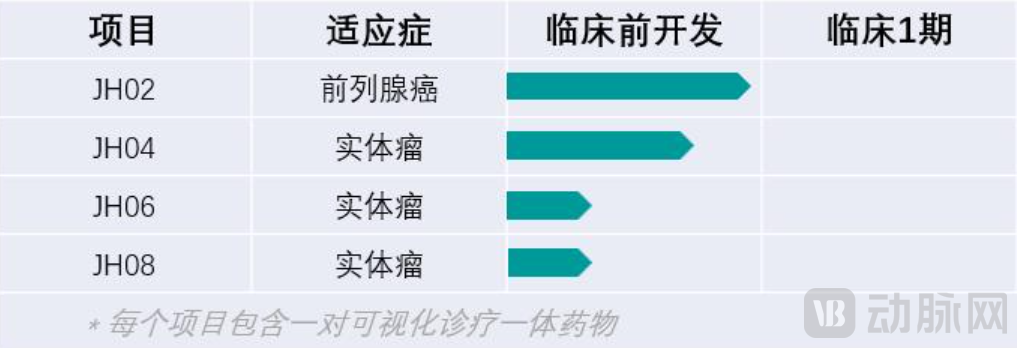 Bivision Pharmaceuticals' Drug Pipeline
“The other three pipelines are advancing rapidly, with the fastest one about to enter the PCC confirmation stage. Each pipeline has the potential to target more than five indications,” said Wang Yu. In the future, Bivision Pharmaceuticals will continue to deepen its development of RDC drugs, creating innovative and differentiated medicines to provide more treatment options for patients worldwide.